What Michigan Law Says About Leaves Falling From A Neighbor’s Tree Into Your Yard
Few things stir neighborhood tension in Michigan faster than leaves drifting across a property line.
What starts as a harmless autumn chore can quickly turn into a full-blown dispute when one yard becomes another’s cleanup problem.
So where does the law actually stand?
Michigan law draws a clear line—though not everyone likes where it’s drawn.
While trees may belong to one homeowner, gravity has a mind of its own, and fallen leaves don’t come with ownership tags.
Understanding your rights—and your responsibilities—can prevent misunderstandings from turning into legal headaches.
From trimming branches to dealing with seasonal debris, the rules aren’t always intuitive.
Many homeowners are surprised to learn what they can and can’t demand of a neighbor.
Before you fire off a frustrated text or start raking angrily toward the fence, it pays to know what Michigan law actually says.
Because when leaves fall, tempers don’t have to.
Who Owns Fallen Leaves Under Michigan Law

Once leaves tumble from a neighbor’s tree and land on your property, they become yours to manage.
Michigan property law follows a long-standing principle that natural debris crossing property lines becomes the responsibility of the landowner where it lands.
This applies to leaves, acorns, seeds, twigs, and other materials that fall naturally from trees.
Courts across the state have consistently ruled that these items are considered a natural consequence of living near vegetation.
Your neighbor doesn’t retain ownership or responsibility once gravity does its work.
The reasoning is simple: nature doesn’t respect boundary lines, and the law recognizes this reality.
Property owners are expected to maintain their own yards, including managing organic matter that arrives from neighboring trees.
This rule applies whether the tree sits entirely on your neighbor’s land or straddles the property line.
Even if the tree overhangs your yard significantly, the leaves that fall are still your responsibility to remove.
Michigan law treats this situation the same way it handles rain, snow, or wind that affects your property.
These are natural conditions that come with homeownership.
You can’t demand your neighbor rake your yard, send them a bill for cleanup, or take legal action for ordinary leaf accumulation.
However, you do have the right to remove the leaves however you see fit.
You can rake them, mulch them, compost them, or dispose of them according to local waste management rules.
The key takeaway is that ownership transfers when the leaves land, making them your problem to solve, not your neighbor’s obligation to address.
Is A Neighbor Legally Responsible For Cleaning Up Your Yard
Your neighbor has no legal duty under Michigan law to clean leaves from your property, even if they came from their tree.
The state views leaf drop as a natural occurrence rather than an act of negligence or trespass.
This means you cannot successfully sue your neighbor or force them to rake your yard through legal channels.
Michigan courts have addressed this issue multiple times, and the outcome remains consistent.
Trees shed leaves as part of their normal life cycle, and this process doesn’t constitute a legal wrong.
The law distinguishes between natural conditions and human-caused problems that might create liability.
For a neighbor to be held responsible, you would need to prove actual negligence or intentional harm.
Simply owning a tree that drops leaves doesn’t meet this standard.
Even if the tree is large, messy, or drops an enormous volume of leaves, Michigan law still classifies this as a normal incident of property ownership.
Some homeowners mistakenly believe that because the tree belongs to their neighbor, the neighbor must handle all consequences.
This assumption doesn’t align with how Michigan property law actually works.
The legal system prioritizes practical solutions over assigning blame for natural processes that affect adjacent properties.
If you’re frustrated by the amount of cleanup required, your best option is friendly negotiation rather than legal threats.
Many neighbors are willing to help out or share the workload if approached respectfully.
Some might even agree to trim branches or share yard waste bags as a goodwill gesture, though they’re not legally obligated to do so.
Understanding that the law won’t force your neighbor to act can help you focus on realistic solutions.
Can You Trim Branches To Stop Leaves From Falling
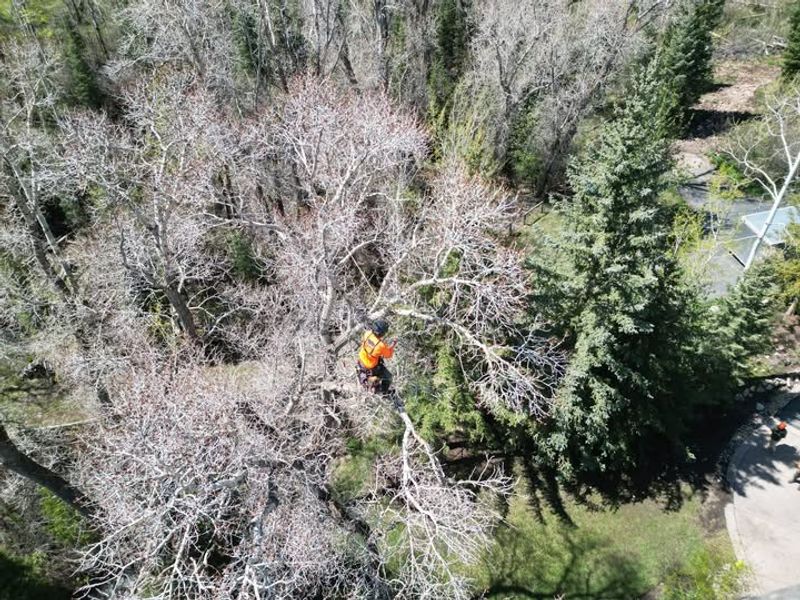
Michigan recognizes a self-help remedy that allows property owners to trim branches extending over their land.
If your neighbor’s tree has limbs crossing your property line, you have the legal right to cut them back to the boundary.
This rule applies regardless of whether your neighbor gives permission, though communication is always recommended for maintaining good relationships.
The critical limitation is that your trimming cannot harm the overall health of the tree.
You must exercise reasonable care when cutting branches to avoid damaging or endangering the tree itself.
If your pruning causes significant harm, you could be held liable for the tree’s diminished value or the cost of treatment.
Most legal experts recommend hiring a professional arborist to handle trimming near property lines.
Professionals understand how to make cuts that promote tree health while respecting your rights.
They can also document that the work was done properly, which protects you if a dispute arises later.
You cannot enter your neighbor’s property to trim branches without permission, even if they overhang your land.
All cutting must be done from your side of the boundary line.
Additionally, you’re responsible for disposing of any branches you remove—you can’t toss them back onto your neighbor’s property.
While trimming overhanging branches might reduce the number of leaves falling into your yard, it won’t eliminate the problem entirely.
Trees can drop leaves from quite a distance, especially on windy days.
Still, strategic pruning can minimize the volume of debris and give you more control over your property’s appearance without violating Michigan law or creating neighborly tension.
When A Tree Becomes A Legal Nuisance Or Hazard
Michigan law does recognize situations where a tree crosses the line from natural feature to legal nuisance.
However, ordinary leaf shedding never qualifies as a nuisance, no matter how messy or inconvenient it might be.
For a tree to become actionable, it must pose a genuine hazard or cause damage beyond normal inconvenience.
Specific conditions that might create legal liability include branches that are visibly diseased, structurally unsound, or hanging precariously over structures.
If your neighbor knows about dangerous limbs and fails to address them, they could be held responsible for resulting damage.
The key factor is whether the tree owner had notice of the hazard and reasonable time to correct it.
Documentation becomes crucial if you believe a tree poses a real threat.
Taking photos, getting an arborist’s assessment, and sending written notice to your neighbor creates a record of the problem.
If the hazardous condition causes damage after proper notice, you may have grounds for a legal claim.
Michigan courts have consistently ruled that aesthetic concerns, excessive shade, or abundant leaf drop don’t constitute legal nuisances.
These are considered normal aspects of living near trees.
Even if cleanup takes significant time and effort, the law views this as an ordinary burden of property ownership rather than an actionable harm.
The distinction matters because it affects your legal options and expectations.
You can’t force a neighbor to remove a healthy tree just because it sheds heavily.
However, if structural failure seems imminent or limbs are clearly compromised, you have stronger grounds to request action or pursue legal remedies if your neighbor refuses to address a documented safety concern.
What Michigan Courts Say About Natural Debris Disputes
When neighbors end up in court over leaves and other natural debris, Michigan judges typically side with the tree owner.
Legal precedent in the state firmly establishes that falling leaves, seeds, flowers, and similar organic matter are normal incidents of property ownership.
Courts have repeatedly refused to classify these natural processes as trespass, nuisance, or negligence.
One key principle emerges from Michigan case law: living near vegetation comes with predictable consequences.
Homeowners are expected to accept a reasonable level of natural debris as part of owning property in a community with trees.
This expectation applies in urban, suburban, and rural settings throughout the state.
Judges recognize that imposing liability for natural processes would create an unworkable legal standard.
Trees grow, shed, and spread seeds regardless of property boundaries.
Requiring owners to prevent all debris from crossing lines would be impractical and contrary to environmental values that Michigan courts often acknowledge.
The legal system distinguishes between natural conditions and artificial ones created by human action.
If your neighbor deliberately dumps yard waste on your property, that’s different from leaves falling naturally.
Similarly, if they plant an invasive species that aggressively spreads, you might have stronger legal grounds than you would for ordinary leaf accumulation.
Michigan courts also consider the reciprocal nature of these situations.
Most properties have trees or vegetation that affect neighbors in some way.
Judges understand that creating liability for natural debris would lead to endless litigation over issues that neighbors traditionally resolved through communication and mutual tolerance.
This judicial philosophy encourages practical solutions rather than legal battles over autumn cleanup.
HOA Rules Vs. Michigan State Law
Homeowners associations can create additional obligations that go beyond what Michigan state law requires.
If you live in a community governed by an HOA, the association’s covenants and rules might impose cleanup standards that affect both you and your neighbor.
These private agreements can sometimes override the default expectations established by state property law.
Many HOAs have specific landscaping requirements, including rules about leaf removal, yard maintenance schedules, and aesthetic standards.
When you purchase property in an HOA community, you typically agree to follow these rules as a condition of ownership.
This means your association might require your neighbor to manage leaves differently than state law would demand.
HOA enforcement mechanisms can include fines, liens, or other penalties for homeowners who don’t maintain their properties according to community standards.
If your neighbor’s tree creates excessive mess that violates HOA rules, the association may have authority to require cleanup or trimming.
This gives you a potential avenue for addressing leaf problems that wouldn’t exist under state law alone.
However, HOA rules must still comply with Michigan law and can’t violate fundamental property rights.
They can impose maintenance standards but typically can’t force removal of healthy trees or prohibit common landscaping features.
The rules must be reasonable, consistently enforced, and properly established through the association’s governing documents.
Before assuming HOA rules will solve your leaf problem, review your community’s specific covenants and enforcement history.
Some associations actively monitor compliance, while others only respond to complaints.
Understanding both state law and HOA requirements gives you a complete picture of your rights and your neighbor’s responsibilities in your particular situation.
How To Handle Leaf Disputes Without Legal Trouble

Starting with friendly conversation often resolves leaf disputes more effectively than any legal action.
Approach your neighbor calmly and explain your concerns without accusations or demands.
Many people are willing to help or compromise when approached respectfully, especially if they weren’t aware the situation bothered you.
Consider suggesting shared solutions that benefit both properties.
You might offer to help with trimming in exchange for your neighbor’s assistance with seasonal cleanup.
Some neighbors agree to split the cost of professional services or coordinate yard waste pickup to make disposal easier for everyone involved.
If direct conversation doesn’t work, mediation provides a structured alternative to court.
Many Michigan communities offer free or low-cost mediation services through local government or community organizations.
A neutral third party can help both sides find practical compromises that preserve neighborhood relationships while addressing legitimate concerns.
Avoid taking actions that could create legal liability for you.
Never damage your neighbor’s tree, toss debris back onto their property, or block shared spaces with piled leaves.
These responses might feel satisfying but could result in you facing legal consequences instead of solving the problem.
Document your efforts to resolve the situation amicably, especially if you think legal action might eventually become necessary.
Keep records of conversations, written communications, and any offers to compromise.
This documentation shows you made reasonable efforts before escalating the dispute.
Remember that Michigan law strongly favors informal resolution of neighbor disputes over litigation.
Courts prefer to see evidence that parties attempted communication and compromise before seeking judicial intervention.
Focusing on practical solutions rather than legal rights usually leads to better outcomes for everyone involved.