Most Flowers Chase The Sun But This North Carolina Bloom Only Opens After Dark
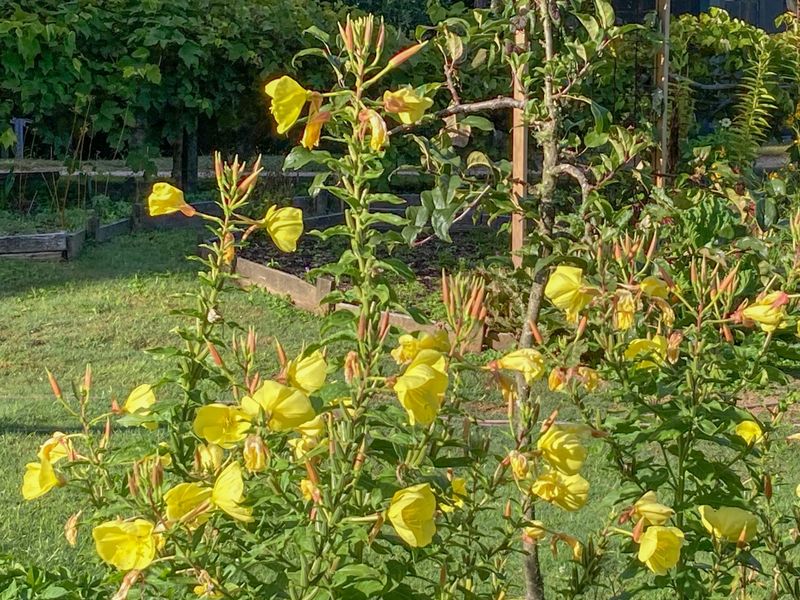
Right around the time you drag your porch chair into the shade and the heat finally starts to let go, something quietly remarkable happens in the garden. A tall, pale yellow wildflower that looked closed and unremarkable all afternoon begins to unfurl its petals, one bloom at a time, as evening falls. That flower is common evening primrose, Oenothera biennis, a widespread native North Carolina wildflower that runs on a different clock than most of what grows in your yard. Plant it where you can see it from the porch, and you have a reason to stay outside after sunset.
Meet Common Evening Primrose
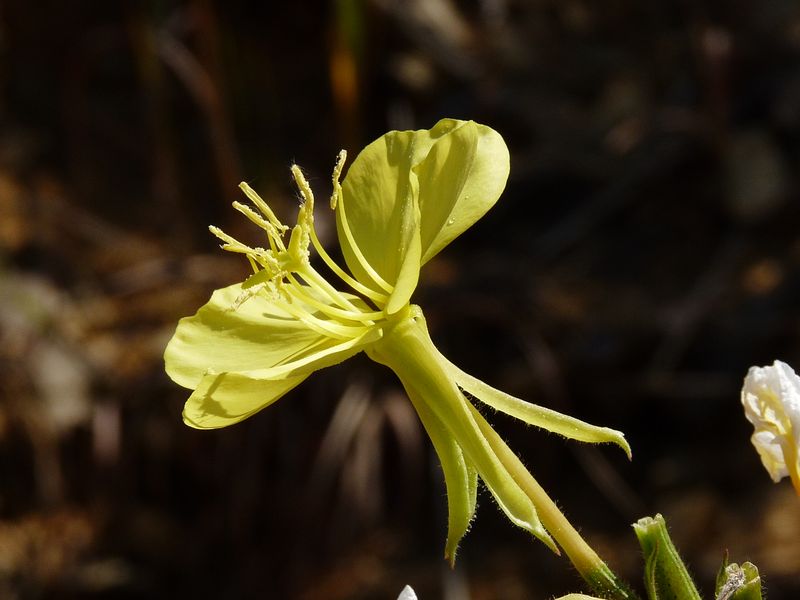
Common evening primrose, Oenothera biennis, is not a rare or exotic find. The North Carolina Botanical Survey documents it as very common across nearly all of the state’s counties, from the high ridges of the Mountains through the Piedmont and across most of the Coastal Plain. You have almost certainly driven past it without knowing what it was.
The flowers are pale yellow, four-petaled, and roughly an inch across. They open at dusk on a tall stem that can reach 3 to 5 feet, sometimes taller, and they carry a light, sweet scent that becomes noticeable once the air cools. Each bloom is short-lived, but the plant produces new ones in succession from summer into fall, so the show continues for weeks rather than days.
What makes this plant genuinely worth planting is its schedule. Many flowers open during the day and close by late afternoon. Evening primrose does the opposite, opening as evening falls and often staying open through the following morning before closing in the daytime heat. That rhythm turns a backyard bed or a fence line into a small event you can actually watch from a chair.
NC State Extension describes it as a native wildflower suited to edges, clearings, roadsides, and informal garden plantings across North Carolina. It is not found only in this state, it is a widespread eastern and central North American native, but it is genuinely at home here, in the Mountains, the Piedmont clay, the sandy Coastal Plain, and everywhere in between.
It Opens As Evening Falls
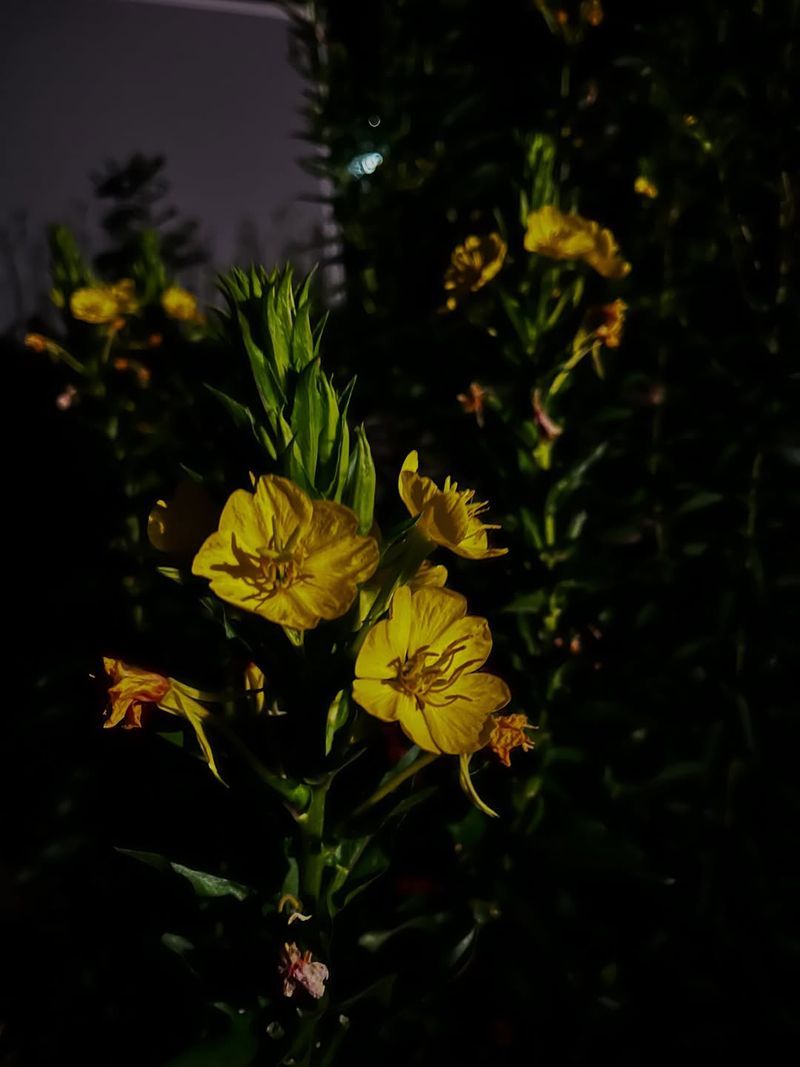
Here is where the biology gets interesting. Evening primrose does not open because the temperature drops, exactly. The trigger is the changing light itself. A peer-reviewed review published in the Journal of Experimental Botany found that flower opening and closure in many plants respond to the transition between light and darkness, and that some flowers retain an internal daily rhythm even when kept in continuous darkness.
Evening primrose fits that pattern: the shift from bright afternoon light to the softer light of dusk is the cue, not a specific temperature reading on your thermometer.
What that means practically is that the flowers do not wait until full dark. They begin to open in the evening, often while there is still color in the sky. On overcast days, they may open earlier or stay open longer than usual. And once open, they frequently remain that way through the night and into the following morning, closing only when the day’s heat builds.
Your North Carolina Garden Changes Every Week. Your Plan Should Too.
Gardening in North Carolina changes quickly throughout the season. Every Friday you’ll receive a simple weekly plan showing exactly what to plant, prune, fertilize, harvest, and protect so you never miss the right timing.
So if you step outside at 7 a.m. on a summer morning in the Piedmont, you may still find them open.
USDA plant guidance on Oenothera notes that the flowers may open at night or on cloudy days, which lines up with what many NC gardeners observe in the field. The safe way to describe this plant is “opens at dusk” or “night-blooming,” not “only opens after dark.” The distinction matters if you are planning a garden around it, because you will actually see the flowers at dusk and sometimes on grey mornings, not just at midnight.
Many flowers open during the day and are controlled by similar light-sensitive and circadian rhythms. Evening primrose simply runs its schedule in the other direction, which is unusual enough to be worth noticing from your porch.
Its Timing Welcomes Night And Morning Visitors
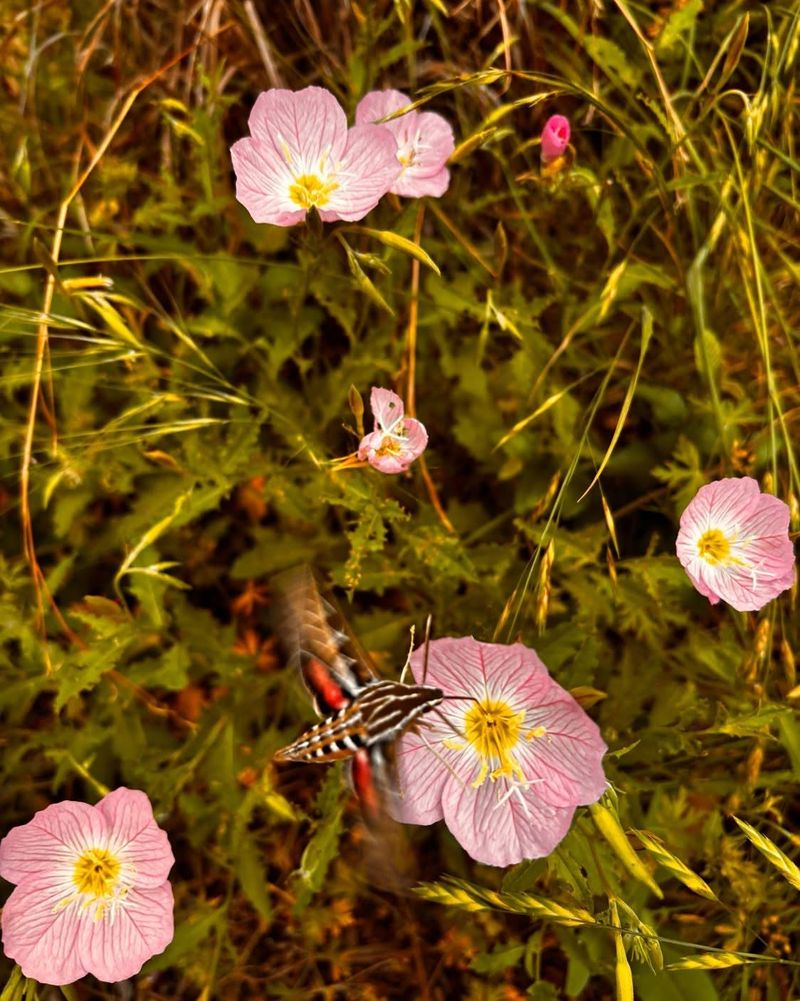
Because the flowers are open from dusk through the following morning, they are available to two very different groups of visitors. Night-flying moths, including sphinx moths and other nocturnal species, can access the nectar and pollen after dark. Early-morning bees may visit before the flowers close in the heat of the day. That window, roughly dusk to mid-morning, covers a stretch of time that many garden flowers miss entirely.
Research on nocturnal Oenothera species documents both moth and bee visitation, along with the possibility of self-pollination in some species. The study recorded nectar production dynamics and chemical composition in five nocturnal evening primrose species and confirmed that night-flying insects were present, but the research does not establish that moth visitation is the sole reason the flowers evolved to open at night. The timing makes the flowers available to nocturnal visitors; that is a documented fact. A single evolutionary cause is harder to pin down.
NC State Extension lists the associated wildlife for common evening primrose as night-flying moths, early-morning bees, specialized native bees, birds, and the primrose moth, Schinia florida. The primrose moth is worth knowing: it is a small pink-and-yellow moth whose caterpillars feed inside the flower buds and seed capsules, so finding one is a sign the plant is doing its job as part of a local food web, not a reason to reach for a spray bottle.
Additional botanical research on Oenothera pollination confirms that both nocturnal and daytime insect visitors are recorded across the genus. Adding evening primrose to your yard contributes one layer of habitat, specifically a late-evening and early-morning nectar source, without promising a dramatic change in local moth populations on its own.
Plan Around Its Two-Year Life Cycle
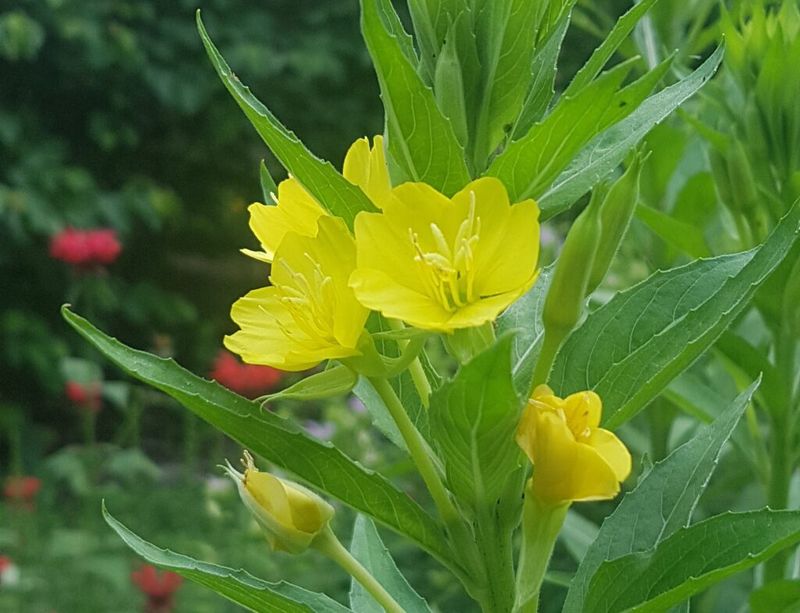
Patience is part of the deal with this plant, and knowing that upfront saves a lot of frustration. Common evening primrose is generally a biennial, meaning it lives for two years and then dies. NC State Extension describes the pattern clearly: in the first year, the plant forms a low basal rosette of leaves that stays close to the ground. No tall stem, no flowers, just a flat cluster of foliage that you might mistake for a weed.
In the second year, the plant sends up a tall flowering stem that can reach 3 to 5 feet, and sometimes taller in rich soil with good sun. Flowers appear from summer into fall, the plant sets seed, and then it dies. That is the full life cycle. So if you plant seeds this year, expect foliage in year one and flowers in year two.
University Extension commentary on the species notes this two-year rhythm as the key thing new growers miss, and it is exactly why buying a first-year transplant from a nursery can feel like a disappointment if you do not know what to expect.
At full height, the plant is not subtle. Three to 5 feet of stem with flowers opening progressively up the stalk is a back-of-the-border plant, not a front-edge specimen. Place it behind shorter perennials or at the middle of a naturalized bed where its height reads as structure rather than chaos. A fence line or a meadow edge works well too, anywhere that an informal, slightly rangy wildflower looks at home rather than out of place.
Allow roughly 2 to 3 feet of space around each plant. The stem can spread at the base and the foliage is broad in the second year. Crowding it into a tight formal bed will make both the primrose and the plants around it look worse.
Choose Sun, Drainage, And Room
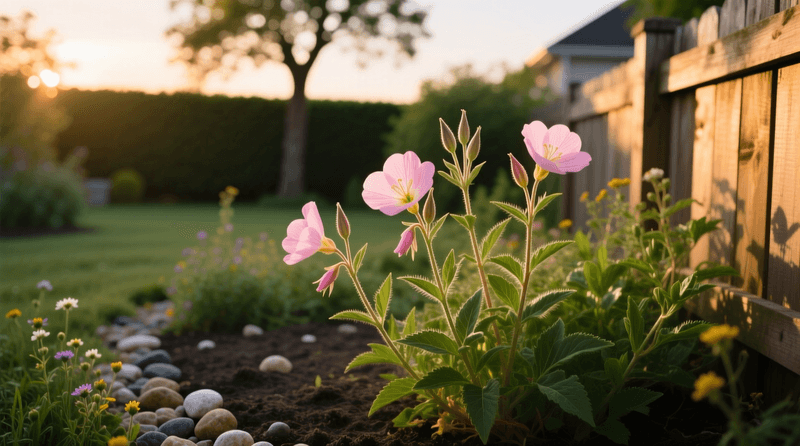
Sun and drainage are the two things this plant will not negotiate on. NC State Extension recommends at least 6 hours of direct sun per day, and that is a real minimum. A spot that gets morning shade and afternoon sun in the Piedmont will work. A spot tucked under a tree canopy will not.
Drainage matters more than soil type. Evening primrose tolerates sandy, gravelly, loamy, and clay soils, and it can handle occasionally dry conditions once established. What it does not handle is standing water or consistently soggy ground. If your Piedmont red clay holds water after a rain and stays wet for more than a day or two, improve drainage before planting rather than hoping the primrose will adapt.
Raised beds, berms, or a slope all help. In sandy Coastal Plain soil, the drainage is usually fine, but the soil dries out quickly, so water regularly during the first growing season until the plant puts down a solid root system, then back off.
Give each plant roughly 2 to 3 feet of horizontal space. The second-year stem is tall and the foliage base is wide, and crowding it makes it more likely to flop or look ragged. A meadow edge, a naturalized bed behind shorter flowers, a fence line, or an informal pollinator planting along the back of your property all make good homes. These are also spots where you can position a chair or a walkway within easy viewing distance at dusk without the plant looking out of place in the surrounding design.
Avoid the front edge of a formal foundation bed. The plant is not compact, not reliably tidy, and not going to stay put in one predictable spot year after year. In an informal setting, those qualities read as wildflower character. In a clipped foundation planting, they read as a problem.
Manage The Seed Before It Manages The Bed
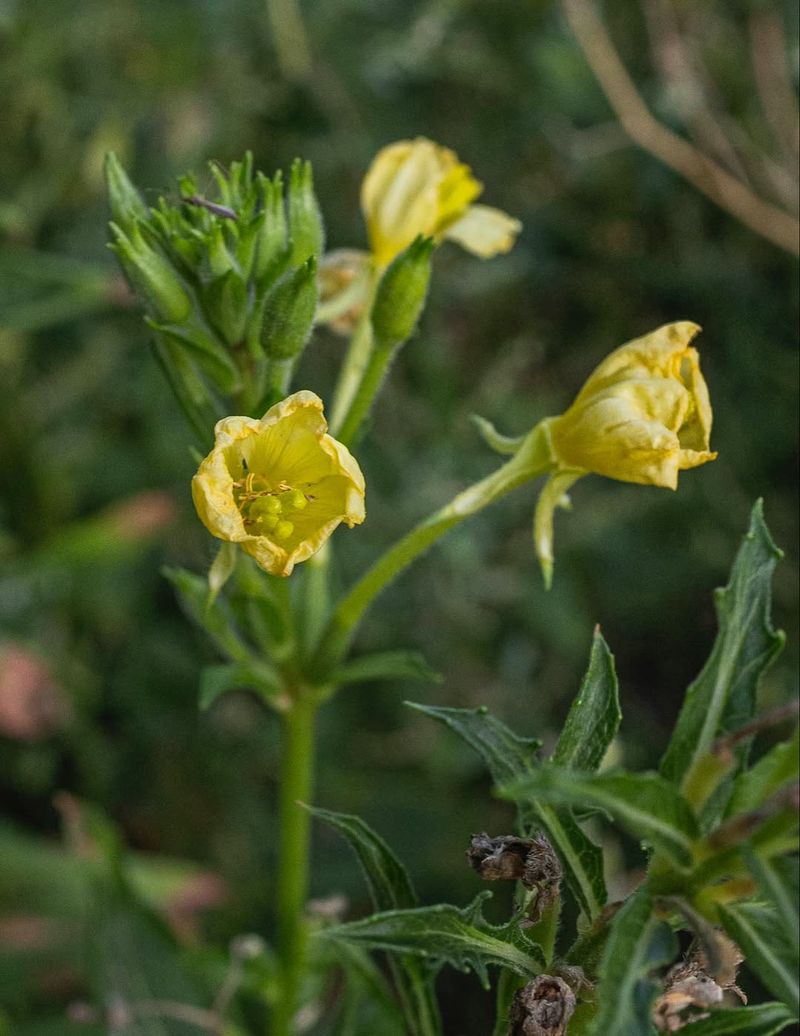
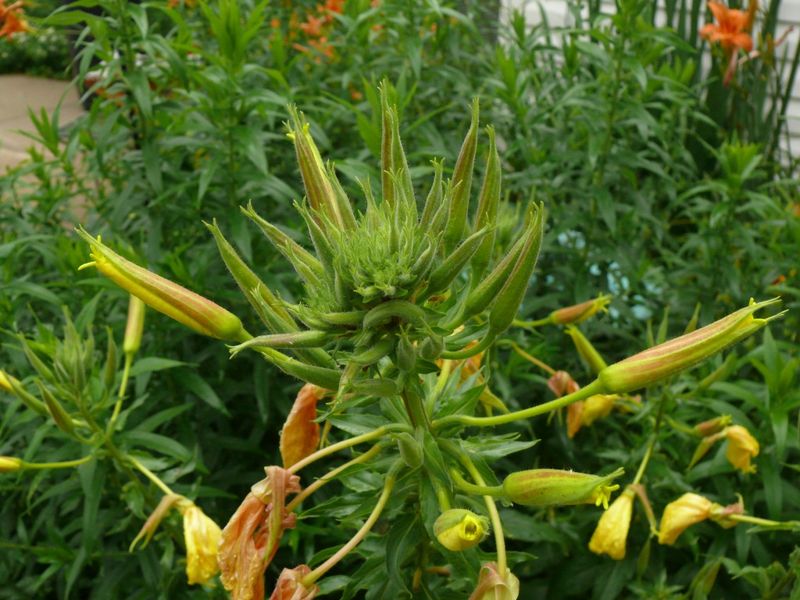
Seed is how this plant spreads, and it is genuinely good at it. NC State Extension notes that common evening primrose can self-seed readily and may become somewhat weedy. Each narrow seed capsule can hold up to 100 seeds, and those seeds can remain viable in the soil for up to 70 years. That last number is not a typo.
Seeds that fall this autumn could still germinate decades from now if conditions are right. That is a useful trait for a wildflower trying to persist in disturbed ground, and a relevant detail for anyone who does not want evening primrose showing up uninvited in three different beds.
The practical response is simple: watch the capsules. When the second-year plant finishes flowering in late summer or fall, the seed capsules develop along the stem. Before they split and scatter, remove the ones you do not want. You do not have to remove all of them.
Leave a few capsules in the spots where you want next year’s rosettes to appear, and pull the rest. This gives you a working patch without a takeover.
On the pest and disease side, common evening primrose is generally low-maintenance. NC State lists no serious insect or disease problems, though leaf spot and powdery mildew can appear in humid conditions, which covers most of a North Carolina summer on the coast or in the Piedmont. Neither condition usually threatens the plant’s survival. If you notice unusual feeding damage on the foliage or buds, inspect the plant before doing anything else.
Tolerate minor feeding, especially from the primrose moth caterpillar, which is part of the plant’s actual ecological value. Use the least disruptive response only when the plant’s health genuinely requires it, and avoid routine pesticide spraying at dusk when moths and other nocturnal visitors are most active.
Build A Broader Evening-Friendly Garden
Evening primrose works best when it is one part of a larger planting, not the whole plan. NC State Extension guidance on landscaping for wildlife with native plants is clear that meaningful habitat requires daytime flowers, host plants, shelter, and reduced pesticide exposure alongside any single species you add. Evening primrose contributes a dusk-to-morning nectar source. Goldenrod, Joe Pye weed, and native asters cover the afternoon shift for bees and butterflies.
Together, those plants give you something blooming for visitors across most of the day and night.
Before you buy, sort out which plant you actually want, because the common names in this group are genuinely confusing. Common evening primrose, Oenothera biennisOenothera fruticosa, is the native biennial described in this article. Southern sundrops, , is a different native species that NC State Extension describes as a day-flowering perennial found throughout most of North Carolina. It is a fine plant, but it opens in daylight and does not give you the evening experience.
Showy evening primrose, Oenothera speciosa, is native to the southwestern United States, has naturalized in parts of the Southeast, and can spread aggressively enough to take over a perennial bed. It is not the same plant as the native North Carolina species.
Moonflower, Ipomoea alba, is another evening bloomer that sometimes gets grouped with evening primrose in garden conversation. NC State Extension describes moonflower as an introduced, tender climbing vine grown as an annual in North Carolina, with large fragrant white flowers that open in the evening and close around dawn. It needs a trellis or arbor, and NC State notes that large amounts of its seeds have low-severity poisonous characteristics, with potential concerns for cats, dogs, and horses. It is worth growing if you have the right structure for it, but it is a separate plant with a separate set of requirements.
Plant common evening primrose where you can actually see it from a porch chair or a walkway at dusk, give it sun and drainage, and let the biennial cycle do its work. A well-placed patch of this native wildflower will not transform your yard overnight, but on a July evening in North Carolina when the heat finally breaks and the first pale yellow petals open up, you will be glad you stayed outside to watch.