11 Types Of Weeds In Florida And How To ID Them

Your lawn can look perfectly fine one day and completely different the next. Small mystery plants suddenly pop up between blades of grass, strange leaves spread across garden beds, and stubborn patches start creeping along sidewalks and driveways.
In Florida’s warm, rainy climate, weeds waste no time making themselves at home. Some sneak in quietly and blend right into the turf.
Others spread so quickly they seem to take over overnight. A few even look almost identical to other plants, which leaves many homeowners guessing about what they are actually dealing with.
That’s where knowing how to identify common Florida weeds becomes a game changer.
Once you recognize their shapes, leaves, and growth habits, those mystery invaders stop being confusing and start becoming easy to spot before they spread across the yard.
1. Dollarweed Spreads Round Leaves Across Damp Lawns
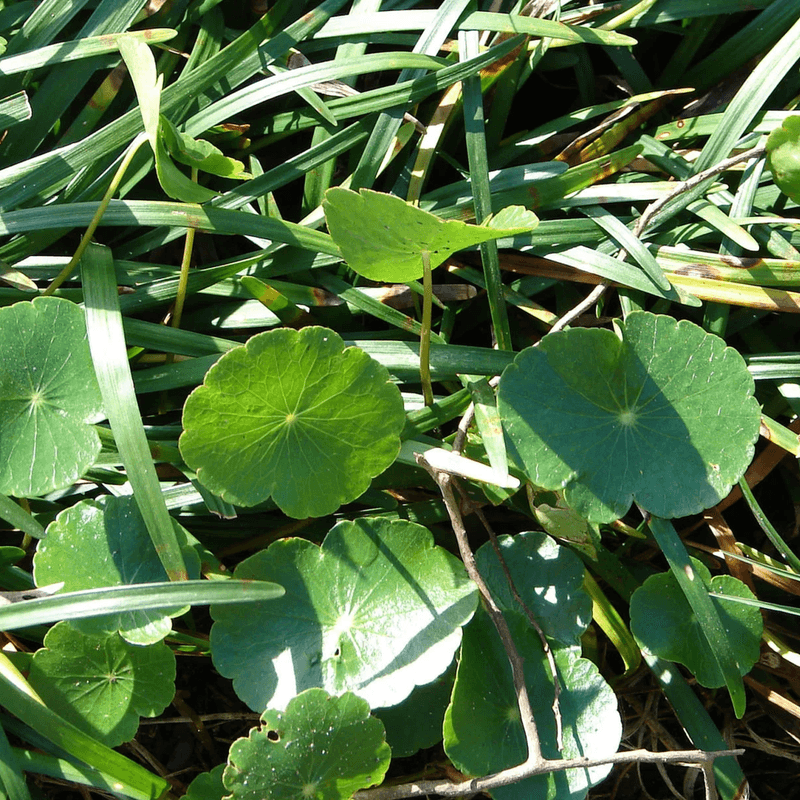
Walk across a Florida lawn after a week of heavy rain and you might notice bright, shiny green circles popping up everywhere. That’s dollarweed, botanically known as Hydrocotyle umbellata, a persistent perennial weed that absolutely loves moisture.
It thrives in overwatered lawns, low-lying soggy areas, and shaded spots where water tends to collect.
The round, coin-shaped leaves are the most recognizable feature. Each leaf is bright green, smooth, and roughly the size of a silver dollar, which is exactly how it got its common name.
What really sets dollarweed apart is where the stem attaches: it connects directly to the center of the leaf, like an umbrella handle, rather than at the leaf’s edge.
Many Florida homeowners confuse dollarweed with dichondra. Both plants have round leaves and grow low across the lawn, but their leaf shapes and stem attachment points are different.
The center-attached stem on dollarweed is the clearest identifier you’ll find.
Dollarweed spreads aggressively through rhizomes and seeds, making it especially stubborn in St. Augustine and Bahia turf lawns.
The University of Florida IFAS Extension notes that reducing irrigation frequency is one of the most effective ways to discourage its spread across warm Florida turf.
2. Crabgrass Quickly Takes Over Thin Florida Turf
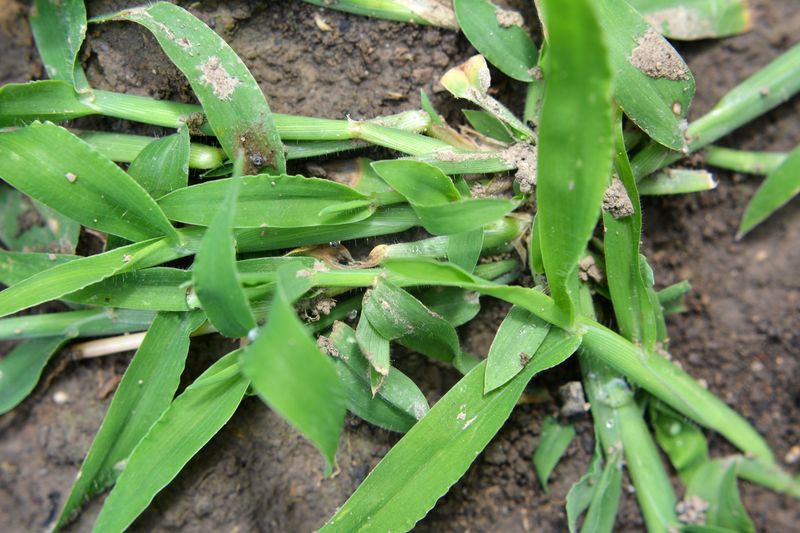
Blink once during a hot Florida summer and a bare patch in your lawn can suddenly be covered in a sprawling, light-green grassy weed.
Crabgrass, scientifically named Digitaria sanguinalisDigitaria ischaemum (large crabgrass) or (smooth crabgrass), is one of the most aggressive summer annuals Florida homeowners battle each year.
Sandy soils and warm temperatures are basically an open invitation for this weed to move in.
Its blades spread outward from a central point, low to the ground, resembling the legs of a crab. The stems are flat, often rooting at the nodes where they touch the soil.
Leaf blades are wider than most fine-textured turf grasses and have a slightly rough texture with visible hairs along the edges.
Goosegrass is a common lookalike, but there are clear differences. Goosegrass has a distinctive flattened, silvery-white center stem and forms a very flat rosette, almost like a wagon wheel pressed against the ground.
Crabgrass stems are rounder and less compressed at the base.
Crabgrass typically appears from late spring through summer across Florida lawns. Thin turf, compacted sandy soil, and over-mowing create the bare spots it loves to colonize.
Keeping your lawn thick and mowed at the correct height is one of the best defenses against this fast-spreading grass weed.
3. Chamberbitter Sprouts Tiny Mimosa Like Leaves In Summer
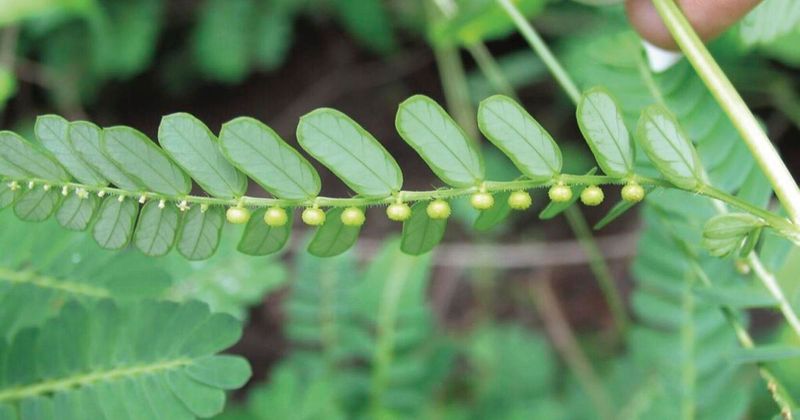
At first glance, this delicate little plant looks almost too pretty to be a weed. Chamberbitter, known botanically as Phyllanthus urinaria, earns its reputation as a sneaky summer invader across Florida lawns, garden beds, and landscaped areas.
It tends to emerge quickly after summer rains, often growing unnoticed until it has already set seeds.
The leaves are small and oval, arranged in two neat rows along each stem, giving the plant a feathery, compound-leaf appearance. Look closely at the underside of the branches and you’ll spot rows of tiny, round, greenish seed pods hugging the stems.
That’s one of chamberbitter’s most distinctive features and the easiest way to confirm your identification.
Many gardeners, especially newer ones, confuse chamberbitter with mimosa seedlings. Both have small, evenly spaced leaflets along their stems.
The key difference is that mimosa seedlings have true compound leaves branching off a central stem, while chamberbitter’s leaflets are arranged directly along a single, unbranched shoot. Mimosa also lacks those telltale seed pods lined up underneath the stems.
Chamberbitter thrives in Florida’s warm, humid summers and spreads rapidly through seed. According to University of Florida IFAS research, it commonly appears in thin turf, mulched beds, and disturbed sandy soils throughout the state from June through September.
4. Spurge Forms Low Mats With Tiny Leaves And Milky Sap
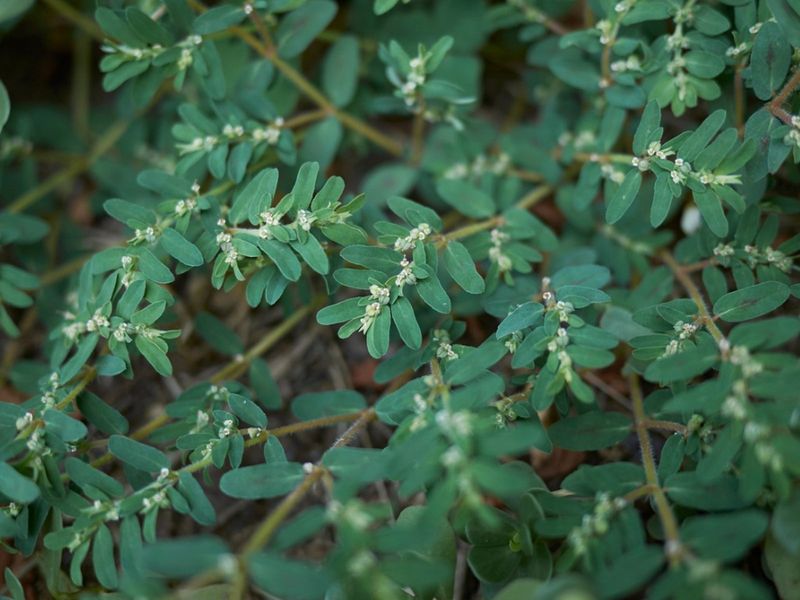
Spotted spurge has a way of appearing almost overnight in the hottest, driest parts of a Florida lawn. Euphorbia maculata is a summer annual that hugs the ground tightly, forming flat, dense mats that can smother surrounding turf.
Sandy, dry soils in full sun are exactly where this weed feels most at home.
The leaves are small, oval, and often display a distinctive reddish-purple spot or blotch near the center. Stems are reddish and radiate outward from a central taproot.
Break any part of the stem and a white milky sap immediately oozes out. That sap is the single most reliable identification clue for spurge and can cause mild skin irritation, so handle with care.
Purslane is frequently mistaken for spurge because both grow low and form mats with small leaves. The differences are easy to spot once you know what to look for.
Purslane has thick, fleshy, succulent leaves that feel almost rubbery, and its stems are smooth and reddish but produce no milky sap when broken. Spurge leaves are thin and papery by comparison.
Spotted spurge is widespread across Florida’s warm climate, appearing from spring through late fall. The University of Florida IFAS Extension identifies it as one of the most common broadleaf weeds found in Florida turf, especially in Bermuda and Zoysia lawns growing in dry, compacted sandy soils.
5. Florida Betony Sends Up Mint Like Stems And Tubers

Pull what looks like a young mint plant from your Florida garden bed and check the roots. If you find small, white, segmented tubers that look like tiny rattlesnake rattles, you’ve got Florida betony on your hands.
Stachys floridana is a cool-season perennial that sneaks into lawns and garden beds from fall through spring, making it one of the more unusual weeds in Florida’s lineup.
Above ground, the plant has square stems, a hallmark of the mint family, with pairs of toothed, slightly hairy leaves growing opposite each other along each stem. Small pinkish-white tubular flowers appear in spring.
The whole plant has a faintly minty or herby scent when crushed, which adds to the confusion with true mint.
Young mint plants and other mint-family members look strikingly similar to Florida betony. The key differences are the distinctive white underground tubers and the slightly rougher leaf texture of betony compared to most culinary mints.
True mint also tends to have a much stronger, cleaner scent.
Florida betony spreads both by seed and through its tubers, which break apart easily during hand-pulling and can regenerate from small fragments left in the soil.
The University of Florida IFAS Extension notes it is especially common in moist, well-maintained lawns and shaded garden beds throughout North and Central Florida during cooler months.
6. Nutsedge Produces Fast Growing Grass Like Blades
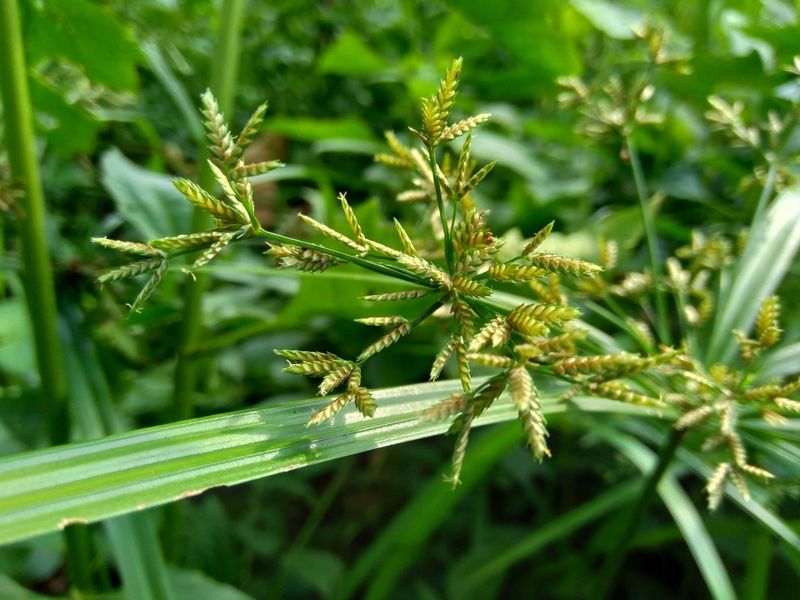
Something is growing faster than your grass, and no matter how often you mow, it keeps bouncing right back taller than everything else. Welcome to the nutsedge problem that plagues countless Florida lawns every season.
Yellow nutsedge (Cyperus esculentusCyperus rotundus) and purple nutsedge () are among the most stubborn weeds in Florida’s warm climate, thriving especially in poorly drained or overwatered turf.
The most important identification feature is the stem. Nutsedge stems are triangular in cross-section, meaning if you roll the stem between your fingers, you’ll feel three distinct edges.
A handy old saying captures it perfectly: “sedges have edges.” Grass stems, by contrast, are round or slightly flat. Nutsedge blades are also bright yellow-green, stiff, and v-shaped, and they emerge in sets of three from the base.
Confusing nutsedge with regular lawn grass is extremely common, especially before the seed heads form. Yellow nutsedge produces a golden-brown, branched seed head, while purple nutsedge has a reddish-purple seed head.
Both grow noticeably faster than surrounding turf after mowing.
According to the University of Florida IFAS Extension, nutsedge spreads through underground tubers called nutlets that can remain viable in Florida’s sandy soils for years.
Improving drainage and avoiding overwatering are practical first steps toward reducing nutsedge pressure in Florida lawns.
7. Creeping Beggarweed Sticks To Clothes With Velcro Seeds
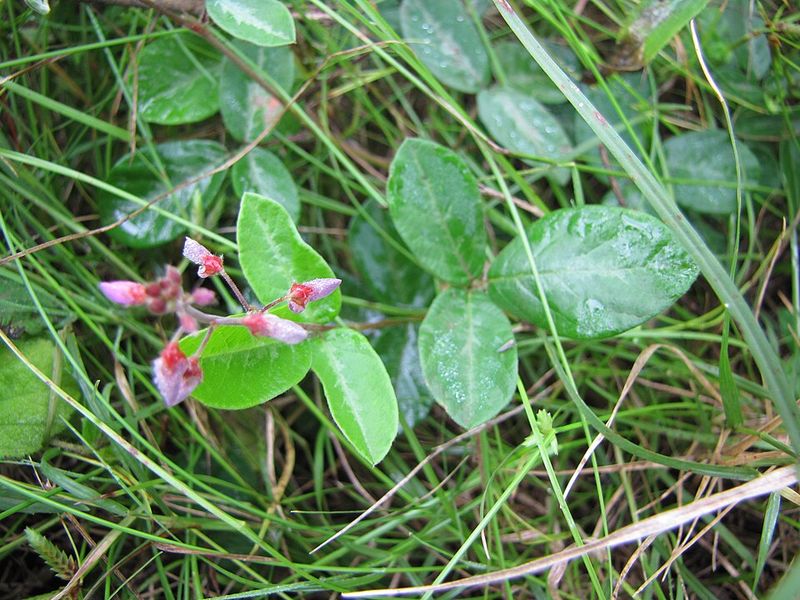
Ever walked through your Florida yard and come back inside with dozens of tiny flat seed pods stuck all over your socks and shoelaces? That’s creeping beggarweed doing exactly what it does best.
Desmodium incanum is a perennial warm-season weed that spreads across lawns, roadsides, and garden edges throughout Florida, and its sticky seeds make it one of the most memorable weeds you’ll ever encounter.
The leaves are trifoliate, meaning each leaf is made up of three leaflets, similar to clover. The central leaflet is noticeably larger and more oval than the two side leaflets.
Stems are slender and creep along the ground, rooting at nodes as they spread. Small purplish-pink flowers appear along upright shoots from summer through fall.
Clover is the most common lookalike, and the trifoliate leaves make the confusion understandable. The clearest difference is the seed pods.
Beggarweed produces flat, segmented pods covered in tiny hooked hairs that grab onto fabric and animal fur. Clover produces small round seed pods and does not stick to clothing.
Clover leaflets are also more rounded and often have a light chevron marking.
Creeping beggarweed thrives in Florida’s sandy soils and warm climate, tolerating both sun and partial shade. The USDA Plants Database confirms it is widespread across Florida’s turf and natural areas, especially in Bahia and Bermuda grass lawns where turf cover is thin.
8. Virginia Buttonweed Spreads Tough Matted Stems In Lawns
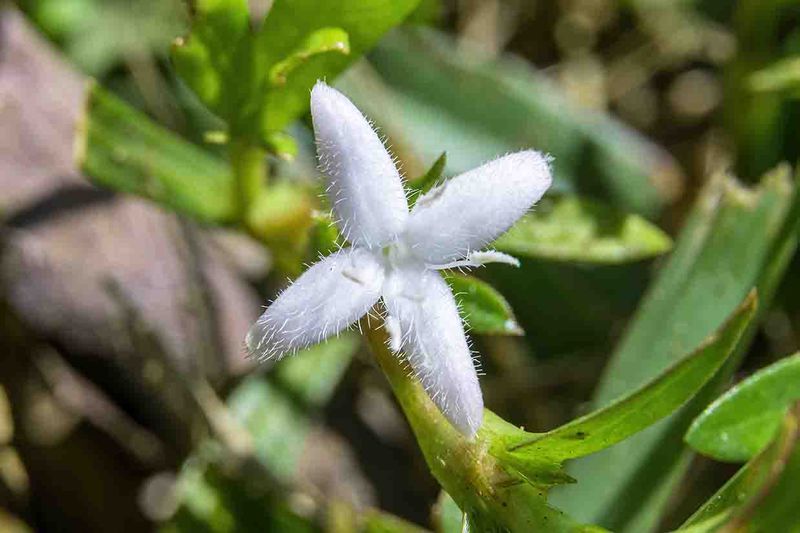
Few weeds frustrate Florida homeowners quite like Virginia buttonweed. Once it establishes itself in a lawn, it forms thick, wiry mats that crowd out surrounding grass and resist most casual removal attempts.
Diodia virginiana is a perennial broadleaf weed that spreads through both seeds and stem fragments, making it especially persistent in Florida’s moist, warm-climate turf.
The stems are slender, creeping, and branch freely as they spread across the lawn surface. Leaves are narrow, lance-shaped, and grow in opposite pairs along each stem.
Look closely at the base of each leaf pair and you’ll see small, bristly stipules connecting them. Tiny white, four-petaled flowers bloom along the stems from spring through fall, giving the plant a deceptively delicate appearance.
Doveweed is one plant that Virginia buttonweed is frequently confused with, especially in St. Augustine lawns. Doveweed has wider, succulent-looking leaves and lacks the small white flowers and bristly stipules.
Doveweed also tends to grow more upright rather than creeping flat against the turf surface.
Virginia buttonweed favors moist, poorly drained areas and is especially common in Florida lawns that receive frequent irrigation.
The University of Florida IFAS Extension considers it one of the most difficult-to-manage weeds in Florida turfgrass systems, particularly in St. Augustine and centipede lawns where its creeping mats can become well established before being noticed.
9. Sandspur Drops Painful Spiny Burrs In Dry Turf
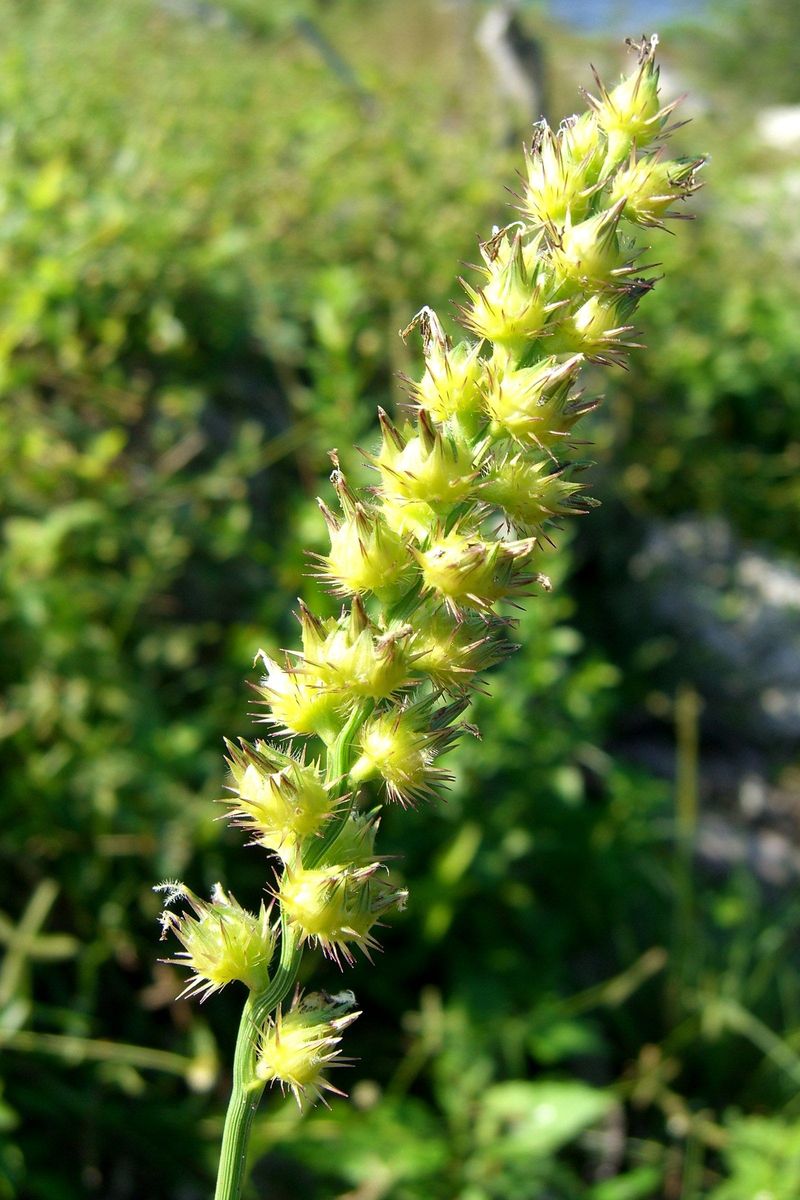
Step barefoot across a dry Florida lawn in late summer and one encounter with a sandspur will make you a much more careful walker.
Cenchrus spp., commonly called sandspur or sandburr, is a warm-season annual grass weed notorious for its sharp, spiny burrs that form along the seed stalks.
Sandy soils, dry conditions, and thin turf are exactly where this weed is most at home.
Before the burrs appear, sandspur looks remarkably like regular lawn grass. The blades are flat, medium green, and similar in width to Bermuda or Bahia grass.
The stems are slightly flattened at the base. The real giveaway comes later in the season when clusters of hard, spiny seed heads develop along the stem.
Those burrs are designed to hitch rides on animals, shoes, and clothing to spread the seeds.
Early identification before burrs form takes a closer look. Sandspur leaves often have a slightly rough texture when you run a finger along the blade edge, and the base of the plant tends to sprawl outward rather than growing strictly upright.
The ligule, a small membrane where the leaf meets the stem, is a fringe of hairs rather than a solid membrane.
The USDA Plants Database confirms sandspur is widespread across Florida’s coastal and inland sandy soils. Maintaining thick, healthy turf through proper fertilization and watering is the most reliable way to prevent sandspur from establishing in Florida lawns.
10. Dayflower Shows Bright Blue Petals In Garden Beds
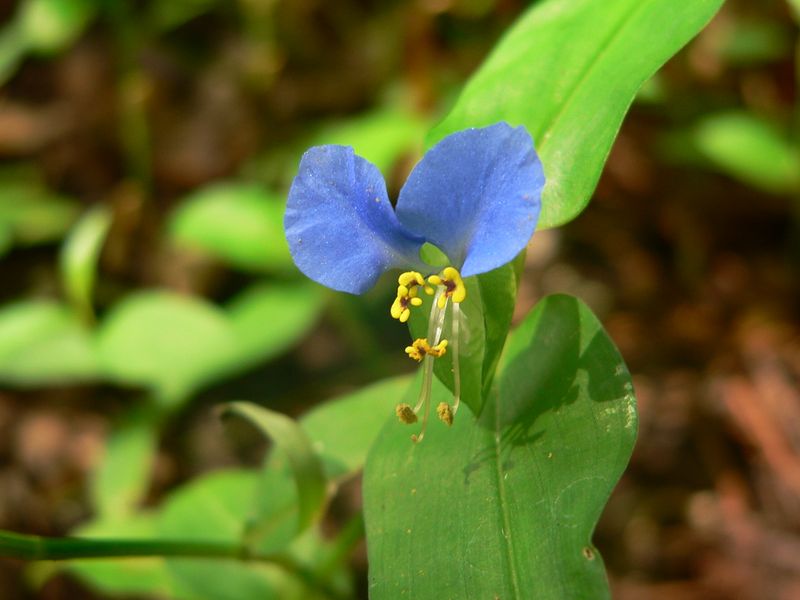
Bright blue flowers in a garden bed sound lovely until you realize the plant producing them is spreading aggressively through your mulch and crowding out everything you actually planted.
Dayflower, scientifically known as Commelina diffusa, is a warm-season weed that shows up in Florida gardens, landscape beds, and moist lawn edges with surprising speed during summer and early fall.
The flowers are genuinely eye-catching, with two rounded, vivid blue upper petals and one much smaller, almost transparent lower petal. They bloom in the morning and close by midday, which is exactly why the plant is called dayflower.
The stems are somewhat succulent, smooth, and creeping, rooting at the nodes wherever they touch moist soil. Leaves are lance-shaped with a slightly clasping base that wraps around the stem.
Spiderwort is the plant most commonly confused with dayflower, and the bright blue-purple flowers are the main reason. True spiderwort (Tradescantia spp.) has three equal-sized petals and tends to grow more upright with longer, strappy leaves.
Dayflower’s unequal petals and creeping, succulent stems are the clearest distinguishing features.
Dayflower thrives in Florida’s humid, warm climate, especially in shaded or partially shaded moist areas.
The University of Florida IFAS Extension identifies it as a common weed in vegetable gardens, ornamental beds, and along the edges of St. Augustine and other Florida turf types where moisture is consistently available.
11. Spanish Needles Produces Daisy Like Flowers And Sticky Seeds

Tall, cheerful-looking plants with white daisy-like flowers might seem like a welcome addition to a wild corner of the yard until you brush past them and come away covered in thin, black, needle-like seeds that stab right through fabric.
Spanish needles, known botanically as Bidens alba, is one of Florida’s most widespread and recognizable weeds, popping up in lawns, roadsides, garden edges, and disturbed areas across the entire state.
The flowers have white ray petals surrounding a bright yellow center disk, giving them a classic daisy appearance. Plants grow upright, often reaching two to four feet tall, with opposite, deeply divided compound leaves that have toothed leaflets.
The stems are green to slightly purplish and branch freely as the plant matures through summer and fall.
Other daisy-like weeds in Florida, such as Asiatic hawksbeard or fleabane, can look similar from a distance. The easiest way to confirm Spanish needles is by the seeds: long, thin, black, two-pronged barbed needles that cling aggressively to clothing and pet fur.
No other common Florida weed produces seeds quite like these.
Interestingly, Spanish needles is considered an important native wildflower by some Florida ecologists because its flowers provide valuable nectar for butterflies and bees.
The Florida Native Plant Society notes its ecological value, though most homeowners still prefer to manage it carefully in maintained lawn and garden areas.