Your grocery-store orchid isn’t a throwaway — here’s how to rebloom it on an Oregon windowsill
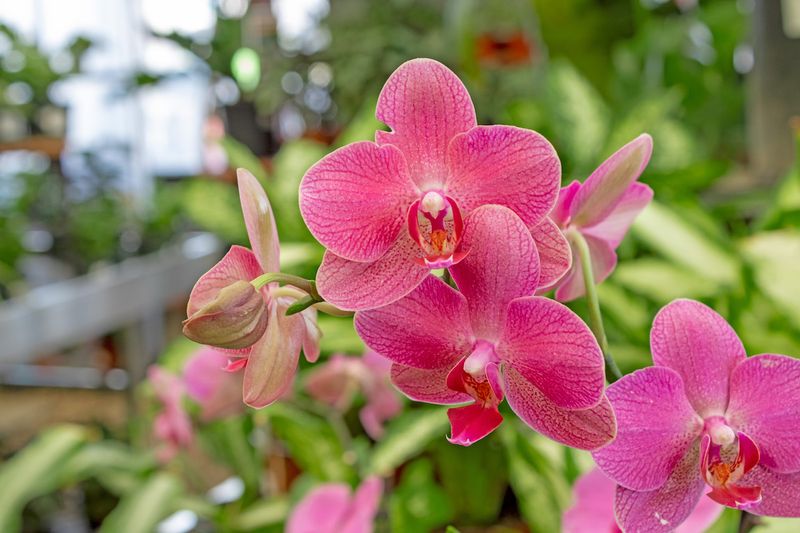
That orchid you grabbed at the grocery store checkout still has a lot of living to do, even after every last flower has dropped. Most supermarket orchids are Phalaenopsis hybrids, and a bare stem does not mean a dead plant.
With the right spot on an Oregon windowsill and a few adjustments to how you water and care for it, reblooming is a real possibility, though not a guarantee, and the journey there is simpler than most people expect.
That “spent” grocery-store orchid is probably still growing
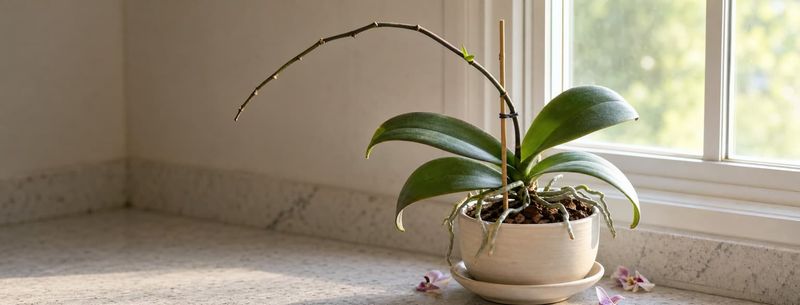
Somewhere between the checkout line and your kitchen counter, that orchid got labeled a throwaway. Flowers fell, the spike went bare, and suddenly a perfectly alive plant started looking like a composting candidate.
Before you reach for the trash bag, take a closer look at the leaves.
Most orchids sold at grocery stores and big-box retailers are Phalaenopsis hybrids, sometimes called moth orchids, recognized by their broad, leathery leaves and long arching flower spikes that emerge from beneath the foliage. That said, “grocery-store orchid” is a retail description, not a botanical guarantee.
If yours came with minimal labeling, the broad-leaf, arching-spike profile is your best clue that you are probably working with a Phalaenopsis, though not every inexpensive supermarket orchid is necessarily the same species or has identical care needs.
What matters most right now is that dropped flowers are a normal end to one bloom cycle, not the end of the plant. Phalaenopsis orchids are widely grown as houseplants precisely because they can flower again after their original blooms fade, provided the plant stays healthy and receives what it needs.
The root system is likely still active, the leaves are storing energy, and the plant is simply resting between performances.
Reframing that moment matters. A lot of plant-lovers feel a pang of guilt when they consider tossing something still green, and in this case, the guilt is pointing in the right direction.
Phalaenopsis is noted for producing long-lasting flowers and for its potential to rebloom as a houseplant, which is exactly why it became one of the most popular indoor plants in the world. Keeping yours going is a reasonable plan, not a gardening fantasy.
The old flower spike gives you two reasonable choices
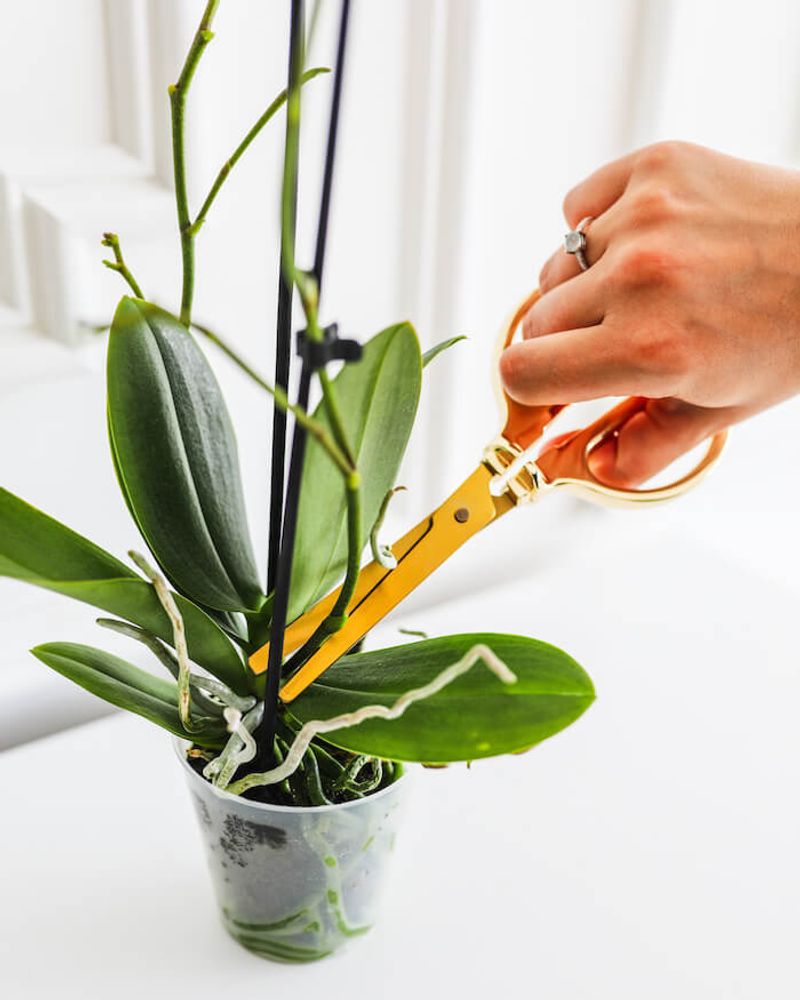
Before you cut anything, spend a minute actually looking at the spike. Run your eyes from the base all the way to the tip and ask one question: is this thing still green?
A spike that is fully green and firm, with small bumpy nodes spaced along its length, is a spike that still has options. Cutting just above the second healthy node from the bottom can allow a side branch to develop from that point, potentially producing another round of flowers sooner than a brand-new spike would.
That is the quicker path, though the resulting bloom is often smaller and carries fewer flowers than the original. If your plant is already showing signs of stress, thin roots, or pale drooping leaves, pushing it toward a quick secondary bloom may not be the kindest choice.
Your Oregon Garden Changes Every Week. Your Plan Should Too.
Gardening in Oregon changes quickly throughout the season. Every Friday you’ll receive a simple weekly plan showing exactly what to plant, prune, fertilize, harvest, and protect so you never miss the right timing.
A spike that has turned brown, yellowed, or gone papery is finished. No amount of careful cutting will revive it.
Remove that spike cleanly near the base with a sterilized blade and let the plant redirect its energy into root and leaf growth. A clean cut matters here: a jagged or torn base invites rot and disease into the wound.
The honest tradeoff looks like this. Leaving or trimming a healthy green spike may get you flowers faster, but they may be fewer and smaller, and a weaker plant may struggle to produce them at all.
Cutting a finished or struggling spike all the way back gives the plant more room to recover, build stronger roots, and eventually push a fresh spike from the base, though that process takes longer. Neither choice guarantees flowers.
What you are really doing is reading the plant’s current condition and making a realistic bet on how to support it from here.
Sterilize your blade between cuts, whether you use rubbing alcohol or a quick pass with a lighter, to avoid spreading any bacterial or fungal trouble from one plant to another.
Your Oregon windowsill should supply light without extremes
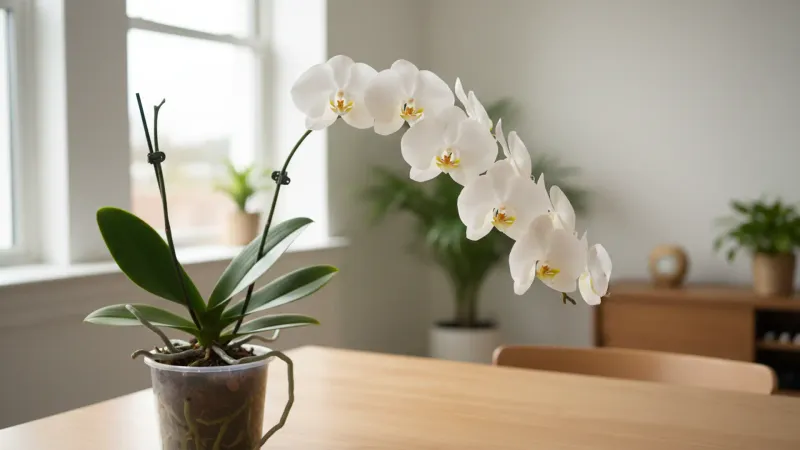
Light is where most grocery-store orchids quietly fail indoors, and Oregon winters make it easy to underestimate how dim things get inside a house. Phalaenopsis needs bright, filtered, or indirect light to stay healthy and eventually build the energy for a new flower spike.
Too little light, and the plant just sits there, green and alive but going nowhere.
An east-facing window is a reliable starting point for most Oregon homes. Morning light is gentle enough that it rarely scorches leaves, and it delivers the kind of steady brightness a Phalaenopsis appreciates.
A south or west window can also work if the light is filtered through a sheer curtain or partially blocked by an overhang, especially during the darker months from October through February when Oregon’s maritime weather brings clouds and rain for weeks at a stretch. During that period, a south exposure may actually be your best option since it captures whatever low-angle sun manages to break through.
Leaf color can offer a rough clue about light levels. Very dark green leaves sometimes point to insufficient light, though color varies by hybrid, so it is not a definitive test.
What you are aiming for is medium green leaves that feel firm and leathery, not limp or pale yellow.
Placement within the room matters as much as which window you choose. Keep the orchid near the glass for maximum light, but do not let the leaves rest directly against it.
The Phalaenopsis culture guidance notes that intense direct sun can scorch foliage, so if your window gets strong afternoon sun in summer, a sheer curtain is your friend. The OSU Extension houseplant guide specifically describes Phalaenopsis as a plant that does well in soft light, which aligns with the filtered-window approach.
One regional note worth making: this default guidance fits a typical heated home west of the Cascades. If you are in eastern Oregon, where winter nights run colder and homes may be less consistently heated, keep the orchid farther from exterior walls and windows to avoid exposure to temperatures that could damage roots and leaves.
Water the roots, not the calendar
Watering an orchid by the clock is one of the fastest ways to lose it. The popular “three ice cubes once a week” method sounds tidy, but the American Orchid Society advises against ice cube watering because repeated cold exposure can stress a subtropical plant and the small volume of water often fails to flush fertilizer salts from the medium.
Orchid roots need a real drink, not a slow drip from melting ice.
A better routine starts with a look and a feel. Pick up the pot.
Bark-filled pots feel noticeably lighter when the medium is approaching dryness. Poke a finger an inch into the mix.
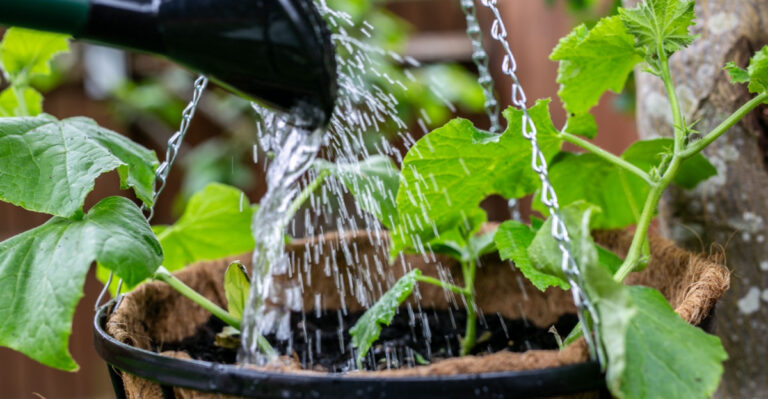
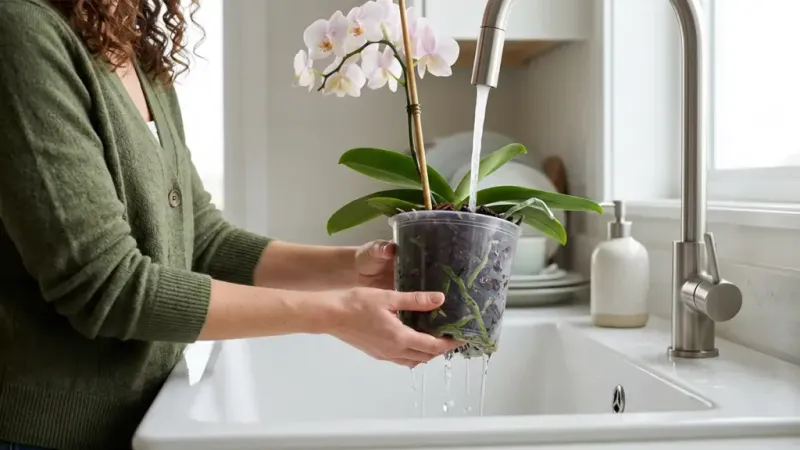
When it is nearly dry but not bone dry, it is time to water. Carry the pot to the sink, pour tepid water slowly and thoroughly through the medium until it runs freely from the drainage holes, then let it drain completely before returning the plant to its saucer or decorative pot.
Never leave the roots sitting in pooled water.
How often that cycle repeats depends on factors specific to your home: bark dries faster than sphagnum moss, small pots dry faster than large ones, and a bright warm room in a dry Oregon summer will pull moisture out of the medium much faster than a cool cloudy January. There is no universal answer, which is exactly why calendar-only watering sets people up for trouble.
Morning is the best time to water when you can manage it. Phalaenopsis care guidance consistently points to crown rot as one of the most common problems, and watering in the morning gives the crown and leaf axils time to dry before temperatures drop at night.
If water pools in the central crown where the leaves meet, blot it out gently with a paper towel or tissue.
Misting is worth addressing directly because it comes up often. Spraying the leaves does not meaningfully raise room humidity for more than a few minutes, and high humidity without good airflow can encourage fungal and bacterial problems.
A small fan on low setting nearby, or simply an open window on a mild Oregon day, does more for your orchid than a spray bottle ever will. Root watering is what sustains the plant; misting is mostly theater.
Healthy roots need an airy home
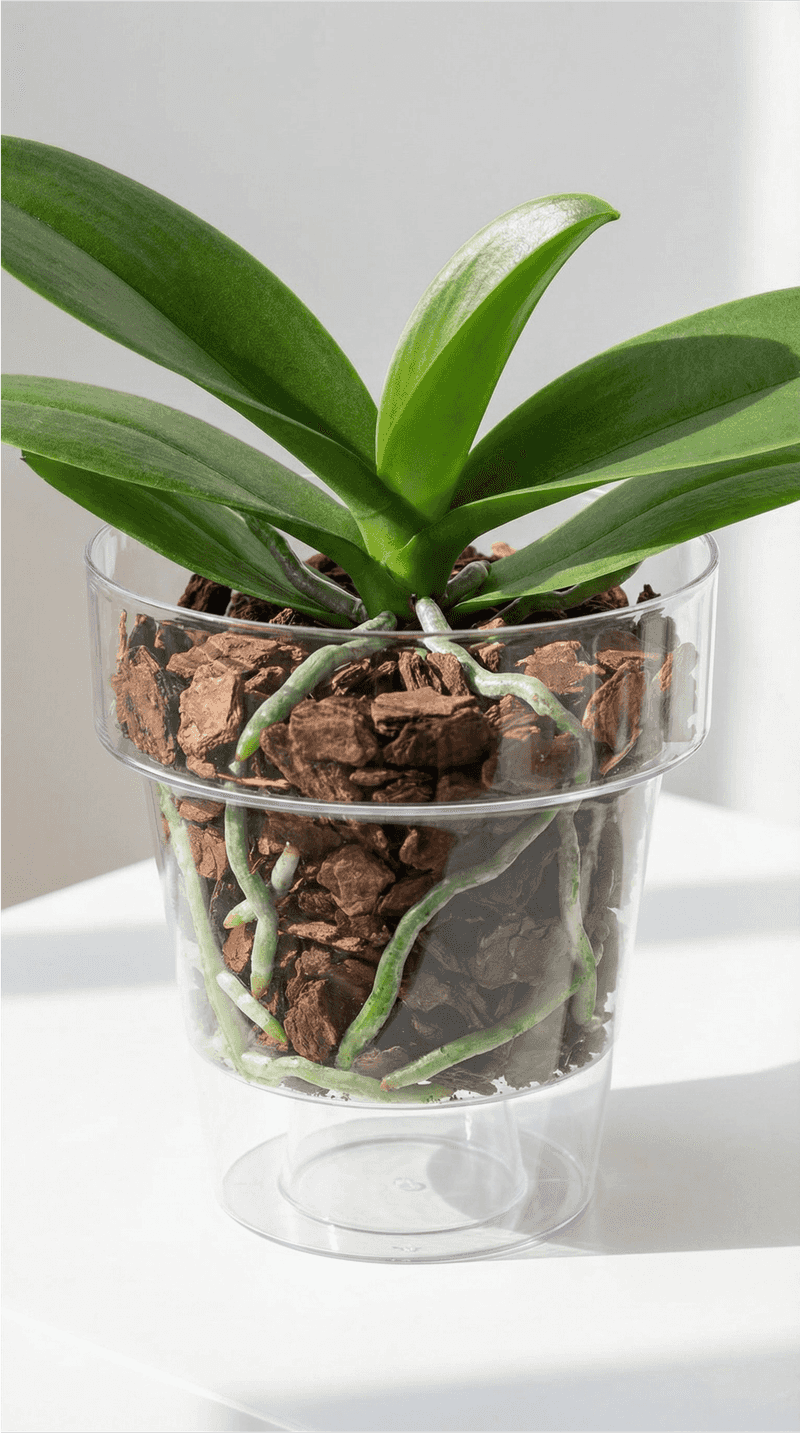
Ordinary potting soil is the wrong home for a Phalaenopsis, and the reason comes down to oxygen. In nature, moth orchids grow attached to tree bark or rocky outcrops, with their roots exposed to air and drying out between rain events.
Dense, moisture-retaining potting soil mimics none of that. It stays wet, blocks airflow around the roots, and creates exactly the soggy, airless conditions that invite rot.
Phalaenopsis thrives in a porous, well-aerated medium such as coarse orchid bark, a chunky orchid bark blend, or a commercial orchid mix designed for epiphytic plants. These materials hold a little moisture while letting excess water drain and allowing air to circulate around the roots between waterings.
Drainage is the non-negotiable part: whatever pot or medium you choose, water has to be able to escape freely.
Repotting does not need to happen on a fixed schedule. The right time is when the medium has broken down into a dense, soggy mush, when roots are declining or rotting, or when the plant has clearly outgrown its container.
Orchid bark and similar media typically last one to three years before decomposing enough to become a problem, but your conditions may speed or slow that timeline. Do not repot automatically after flowering or every spring just because it feels like the right gardening thing to do.
A clear plastic pot is genuinely useful here, not just a trend. Being able to see the roots through the sides lets you check moisture levels and root health without disturbing the plant.
Healthy roots are typically firm and greenish-white or silver. Mushy, brown, or hollow roots are a sign that the medium has stayed too wet for too long.
Repotting guidance notes that doing it after flowering or as new roots begin is generally less disruptive, but a plant sitting in decomposed or waterlogged medium should not wait for a convenient window.
Reblooming begins with steady growth, then a cooler cue
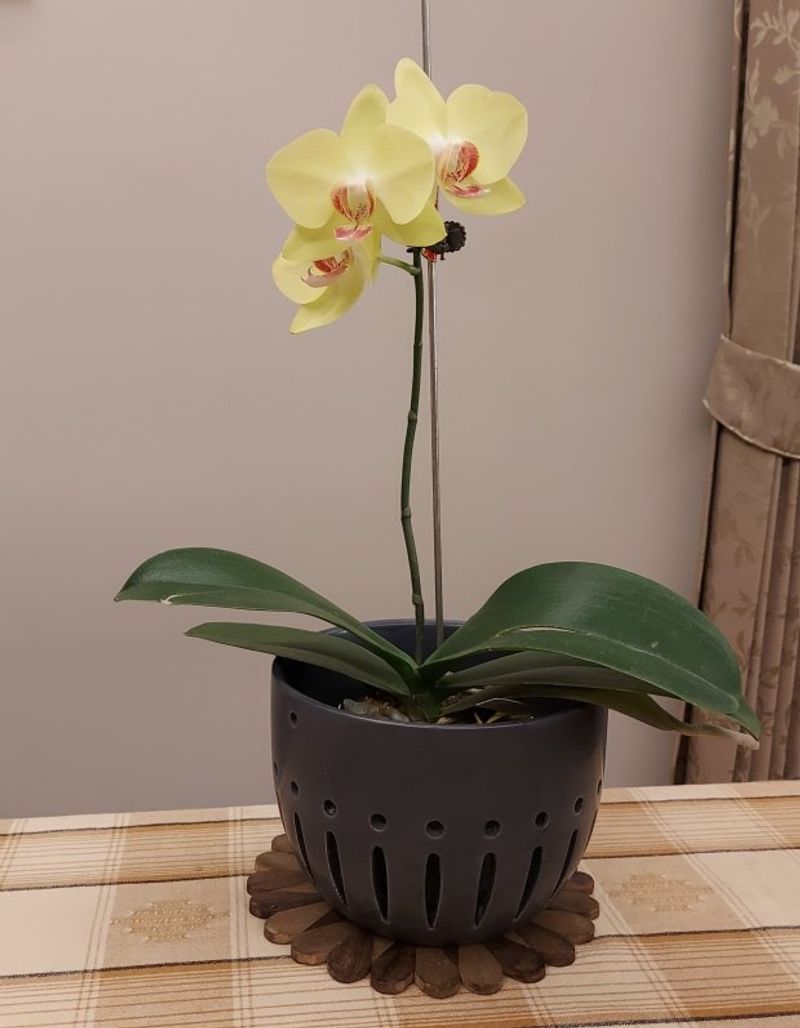
Reblooming is not something you can force on a plant that is not ready for it. The orchid has to get there on its own terms, and that means giving it the foundation before worrying about the flower cue.
Start with light. Adequate light is identified as a primary prerequisite for successful reblooming, and a plant that has spent months in a dim corner is not going to spike no matter what else you do.
Healthy roots come next: a root system that is rotting or dried out cannot absorb the water and nutrients needed to build a flower spike. Once light and roots are in reasonable shape, modest fertilizing during active growth can help.
A balanced orchid fertilizer applied at half the label-recommended strength roughly twice a month during spring and summer gives the plant something to work with without risking burned root tips or salt buildup in the medium.
Oregon’s darker winters naturally slow growth, so reduce or pause feeding from late fall through winter when the plant is not actively pushing new leaves or roots. Fertilizing heavily during low-light months tends to build up salts in the medium without giving the plant the light energy to actually use the nutrients.
The cooler-night cue is real, but it is a gentle nudge rather than a dramatic intervention. A modest nighttime temperature drop into the 50s or low 60s Fahrenheit during fall can help signal the plant to initiate a spike.
Oregon’s maritime climate naturally provides this shift in September and October, especially near windows where nighttime glass temperatures drop. You do not need to move the plant outside or open windows to cold drafts; simply allowing the natural fall temperature swing to register near the windowsill is usually enough.
Protect the plant from freezing temperatures, prolonged chilling, and cold drafts, which cause damage rather than encouragement.
OSU Extension notes that soft light plus cool nights can help prompt new blooms in Phalaenopsis, which fits neatly with what a west-of-the-Cascades windowsill naturally offers in autumn. The Phalaenopsis culture sheet reinforces that the plant needs stored energy and healthy growth first, making the cooler cue the finishing touch rather than the whole strategy.
No new spike yet? Read the plant before blaming yourself
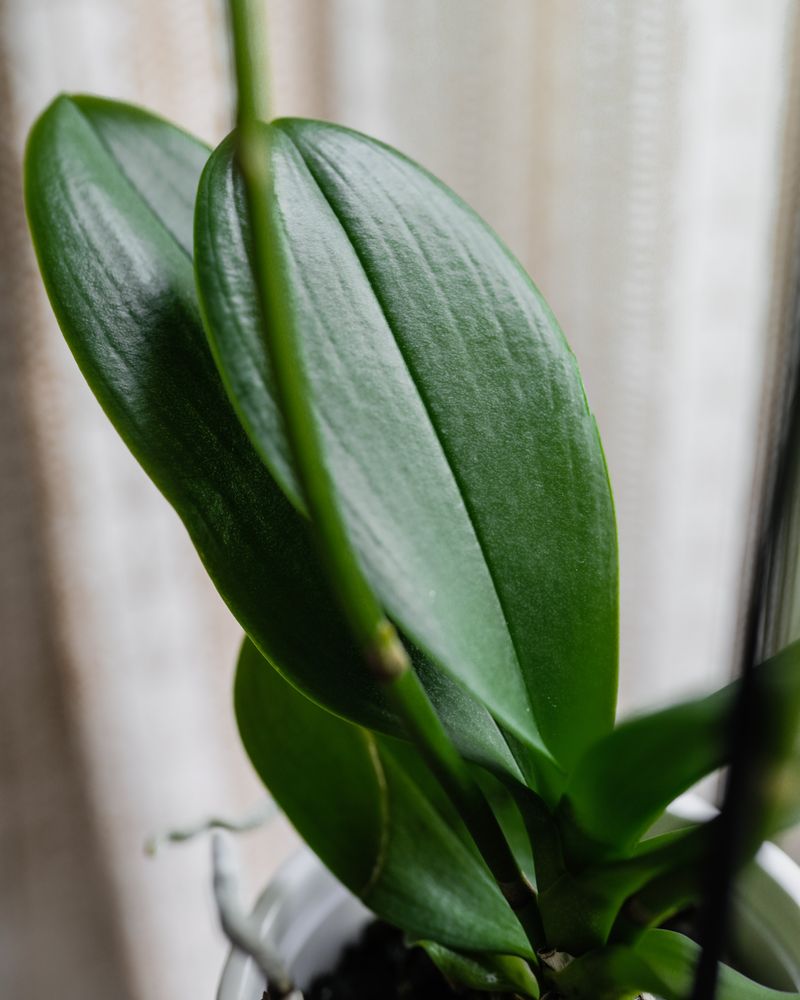
Patience is genuinely part of orchid care, and a plant that stays leafy but flowerless for months is not necessarily failing. Several factors can delay or prevent reblooming, and most of them are readable in the plant itself if you know what to look for.
Insufficient light is the most common culprit. If the leaves have darkened noticeably or the plant has been sitting far from a window, move it closer to a brighter spot and give it several weeks before drawing conclusions.
Weak or damaged roots are the second thing to check: a plant with a compromised root system simply cannot build the energy reserves a flower spike requires. If the medium looks dense and soggy, or if root tips look brown and mushy when you peek through the pot, a repot into fresh orchid bark may do more for reblooming than any temperature trick.
It also helps to know what a new spike actually looks like. A new flower spike emerges from between the leaves at the base of the plant, growing upward with a slightly flattened, mitten-shaped tip.
A root tip, by contrast, is round and tapered. Mistaking a root for a spike (or a spike for a root) is a very common beginner moment, and it does not mean anything went wrong.
Watch the tip for a few days: a spike will grow upward and eventually show the mitten shape; a root will angle toward the medium or the pot wall.
One side note worth adding for pet owners: the ASPCA lists Phalaenopsis as non-toxic to dogs, cats, and horses. That is reassuring, but plant material can still upset a pet’s stomach, and fertilizers, pesticides, or decorative materials like colored moss and wire stakes create separate risks that the non-toxicity listing does not cover.
Keep the plant somewhere curious animals cannot reach the pot or accessories.
Reblooming timing varies widely by hybrid, plant health, light conditions, and stored energy. Some orchids spike within a few months of good care; others take a year or longer.
Avoid setting a deadline for the plant, and avoid concluding that something is permanently wrong just because the calendar has moved on without flowers.
Keep the orchid past the flowers
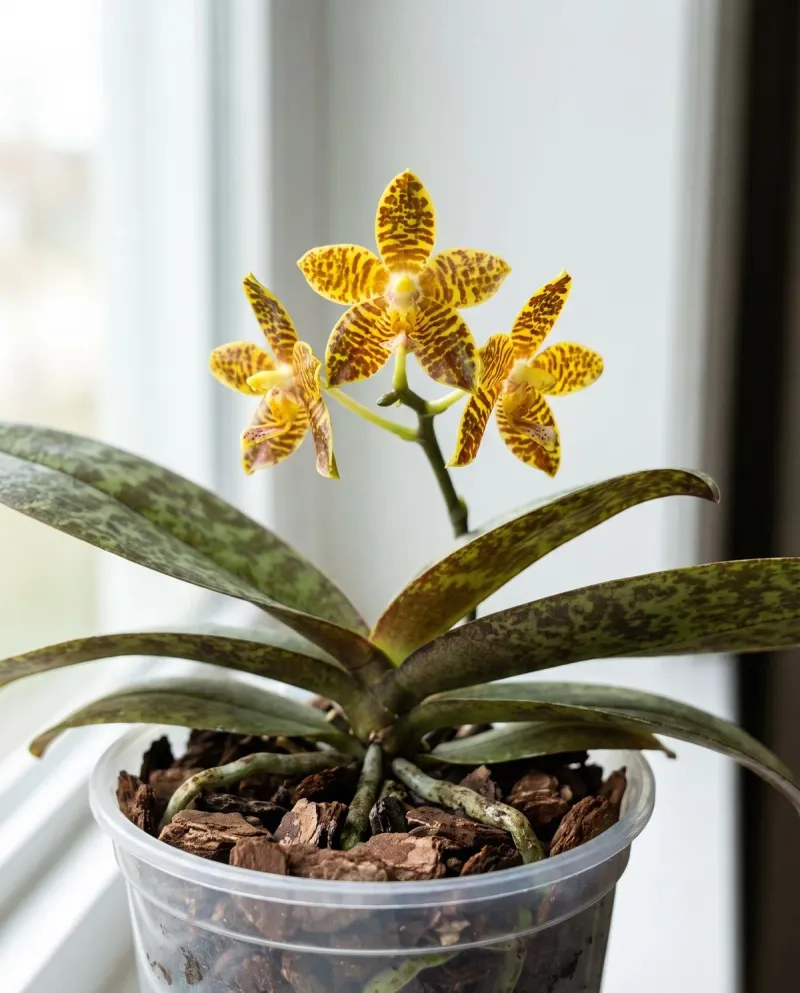
Keeping a grocery-store orchid going past its first bloom is less about perfection and more about paying attention. Inspect the spike honestly and make the pruning call that matches the plant’s actual condition.
Find a bright, filtered spot on your Oregon windowsill, far enough from cold glass and heating vents to avoid the temperature swings that stress the roots and leaves.
Water by feel and weight rather than by the clock. Pour tepid water through the medium thoroughly, let it drain, and wait until the mix is approaching dryness before doing it again.
Keep the crown dry, water in the morning when you can, and give the plant enough airflow to dry between waterings. When the medium eventually breaks down or roots start to struggle, move the plant into fresh orchid bark rather than ordinary potting soil.
A healthy Phalaenopsis in suitable conditions can rebloom, but no care routine makes it a certainty for every plant. Some orchids reward patience in a matter of months; others take considerably longer.
What keeps the possibility open is consistent, honest care rather than any single trick. Oregon’s fall temperature shifts and filtered winter light are genuinely useful tools if the plant is healthy enough to respond to them.
A grocery-store orchid does not need a greenhouse to be worth keeping. It just needs a gardener willing to read it instead of toss it.