North Carolina Bluebirds Start Scouting Nest Boxes In Late Winter And Here’s How To Be Ready
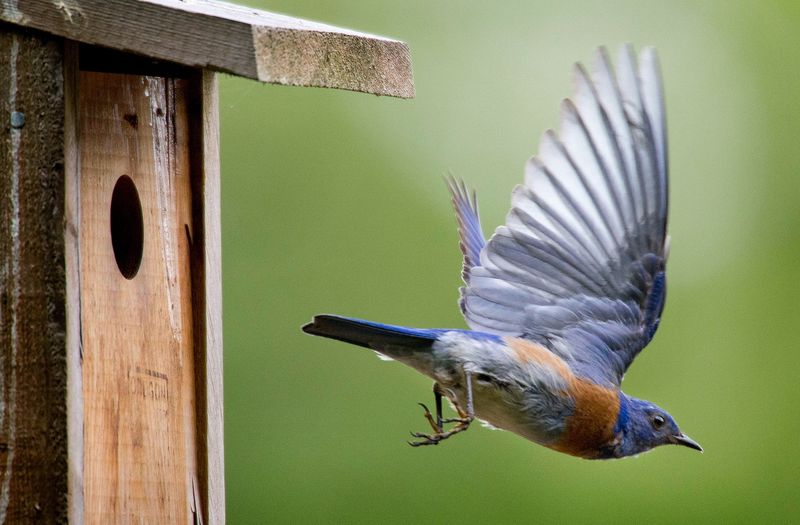
Around late January, something shifts in a North Carolina backyard. A flash of blue lands on a fence post, tilts its head toward an old wooden box, and lingers just a little too long to be passing through. Eastern Bluebirds may begin selecting territories and inspecting potential nest sites as early as February, which means the window to get your box ready is shorter than most people expect. A little preparation now, before the season picks up, could make the difference between a box that gets noticed and one that gets passed over.
Prepare Before Late-Winter Activity Begins
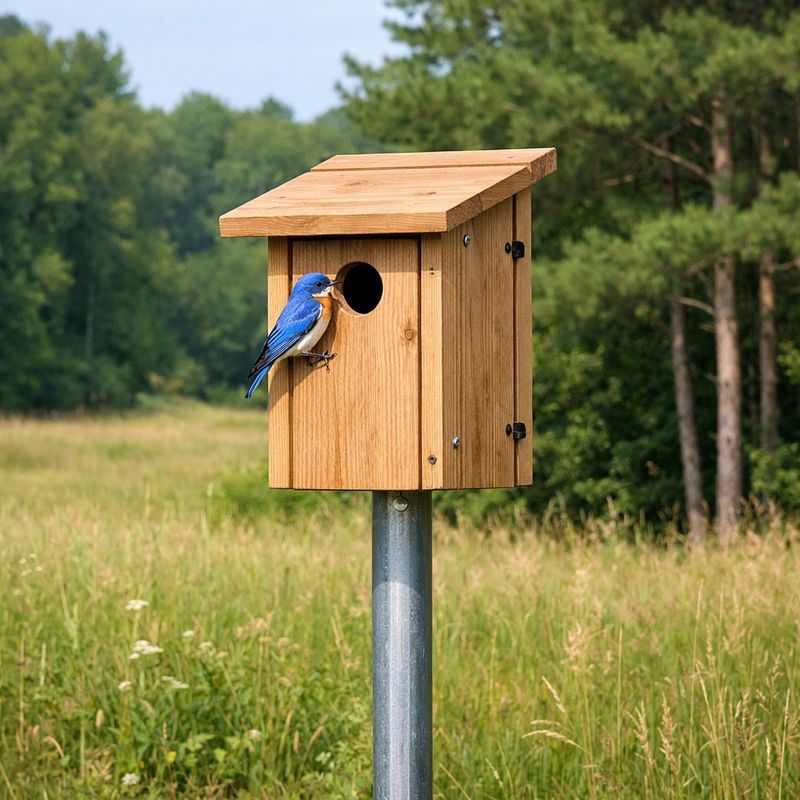
Your safest target is to have a nest box repaired, installed, and predator-protected by the end of January or early February. That window matters because the North Carolina Bluebird Society’s nesting schedule places territory selection around February, while the North Carolina Wildlife Resources Commission describes males locating nest sites in March. Both are real reference points, and neither cancels the other out.
The honest answer is that timing varies. A mild winter in the Coastal Plain can push activity earlier, while a cold snap in the mountains can push it later. Aiming for late January gives you a cushion either way, so the box is ready before bluebirds are actively making decisions about where to raise a family.
Cornell’s NestWatch advises placing nest boxes in southern states by February, before breeding begins. That guidance lines up neatly with North Carolina’s approximate schedule and gives homeowners a practical deadline to work toward.
A box that goes up in March is still worth having. You may catch a second look from a pair that has not yet committed, or you may be perfectly positioned for next season. But late winter is the preparation window that gives you the best odds of being ready when it counts. Think of it less as a hard deadline and more as the moment when readiness starts to matter.
Understand What Bluebirds Are Actually Doing
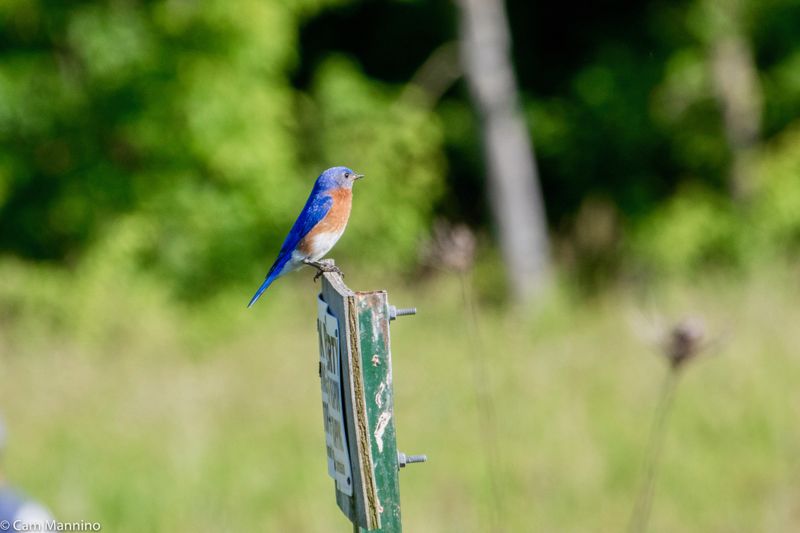
Most North Carolina Eastern Bluebirds do not migrate south for the winter and then return in spring. North Carolina Bluebird Society guidance notes that most resident bluebirds stay in the state year-round, sometimes joined by northern birds during the coldest months. So when you see a bluebird in January, it is probably a neighbor, not a traveler.
What changes in late winter is behavior. A male may begin singing from exposed perches, displaying his brilliant blue back to any rival nearby, and defending a particular tree cavity or nest box as though he already owns it. He might carry a piece of grass to a hole and drop it, or hover at an entrance for a few seconds before flying off. This is what “scouting” actually looks like, and it is really territory establishment and cavity inspection happening at the same time.
The North Carolina Wildlife Resources Commission describes males locating a nesting site in March, while the Bluebird Society’s approximate calendar places territory selection in February. Nest building and egg laying typically follow in March and April, with a first clutch arriving in April or May. A second clutch often follows in June or July, and some pairs attempt a third in August.
Your North Carolina Garden Changes Every Week. Your Plan Should Too.
Gardening in North Carolina changes quickly throughout the season. Every Friday you’ll receive a simple weekly plan showing exactly what to plant, prune, fertilize, harvest, and protect so you never miss the right timing.
Weather, elevation, and local habitat can shift all of those dates. A pair in the Sandhills may be weeks ahead of one in the Blue Ridge. The calendar is a guide, not a contract.
Build A Box Bluebirds Can Use
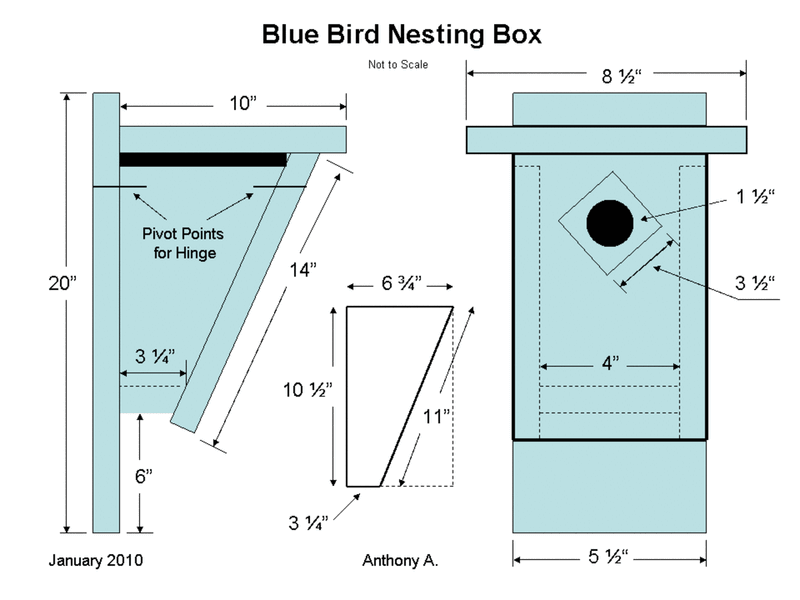
Getting the dimensions right is the single most important construction decision you will make. NC State Extension recommends a floor of approximately 5.5 by 5.5 inches, a box depth of about 9 inches, a 1.5-inch entrance hole, and that entrance positioned roughly 8 inches above the floor. Those numbers are not suggestions to round up or down. A hole larger than 1.5 inches invites starlings, which can take over a box and harm bluebird eggs or nestlings.
Material matters too. Use untreated pine, cedar, or cypress. Cedar and cypress hold up especially well through North Carolina’s muggy summers and wet winters without warping or rotting. Do not use pressure-treated lumber or apply any preservative, paint, or coating to the interior.
Those chemicals can harm nestlings in a confined space.
Leave off the perch. Bluebirds do not need one, and a perch gives House Sparrows and other competitors a convenient foothold to harass or evict a nesting pair. It is an easy feature to skip and a real reason to skip it.
A few finishing details make a box genuinely functional. An overhanging roof keeps rain off the entrance. Small drainage holes in the corners of the floor let water escape if any gets in. Ventilation gaps near the top of the side panels prevent overheating during July afternoons.
An access panel on one side, secured with a simple pivot nail or screw, lets you monitor and clean the box without forcing it open from the front. These features take almost no extra effort and make a real difference across multiple nesting seasons.
Choose Open Ground And A Safe Mount
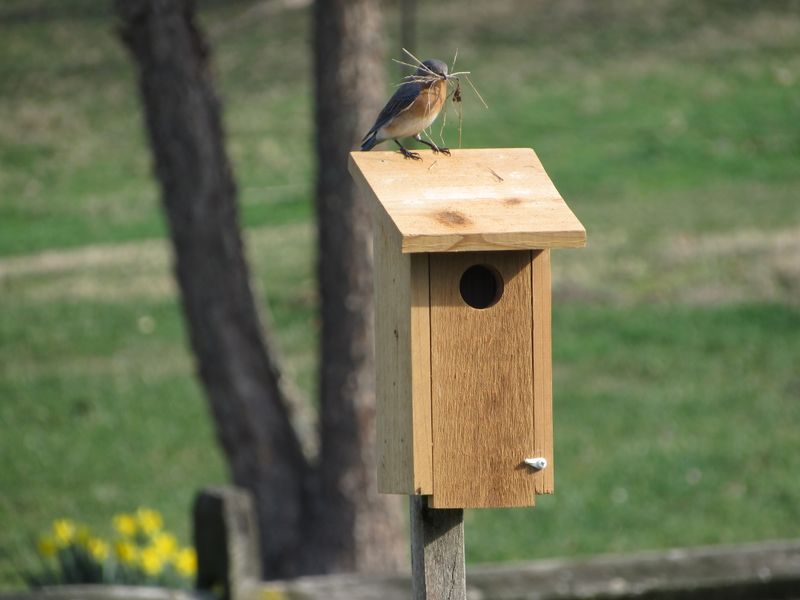
Eastern Bluebirds hunt insects by watching from an elevated perch and dropping to the ground when they spot movement. That hunting style means they need open sightlines in every direction. A box tucked into dense woods, set against a tall hedge, or surrounded by tall ornamental grasses is working against the bird’s natural instincts, and bluebirds are likely to ignore it.
Good placement looks like a large open lawn, a meadow, a pasture, an orchard, a cemetery, or a field edge with scattered low trees or shrubs. Many Piedmont homeowners find that the back corner of a half-acre yard, away from the tree line, works well. NestWatch placement guidance and the North Carolina Bluebird Society both emphasize open habitat as the primary requirement, and that holds whether you are in the Coastal Plain or the foothills.
Mount the box between 3 and 6 feet above the ground. North Carolina guidance commonly points to about 5 feet as a practical target. A smooth metal or PVC pole is the best mount because it accepts predator baffles more easily than a wooden post or tree trunk. A rough surface gives climbing animals the grip they need to reach the box.
A small shrub, low fence, or nearby sapling within a few feet of the box can help fledglings land safely on their first flight out. Just make sure that same structure does not give a raccoon or snake a running start toward the entrance. Before you drive any pole into the ground, call 811 to check for underground utilities.
Use Direction And Spacing To Reduce Conflict
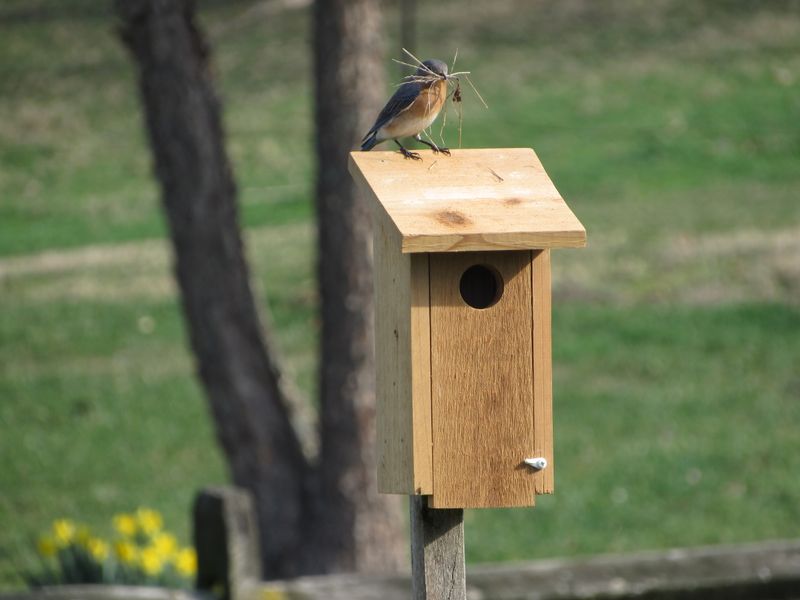
Here is where it gets tricky. You will find different compass-direction recommendations depending on which source you read, and that can feel frustrating when you are trying to do things right. NestWatch lists east as the preferred entrance direction for Eastern Bluebirds, followed by north, south, and then west. North Carolina guidance often suggests southeast or simply facing away from prevailing winds and driving rain.
Both are reasonable starting points.
The more useful frame is this: shade, drainage, and weather protection matter more than any single compass rule. A box facing east in the Piedmont may catch morning sun and avoid the brutal afternoon heat of a July thunderstorm day. A box facing southeast in the mountains may stay drier through a nor’easter. Prioritize those practical outcomes over locking in one direction.
Spacing is less flexible. Keep ordinary Eastern Bluebird boxes at least 300 feet apart, which works out to roughly 100 yards. Bluebirds are territorial, and boxes placed closer than that invite fighting that disrupts nesting for both pairs. Pennsylvania Extension’s bluebird habitat guidance, which aligns with North Carolina practice, reinforces this minimum distance.
You may have read about placing two boxes 15 to 25 feet apart. That is a specific paired-box strategy sometimes used to let a bluebird and a Tree Swallow nest near each other without constant fighting. It is not a workaround for fitting two standard bluebird boxes into a small yard. Those two situations are genuinely different, and mixing them up leads to territorial conflict that benefits neither species.
Give Predators Fewer Ways In
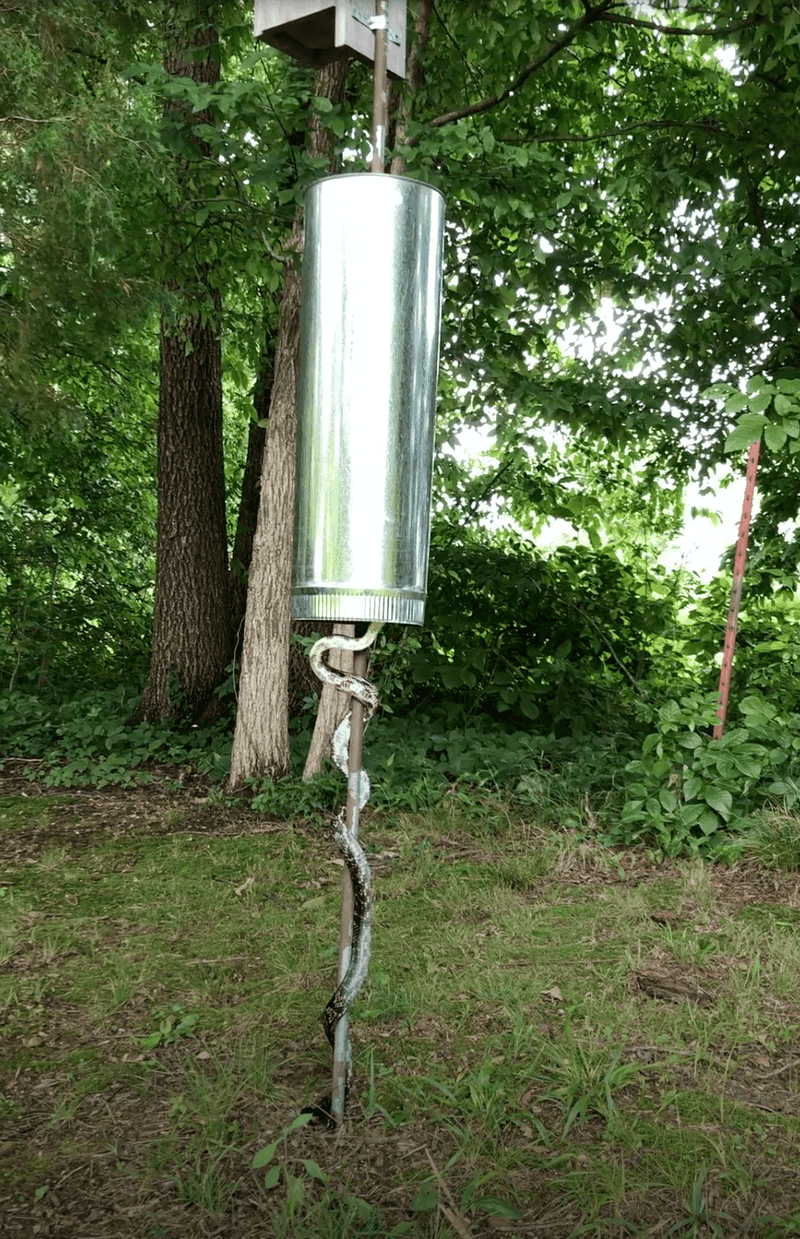
Raccoons are patient. Snakes are patient. Cats, opossums, and mice are patient too, and none of them need a ladder if you give them a rough post and a bit of motivation. The mounting method you choose is actually your first line of defense, not an afterthought.
Install a baffle or predator guard below the box, on the pole itself. A stovepipe-style metal baffle, positioned about 4 feet off the ground, stops most climbing animals because they cannot get a grip or squeeze around it. NestWatch’s predator-deterrence guidance recommends a conical or cylindrical metal baffle as the most effective option for pole-mounted boxes.
The numbers back this up. NestWatch data shows that boxes with predator guards had average nesting success rates 6.7 percent higher than boxes without guards. That is a population-level finding across many boxes and many seasons, not a promise that every nest will survive. A determined snake can still find a way in.
But the odds genuinely shift in your favor when the pole is smooth and the baffle is in place.
Walk around the box location and look for jump routes. A branch hanging within 10 feet, a fence running close by, a shed roof nearby, or even a stacked woodpile can give a raccoon the angle it needs to bypass the baffle entirely. Remove those routes or move the box. And before you drive the pole into the ground, call 811 to confirm there are no underground utilities at that spot.
Monitor Without Endangering The Nest
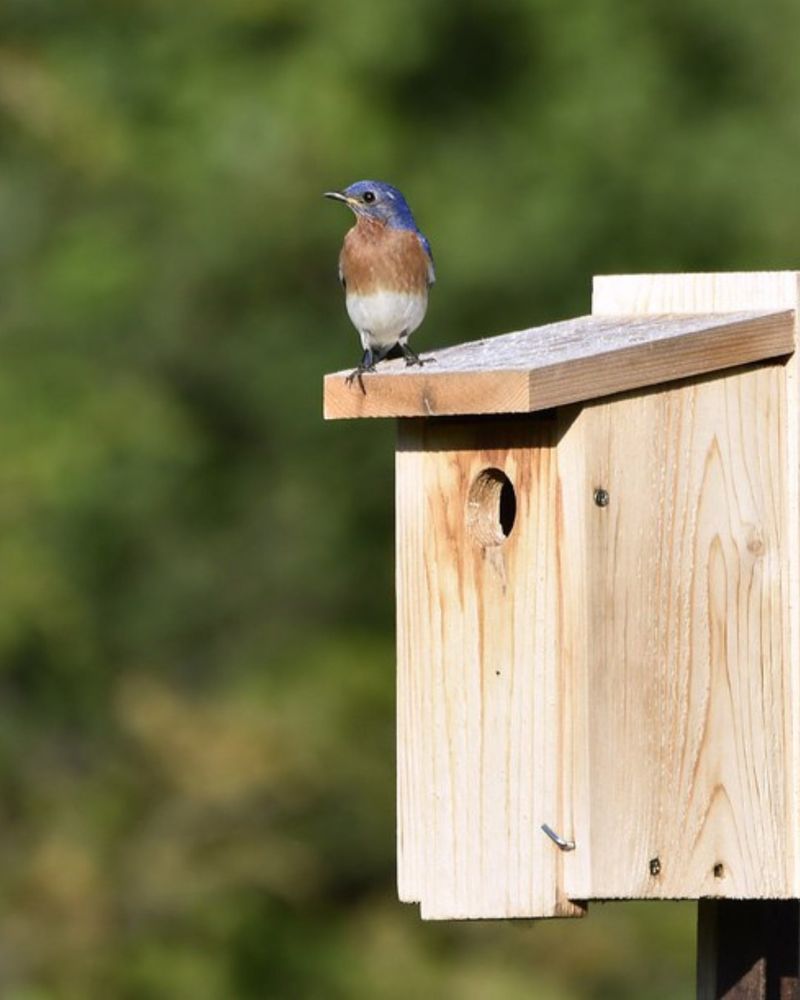
Once a pair moves in, the temptation to check every day is real. Resist it. The North Carolina Bluebird Society recommends weekly monitoring during the nesting season, and that rhythm gives you useful information without wearing a path to the box that predators learn to follow.
Approach the box the same way each time and leave by the same route. North Carolina Wildlife guidance advises checking no more than once a day and departing the same way you came in, because repeated back-and-forth movement can signal to predators that something worth investigating is nearby. A quick look, a count of eggs or nestlings if visible, and a calm exit is all you need.
Before you open the box, put on gloves and eye protection. Boxes can contain wasps that built a nest before the bluebirds arrived, ants, mites, blowfly larvae in the nesting material, and occasionally a snake that found the box before you did. None of those hazards are rare enough to skip the gear.
Stop opening the box once nestlings are well-feathered or appear close to fledging. A surprised nestling that jumps too early is in real danger on the ground. NestWatch monitoring guidelines emphasize avoiding disturbance near fledging time for exactly this reason.
Do not spray any pesticide or insecticide inside an occupied box, even for wasps or mites. And remember: active nests, eggs, and dependent young are protected under federal law. If another native bird has taken up residence, the nest stays.
Clean Inactive Boxes And Improve The Habitat
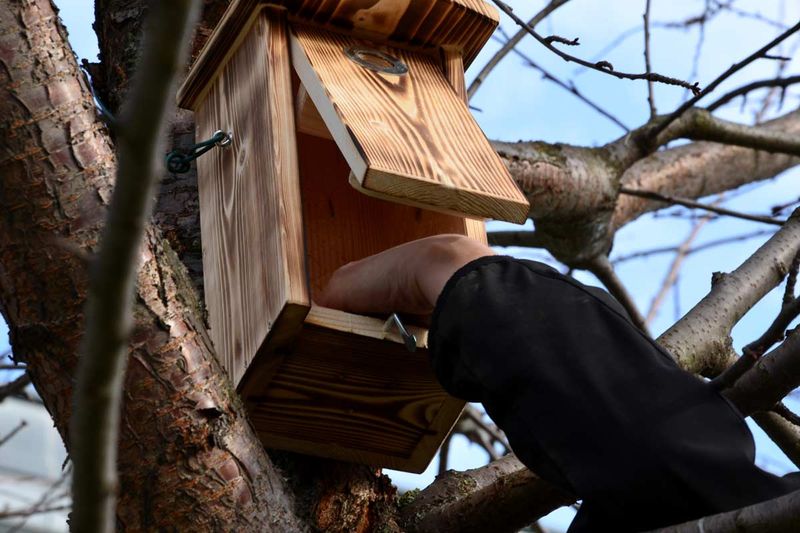
Old nesting material can raise the nest floor closer to the entrance hole, which makes eggs and nestlings easier for predators to reach. Removing it after the breeding season is finished is a reasonable step and a practical way to start fresh. Wait until the box is clearly inactive, with no eggs, nestlings, or adults coming and going, before you open it for cleaning.
Fall is a good time for this task. NestWatch’s cleaning guidance recommends mild detergent and water for routine cleaning, and a solution of 1 part bleach to 10 parts water for boxes with heavy fecal soiling. Rinse thoroughly and let the box dry completely before closing it up.
Whether cleaning actually improves occupancy or nesting success in the following season is genuinely unsettled. A USGS-published study on Eastern Bluebird dispersal found that nesting success, not old nest removal, drove where bluebirds chose to breed next. A North Carolina study summarized by Cornell found bluebirds often preferred cleaned boxes after a successful first brood, while a South Carolina study found no significant effect. Clean the box because it is good maintenance, not because it guarantees a tenant.
The box is only part of the picture. Eastern Bluebirds forage mainly on insects found on or near open ground, so reducing broad pesticide applications around the yard protects both the adults and the nestlings they are feeding. An exposed perch like a low wire or a short wooden stake near the box gives them a hunting platform. A shallow birdbath, no deeper than 2 inches, can draw them in for drinking and bathing, especially if the water moves a little.
None of those additions guarantee that bluebirds will nest, but together they make your yard a place worth returning to. The goal is simply to have a clean, safe, ready cavity waiting when late-winter activity begins again.