Here’s What It Means When Hawks Keep Circling Back To Your North Carolina Yard All Summer
You step onto your back porch on a muggy North Carolina morning, coffee in hand, and there it is again, that same hawk cutting low across the yard before vanishing into the tree line. If it has happened more than once this summer, you are probably wondering what the bird is actually after and whether your feeders, your songbirds, or your backyard chickens are the reason it keeps showing up. A hawk that visits once is just passing through, but one that keeps coming back is finding something useful in your landscape. Understanding why can help you make smart, humane choices without overreacting to a bird that is simply doing what hawks do.
Which Hawk Might Be Visiting?
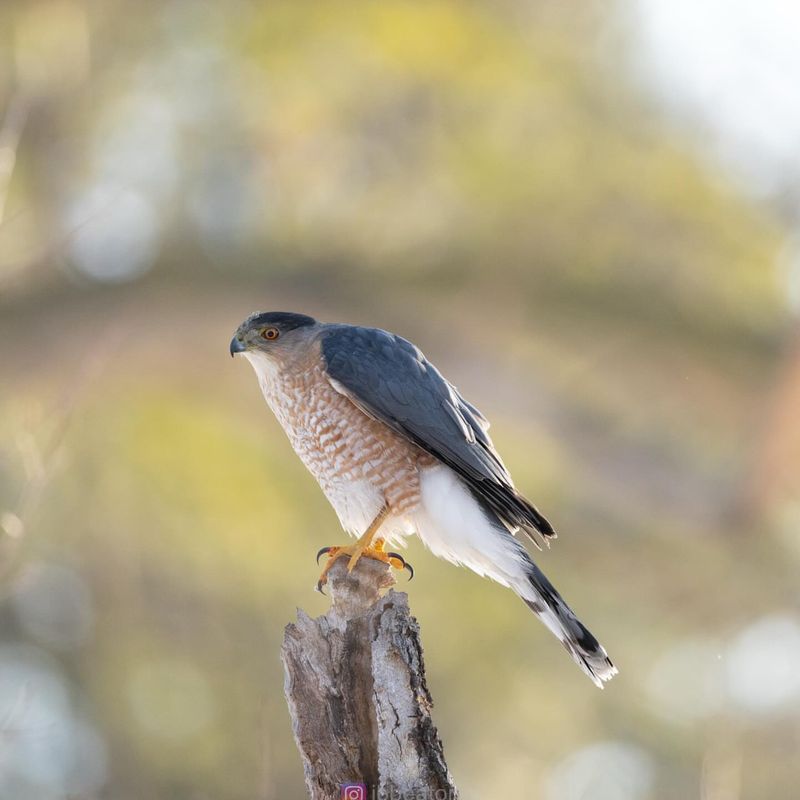
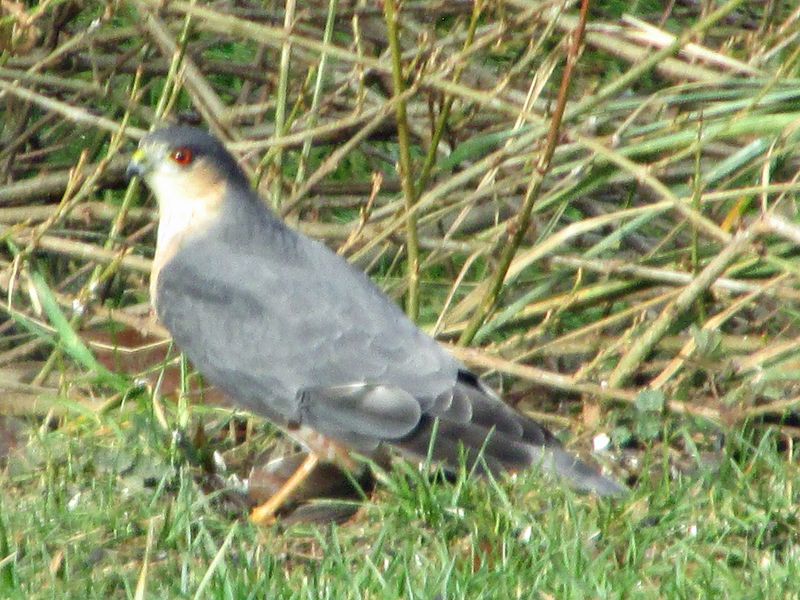
Not every hawk swooping through a North Carolina yard is the same bird playing the same game. Two species stand out as plausible visitors around bird feeders: the Cooper’s Hawk (Accipiter cooperii) and the Sharp-shinned Hawk (Accipiter striatus). Both are long-tailed, short-winged accipiters built for threading through trees at speed, and both specialize in pursuing birds, which is exactly why a busy feeder can catch their attention.
Cooper’s Hawks are crow-sized birds that have adapted well to leafy neighborhoods, parks, and backyards across much of North America. Cornell Lab’s Cooper’s Hawk life history notes that their diet runs heavily toward other birds, including Mourning Doves, American Robins, European Starlings, and even chickens. Sharp-shinned Hawks are noticeably smaller, roughly the size of a blue jay, with a squared-off tail and a habit of hunting small songbirds along forest edges and at feeders. Cornell’s Sharp-shinned Hawk account describes them as the smallest accipiter in North America, built for quick, nimble strikes rather than sustained open-air chases.
Telling the two apart from a quick backyard glance is genuinely tricky. Cooper’s Hawks tend to show a more rounded tail tip and a slightly larger, more projected head, while Sharp-shinneds look smaller-headed and often show a more squared or notched tail. But a brief or distant sighting rarely settles the question with certainty. Photographs, repeated close observation, and attention to body proportions in flight are better tools than a single glimpse.
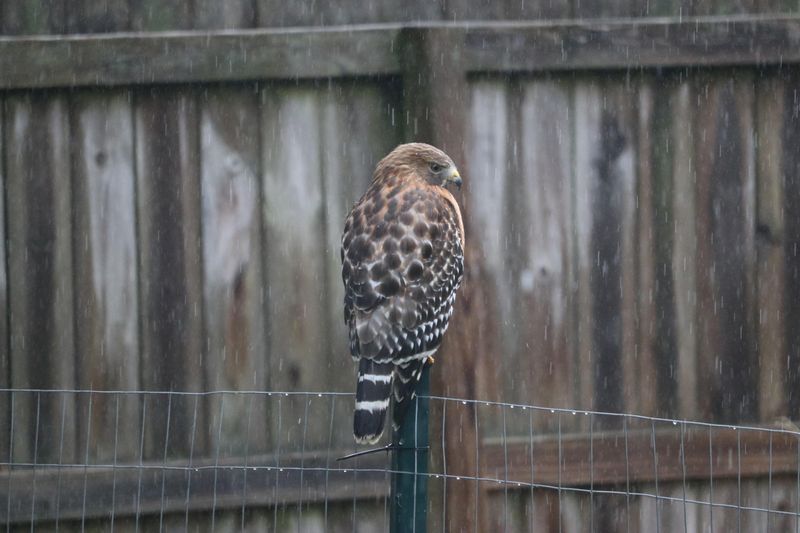
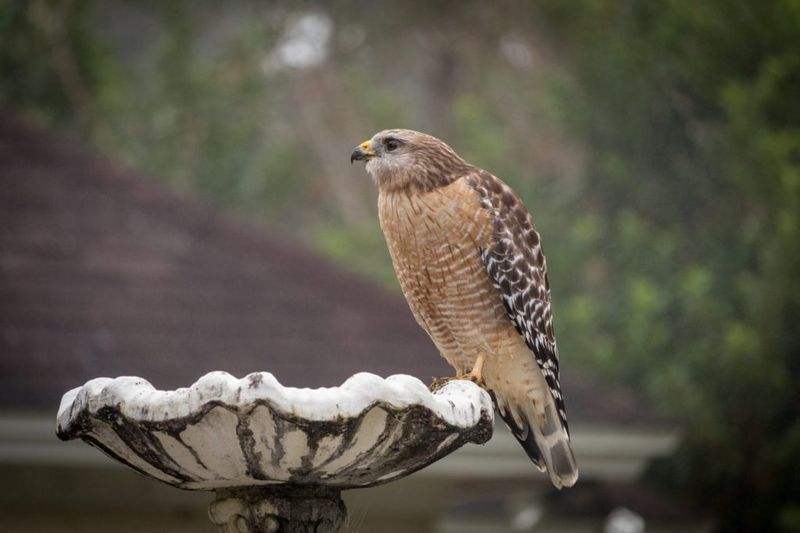
The Red-tailed Hawk (Buteo jamaicensis) is a different story. It is a much larger bird with broad, rounded wings and a relatively short, fan-shaped tail. Cornell’s Red-tailed Hawk guide places its main prey squarely in the mammal category, things like mice, voles, rabbits, and squirrels, rather than feeder birds. If the hawk you keep seeing is large, soaring high, and perching on power poles or isolated trees over open ground, a Red-tail is a reasonable possibility, though no species call should be made from a single brief look.
Your Landscape May Offer a Reliable Opportunity
A hawk that returns to the same yard more than once is not acting on loyalty or habit for its own sake. It is responding to something the landscape keeps providing. For accipiters like Cooper’s and Sharp-shinned Hawks, a backyard feeder that concentrates dozens of doves, sparrows, and finches in one spot is roughly the equivalent of a well-stocked pantry with an unlocked door.
Your North Carolina Garden Changes Every Week. Your Plan Should Too.
Gardening in North Carolina changes quickly throughout the season. Every Friday you’ll receive a simple weekly plan showing exactly what to plant, prune, fertilize, harvest, and protect so you never miss the right timing.
Research supports this picture. A peer-reviewed study on urban raptor ecology found that hawks were more likely to colonize and persist in developed areas where prey birds were abundant, including sites with high feeder activity. A related study reinforces that prey availability is a meaningful driver of hawk presence in neighborhoods. That does not mean your yard has an unusually large or unhealthy prey population.
It means the hawk found something worth checking on, and it came back.
Prey is one factor, not the only one. Open ground, low shrubs, useful perches, tree cover at the yard’s edge, and the general structure of the surrounding block all shape whether a hawk finds a spot productive. A Cooper’s Hawk hunting a feeder area will often use low, fast flights that thread through shrubs and fences, while a Red-tailed Hawk working the same neighborhood is more likely to be scanning a weedy corner or an open lawn for mice, voles, or chipmunks. Cornell’s Red-tailed Hawk life history confirms that mammals make up the bulk of their diet.
So repeated visits are a signal worth paying attention to, but they do not prove that your yard is uniquely overstocked with prey. The hawk may also be using your neighbor’s yard, the vacant lot two doors down, or a greenway corridor nearby. Your feeders and your open lawn are simply pieces of a larger hunting landscape the bird has found worth revisiting.
Circling Alone Does Not Prove a Hunt
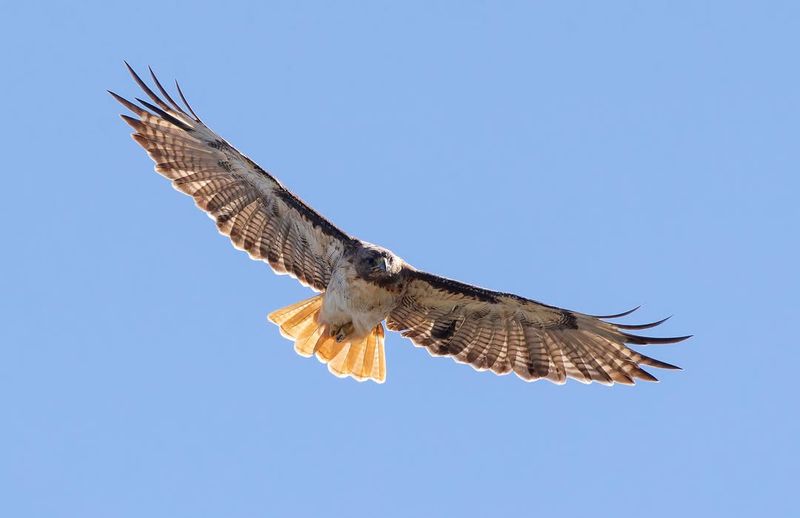
Seeing a hawk overhead in big lazy circles is one of the most dramatic backyard moments a North Carolina summer can offer. But circling high in the sky and actively hunting your feeder birds are two very different things, and mixing them up leads to a lot of unnecessary worry.
Hawks circle for reasons that have nothing to do with your yard specifically. Rising columns of warm air, called thermals, form over heated rooftops and parking lots on muggy afternoons, and soaring birds ride them to gain altitude with almost no energy cost. A hawk wheeling slowly overhead at rooftop height or higher may simply be traveling through, using the lift to move across its territory, or watching a wide area from above.
Cornell’s Red-tailed Hawk identification notes describe this kind of soaring as typical behavior, especially over open country.Actual hunting behavior looks quite different. Cornell’s Cooper’s Hawk identification account describes a hunting accipiter as flying with quick, powerful wingbeats and using trees, fences, and shrubs as cover to launch surprise attacks. The signs worth watching for are low and fast passes through vegetation, songbirds exploding off the feeder in a panic, the hawk landing repeatedly near the feeder station and waiting, or the bird leaving with prey in its talons. A Sharp-shinned Hawk on the hunt shows a similar pattern, threading through dense cover at speed rather than drifting in open air.
One more thing worth keeping in mind: repeated sightings do not automatically mean you are watching the same individual bird. Without a photograph, a color band, or some other distinguishing mark, there is no reliable way to know whether it is one hawk making return trips or several different hawks moving through the same area. Treat each sighting as data, not as confirmation of a single persistent visitor.
Summer Visits May Reflect Breeding Behavior
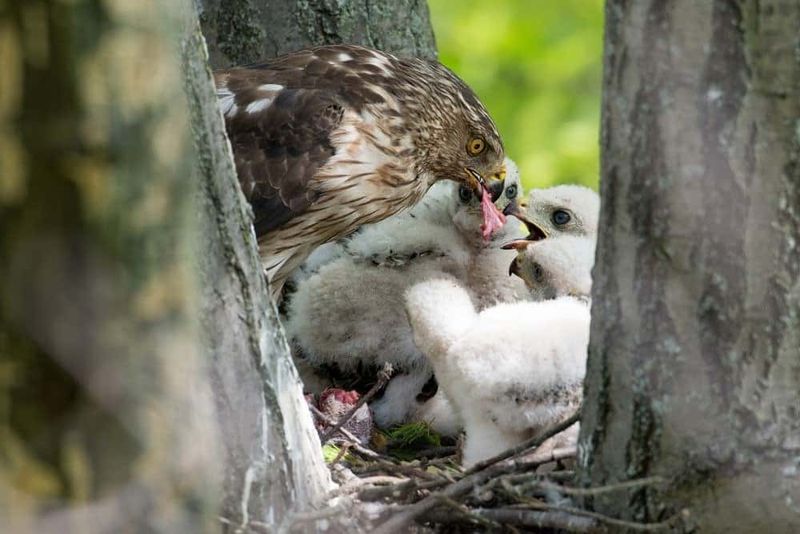
Late spring and summer hawk activity around North Carolina yards sometimes has less to do with your feeders and more to do with what is happening in the tree canopy overhead. Breeding season adds a whole layer of explanation for repeated visits that often gets overlooked.
Cornell’s Cooper’s Hawk life history notes that this species commonly nests in wooded neighborhoods, parks, and backyards, often placing nests roughly 25 to 50 feet above the ground in tall deciduous or mixed trees. Adults with a nest nearby need to make frequent food runs, and a yard with reliable prey can become a regular stop on that circuit. Young Cooper’s Hawks leave the nest before they are fully capable hunters, and the weeks after fledging involve a lot of practice, missed strikes, and dependence on parents who are still delivering meals.
A few specific clues can suggest breeding activity rather than simple opportunism. Watch for an adult arriving with prey held in its talons and then flying directly into a tree rather than eating on a perch. Listen for high, repeated begging calls, which sound something like a rapid, insistent series of notes, coming from the canopy. A visible nest platform of sticks is the strongest indicator, though nests are easy to miss until leaves drop in fall.
Keep the conclusion qualified, though. An adult working its summer territory, a parent making food runs, a recently fledged youngster awkwardly chasing birds, or simply a different hawk passing through on separate days could all produce the pattern of repeated summer sightings. eBird’s Cooper’s Hawk range maps show the species as a year-round resident across much of North Carolina. Sharp-shinned Hawks, by contrast, are more strongly tied to migration and the nonbreeding season across much of their range, so seasonal occurrence genuinely varies by species and location. The NC Wildlife Resources Commission is a useful contact if you want region-specific guidance on what species are expected in your area at a given time of year.
None of this requires you to confirm a nest before acting. If a hawk is repeatedly disrupting your feeder station regardless of the reason, the practical options described in the next sections apply the same way.
Pause the Feeders When Attacks Keep Disrupting Birds
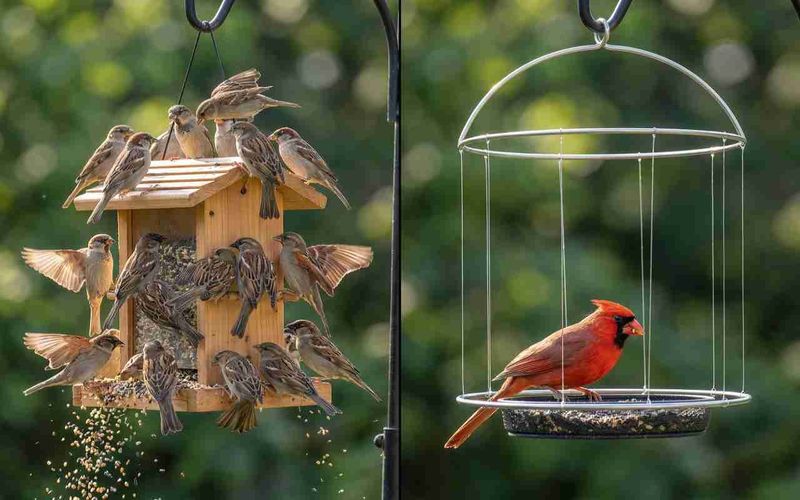
Watching a hawk scatter your feeder flock every afternoon gets old fast, and there is a practical step that genuinely helps: stop filling the feeders for a while. Cornell Lab’s guidance on hawks at feeders recommends taking feeders down or stopping the food supply for several days to a couple of weeks. When the concentrated food source disappears, the smaller birds spread out and find food elsewhere, and the hawk loses its reason to keep checking that particular spot.
Do not expect a guaranteed outcome or a fixed timeline. The hawk may shift its routine after a few days, or it may continue patrolling the area because other prey, neighboring feeders, or natural food sources nearby are keeping it around. When you put the feeders back up, there is a real chance the hawk will return once the songbirds concentrate again. That is not a failure of the strategy; it is just how a predator’s routine works.
Removing one feeder also may not change much if you have three others running in the same yard, or if a neighbor’s setup thirty feet away is drawing the same birds.
While the feeders are down, use the break to clean them properly. NC State Extension’s backyard bird habitat guidance recommends cleaning feeders every two to three weeks, a schedule that matters even more in North Carolina’s humid summers, when mold and spoiled seed can develop quickly and spread disease through a crowded feeder flock. Scrub the feeder surfaces, rinse thoroughly, and let them dry completely before refilling.
Manage spilled seed on the ground too. Piles of old seed draw sparrows and doves to a predictable ground-level spot, which is exactly the kind of easy target an accipiter looks for. Raking up spilled seed regularly is a small task that reduces one more concentration point. Think of the pause and the cleaning together as a reset, not as giving up on feeding birds altogether.
Cornell’s Sharp-shinned Hawk account notes that feeders supplement the birds’ natural diet, so a short break does not leave your flock in crisis.
Give Smaller Birds Cover Without Promising Safety
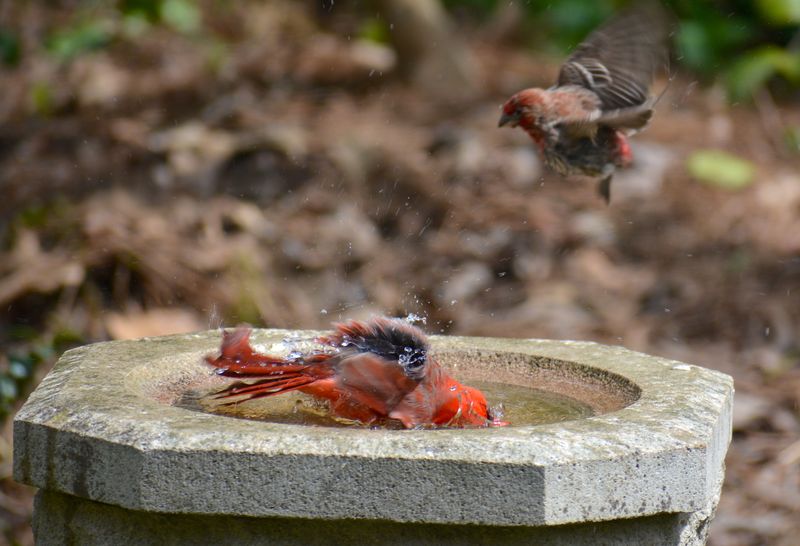
Cover genuinely matters to a small bird trying to survive a hawk strike. The distance between the feeder and the nearest refuge is the window a Cooper’s Hawk needs to close the gap, and shortening that window can make a real difference in how often feeder birds escape.
NC State Extension’s urban bird habitat recommendations suggest placing feeders within 10 feet of brush piles or shrubby vegetation, with evergreens being especially useful because they hold their cover year-round. A dense holly, a juniper, or a thicket of native shrubs gives a sparrow or a chickadee somewhere to bolt when a shadow crosses the yard. That 10-foot gap is short enough for a small bird to cover in under a second.
Here is where it gets tricky, though. Dense vegetation is not a one-sided advantage. Accipiters are ambush hunters by nature, and a thick shrub that hides a fleeing bird can also hide a waiting hawk. Cats use the same cover to stalk feeders from underneath, which is a separate but real problem for ground-feeding birds.
NC State Extension’s wildlife habitat chapter recommends a layered mix of shrubs, vines, wildflowers, native grasses, trees, and evergreens as a broad habitat strategy, not as a hawk-deterrent system. The goal is a yard that supports more birds and more natural behavior, not a fortress that keeps raptors out.
For backyard chickens, the calculus is different. Landscaping alone cannot protect free-ranging poultry from a determined hawk. NC State Extension’s guide to keeping garden chickens in North Carolina identifies predation as a leading cause of mortality in small backyard flocks and recommends a predator-proof coop paired with a covered or fully enclosed run. Young birds and bantam breeds are especially vulnerable.
If you are free-ranging your flock and a hawk has started visiting regularly, moving them into a covered run during the hours when the hawk is most active, typically morning and late afternoon, is a practical first step. Physical exclusion is the most dependable protection available.
Leave the Hawk Alone and Choose a Proportionate Response
Before doing anything drastic, take a breath and match your response to what the hawk is actually doing. A bird circling high overhead once or twice a week is not the same situation as one that is crashing your feeder every single morning. The first may need no response at all. The second warrants a temporary feeder pause, some cover improvements, and possibly a more secure chicken run.
A hawk visiting your yard does not mean you created an unhealthy environment, that raptors are overpopulated in your neighborhood, or that something has gone wrong with your yard’s ecosystem. Hawks are native predators, and their presence reflects a functioning food web in the broader landscape. At the same time, you are allowed to manage your yard humanely if repeated attacks are clearing out your feeder birds or putting your poultry at risk.
What you cannot do is trap, relocate, injure, or kill the bird. Hawks are protected under federal law. The Migratory Bird Treaty Act of 1918 makes it illegal to pursue, capture, kill, or possess a migratory bird without federal authorization, and most North American hawks fall under that protection. U.S.
Fish and Wildlife Service handling guidance makes clear that even well-intentioned trapping or relocation by a homeowner is prohibited. Give any wild raptor, its nest, and its fledglings plenty of space, and do not approach a bird that appears to be guarding young.
If you find a hawk that is injured, entangled in netting, or behaving in a way that seems abnormal, contact the North Carolina Wildlife Resources Commission or a permitted wildlife rehabilitator rather than handling the bird yourself. Cornell Lab notes that hawk sightings in neighborhoods have actually increased in recent decades as some species have adapted to suburban landscapes. A hawk in your yard is not a crisis; it is North Carolina wildlife doing exactly what it evolved to do, and a little patience goes a long way toward living alongside it.