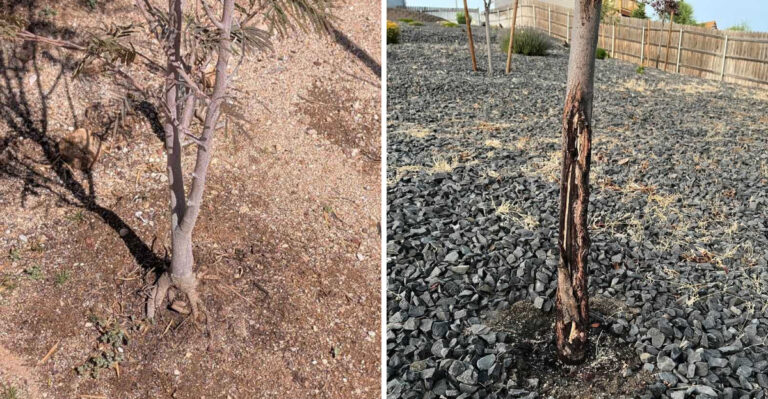
This Invasive Tree Is Spreading Through Arizona Yards While Homeowners Mistake It For A Harmless Volunteer
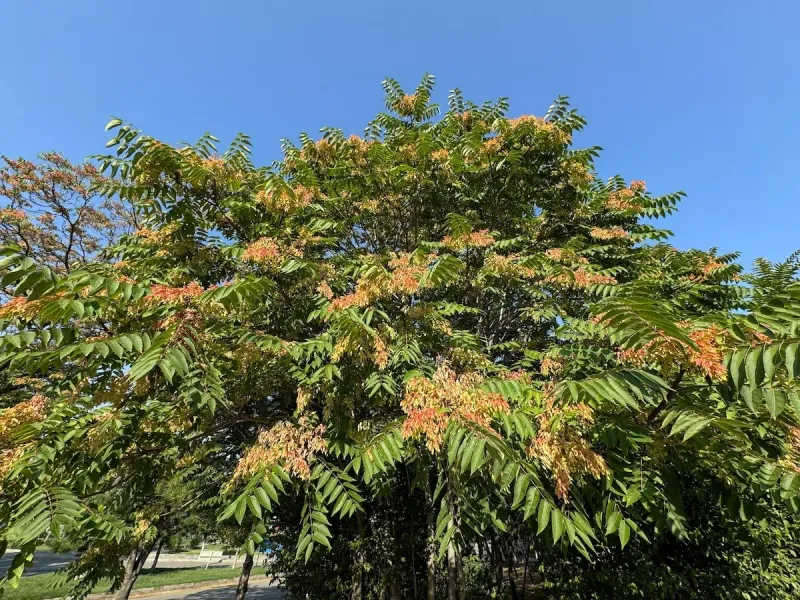
Somewhere in an Arizona yard, a fast-growing tree with enormous feathery leaves is quietly putting down roots while the homeowner assumes it volunteered from a neighbor’s walnut or ash. That tree could be Ailanthus altissima, commonly called tree-of-heaven, a nonnative species from China that has established itself in parts of Arizona and can be surprisingly difficult to remove once it matures.
Knowing what to look for before reaching for a shovel could save you from accidentally making the problem worse, or from cutting down a tree that turns out to be something valuable entirely.
A suspicious volunteer is one possibility—not a statewide Arizona trend
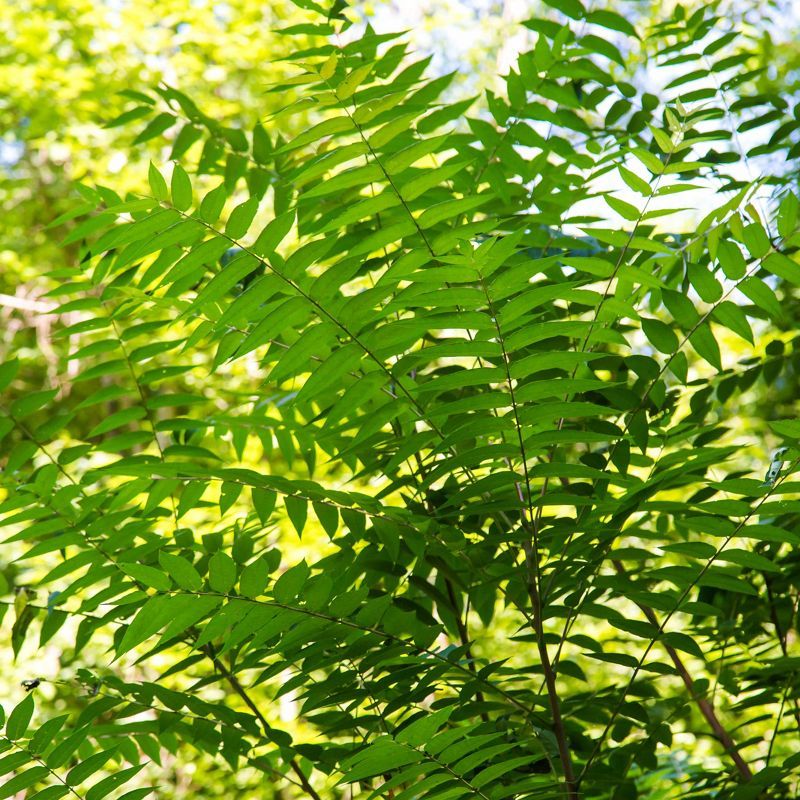
Tree-of-heaven (Ailanthus altissima) is a nonnative tree originally from China that has established itself in parts of Arizona, and it is worth considering when an unfamiliar volunteer appears in your yard. That said, no plant can be identified from a general description alone, and not every fast-growing volunteer with compound leaves turns out to be this species.
The recognition gap is real, though: University of Arizona extension materials note that people sometimes appreciate tree-of-heaven early on for its shade and low-water tolerance before seedlings or root sprouts start multiplying.
What makes the confusion understandable is that tree-of-heaven grows quickly, tolerates alkaline soils, and asks for very little water. Those qualities make it look like a gift in a hot, dry yard, at least until the problems surface.
Homeowners in central and northern Arizona are more likely to encounter it than those in the low desert, but isolated plants can appear in disturbed urban sites anywhere.
The strongest documented Arizona populations are in Jerome, Cottonwood, and Clarkdale, with spread recorded down washes into riparian areas and stands noted at Dead Horse Ranch State Park. That regional picture matters: the evidence points to established plants along washes, disturbed ground, and roadsides, not a uniform invasion of Phoenix or Tucson neighborhoods.
A volunteer in your yard may or may not be this species, and confirming its identity is the essential first step.
Identify the whole plant before you remove it
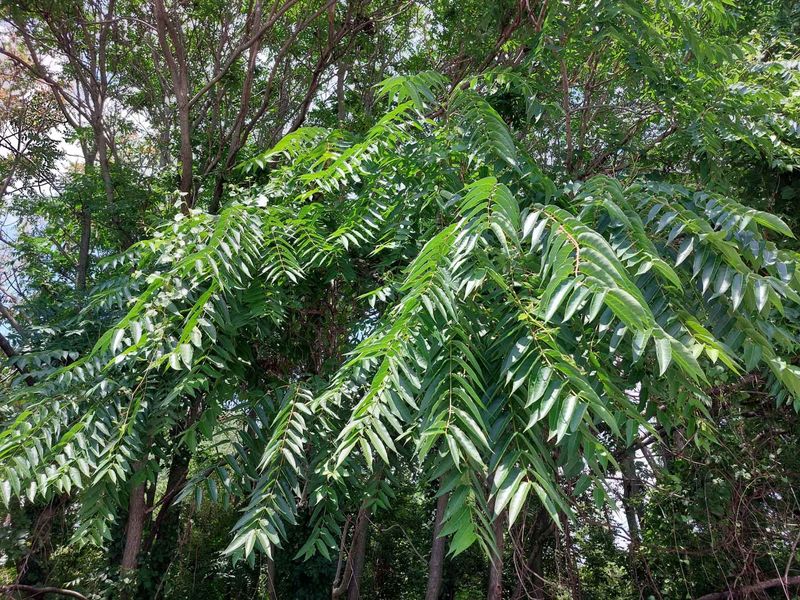
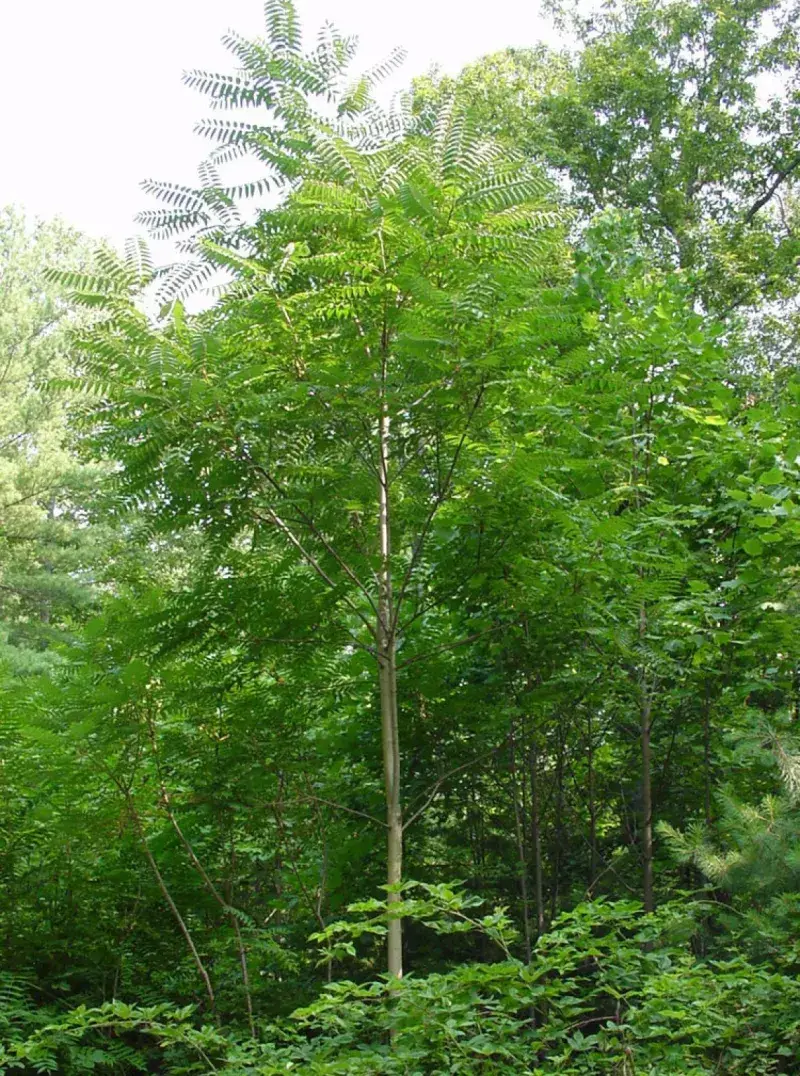
Leaf shape is a useful starting clue, but it cannot close the case on its own. Tree-of-heaven produces very large pinnately compound leaves, commonly ranging from one to four feet long, with many leaflets arranged along a straight central stem.
The detail that separates it from most look-alikes is leaflet margin texture: Arizona invasive plant records describe leaflets with mostly smooth edges and only a few teeth or lobes concentrated near the base, rather than toothed margins running the full length of the leaflet.
Crush a leaflet between your fingers and notice the smell. Tree-of-heaven foliage, bark, and male flowers tend to produce a strong, unpleasant odor that most people find distinctive.
Young bark is relatively smooth and grayish; older bark becomes rougher over time. Female trees produce flat, papery, winged seeds that may stay attached to the tree well into the season.
Several native or otherwise valuable trees share the compound-leaf structure and can look similar at a glance. Walnut and pecan leaflets are toothed along much or most of their edges.
Your Arizona Garden Changes Every Week. Your Plan Should Too.
Gardening in Arizona changes quickly throughout the season. Every Friday you’ll receive a simple weekly plan showing exactly what to plant, prune, fertilize, harvest, and protect so you never miss the right timing.
Ash leaflets are also toothed and tend to be fewer in number. Sumac species have leaflets with toothed margins as well, and some sumacs are native to Arizona.
Penn State Extension’s look-alike guide recommends photographing the whole plant, individual leaflets, bark, branching pattern, and any fruit or seed structures before removing a mature tree, because a hasty misidentification could mean losing something worth keeping.
A young plant may come from seed or a connected root
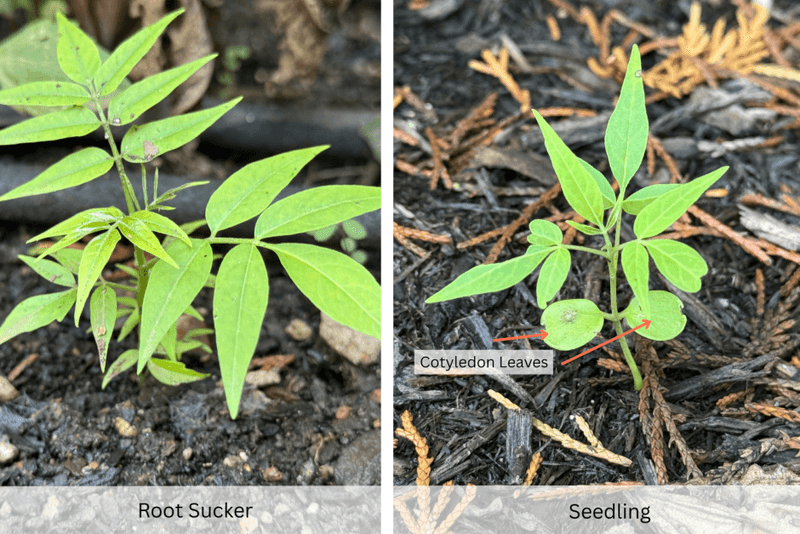
Where a volunteer comes from changes what removal actually involves. Mature female tree-of-heaven trees can produce large quantities of winged seeds that travel by wind, water, animals, and human activity, so a seedling might have arrived from a tree on a neighboring property, along a nearby wash, or from a roadside stand some distance away.
That kind of true seedling grows from its own root system and, if caught early, can sometimes be removed without triggering further spread.
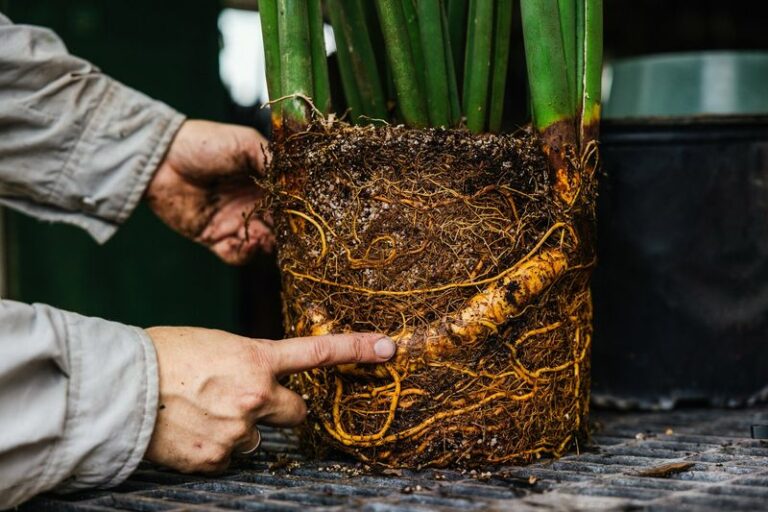
Established trees also reproduce through lateral roots and root suckers. A sucker is a shoot that emerges from a connected root system rather than from a separate seed, and it may appear away from the visible trunk with no obvious connection at the soil surface.
Clusters of young stems, sprouts that keep returning after cutting, or new growth near a known tree are all signs that a plant may belong to a root-connected colony rather than starting fresh from seed.
Distinguishing between the two situations matters because the removal problem is fundamentally different. University of Arizona guidance makes clear that root-connected suckers can be nearly impossible to eliminate without addressing the root system, while a true seedling removed entirely before it establishes a deep root system presents a more manageable task.
Avoid assuming a single stem represents the full extent of the plant until you can confirm it grew from seed.
Several traits help tree-of-heaven persist
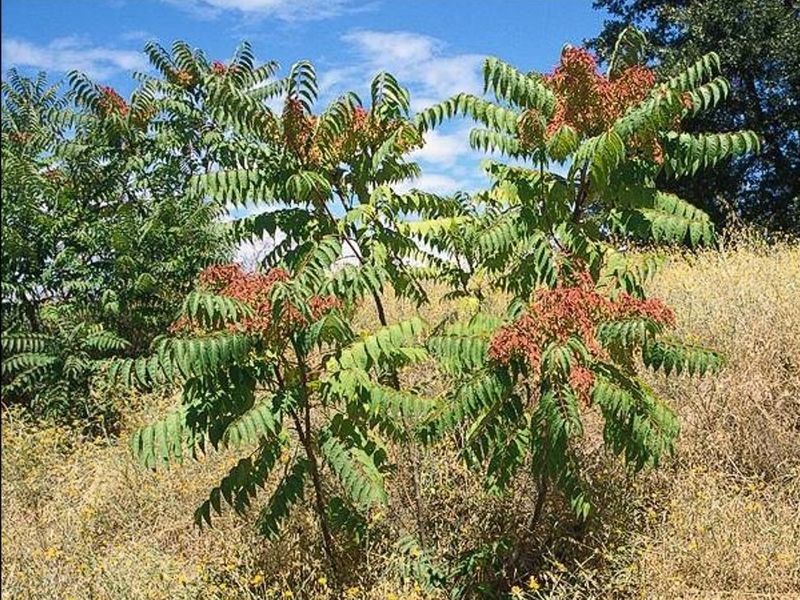
Rapid growth is one of tree-of-heaven’s most striking characteristics. Young plants can add several feet of height in a single growing season, outpacing many native competitors for light and space in disturbed areas.
Combine that speed with abundant seed production from mature female trees and the ability to resprout vigorously after damage, and you have a plant that can recover from setbacks that would slow or kill other species.
Tolerance of difficult conditions adds to its persistence. Tree-of-heaven handles alkaline soils, compacted ground, and low water availability, which makes disturbed roadsides, vacant lots, wash banks, and urban fill sites suitable habitat.
Disturbance actually favors it: cleared ground, road cuts, and construction zones reduce competition from established plants and give wind-carried seeds open soil to colonize.
Research has also examined whether tree-of-heaven produces compounds that suppress neighboring plants, a phenomenon called allelopathy. Rapid growth, prolific seeding, clonal root spread, resprouting after damage, and limited natural enemies in North America all contribute to how well it establishes.
No single mechanism tells the whole story, and the competitive edge tree-of-heaven holds in Arizona comes from several of these factors working together rather than from one dramatic trait.
Arizona’s Class C label signals concern, not automatic eradication
Arizona lists tree-of-heaven as a Class C noxious weed, and that designation is worth understanding before assuming it triggers a specific legal obligation. According to the Arizona Department of Agriculture’s noxious weed program, Class C reflects a species that is widespread and may be recommended for active control based on risk assessment.
The classification is a management priority signal, not a universal order requiring every property owner to remove every tree immediately, and it does not make possession illegal in every context.
What the designation does communicate is that the state recognizes tree-of-heaven as a species with enough invasive potential to warrant attention, particularly where it threatens native habitats, riparian corridors, or agricultural land. The documented Arizona populations around Jerome, Cottonwood, Clarkdale, washes, and disturbed sites support that concern, but those records do not establish that the tree is equally common in every low-desert Phoenix or Tucson neighborhood.
Local rules can vary considerably. Homeowner association requirements, municipal ordinances, and county regulations may impose different or additional expectations beyond the state classification.
Pesticide application rules also apply independently of the noxious-weed designation. Before taking action based on the Class C label alone, check what your local jurisdiction actually requires for your specific property and situation, and consult current guidance from the Arizona Department of Agriculture if you have questions about control obligations.
Small, isolated seedlings may come out by hand
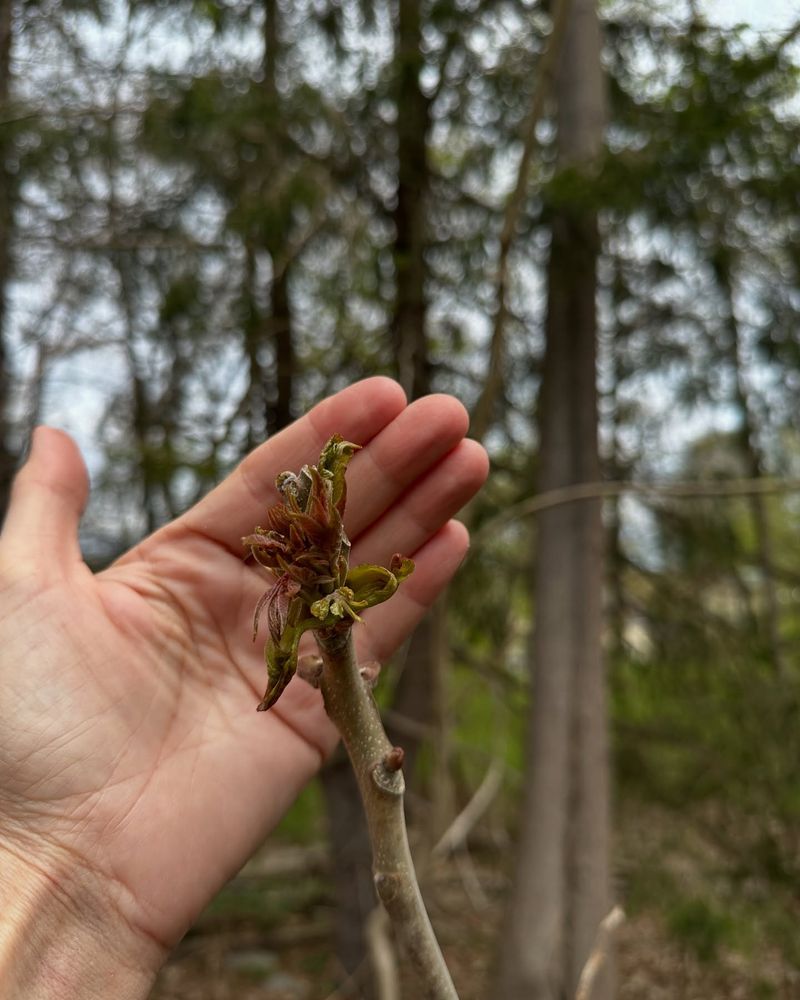
Hand-pulling or digging is a reasonable option when the plant is genuinely small, its identity has been confirmed, and there is good reason to believe it is a true seedling rather than a root sucker. Moist soil makes the task easier and improves the odds of getting the entire root system out in one effort.
Dry, compacted Arizona soil can cause roots to snap off, leaving fragments that may resprout.
The critical requirement is removing the whole root, not just the visible stem. Even a small section of root left behind can generate new growth.
After you finish, monitor the area and return to check for regrowth over the following weeks and months. A single pass is rarely enough to be certain.
This method has clear limits. University of Arizona extension guidance specifies that hand-pulling or digging applies primarily to small seedlings, not to root suckers connected to a larger parent tree.
If the shoot you are pulling belongs to an established root system, removing the visible stem will not address the source, and new sprouts may continue appearing from the same lateral roots. Before digging, consider whether the plant appeared near an established tree, whether previous cutting produced more stems rather than fewer, and whether other sprouts have emerged nearby.
Those patterns suggest a connected root system rather than an independent seedling, and that situation calls for a different approach than hand removal.
Cutting a larger tree can trigger more sprouts
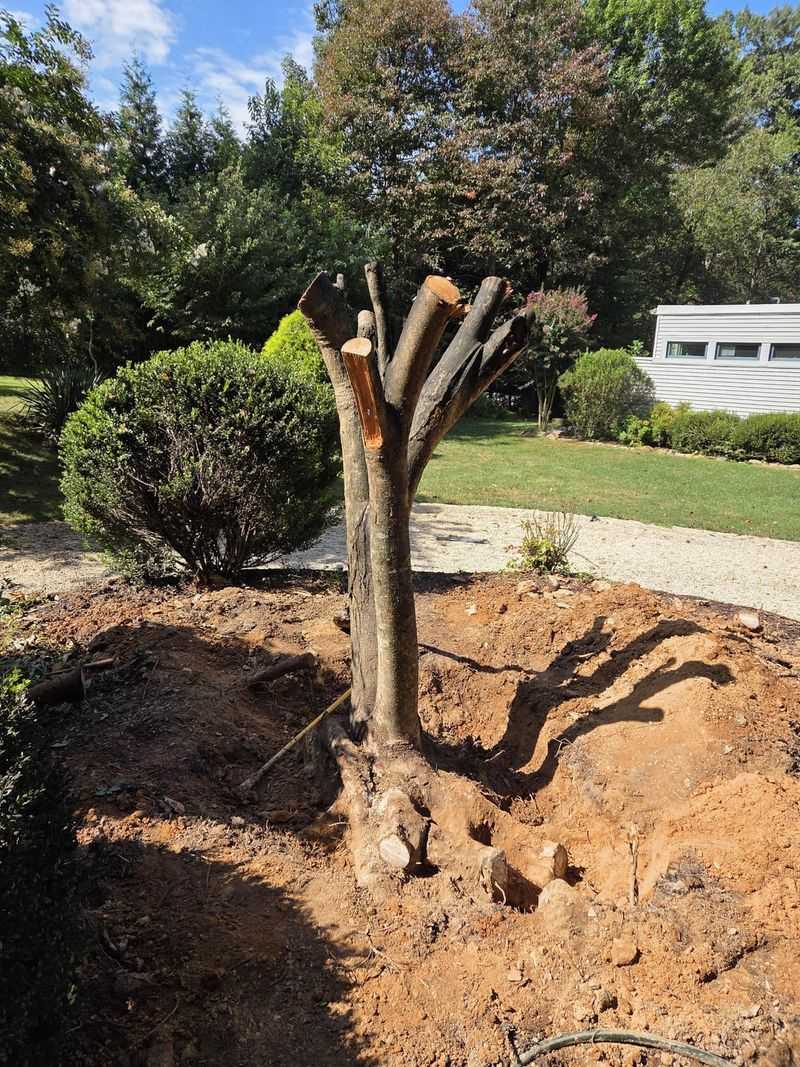
Reaching for a saw when a tree-of-heaven grows too large for hand removal is an understandable instinct, but cutting the main stem without a broader plan often makes the situation harder to manage. Damaging or severing the trunk can stimulate vigorous resprouting from the root system, producing a cluster of new stems where one trunk stood before.
For a species that already spreads through lateral roots, that response can expand the footprint of the problem rather than reduce it.
Arizona guidance identifies foliar, basal-bark, and hack-and-squirt herbicide methods as more effective approaches for larger plants because they target the root system rather than just the above-ground growth. The University of Arizona extension program identifies mid-to-late summer, roughly July through September, as the preferred treatment window in Arizona, when the plant is actively moving resources toward its roots and herbicide uptake tends to be more effective.
That timing aligns with Arizona’s monsoon season, so site conditions and nearby desirable plants matter when planning any application.
Herbicide use requires careful attention to the current product label, which controls application rates, methods, and safety requirements. Generic advice about stump treatment or off-label mixing can injure ornamental plants, fail to stop root suckers, or create regulatory problems.
Trees that are tall, near structures, close to utility lines, or growing beside plants you want to protect are good candidates for professional assessment. Dense sprout colonies connected to an unknown root system also benefit from a qualified review before any treatment begins, because the visible growth may represent only part of what needs to be addressed.
Verify the tree and protect yourself before acting
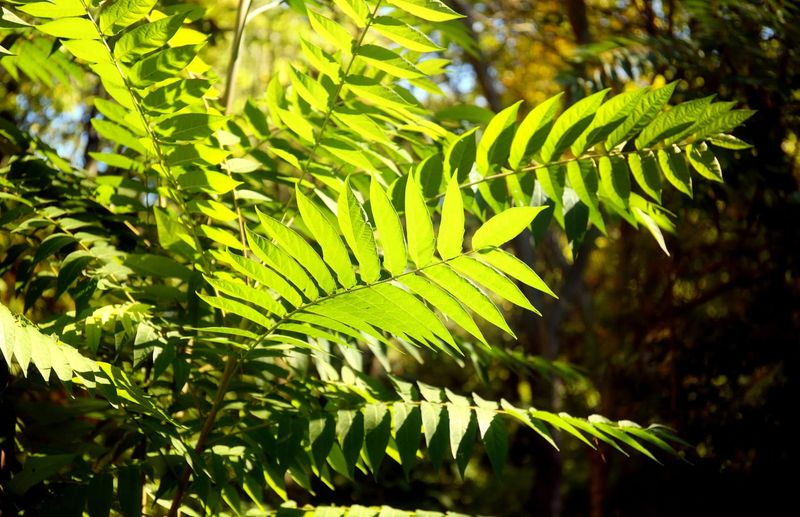
Before removing anything, work through a short checklist. Confirm the identity using several traits together: very large compound leaves, mostly smooth leaflet margins with teeth near the base, an unpleasant odor when foliage is crushed, winged seeds if present, and the bark progression from smooth to rough.
One trait is not enough. NSW WeedWise guidance on tree-of-heaven notes that sap can irritate skin and eyes, and some sources flag possible allergic reactions and toxicity concerns with large quantities ingested, so handle any suspected plant with gloves, eye protection, and long sleeves from the start.
Ordinary yard contact is not highly dangerous, but basic protection is sensible.
Once identity feels reasonably certain, decide whether the plant is a true seedling or a root-connected sucker, and assess its size and location honestly. A small, confirmed seedling in open soil is a hand-removal candidate.
A larger tree, a cluster of recurring sprouts, or a plant near structures or utilities calls for a planned approach or professional help. Do not sacrifice a native sumac, walnut, or ash based on leaf shape alone: a misidentification can cost you a tree worth keeping.
The most useful thing any Arizona homeowner can do is slow down before acting. Getting the identification right protects both your yard and the plants around it.