What It Really Means When Green Anoles Suddenly Fill Your North Carolina Yard By Late Summer
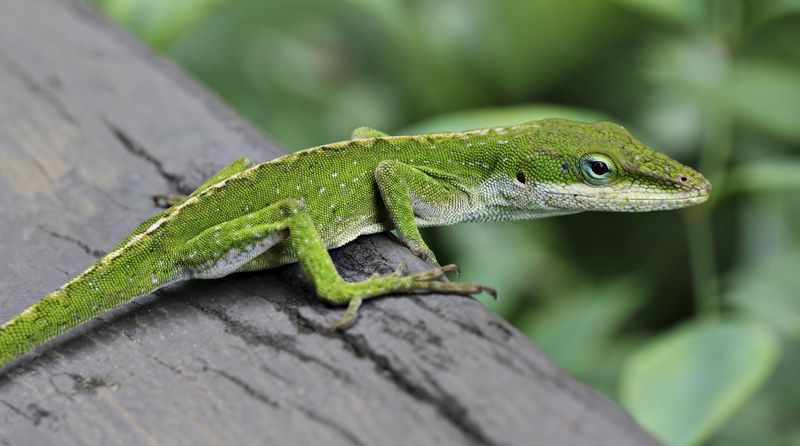
You step onto the back porch on a muggy August evening and count five small lizards without even trying. One clings to the fence post, two more disappear into the azalea, and another peers at you from the porch rail like it owns the place. If you live in North Carolina and this scene sounds familiar, you are not imagining things, and the lizards are not random visitors. Understanding why they show up in numbers by late summer tells you something genuinely useful about your yard.
Several Explanations Can Produce a Late-Summer Surge

August is prime time for noticing green anoles in North Carolina, but there is not one clean reason why. Several things can happen at once, and sorting them out matters before you read too much into the sighting.
Juvenile recruitment is one possibility worth checking. Female green anoles (Anolis carolinensis) may lay a single egg roughly every 7 to 14 days during warm months, and research on green anole reproductive biology shows eggs can hatch after approximately 4 to 6 weeks, though local timing shifts with latitude, elevation, shelter, and weather. Eggs laid in June or July could produce hatchlings right around the time many Piedmont and Coastal Plain homeowners start noticing a crowd of small lizards near the porch or garden edge.
Look closely at size. Juveniles are noticeably smaller than adults, often only an inch or two of body length, and they tend to cluster near low cover and garden edges where small insects are easy to catch. But finding several small anoles does not confirm that juveniles caused the increase, and it does not mean the adult population suddenly multiplied.
Warm-season activity, seasonal visibility, habitat quality, and local movement can all contribute at the same time. Rain might shift where lizards appear without changing how many live on the property. A neighbor’s landscaping project, a change in mowing schedule, or a shift in where afternoon shade falls could push lizards into new visible spots. The honest answer to “why are there so many?” is that several overlapping forces are probably at work, and the lizards themselves are not telling you which one led the charge.
Warm Weather Makes Anoles Easier to See
Green anoles are ectothermic, meaning they rely on heat from their surroundings to warm up and get moving. On a hot August morning in the Sandhills or along the Coastal Plain, a lizard that spent the night tucked inside a shrub needs to bask before it can hunt, defend territory, or do much of anything else.
The North Carolina Wildlife Resources Commission notes that lizards are diurnal and use environmental heat to regulate body temperature, which helps explain why sightings spike on warm, sunny days and drop off during cool spells. Late summer in North Carolina delivers both high temperatures and long stretches of afternoon sun, conditions that push anoles out onto fences, porch rails, and sunny shrub branches where people can actually see them.
Here is where it gets tricky. More sightings do not automatically equal more lizards across the whole property. A temporary concentration near the spots you watch most closely, the garden edge, the sunny side of the fence, the potted plants by the door, can feel like a surge when it is really just a shift in where the lizards you already have are choosing to spend their mornings.
Your North Carolina Garden Changes Every Week. Your Plan Should Too.
Gardening in North Carolina changes quickly throughout the season. Every Friday you’ll receive a simple weekly plan showing exactly what to plant, prune, fertilize, harvest, and protect so you never miss the right timing.
Possible, unverified influences like a change in irrigation timing, a section of lawn recently mowed short, or a stretch of dry weather can also push lizards toward shadier, damper corners without changing the total population at all. The practical takeaway: before concluding that more anoles appeared, notice whether you are also spending more time outside in late summer, and whether the spots where you see them are simply the warmest, most visible edges of your yard.
Insects Support Anoles but Do Not Prove a Pest Boom

Green anoles eat small insects, spiders, and other arthropods. The National Park Service lists crickets, moths, and flies among their prey, and the University of Georgia Savannah River Ecology Laboratory adds spiders and other invertebrates to that list. So yes, a yard with foraging anoles is a yard with something worth eating.
The connection between prey and anole health has some research support. A study examining green anoles across plots with different land-use histories in Texas found associations between arthropod availability and lizard body condition. That is useful ecological context, but the study looked at six plots within one state park in Texas, not at North Carolina yards. It supports a plausible food-web connection without proving that a Piedmont homeowner with more anoles has more insects than their neighbor down the street.
The pest-control question comes up often, and the honest answer is that anoles are not a reliable fix for any named pest. They will eat whatever small arthropod crosses their path, including gnats, small beetles, and soft-bodied insects, but no available evidence establishes dependable control of mosquitoes, ticks, Japanese beetles, or stink bugs in a typical North Carolina yard. Treating a lizard sighting as proof of an insect boom, or counting on lizards to handle a pest problem, sets up an expectation the evidence cannot support.
What the food-web research does suggest is that a yard offering some accessible arthropod life is more usable to anoles than one stripped of it. That is a reasonable inference, but it is a far more modest claim than “your garden is thriving.” The lizards found something to eat, and that is about as far as the evidence takes you.
Shrubs and Sheltered Edges Create Usable Habitat

Structure matters more than most people realize. Shrubs, vines, leafy garden edges, and low groundcover give anoles places to hunt, hide, bask, and lay eggs, and a yard without those layers is simply harder for them to use.
A habitat study conducted in eastern Texas open pine forest found that the population estimate in a higher-shrub-density plot was 16 times greater than in a lower-density plot, and that the shrubs anoles actually used were 4 to 6 times larger in volume than the average shrub in the plots. That is a striking result. It should not be turned into a formula for how many shrubs a homeowner in Raleigh, Wilmington, or Asheville needs to plant, because the study reflects eastern Texas pine habitat, not a North Carolina backyard. But it does support the general principle that substantial, layered woody cover makes a real difference.
NC State Extension’s guidance on landscaping for wildlife with native plants recommends retaining less-manicured areas with native grasses, forbs, brambles, and shrubs rather than converting every corner to close-mowed lawn. That advice lines up well with what the anole research suggests: layers beat uniformity.
Moisture deserves a modest mention. Green anole eggs are buried in damp, concealed substrate, and reproductive research on the species confirms that suitable egg-laying sites require sheltered, moist conditions. Leaf litter at the base of shrubs and small pieces of decaying wood along garden edges can fill that role naturally. What that does not mean is that you should add a pond, install a mister, or keep ground permanently soggy to attract lizards.
Standing water invites mosquitoes and is not necessary. Water your plants according to their needs during dry stretches, and let leaf litter do the quiet work it was already doing.
Identify the Lizard Before Interpreting the Yard

Before drawing any conclusions about what a yard full of lizards means, make sure you are looking at green anoles. The identification step is easy to skip and easy to get wrong.
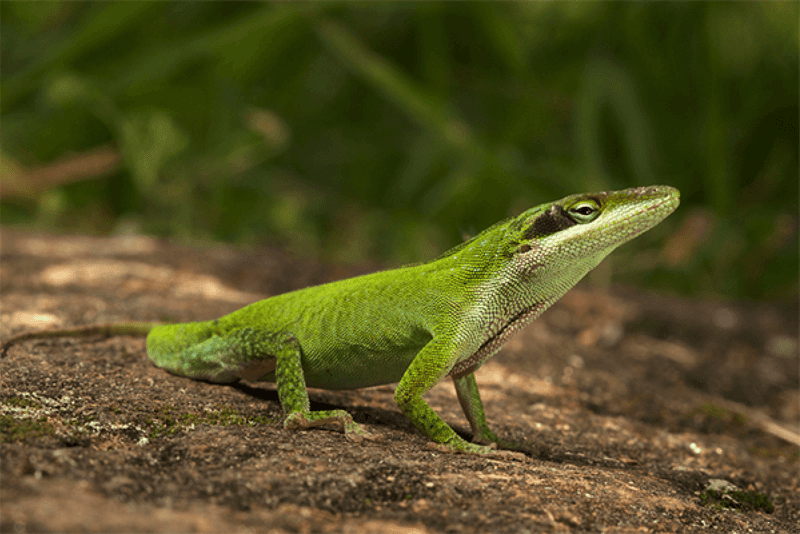
The North Carolina Wildlife Resources Commission notes that green anoles are native lizards typically 5 to 8 inches long including the tail, and that they can appear green, brown, or gray depending on temperature, stress, and activity. Color alone cannot identify the species and does not indicate health. A brown-looking lizard on your fence might be a perfectly healthy green anole that has not warmed up yet.
The National Park Service describes brown anoles (Anolis sagrei) as a separate introduced species found in parts of the southeastern United States, with a tendency toward stronger body patterning and a preference for staying closer to the ground. Green anoles are generally more comfortable higher in vegetation. But those clues are imperfect, and the NPS acknowledges as much.
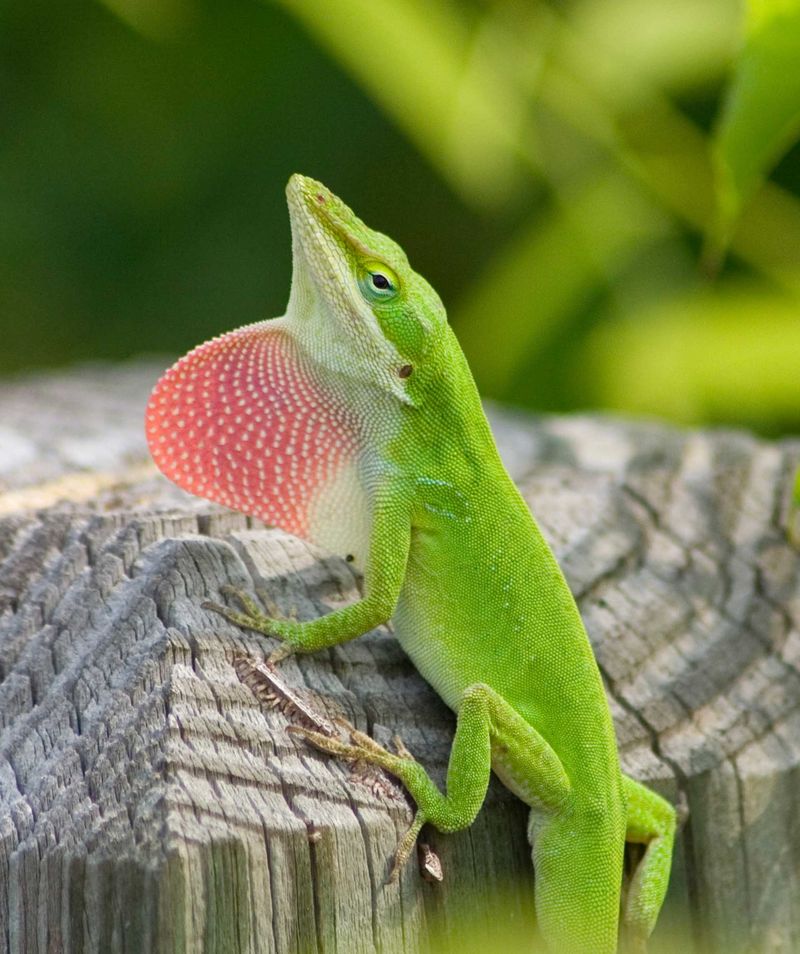
A more reliable approach uses several traits together: body shape (green anoles are slender and long-tailed), dewlap color (native green anoles display a pink to reddish-pink throat fan when defending territory or courting), perch height, and how much time the lizard spends at ground level versus up in shrubs or on fences. No single clue clinches it. If you are seeing small, slender lizards actively climbing into shrubs and displaying a pink dewlap, green anole is a reasonable call. If they are stockier, patterned, and staying low near the ground along a coastal yard, check a reliable local field guide before assuming.
Getting the identification right matters because a yard full of introduced brown anoles tells a different ecological story than a yard full of native green anoles.
Protect Anoles with Targeted Pest Management

Knowing green anoles are in your yard changes how you should think about pest management. Not because lizards are magic pest controllers, but because the same spray that kills a caterpillar on your tomatoes can reach a lizard foraging nearby in ways that are genuinely harmful.
A USGS study found dose-related mortality and measurable cholinesterase effects in green anoles exposed to four organophosphorus pesticides. A broader review of pesticide toxicity in lizards reinforces that effects vary by chemical and species, so a product labeled safe for pets, birds, or mammals is not automatically safe for reptiles. Do not assume the label covers everything in your yard.
NC State Extension’s integrated pest management guidance lays out a clear sequence: identify the pest and the host plant first, then correct any cultural problems like poor drainage or crowding, then try mechanical or biological controls before reaching for a chemical treatment. Use a labeled chemical only when a pest is correctly identified and other options have not been enough, and apply the narrowest effective treatment rather than a broad-spectrum calendar spray.
One specific warning: do not leave pesticide-treated insects where lizards forage, thinking the lizards will clean them up safely. The available evidence does not support treating anoles as a disposal route for poisoned prey. A lizard that eats a recently treated insect is exposed to whatever chemical was used.
The habitat side of protection is simpler. Keep some shrubs, vines, and leafy planting edges intact. NC State’s native landscaping guidance recommends retaining less-manicured native edges rather than mowing everything to a uniform surface. Avoid unnecessary disturbance of leaf litter and sheltered substrate along garden borders.
Those small, easy choices preserve the structure anoles actually use without requiring any special installation.
Treat the Sighting as a Clue, Not a Scorecard
A yard suddenly full of green anoles in August is worth paying attention to, but it does not hand you a grade. The honest read is more interesting than a simple pass or fail.
Start by noticing a few things. Are the lizards mostly small and concentrated near low cover, or are adults spread across a wider range of the yard? Are they appearing near preserved shrub edges and leafy planting areas, or near spots that were recently treated or disturbed? Are they high in the vegetation or staying close to the ground?
Those observations will not give you a definitive answer, but they can help you distinguish juvenile recruitment from adult activity, and concentrated visibility from a true population increase.
The North Carolina Wildlife Resources Commission reminds us that these are native lizards shaped by the same warm, humid summers that define life from the Piedmont to the coast. Their presence reflects a combination of seasonal timing, local movement, available food, and structural cover, not a single variable you can tune like a thermostat.
What the sighting may genuinely signal, backed by reproductive and habitat research on the species, is that your yard is meeting some of their needs right now. That is worth something. The modest actions that follow from it are also the right ones regardless of the lizard count: retain useful planting layers, match watering to what your plants actually need, preserve native edges where you can, and manage confirmed pests carefully rather than preemptively. NC State Extension’s native landscaping guidance makes the same case from a different angle, pointing out that a yard with structural variety and native plants quietly does more work than a uniform one.
The anoles already figured that out. They are just waiting to see if you will leave the good parts alone.