Why Gila Woodpeckers Become Backyard Regulars In Arizona During May
Arizona in May has a sound that many people cannot quite place at first. A sharp, rolling churr cuts through the morning air. It is loud, confident, and close.
You scan the saguaro. The fence post. The roofline. And there it is. Bold, striped, and completely unbothered by your presence. Gila woodpeckers do not ease into a yard. They arrive like they already own the place.
What is interesting is that by May, nesting and cactus bloom activity can make Gila woodpeckers much more noticeable. A yard that went weeks without a single woodpecker sighting suddenly has a regular.
Same bird, same perches, same route through the yard each morning. The pattern becomes impossible to ignore. It is not random. It is not luck.
There are very specific reasons these birds anchor themselves to certain yards during this particular month, and many people never connect the dots.
Some of it comes down to what is blooming across the desert right now. Some of it comes down to what is nesting nearby.
And a surprising amount of it comes down to what your yard is quietly offering without you ever setting it up intentionally. The full picture is more fascinating than most people expect.
May Nesting Duties Pull Gila Woodpeckers Into Yards
By May, Gila woodpeckers are not out for a casual stroll. They are on a mission. Breeding season in the Sonoran Desert gets rolling early, and by the time May arrives, these birds are deep into the serious business of raising a family.
Both the male and female take active roles in nesting, which means two birds are now moving through the territory instead of one. That doubled presence makes them noticeably more visible in yards near desert habitat.
Cornell Lab of Ornithology notes that Gila woodpeckers ramp up nesting activity as spring temperatures climb. Parents fly short, purposeful routes between food sources and the nest site, and a well-placed yard can become a regular stop on that circuit.
A yard with fruiting plants, insects in bark, or accessible water is essentially putting out a welcome sign. The birds are not wandering randomly. They are working a territory with purpose, keeping pace with the demands of a growing family.
Watch for repeated flight paths between the same trees or structures. That pattern is not a coincidence.
Once a pair locks onto a nearby saguaro or tree cavity as a nest site, expect regular appearances. Nesting season gives these birds a focused, almost restless energy that makes them easier to observe than at any other time of year.
Even first-time backyard birdwatchers tend to notice them. That kind of presence is hard to miss.
Territory Patrols Turn Trees And Fences Into Busy Routes
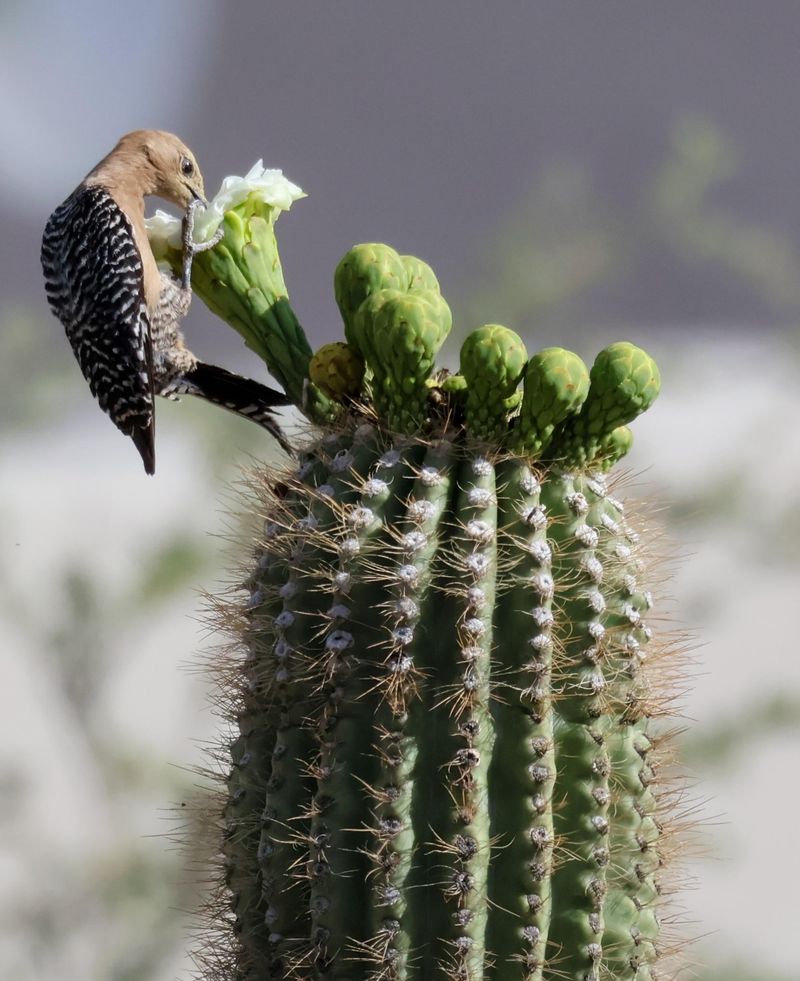
That woodpecker on your fence post is not lost. It is on patrol. During breeding season, Gila woodpeckers establish nesting territories and patrol the edges with impressive consistency. These birds actively defend areas around their nest cavities.
Fences, rooflines, utility poles, and tree lines all become regular checkpoints on a daily circuit. A homeowner might notice the same bird landing on the same post at roughly the same time each morning. That is not a coincidence. It is a schedule.
Your Arizona Garden Changes Every Week. Your Plan Should Too.
Gardening in Arizona changes quickly throughout the season. Every Friday you’ll receive a simple weekly plan showing exactly what to plant, prune, fertilize, harvest, and protect so you never miss the right timing.
The bird is checking its turf, announcing its presence, and watching for rivals who might get any ideas. Backyard structures near saguaros or mature trees can fall right inside an established territory without the homeowner realizing it.
For anyone interested in birdwatching, territorial behavior is genuinely useful. It makes Gila woodpeckers predictable. Once you spot the pattern, you can plan around it.
Look for repeated visits to the same elevated perches, especially in the early morning. The birds may also drum on hard surfaces like metal gutters or wooden posts as part of their territorial signaling. That drumming carries surprisingly far through a quiet neighborhood.
A yard that sits near open desert or a wash lined with saguaros may fall right inside or next to an active territory during May. No special setup required. The woodpecker has already decided your yard is part of its world. Your job is just to notice.
Hungry Chicks Send Parents Searching For Insects
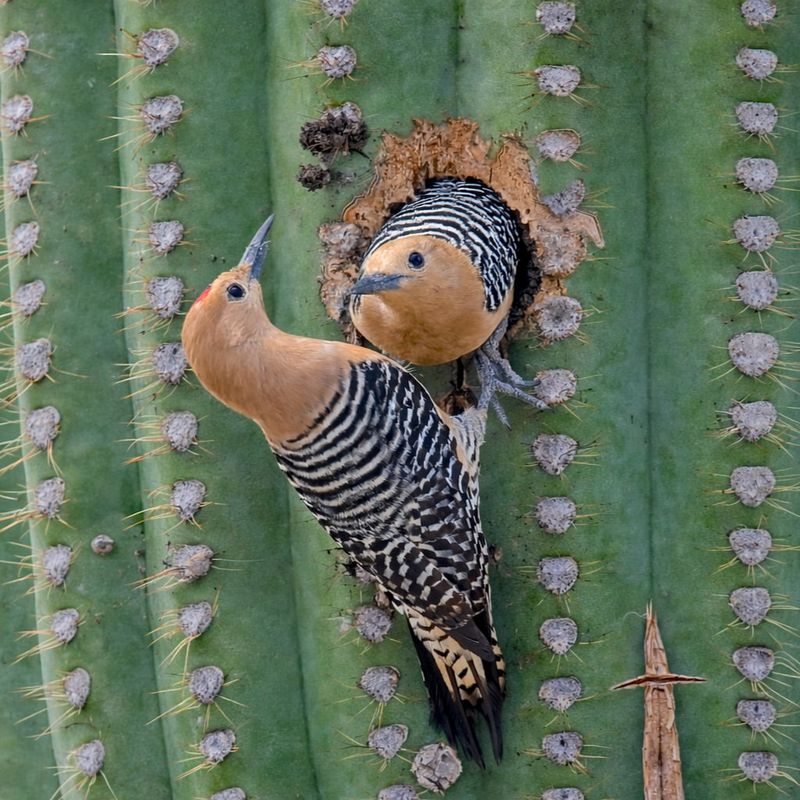
Breakfast does not make itself when there are nestlings waiting. Once Gila woodpecker chicks hatch, the parents shift into near-constant foraging mode. The demand for protein-rich food rises sharply when hungry mouths are waiting back at the nest cavity.
Insects become the priority, and the search for them does not stop until the day does. Insects, larvae, and other invertebrates are key food sources for Gila woodpeckers.
They forage on tree trunks, thick branches, cacti, and shrubs, probing and tapping for beetles, ants, and anything else hiding under bark or wedged into crevices.
A yard with native trees like mesquite or palo verde, or even older ornamental trees with rough bark, can become a productive foraging stop on a parent’s daily route.
The foraging style of Gila woodpeckers is active and highly visible. They work surfaces out in the open, not hidden in dense foliage.
Watching one work its way up a tree trunk is one of the more satisfying sights in desert birdwatching.
May is a particularly good month to catch this behavior. The food demand is high, and the parents cannot afford to be selective about where they search. Modesty goes out the window when chicks are calling.
Yards with a mix of trees, shrubs, and natural features like fallen branches or rough-barked trunks tend to attract more foraging visits.
Cutting back on pesticide use also helps keep the insect supply intact for foraging birds. Feed the bugs. The woodpeckers will handle the rest.
Cactus Blooms Bring Nectar And Bug Snacks
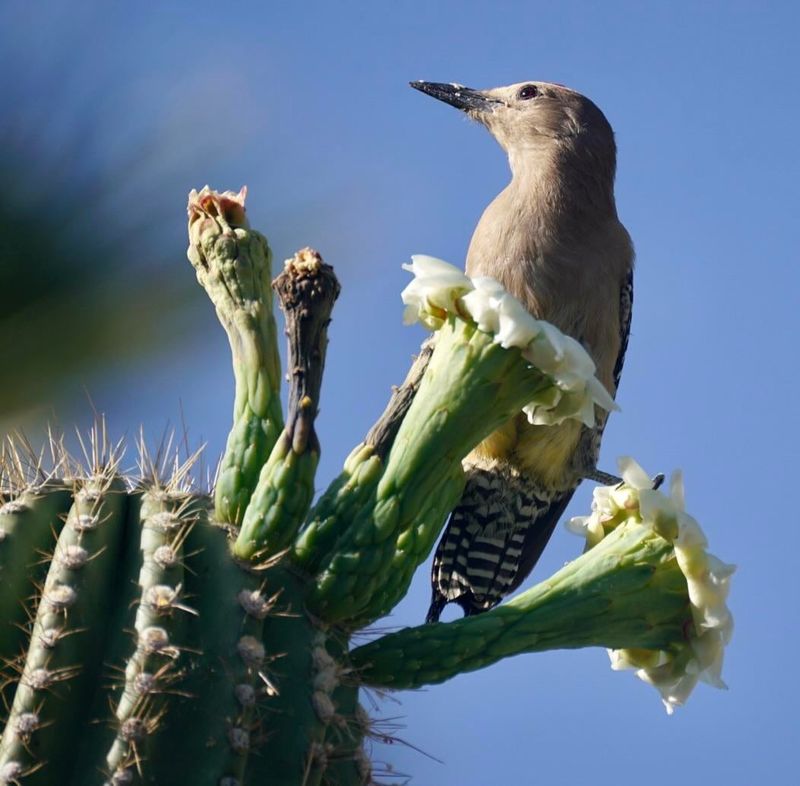
May turns the Sonoran Desert into a buffet, and Gila woodpeckers have definitely made a reservation. Saguaros burst into bloom across Arizona this month, producing large white flowers loaded with nectar. For Gila woodpeckers, a blooming saguaro is not just beautiful scenery.
It is a two-for-one food stop. Their diet includes nectar, cactus fruit, berries, and insects, so cactus season lands right in their nutritional sweet spot.
The blooms pull in pollinators like bees and beetles, which in turn pull in insect-eating birds. A woodpecker visiting a flowering saguaro might be sipping nectar one moment and snatching a passing beetle the next. Efficient does not begin to cover it.
Prickly pear and cholla also bloom during Arizona’s spring season, adding more food sources beyond the saguaro. A yard with native desert plants, or one that sits close to natural desert, can suddenly feel alive with bird activity during this window.
You do not need a saguaro on your property to benefit from this seasonal surge. Proximity to blooming desert plants is often enough to draw foraging woodpeckers regularly.
The bloom window is relatively short, which is part of what makes it so concentrated and exciting to watch. Everything happens at once.
Birds move fast, flowers open fast, and the whole desert feels like it shifts into a higher gear for a few weeks. May is that gear. Do not miss it.
Saguaro Cavities Keep Woodpecker Families Nearby
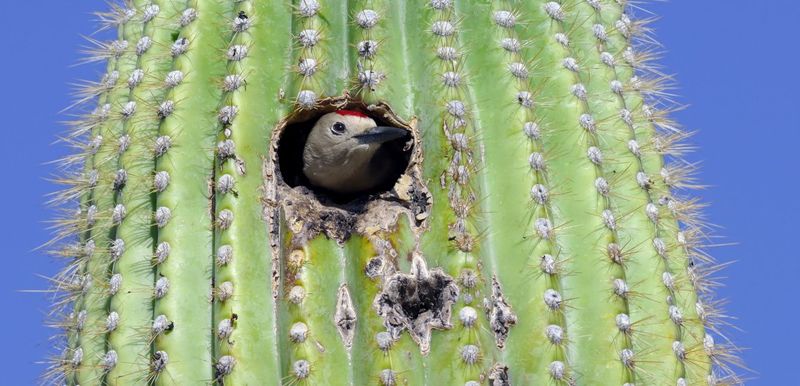
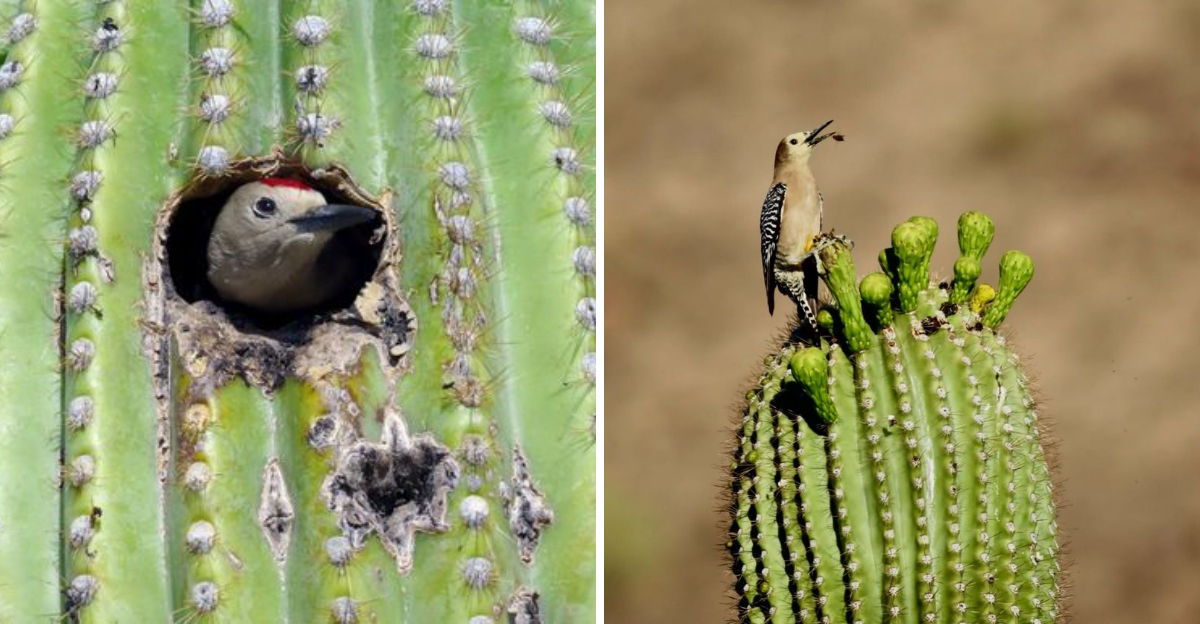
That hole in the saguaro is not damage. It might be a front door. A mature saguaro with a round, smooth-edged opening near its upper arms could be hosting an active Gila woodpecker nest.
These birds excavate cavities in the thick, moisture-rich tissue of the cactus. However, this process takes time. After excavation, the saguaro responds by forming a hardened lining around the wound, creating a durable hollow chamber that serves as the nest.
It is one of the more remarkable examples of a bird and a plant working together without either one realizing it.
Once established, a cavity can be used across multiple seasons and eventually by multiple species. Elf owls, for example, are known to move into old Gila woodpecker cavities later on.
Having an active nest nearby anchors a woodpecker pair to a small area for weeks. Homeowners with a mature saguaro on or near their property may notice the birds flying in and out repeatedly throughout the day.
That behavior is easy to observe once you know what to look for. Even a saguaro next door or across the wash can make your yard part of the daily foraging range for a nesting pair. The nest is the anchor. Everything within reach of it becomes part of the territory.
Protecting mature saguaros on and around your property is one of the most meaningful things an Arizona homeowner can do for desert wildlife.
Prominent Perches Make Calling Birds Easier To Spot
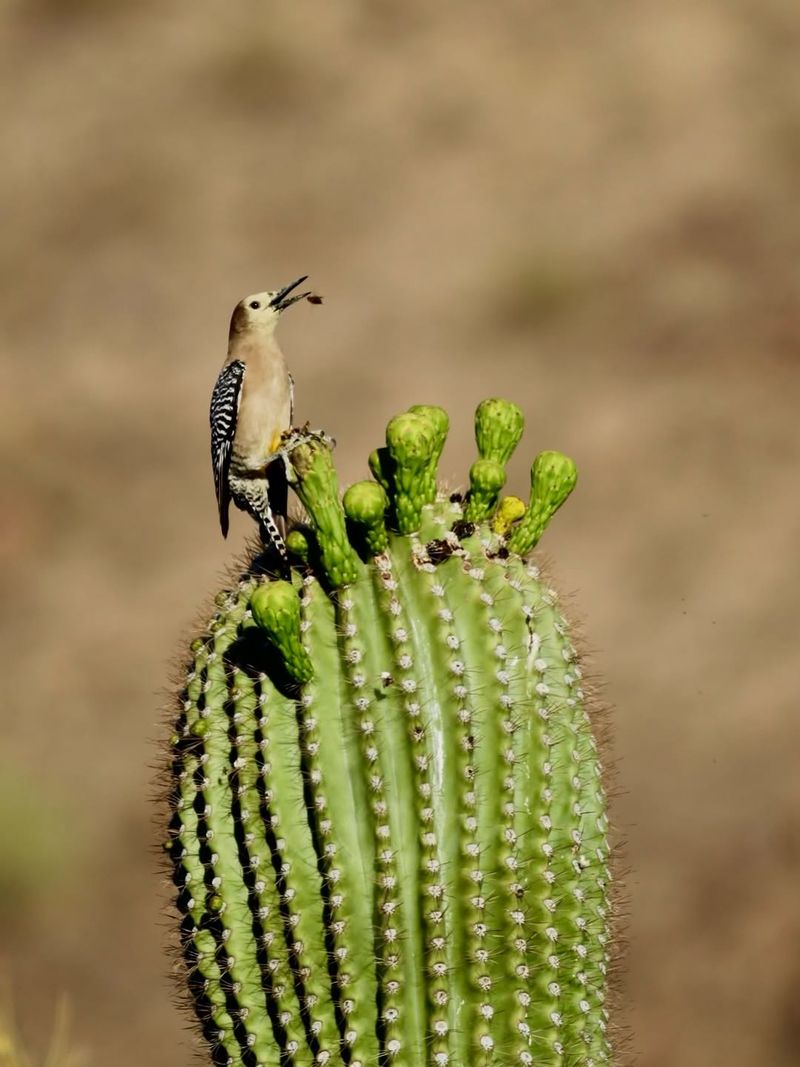
You will probably hear a Gila woodpecker before you see one. That is very much by design. Cornell Lab of Ornithology describes them as conspicuous and noisy birds that favor prominent perches, and that description earns its adjectives.
The call is a loud, rolling churr that cuts through neighborhood noise with ease. Once you know the sound, you will start noticing these birds in places you walked past without a second glance.
In a typical Arizona yard, prominent perches include the tops of saguaro arms, fence posts, utility poles, roof ridges, and the upper branches of tall desert trees.
Gila woodpeckers are not interested in staying hidden. They want to be seen and heard, and they are quite good at both.
May keeps them especially vocal. Territorial defense and nesting activity push the birds to call and drum throughout the day.
Morning hours tend to be the most active, but sightings can happen at various points as the day moves along.
Drumming is part of the communication toolkit too. A woodpecker hammering on a metal gutter or wooden post is not causing problems out of spite.
It is sending a message to any rival within earshot. That sound carries further than most people expect.
Yards with tall trees, saguaros, or rooflines give Gila woodpeckers easy lookout spots. Wait near one with binoculars, and you may get a clear view of one of the desert’s most entertaining birds.
Hummingbird Feeders Tempt Gila Woodpeckers With Sugar Water
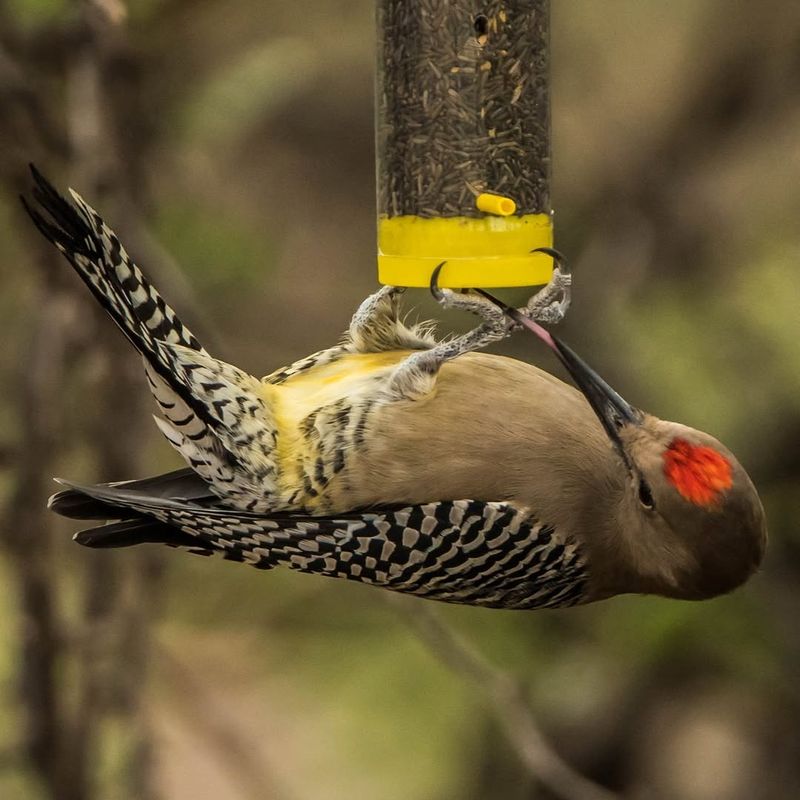
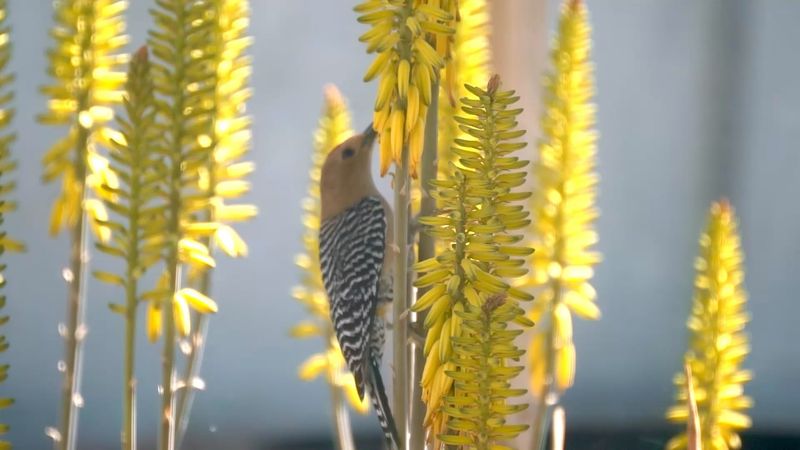
You set up the feeder for hummingbirds. The Gila woodpecker did not read that part. Gila woodpeckers are known to visit hummingbird feeders for sugar water, and they approach the task with the same confident resourcefulness they bring to everything else.
A feeder that was draining faster than expected may have a larger, stripier explanation than you realized.
Gila woodpeckers are not built for the delicate hover-and-sip technique that hummingbirds use. They grip, hang, and reach in ways that can look improvised.
It works anyway. These birds are persistent, and a reliable food source does not go unnoticed for long.
Keeping feeders clean matters for every bird that visits. Fermentation happens quickly in Arizona heat, and mold is a real concern once temperatures climb. Shade during the hottest part of the day also extends the life of each fresh batch.
Placement matters too. A feeder positioned away from windows reduces the risk of collision, and a spot with some nearby perching options gives visiting birds a place to land before and after feeding.
A Gila woodpecker at close range is a genuinely impressive sight. Larger than expected, louder than expected, and completely at ease in your yard. The hummingbirds will share. They just will not be happy about it.