Orange Wings Are Gathering By The Hundreds In Minnesota Trees Before Disappearing South

Wings fill your maple tree without asking permission first. You feel the shift before you understand why. Minnesota sits inside a flight path built for you. Orange wings cluster together across your yard by dusk.
Nobody warns you when these visitors pick your maple. Morning arrives, and your branches sit strangely empty. Countless travelers lift off toward ground far from you. Few locals realize what just left your backyard.
Your porch light witnessed a migration you barely noticed. Something ancient pulls these wings past you, toward Mexico. That instinct guided monarchs long before your porch existed.
Distance means little once the warm wind carries you. Fuel comes from Minnesota fields before your neighbors even notice. This state feeds a journey you rarely get to witness.
What happens next depends on timing, wind, and your luck. Watch your own maple this September, because you will not want to miss what happens.
Orange Wings That Turn Backyard Trees Into Overnight Hotels

Picture a tree that suddenly looks like it grew a second set of leaves, except the leaves are orange and they twitch. That is a monarch roost, and Minnesota gets them by the hundreds each fall.
Monarchs are the large orange-and-black butterflies with thick dark veins and white speckles along the wing edges. Females have wider veins, while males carry two small black dots on their hind wings.
In September, monarchs stop traveling alone. They pile into willows, maples, cottonwoods, and pines, often near lakeshores or river valleys where the wind eases up.
A roost usually forms in late afternoon. Butterflies drift in a few at a time, hang from twigs with wings closed, and cover each other like shingles on a roof.
Closed wings look pale and dull, which is exactly the point. From a distance the cluster blends into dried foliage, so a passing hawk sees nothing worth a second look.
Warmth matters more than comfort. Butterflies cannot fly when their flight muscles drop below roughly 55 degrees, so they wait for morning sun before lifting off.
Then the whole group leaves within an hour or two, sometimes spiraling upward before catching a southerly push. The tree empties out and looks completely unremarkable by lunchtime.
If you want to catch one, walk the same shelterbelt or park grove around 6 p.m. during the first three weeks of September. Bring binoculars and look up into the shaded side of the canopy, because roosts hide better than you would expect.
A 2,000-Mile Trip Made By An Insect Lighter Than A Paperclip

Here is the part that makes scientists shake their heads: a monarch weighs about half a gram, roughly the heft of a paperclip. That featherweight body flies from Minnesota to central Mexico.
The trip covers somewhere between 1,800 and 2,500 miles depending on where the butterfly starts. Minnesota monarchs generally head south-southwest through Iowa, Kansas, and Texas before crossing into Mexico.
They aim for the oyamel fir forests in the mountains west of Mexico City. Those groves sit around 10,000 feet, where cool, humid air keeps the butterflies calm through winter.
Your Minnesota Garden Changes Every Week. Your Plan Should Too.
Gardening in Minnesota changes quickly throughout the season. Every Friday you’ll receive a simple weekly plan showing exactly what to plant, prune, fertilize, harvest, and protect so you never miss the right timing.
Monarchs do not flap the whole way. They glide, catch thermals, and let warm rising air carry them upward, then coast forward and repeat the trick for hours.
Some radar studies suggest monarchs can cruise at several hundred to over a thousand feet, and sometimes higher.
Fuel comes from flower nectar, which they convert into body fat. Some monarchs that leave Minnesota lean can arrive in Mexico heavier than when they departed, a pattern uncommon among migratory animals.
The generation making the trip has never seen the destination. Their great-grandparents left Mexico the previous spring, so the route is inherited rather than learned.
Researchers believe monarchs use a sun compass in their brains, corrected by an internal clock in their antennae. Cut the antennae signals and the sense of direction gets scrambled, which is how the clock was discovered.
The Super Generation That Lives Eight Times Longer Than Its Parents

Most monarchs get about two to six weeks of adult life. The ones leaving Minnesota in September get eight or nine months, and biologists call them the super generation.
The difference comes down to timing and hormones. Shorter days and cooler nights in late August tell developing caterpillars to skip reproduction entirely.
Instead of mating, these butterflies enter a paused state called diapause. Their reproductive organs stay undeveloped, and the energy that would have gone into eggs goes into fat storage and flight muscle.
That switch is what makes the journey possible. A butterfly busy laying eggs cannot also fly 2,000 miles and then wait out a winter.
Minnesota typically produces three to four monarch generations per summer. Generations one and two live fast, breed, and hand off the baton within weeks.
The final batch, usually emerging from chrysalises between mid-August and mid-September, becomes the travelers. Look closely and their wings often appear brighter and less tattered than midsummer monarchs.
Come February and March, hormones finally kick in down in Mexico. The same individuals mate, fly north into Texas, lay eggs on fresh milkweed, and their story ends there.
Their children and grandchildren continue the push northward, arriving back in Minnesota around late May or June. So the butterfly you see in your garden in July is likely a great-grandchild of the one that roosted in your maple last fall.
Knowing that changes how a September sighting feels. You are watching the start of a relay, not a single flight.
The Only Plant Their Caterpillars Will Touch

Fussy eaters get a bad reputation, but monarch caterpillars have turned pickiness into a survival strategy. Milkweed leaves are the one and only item on their menu.
Minnesota happens to be generous with the stuff. Common milkweed, swamp milkweed, butterfly weed, whorled milkweed, and showy milkweed all grow across the state.
Milkweed sap contains bitter compounds called cardenolides that upset the stomachs of birds and small mammals. Caterpillars store those compounds in their bodies without harm.
The result is a butterfly that tastes terrible. Bright orange wings act as a warning label, and predators that sample one monarch tend to avoid the pattern afterward.
Female monarchs test plants by drumming their front legs on leaves, sensing chemicals through tiny receptors. Satisfied, she lays a single cream-colored egg the size of a pinhead, usually on the leaf underside.
A caterpillar hatches in three to five days and eats almost nonstop for about two weeks. It grows roughly 2,000 times its starting weight, molting several times along the way.
Then comes the jade-green chrysalis with its ring of gold dots, hanging for eight to fourteen days before an adult emerges.
Planting milkweed is one of the most useful things a Minnesota gardener can do here. Choose native species, buy from nurseries that skip systemic pesticides, and put in a clump of at least six plants.
Swamp milkweed behaves politely in flower beds with its pink blooms. Common milkweed spreads by roots, so give it a back corner where wandering is welcome.
Where To Stand In Minnesota When The Skies Start Moving
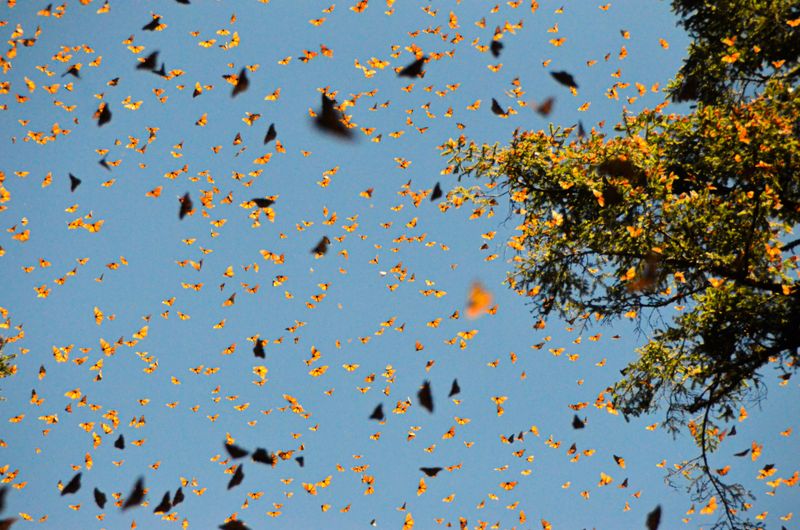
Timing beats luck when it comes to spotting a migration wave. Minnesota’s window runs from roughly mid-August through the first week of October, peaking in early to mid-September.
Geography does a lot of the work. Monarchs funnel along shorelines and river corridors because they prefer not to cross large stretches of open water.
The North Shore of Lake Superior concentrates butterflies as they drift down the coast. Bluffs near Duluth, including the Hawk Ridge area, can produce high counts on breezy days.
The Mississippi and Minnesota River valleys act as highways too. Prairie remnants in the southwest and restored grasslands near the Twin Cities often hold clouds of feeding monarchs.
Watch the weather map rather than the calendar. A cold front with north or northwest winds behind it tends to push large numbers south within a day or two.
Mornings between 9 and 11 a.m. are excellent for watching roosts break up. Late afternoon, from about 4 to 7 p.m., is when new roosts assemble.
Bring binoculars, a folding chair, and patience. Scan low over goldenrod fields and then look higher, because plenty of monarchs pass overhead unnoticed.
Nature centers across the state host tagging events in September, and joining one is the easiest way to see a monarch up close. Volunteers place a tiny sticker on the hind wing, record the code, and release the butterfly.
Occasionally a Minnesota-tagged monarch turns up in Mexico months later. Those recoveries built the map we use today.
Small Backyard Moves That Help The Travelers Refuel

Monarch numbers have fluctuated significantly over recent decades, with overwintering areas in Mexico declining since the 1990s. Habitat loss along the route is a big piece of the puzzle.
A key part is that yards add up. A quarter-acre lot with the right flowers becomes a genuine fuel stop for butterflies heading south.
Late-blooming nectar plants matter most in Minnesota. Stiff goldenrod, New England aster, blazing star, joe-pye weed, and sedum keep serving nectar into late September.
Plant in clusters rather than singles, since a mass of color is easier for a passing butterfly to spot. Aim for at least three plants of each species grouped together.
Skip broad-spectrum insecticides in the growing season, and check nursery tags for neonicotinoid treatments. Even small residues can affect caterpillars feeding on treated leaves.
Hold off on cutting back your perennials until spring. Standing stems shelter overwintering insects, and the seed heads feed finches through January.
A shallow dish of wet sand gives butterflies a place to sip minerals, a behavior called puddling. Refresh it every couple of days.
Leave a sunny, sheltered corner unmowed if your city ordinance allows. Monarchs rest there on cool mornings while their wings warm up.
Reporting sightings to Journey North or Monarch Watch turns your backyard into a data point. Thousands of Minnesotans doing that has given researchers a detailed picture of when and where the migration moves.