What Sawfly Larvae Damage Looks Like On Michigan Pine Trees Before Needles Drop
Something looks wrong with the pine in your yard, and it took a while to notice. The tips are green. Bright, healthy, standing up the way they should.
Behind them the branch runs thin and see-through, with bare twigs where needles used to be. That backward pattern is unusual, and it points at one specific culprit.
Most needle problems work the other direction. Drought and disease affect older growth broadly, or new growth suffers first.
This one strips last year’s needles while leaving the current growth untouched.
Michigan yards and Christmas tree fields see it every spring, generally in May. By the time the thinning shows from the street, the feeding has mostly finished.
Catching it early changes the outcome considerably.
Curious what’s been eating your pine?
1. Older Needles Get Stripped First
Walk up to a Scotch pine in May and something looks off. Branch tips appear green and healthy while everything behind them runs thin.
That backward pattern is among the strongest clues that sawfly larvae have been feeding.
European pine sawfly is the species most Michigan homeowners encounter. It hatches early in spring before new candles have stretched out.
Larvae settle onto last year’s needles and chew them down to short brown stubs. Timing explains why new growth escapes.
Younger larvae only scrape the outside of a needle. That leaves dry curled straw-colored strands hanging on the twig for weeks.
Larger larvae finish the job, eating needles down to the base. Two different appearances from the same insect at different stages.
The result resembles a bottle brush with bristles missing in the middle. Red pine, jack pine, Austrian pine, mugo pine, and Scotch pine all show it.
Checking older needles first saves time when diagnosing a pine problem. Drought, needle cast fungi, and normal shedding all affect older needles too.
Those problems don’t leave chewed stubs or straw-like remnants though. That distinction settles most questions quickly.
Look at branch undersides while you’re there, since colonies often start where nobody checks.
Damage stopping exactly where this year’s growth begins puts sawflies at the top of the list.
2. Larvae Feed In Visible Groups
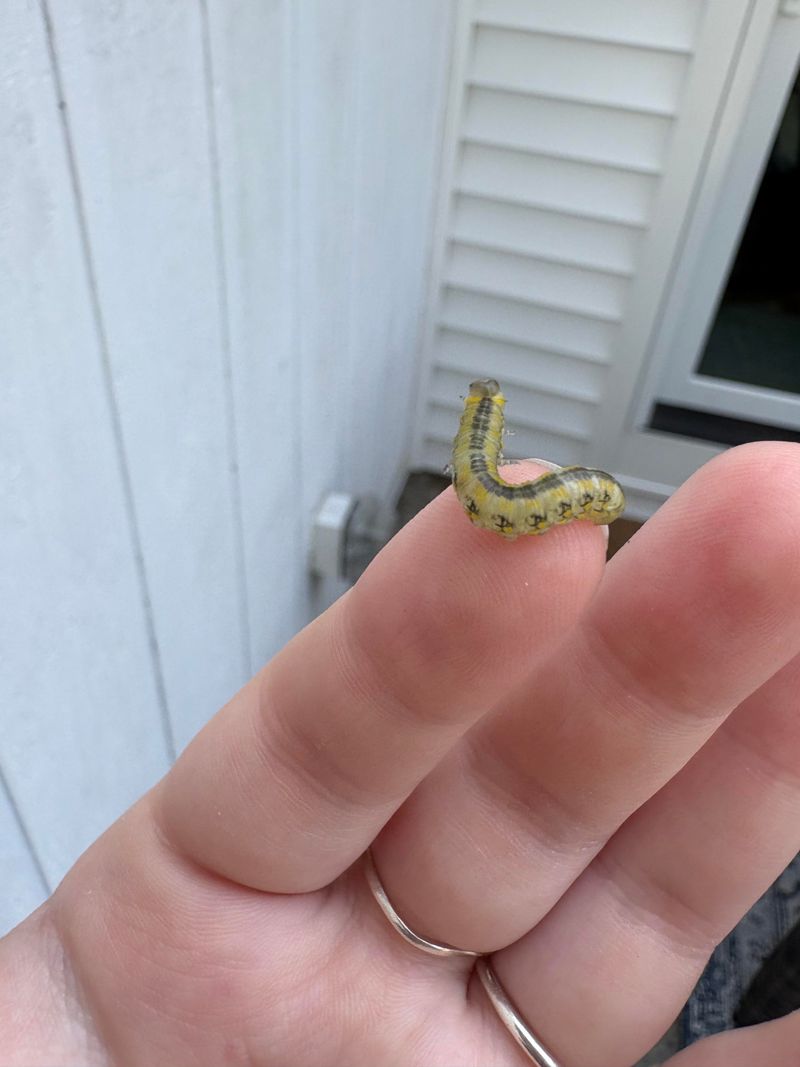
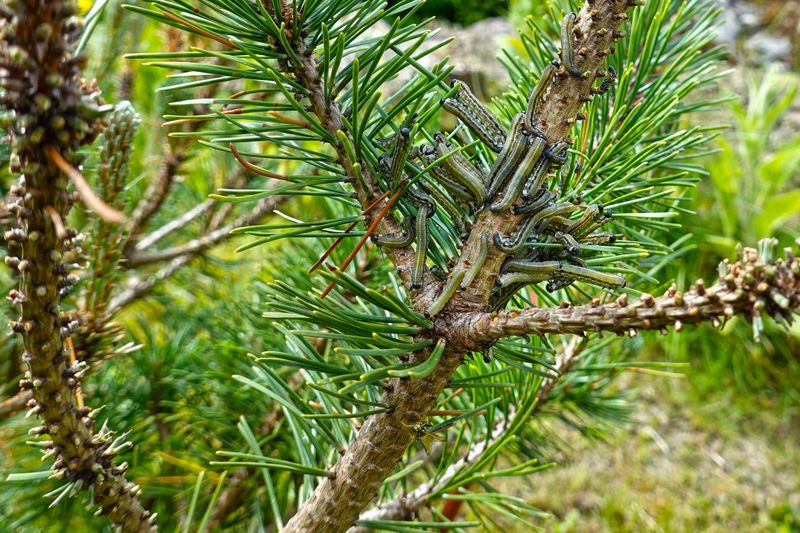
Here’s the behavior that gives these insects away completely: poke a branch and a whole row of larvae rears back in unison.
They curl into small S shapes simultaneously, which is genuinely strange to watch.
Sawfly larvae are gregarious, meaning they hatch and feed together in colonies holding dozens of individuals on one twig.
Most other needle pests scatter across a tree. That clumping habit makes identification considerably easier.
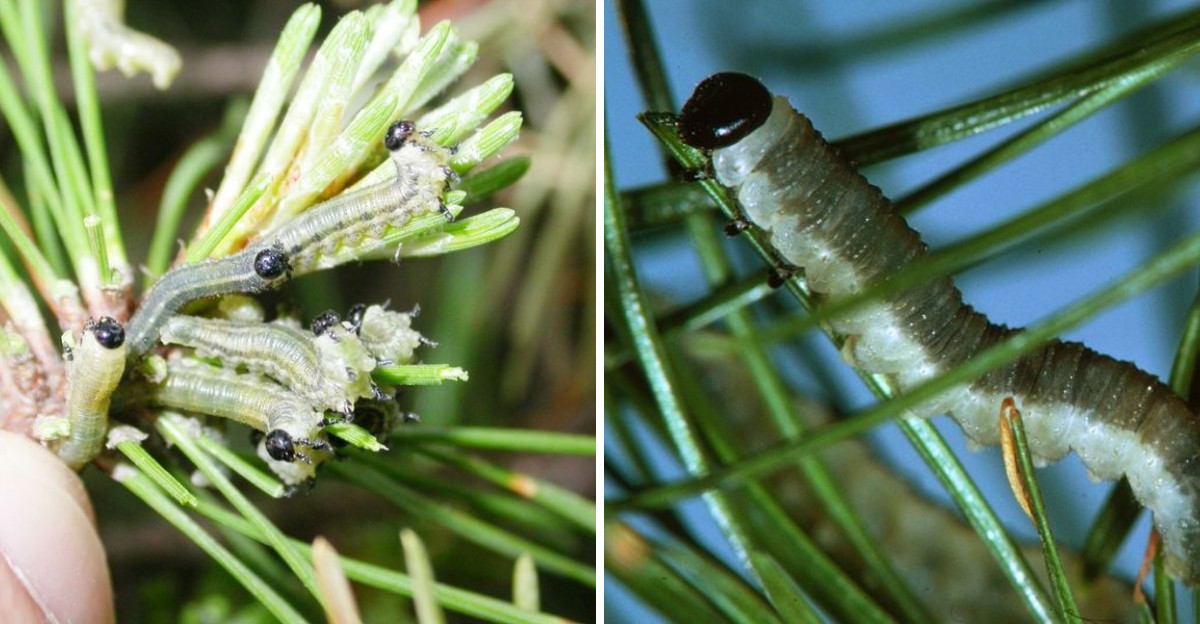
European pine sawfly larvae appear grayish green with darker stripes and shiny black heads. Distinctive once you’ve seen them.
Redheaded pine sawfly larvae show up later in summer, yellowish white with rows of black spots and a rusty red head.
Counting legs settles any remaining doubt. Sawfly larvae have more than five pairs of fleshy prolegs behind their true legs.
Caterpillars have five pairs or fewer. That difference reflects real biology, since sawflies are wasp relatives rather than moths.
Your Michigan Garden Changes Every Week. Your Plan Should Too.
Gardening in Michigan changes quickly throughout the season. Every Friday you’ll receive a simple weekly plan showing exactly what to plant, prune, fertilize, harvest, and protect so you never miss the right timing.
Sprays formulated only for caterpillars won’t affect them at all. Worth knowing before buying anything.
Because colonies stay packed together, small infestations on a yard tree respond to hand removal.
Clip the infested twig or knock larvae into soapy water and the problem ends that afternoon.
Check shaded inner branches during a walk around the tree, and revisit the same spots every few days.
3. Damage Spreads From The Inside Out
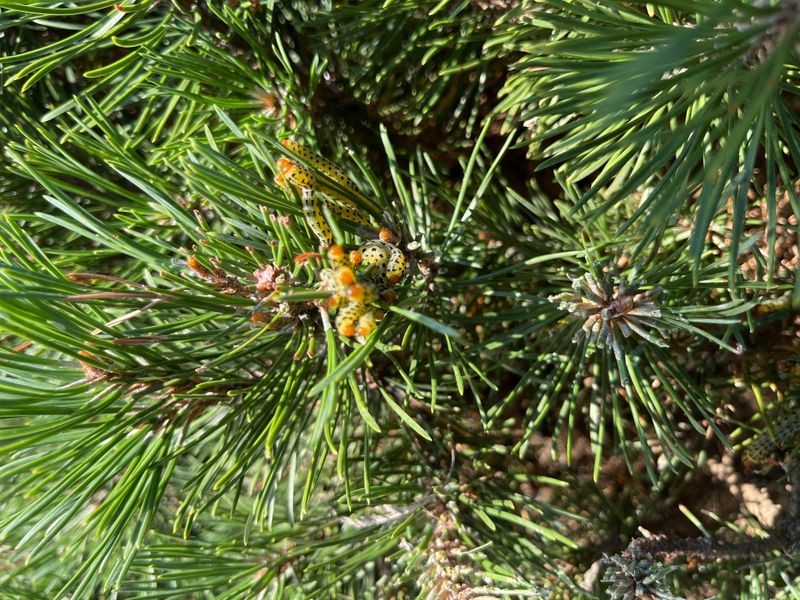
Picture a pine losing needles the way a sweater unravels from an inner seam. Feeding typically starts on lower interior branches.
It then works upward and outward as the colony grows and requires more food.
Egg-laying females often choose sheltered locations, so the first chewed needles hide where nobody looks.
Homeowners frequently discover damage only after the outer canopy starts thinning. By then the colony has been working for weeks.
A single colony strips one branch bare before moving to the next. That produces a patchy uneven appearance rather than uniform browning.
Uneven damage is a useful signal on its own. Diseases and root problems generally progress more evenly across a tree.
On larger landscape pines, look up into the crown from directly underneath. Bare inner twigs framed by green tips is the classic outline.
Small trees and open-grown Christmas tree plantings show progression fastest. A colony can reach a large share of the foliage within a couple weeks.
Bigger older pines usually lose only part of the canopy in one season.
Mark damaged branches with flagging tape. Next spring you can start scouting at those exact spots.
Sawflies frequently return to trees they’ve used before. Tracking that pattern tells you whether the population is building or declining.
4. New Growth Is Often Left Untouched
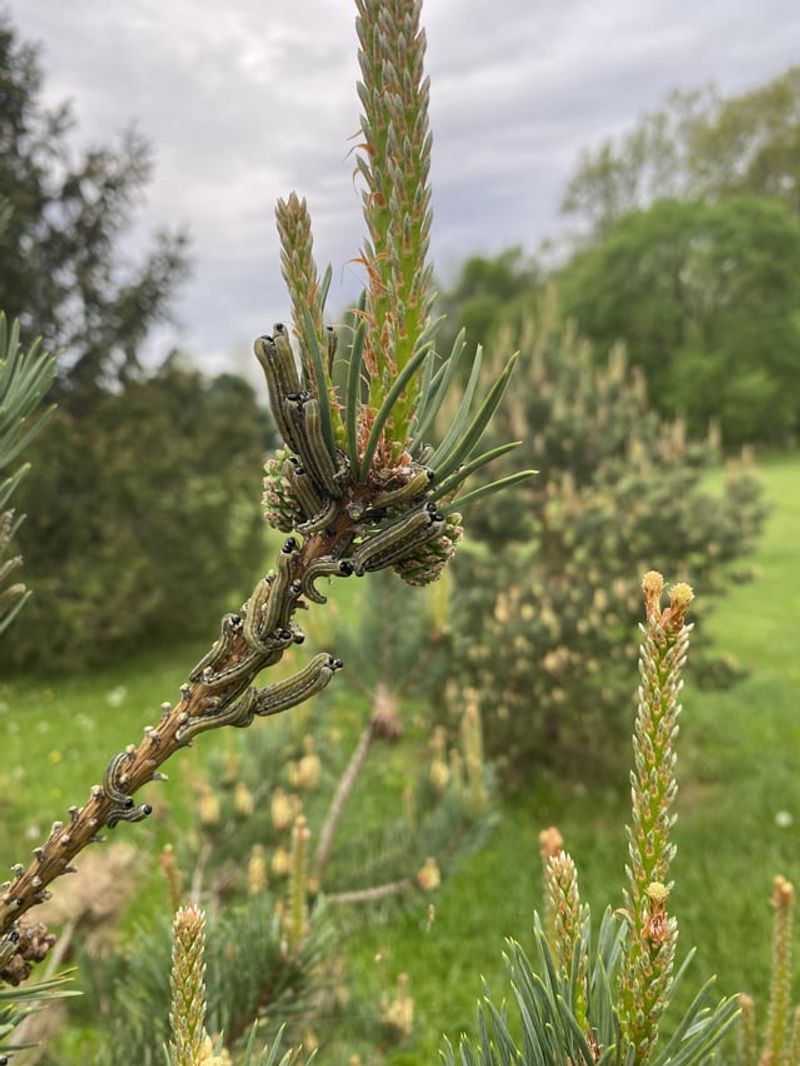
Oddly enough, a badly chewed pine in June can still look bright green from the street. Timing explains that entirely.
European pine sawfly larvae finish most feeding before new candles harden into full needles.
Current-year growth escapes as a result. That spared growth is a key reason trees usually survive an attack.
Green tips keep producing food while buds set for next year remain intact. The tree retains its capacity to recover.
Not every species follows those rules though. Redheaded pine sawfly appears in mid to late summer.
That one eats both old and new needles, and it can destroy small trees outright. Species identification matters for exactly that reason.
Noting which needles are missing therefore does double work. It confirms sawflies and narrows the species.
Compare a damaged branch against an undamaged one from the same tree. Held side by side, the untouched tuft at the tip becomes obvious.
That tuft-on-a-bare-stick look gets called a lion’s tail appearance. Arborists picture it immediately when someone describes sawfly feeding.
Stripped older needles won’t regrow on those bare sections. Pines don’t produce needles from old wood.
The tree fills in over following seasons by pushing new shoots. A young Scotch pine may look ragged for two or three years.
5. Heavy Feeding Weakens The Whole Tree
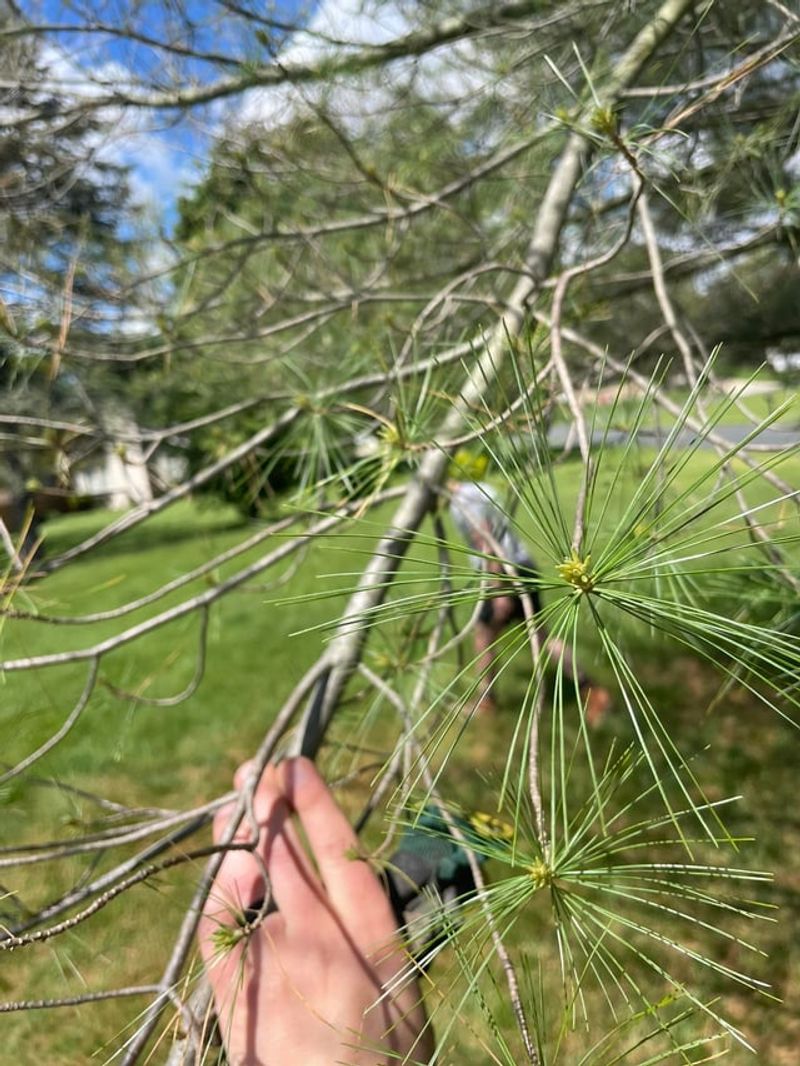
One bad spring rarely finishes a healthy pine. Three consecutive bad springs is a different situation entirely.
That repetition is where sawflies earn their reputation.
Needles function as the tree’s food factories, so every one removed reduces energy production.
Repeated defoliation shrinks annual shoot growth, thins the crown, and depletes reserves needed for difficult weather.
Weakened pines become easier targets for secondary problems. Bark beetles, root rots, and drought stress all hit trees running low on stored sugars.
Young trees carry the most risk. A six-foot Scotch pine holds far less foliage in reserve than a thirty-foot red pine.
Losing most older needles two years running can end a small tree. Scale matters considerably here.
Christmas tree growers watch this for a different reason. Even light feeding ruins the shape and salability of a tree representing eight years of work.
Keeping a damaged pine watered through dry Michigan summers helps more than most people expect.
An inch of water weekly during drought supports recovery. Simple and effective.
Skip heavy nitrogen fertilizer right after defoliation. Pushing growth on a tree with reduced foliage works against it.
Mulch, steady moisture, and avoiding string trimmer injuries all accomplish more.
Records help too. Note the year and how much canopy was affected, which reveals multi-year trends.
6. Early Detection Limits Long Term Damage
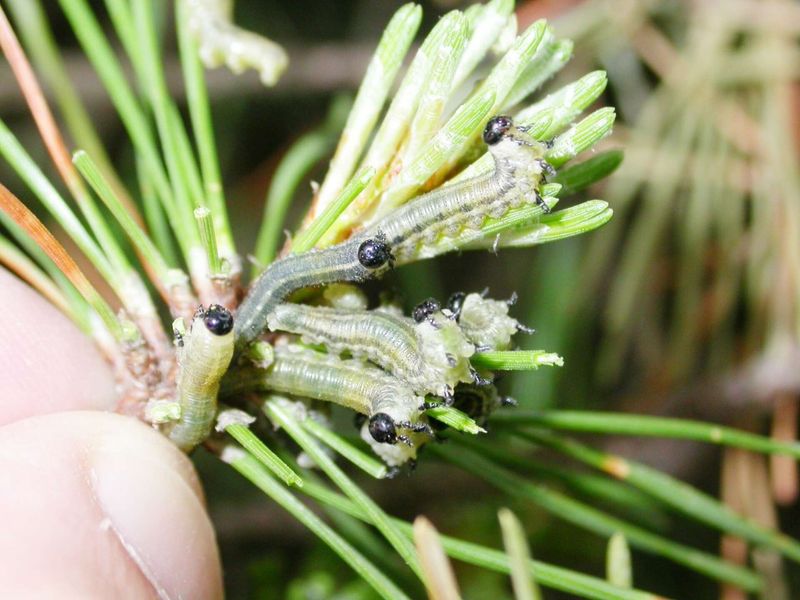
Finding a colony when larvae are the size of a pencil lead changes everything.
Tiny larvae eat tiny amounts. A colony discovered in the first week comes off with two fingers and a bucket.
Most of a sawfly’s lifetime feeding happens in its final stages before dropping to pupate.
Wait until larvae reach an inch long and the majority of damage has already occurred. Timing is the whole game.
Scouting works best from late April through May for European pine sawfly in Michigan.
A second round in July catches other species. Different schedules for different insects.
Egg hatch ties to growing degree days rather than calendar dates. Enviroweather data for your county beats guessing.
Before hatch you can find the eggs themselves. Females cut small slits in last year’s needles and tuck eggs inside.
Those leave rows of yellowish or brown scars resembling stitching. Visible if you look closely.
Pruning off egg-marked needles in late winter is about as simple as pest control gets. Costs nothing but time.
Set a phone reminder for the first warm week of spring and walk your pines with a flashlight.
Birds, small mammals, and parasitic wasps all reduce sawfly numbers. A light infestation may fade without intervention.
Watching for a week before acting is often smarter than reaching for a sprayer immediately.
7. Timing Treatment Matters More Than Product
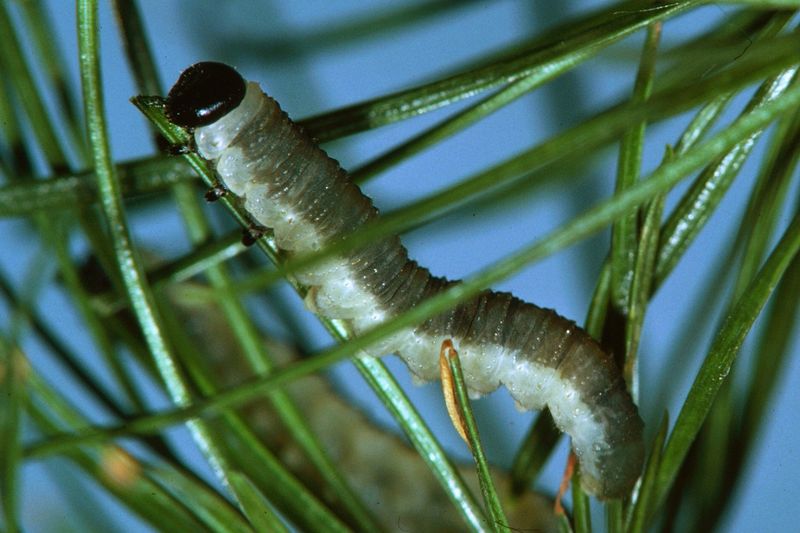
Ask ten people how to handle sawflies and you’ll get ten product recommendations. Ask an entomologist and the first question back concerns the size of the larvae.
Small freshly hatched larvae are soft and vulnerable. Even a hard spray of water or soap-based products knocks them down.
Once they reach full size those approaches work poorly. The needles are gone by then anyway. One category deserves specific warning. Bacterial sprays sold for caterpillars have no effect on sawflies.
Sawflies are wasp relatives rather than moth or butterfly larvae. Different biology, different products. Coverage matters more than product strength. Larvae hide on undersides of inner branches.
Anything applied has to actually reach them, which is genuinely difficult on a tall pine without professional equipment.
For a yard tree with two or three colonies, physical removal beats any spray. Clip the twig, drop it in soapy water, finished.
Larger infestations, tall trees, and repeat years all warrant a call to a certified arborist or your county Extension office.
They can confirm the species and match response to larval stage.
Read and follow label directions on anything applied. Avoid treating when pollinators are active on nearby plants.
Good timing protects both the tree and the beneficial insects that suppress sawflies the rest of the year.
8. Distinguish It From Other Pine Problems
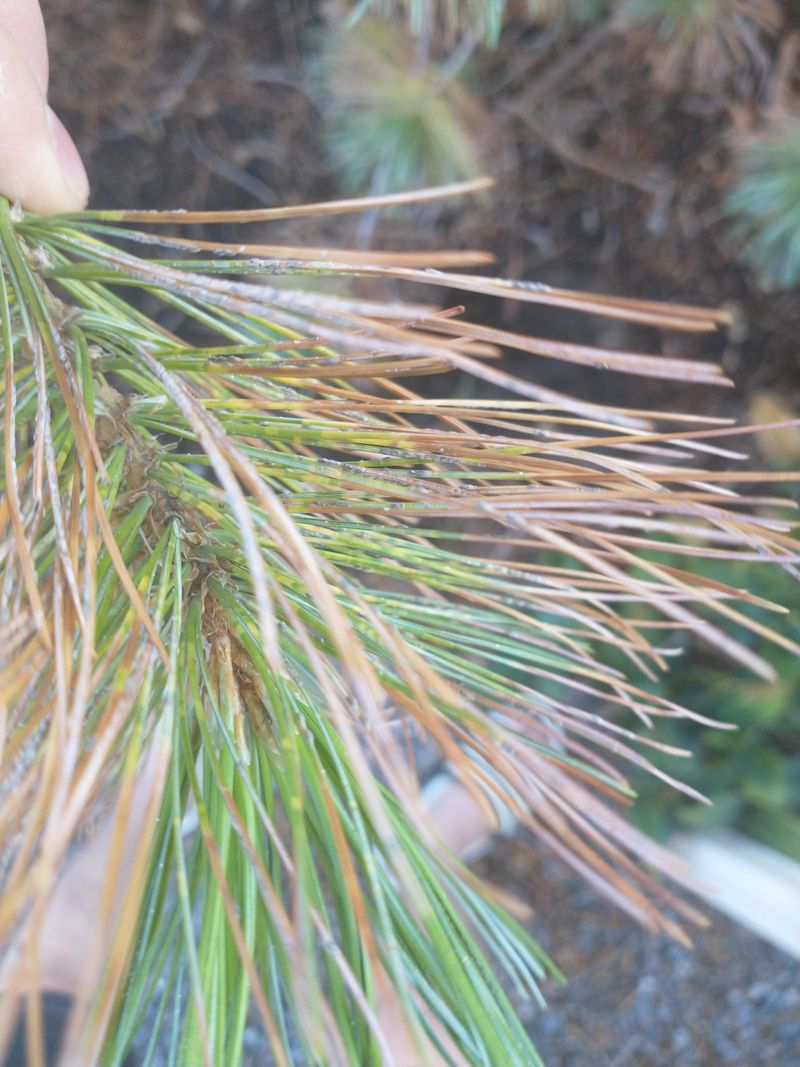
Several Michigan pine problems produce thinning that gets confused with sawfly damage.
Knowing the differences prevents treating the wrong thing.
Needle cast diseases cause older needles to yellow, develop spots, then drop. No chewing marks and no stubs remain.
Diplodia tip blight destroys new shoots rather than sparing them. Candles turn brown and curl, which is essentially the opposite pattern.
Pine needle scale appears as small white flecks on needles. Feeding causes yellowing without removing tissue.
Zimmerman pine moth tunnels into branches and trunks, producing pitch masses and dropped limbs. Damage is structural rather than foliar.
Pine sawyer beetles attack stressed and declining trees, leaving sawdust and boring holes in wood.
Winter injury and salt damage both cause browning on the windward or road-facing side. Position on the tree gives that away.
Normal needle shedding happens in fall as pines drop their oldest needles. Yellowing progresses evenly rather than in patches.
Deer and rabbit browsing leaves ragged cut ends on shoots at accessible heights.
The chewed stub is the sawfly signature. Straw-colored remnants and bare inner twigs with green tips confirm it.
When identification stalls, your Extension office accepts samples and photographs. That beats guessing at a treatment.