The Underrated Texas Houseplant That Keeps Gnats And Flies Off Your Porch
A July evening on a Houston porch, and the pothos looks like it is smoking. Lean closer, and the haze turns into fungus gnats, dozens of them, lifting off damp potting soil every time someone brushes past.
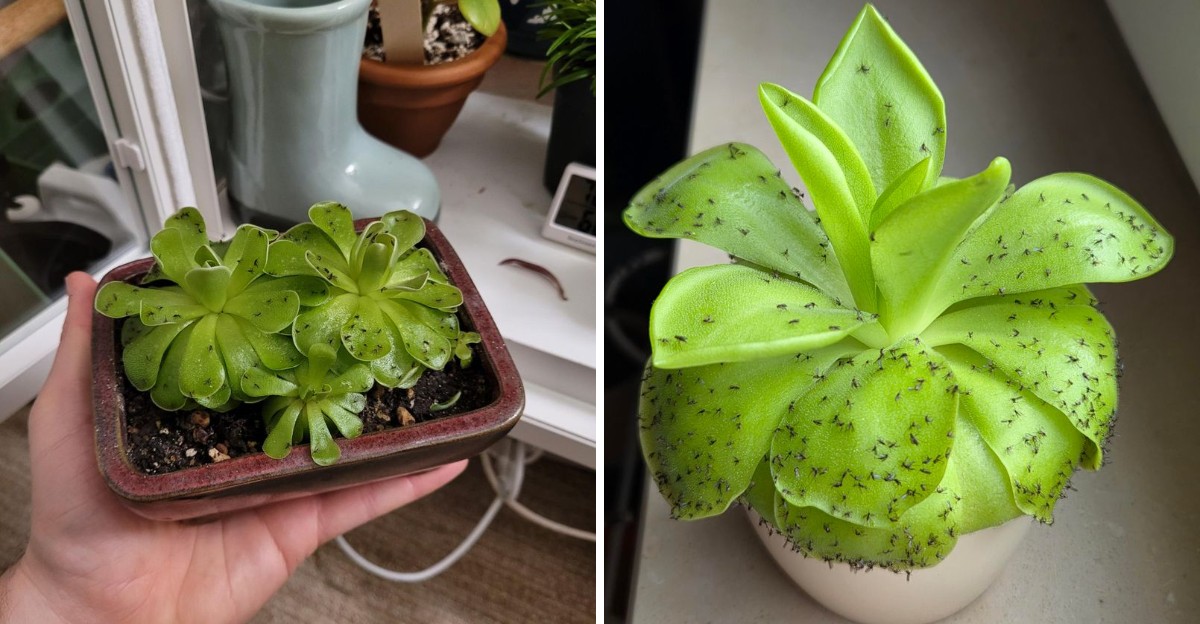
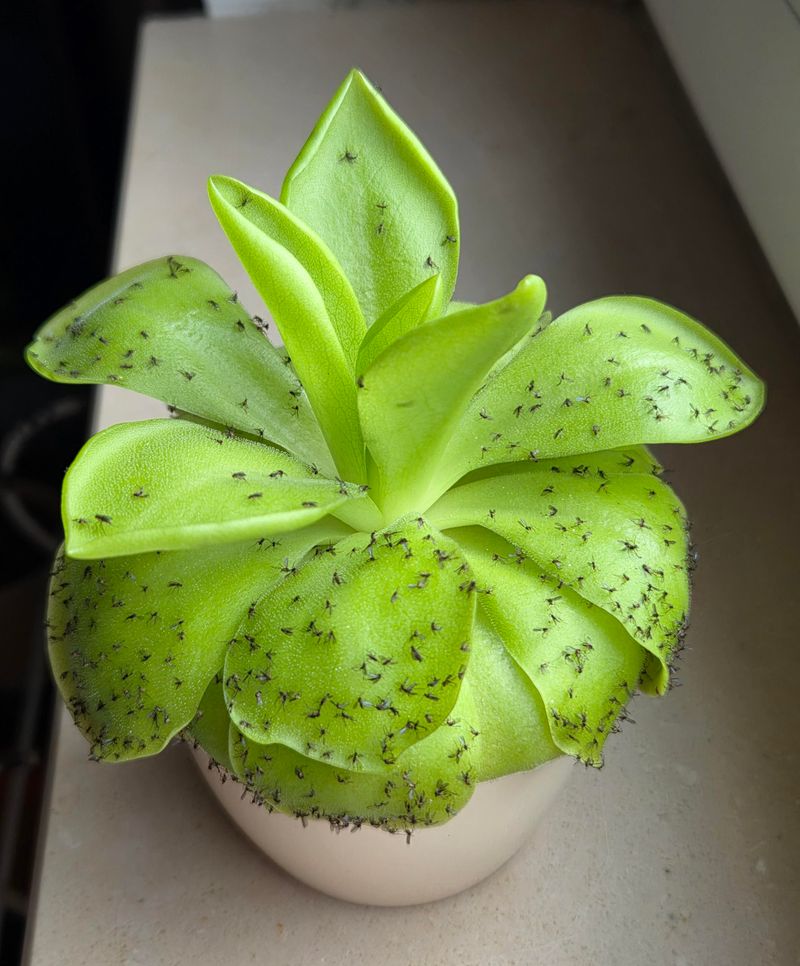
Two feet away sits a squat little rosette with leaves that shine like buttered toast, and its surface is freckled with dark specks.
Every speck used to be a gnat. That plant is butterwort, and it belongs to a small club of houseplants that handle pests through real biology instead of rumor.
Most gardeners reach for scented herbs first, assuming fragrance alone will chase insects away, and that assumption falls apart the moment a breeze moves through.
Butterwort skips the theatrics entirely. Sticky glands on its leaves trap tiny flying insects, then digest them for nutrients its roots cannot easily find.
What follows covers how the plant works, what it actually catches, which varieties perform best, and how to keep one thriving through a Texas year.
Meet Butterwort, The Sticky Gnat Trap
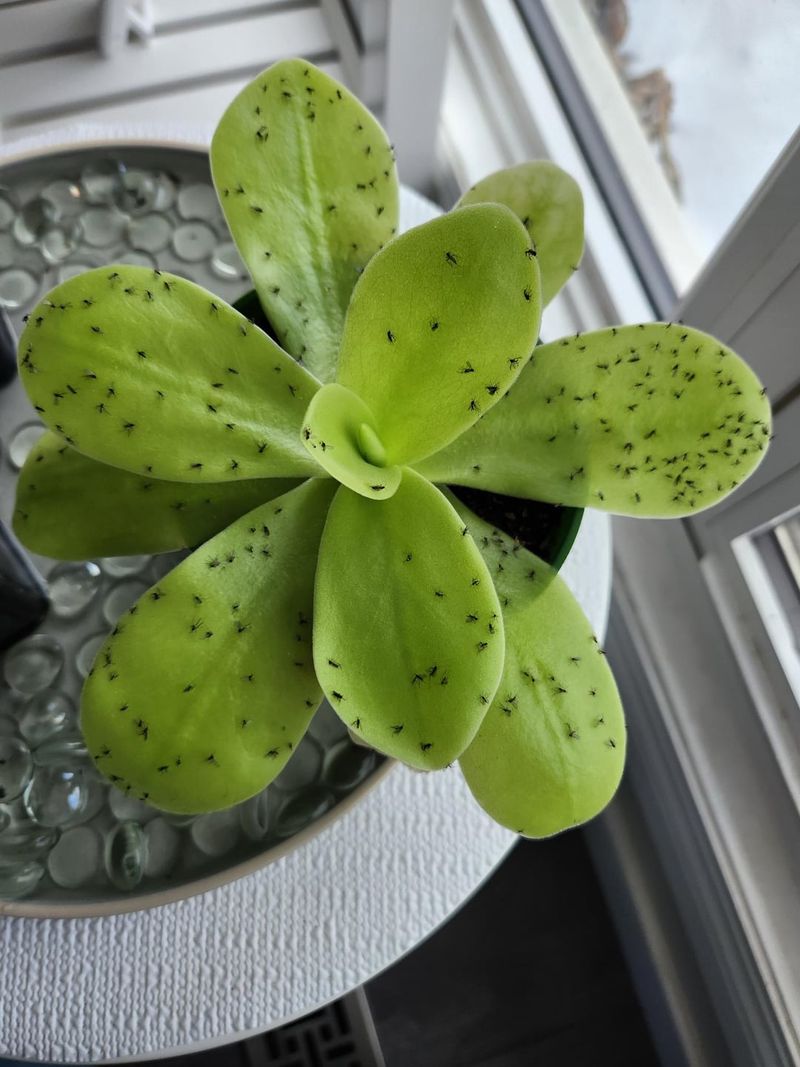
Tucked among the ferns and pothos on a shaded porch, a small rosette of pale green leaves looks oddly buttered. That greasy shine is not dust, polish, or leftover water from a spray bottle.
Butterwort, known to botanists as Pinguicula, is a carnivorous plant, and the glow comes from sticky mucilage covering the surface.
The name traces back to the Latin pinguis, meaning fat, a nod to how slick the foliage feels. Collectors shorten it to ping among themselves.
Aromatic herbs get all the pest-fighting publicity, yet their fragrance rarely stops a gnat mid flight. Butterwort skips scent entirely and works by contact instead.
Fungus gnats, those dark specks that hover over damp potting soil, are its most common catch by far. Fruit flies get snagged too, especially near a bowl of peaches.
Care is refreshingly simple to follow. Bright indirect light, low-mineral water, lean soil, no fertilizer at all needed.
Slender flower stalks appear in purple, pink, or white, which feels like a raise for a plant hired as pest control. Few houseplants earn their spot so literally.
Its Leaves Work Like Living Flypaper
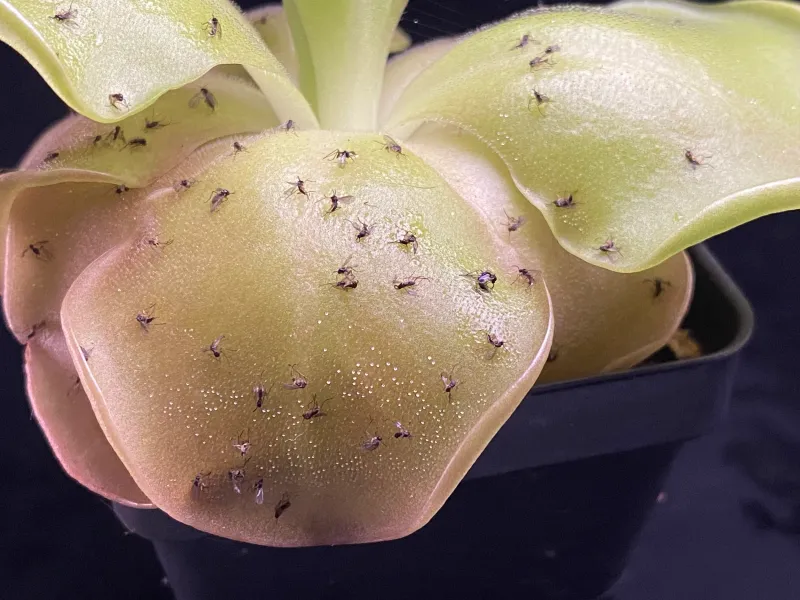
Run a finger across a butterwort leaf, and it feels tacky, like the back of a sticky note. Thousands of tiny stalked glands cover the surface, each holding a droplet of clear mucilage.
A gnat touching down finds no solid footing anywhere. Its legs and wings press into the goo, and every struggle spreads the glue further across its body.
A second set of flat glands then releases digestive enzymes onto the trapped insect. Those enzymes break the insect into nitrogen and other nutrients that roots struggle to find elsewhere.
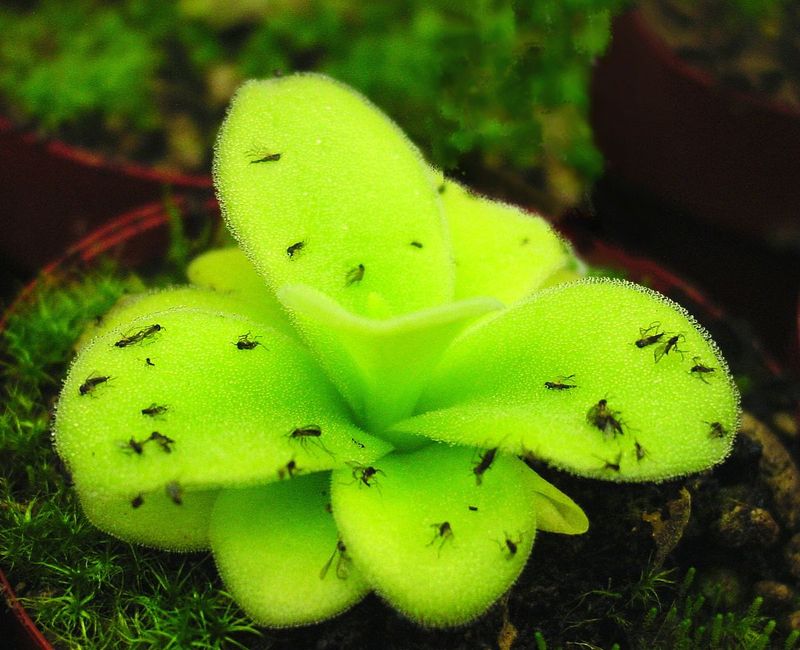
Older leaves often look speckled with dark dots scattered across the surface. Those specks are the leftover shells of past catches, and they are the clearest proof the plant is earning its keep.
Rain and heavy misting can rinse mucilage off temporarily, so keep butterwort under an overhang on stormy days. The leaves rebuild their coating within a day or two on their own.
A single healthy rosette can hold dozens of gnats at once, more than most paper traps manage in a week of hanging there.
Think of it as flypaper that grows its own replacement sheet, no refills required from the owner. Growers fighting fungus gnats often notice fewer hovering adults within two weeks.
Real Science Backs The Catch, Not Just Folklore
Most pest-repelling plant advice rests on shaky ground overall. Citronella geranium, lavender, and mint get praised constantly, yet tests on scented foliage repelling insects outdoors show weak, short-lived results.
Carnivory is a different story entirely. Botanists have studied Pinguicula trapping for well over a century, going back to Charles Darwin’s 1875 book on insectivorous plants.
Those surveys keep landing on the same answer every time. Small flying insects in the order Diptera, meaning gnats, midges, and fruit flies, make up most of the catch.
No folklore needed here at all. You can watch the mechanism happen on your own windowsill, which is rare for a pest-control claim worth trusting.
Honesty matters about limits though. Butterwort is not mosquito control by any stretch. Large house flies are too heavy and too strong for the glue to hold.
Scope your expectations to tiny fliers, and the plant delivers reliably. Texas A&M AgriLife Extension links indoor gnat outbreaks to soggy potting soil, which is why plant plus habit works best together.
Skeptics tend to become believers after spotting the first speckled leaf sitting right there on their porch.
Mexican Varieties Catch The Most Insects
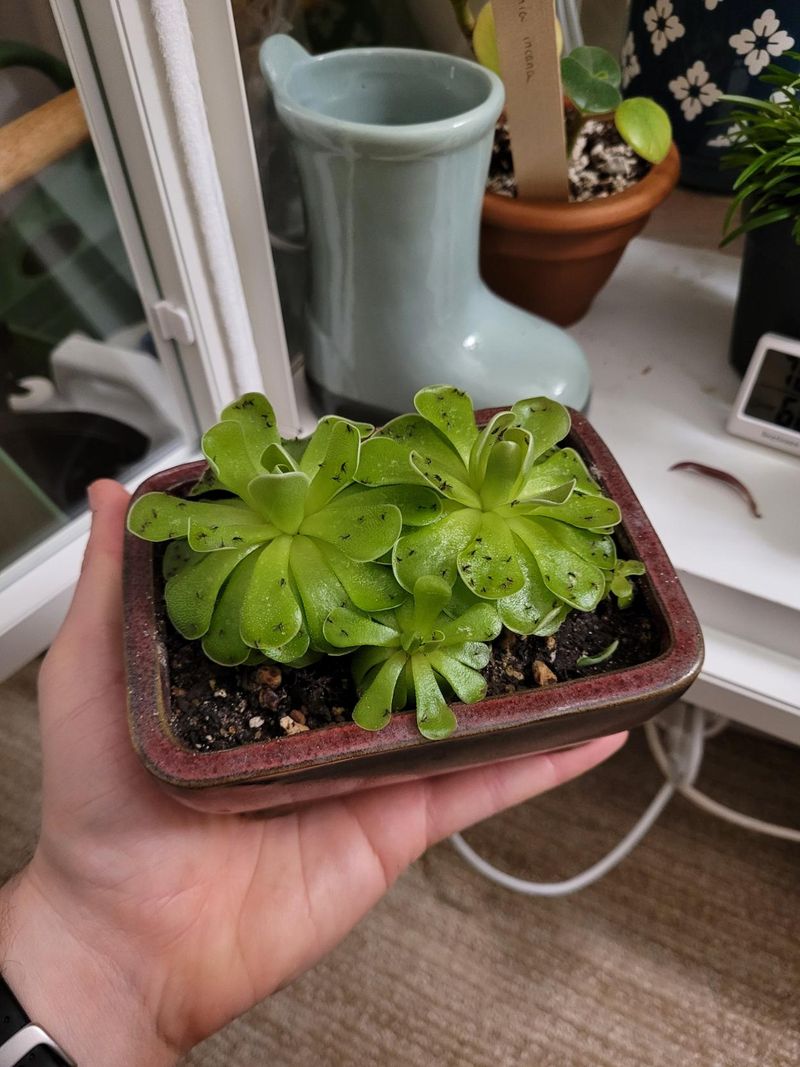
Leaf shape decides how many gnats end up stuck to a given plant. Broad, flat, pancake-style rosettes offer far more landing area than narrow, curled leaves ever could.
Pinguicula moranensis, Pinguicula gigantea, and hybrids such as Sethos or Aphrodite are the usual nursery picks worth seeking out. Gigantea lives up to its name, sometimes spanning a foot across.
Mexican types also forgive beginners nicely. They tolerate normal household humidity and temperatures between roughly 60 and 85 degrees without much fuss.
Many shift into a succulent phase during dry winter months naturally. Leaves shrink, the sticky coating fades, and trapping pauses until spring returns.
Temperate bog species behave differently and are much fussier indoors overall. They want cold winters, constant moisture, and light cycles few porches provide reliably.
Shop from carnivorous plant specialists rather than big-box garden centers for better results. Labels are more accurate, and plants arrive healthier overall.
Expect to pay around 15 to 30 dollars for a starter rosette, cheaper than a season of disposable traps bought repeatedly.
Its Not Actually A Texas Native
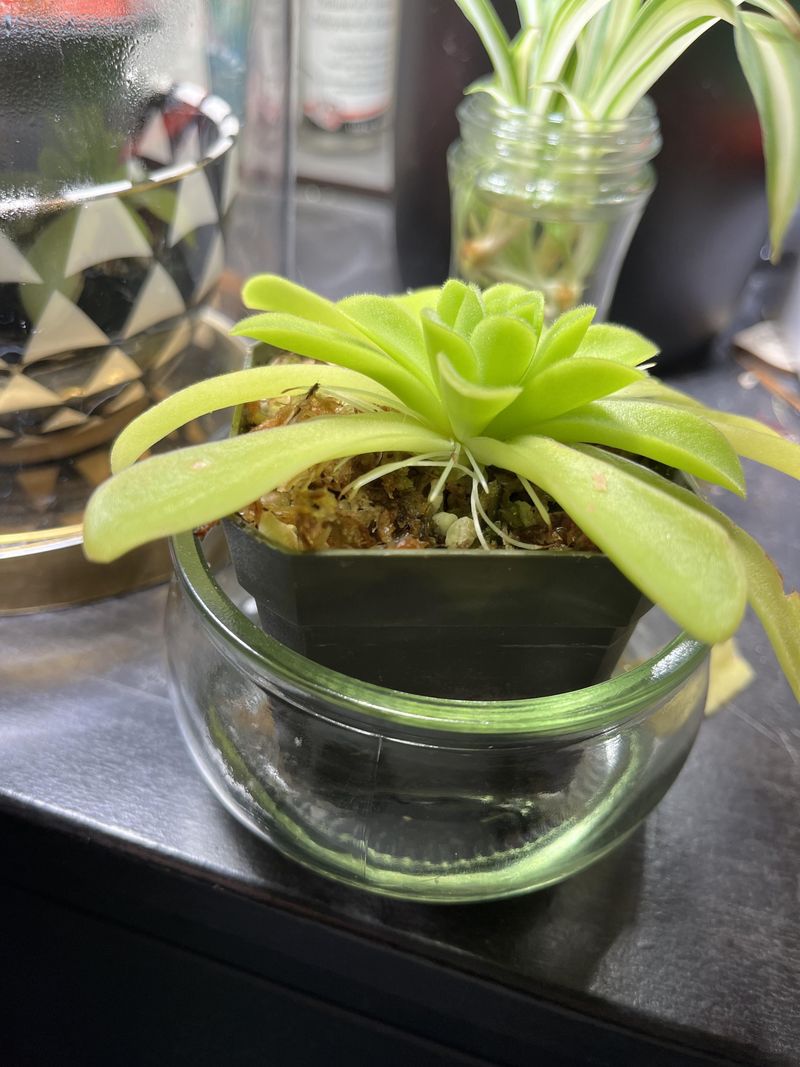
Credit where credit is due here. Texas does have wild butterworts. Pinguicula pumila and Pinguicula planifolia turn up in wet pine savannas along the Gulf Coastal Plain.
Those natives are small, seasonal, and genuinely delicate to grow. Pumila produces a rosette barely an inch wide, difficult to maintain outside its natural bog.
Neither species transplants well, and collecting from the wild is harmful and, in protected areas, illegal to attempt.
The plants people actually buy for gnat duty come from Mexican mountains instead. Warm days, cool nights, and limestone slopes shaped them into tough, adaptable growers.
Does the birthplace matter for your porch practically speaking? Not much. Mexican butterworts handle Texas household conditions better than the local bog species do.
Accuracy still counts though, especially for anyone building a native plant garden intentionally. Gardeners hoping to support regional ecosystems should look at native wetland species instead.
Curious about the wild ones growing locally? Visit a protected bog with a naturalist group during spring bloom season to see them firsthand.
Tap Water Will Cause It To Decline
One habit ruins more butterworts than anything else combined. Filling the watering can at the kitchen sink introduces exactly what this plant cannot tolerate.
Texas tap water runs hard across much of the state, loaded with calcium, magnesium, and dissolved salts. Carnivorous plants evolved in mineral-poor bogs and cannot process that load well.
Damage builds slowly over weeks and months. Salts collect in the potting mix, roots grow stressed, sticky droplets shrink, and leaf edges turn brown and crispy.
Distilled water is the easy fix here, sold by the gallon for about a dollar at most stores. Rainwater works beautifully too, and a small barrel under a downspout collects plenty during storms.
Filtered pitcher water does not qualify though, since carbon filters remove taste and chlorine but leave minerals behind entirely.
Softened water is worse still, because softeners swap calcium for sodium instead. Aim for under 50 parts per million total dissolved solids if you own a cheap TDS meter.
Keep the soil lightly damp, never soggy, and water from the tray so the mix wicks moisture upward naturally. Skip fertilizer completely, since insects deliver all the nutrition needed.
Placement Around The Porch Determines How Well It Works
Where a butterwort sits on a porch matters just as much as the plant itself when it comes to actually reducing gnat numbers around people.
Positioning a rosette directly beside the worst offender, usually a houseplant sitting in perpetually damp soil, puts the trap right in the flight path gnats use to move between breeding ground and open air.
Grouping two or three plants near a cluster of gnat-prone pots works better than scattering single rosettes across a wide porch, since a concentrated trapping zone catches more insects than the same number spread thin.
Airflow deserves consideration too, since a butterwort tucked into a still, stagnant corner attracts fewer passing insects than one positioned where gentle air movement naturally carries gnats toward the sticky leaves.
Direct afternoon sun should be avoided in most of Texas, since intense heat dries out the mucilage faster than the plant can replenish it, reducing trapping effectiveness right when gnat activity often peaks in summer.
A spot with bright morning light and afternoon shade, common on covered porches facing east, tends to keep both the plant and its sticky coating in good working condition through the hottest months.
Rotating plants occasionally between a few gnat-heavy zones, rather than leaving one rosette permanently in a single spot, spreads the benefit around a porch that has multiple problem areas rather than concentrating all the help in one corner.
Combined with good potting soil habits elsewhere, thoughtful placement turns a single butterwort from a passive curiosity into an active part of a porch’s actual pest management routine.