The Porch Plant Arizona Homeowners Set By The Door To Keep Wasps From Nesting There
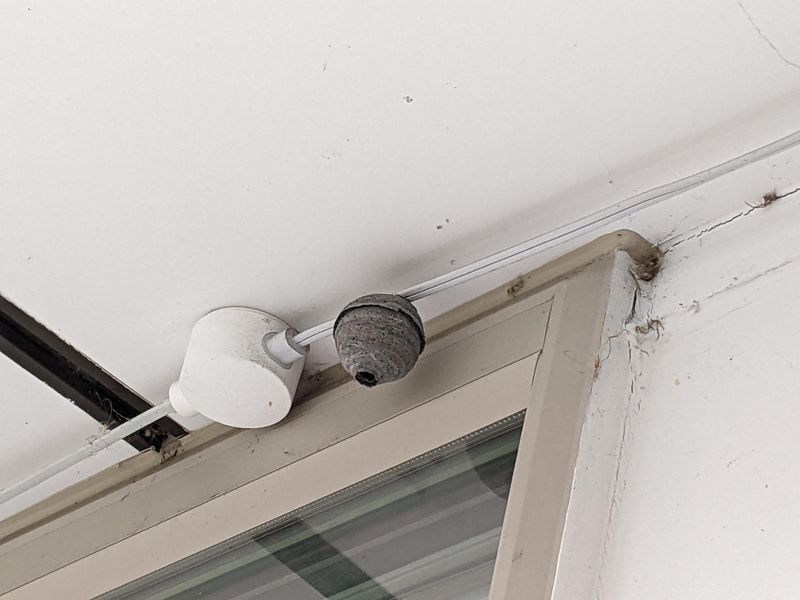
Wasps building a nest right beside your front door is one of those problems that feels urgent the moment you notice it. A popular idea suggests that setting the right potted plant on your porch will stop wasps from nesting there, but the evidence behind that claim is thinner than most people realize.
What actually helps Phoenix-area homeowners is understanding which wasp they are dealing with, cutting off access to sheltered spots, and knowing when to call a professional. This article walks through each of those steps in plain terms.
A potted plant is not a proven doorway-nest solution
Somewhere along the way, the idea spread that placing a fragrant herb like rosemary or mint by the front door keeps wasps from building a nest there. The logic sounds reasonable, but the research behind it does not support that conclusion.
A 2012 field study found that certain essential oils, including peppermint, spearmint, lemongrass, and rosemary, showed repellent effects against some yellowjackets and paper wasps in attractant-baited trap experiments. Those tests used concentrated oils near traps, not living plants growing in pots beside a home entrance.
A potted herb releases a fraction of the volatile compounds found in a concentrated extract. There is no published evidence showing that a growing plant emits enough of those compounds to stop wasps from choosing a sheltered eave or door frame as a nest site.
Treating the oil study as proof that a porch plant works is a stretch the data cannot support.
The practical takeaway is straightforward. Reducing the sheltered spots wasps prefer, sealing openings around the entrance, and responding carefully to an active nest are the steps that actually address the problem.
A fragrant plant on the porch may be pleasant, but it is not a reliable substitute for any of those actions.
Identify which wasp is using the porch
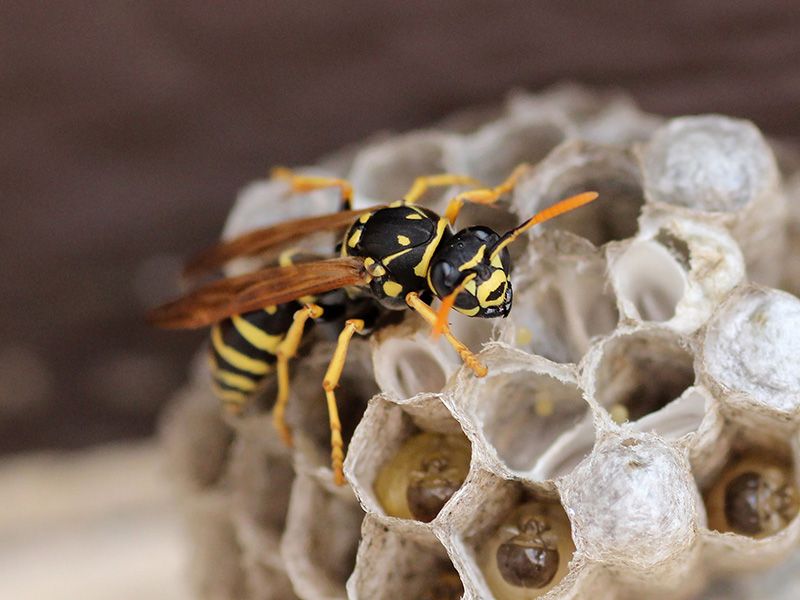
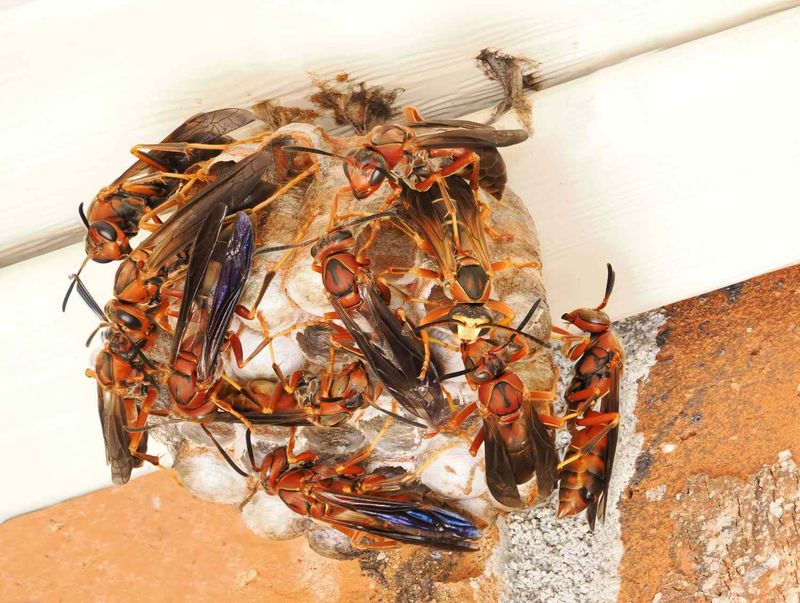
Not every wasp you see near the front door is the same creature with the same habits. Paper wasps are among the most common porch visitors in the Phoenix area.
They build open, papery nests that look like an upside-down umbrella, and they attach them to protected spots like the underside of eaves, door frames, or porch ceilings. According to University of Arizona Extension guidance on paper wasps and yellowjackets, doorways and outdoor living areas are exactly the kinds of high-traffic locations where an active paper wasp nest can become a concern.
Yellowjackets are a different story. Arizona’s western yellowjacket typically nests in the ground, though it can also set up inside wall voids or crawlspaces.
If you are seeing wasps flying in and out of a gap in the siding or a crack in the foundation, a yellowjacket colony is more likely than a paper wasp nest.
Mud daubers are the third type you might spot. These are solitary wasps that build small clay tubes on walls or under overhangs.
They are not defensive in the way social wasps are, and they rarely sting unless handled directly. Knowing which type you have matters before deciding how to respond, because the nesting habits and risks are genuinely different.
Your Arizona Garden Changes Every Week. Your Plan Should Too.
Gardening in Arizona changes quickly throughout the season. Every Friday you’ll receive a simple weekly plan showing exactly what to plant, prune, fertilize, harvest, and protect so you never miss the right timing.
Observe from a safe distance and do not approach or disturb any nest to get a closer look.
Reduce sheltered nesting sites around the doorway
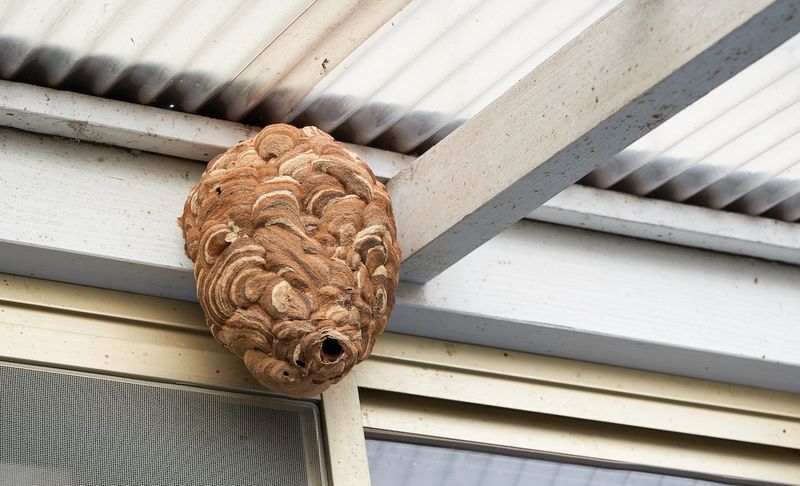
Paper wasps look for locations that offer overhead protection and some enclosure. The underside of an eave directly above a door, the gap between a light fixture and the wall, or a corner where two surfaces meet at an angle are all attractive to a queen scouting for a nest site in spring.
Arizona Extension guidance notes that paper wasp nest construction begins in spring, which means fall sightings of wasps near the porch do not necessarily mean a new nest is being founded at that moment. Those wasps may be foraging workers from an existing colony elsewhere.
Routine inspection of the areas around your entrance can help you catch a nest early, when it is small and the colony is not yet large. Walk the perimeter of your doorway and look up at eaves, porch ceilings, and any decorative trim that creates a sheltered pocket.
Early-stage paper wasp nests are small and papery, often with just a few visible cells.
Removing debris, clutter, or stored items from covered areas near the entrance also reduces the number of protected spots wasps can use. An open, well-maintained porch with fewer hidden corners simply offers fewer options.
These steps reduce the likelihood of a nest forming nearby, though no single maintenance habit guarantees that wasps will never attempt to build in the area.
Seal openings and maintain the entrance
Physical exclusion is one of the most reliable ways to reduce a wasp’s access to the sheltered spaces it needs for a nest. The University of Arizona’s pest-proofing guidance recommends sealing cracks and holes in exterior walls, closing gaps around door frames and window frames, and addressing openings around fascia boards and utility penetrations like pipes and electrical conduit.
Screens on vents and weep holes are also worth adding where they are missing.
For a Phoenix homeowner, the most productive places to check are the spots where different materials meet: where stucco meets wood trim, where a light fixture mounts to the wall, or where a soffit panel has pulled slightly away from the fascia. Even a gap the width of a pencil can be enough for a paper wasp to begin a nest.
A tube of exterior caulk and a roll of weatherstripping cover most of those situations at low cost.
Keeping the entrance itself in good repair matters too. A door that seals tightly, a threshold with no gap at the bottom, and trim that sits flush against the wall all reduce the number of sheltered cavities available.
These steps give wasps fewer starting points. They are not a guarantee of a wasp-free porch, but they meaningfully reduce the number of suitable spots a scouting queen can find in spring when nest construction begins.
Manage food to reduce encounters with foraging wasps

Wasps showing up at your cookout or hovering near the trash cans are a separate situation from wasps building a nest under the eave. Foraging yellowjackets, in particular, are drawn to proteins and sugars, which is why outdoor meals and open garbage attract them.
Keeping food and drinks covered when eating outside and storing garbage in cans with tight-fitting lids can noticeably cut down on these encounters, according to UC IPM guidance on social wasps.
Pet food left outside is another common attractant that is easy to overlook. Bringing bowls in after feeding and rinsing them before storage removes a food source that can draw foraging wasps to the porch area repeatedly.
Managing food sources addresses the encounter problem, not the nesting problem. A yellowjacket foraging near your front door is likely traveling from a nest somewhere else on the property or in the neighborhood.
Reducing food-related visits makes the porch less busy with wasps, but it does not stop a paper wasp from deciding the eave above the door is a good place to build. Both problems are worth addressing, but the solutions are different, and it helps to keep them separate when deciding what to do next.
Treat an active nest beside the entrance as a safety concern
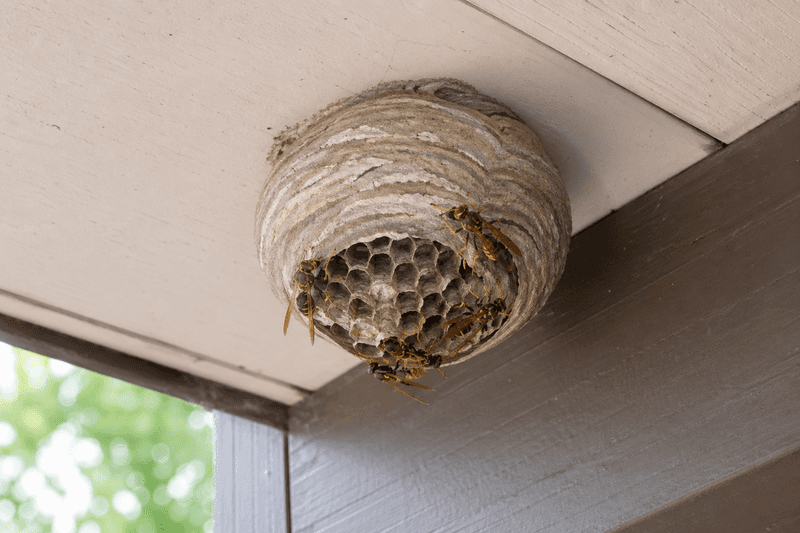
Finding an active paper wasp or yellowjacket nest right beside a front door puts it in one of the worst possible locations. Social wasps can sting repeatedly when they perceive a threat to the colony, and a busy entryway means people are passing close to the nest many times a day.
That combination raises the risk considerably, especially for anyone in the household who has a known allergy to wasp stings.
The safest response is to stop using that entrance if another door is available and to contact a licensed pest professional. Professionals have the protective equipment and the right products to treat a nest in a high-traffic location without putting household members at risk.
UC IPM guidance reinforces that professional help is generally the safest path when a social wasp nest needs to be removed, particularly when the nest is near an entrance or a sensitive person is present.
Not every nest requires immediate action. A nest that is not in a high-traffic spot and is not posing an imminent threat can sometimes be left alone through the season.
Paper wasp colonies do not survive Arizona winters, and an empty nest can be removed safely in the cooler months. Note, though, that paper wasps may build a new nest near an old one the following spring, so sealing the area after removal is worthwhile.
A potted plant on the porch is simply not a stand-in for a professional assessment or a careful seasonal approach. Knowing when to step back and call for help is the most practical thing a homeowner can do.