Could Mourning Doves in Your Arizona Yard Be Hinting at Useful Resources?
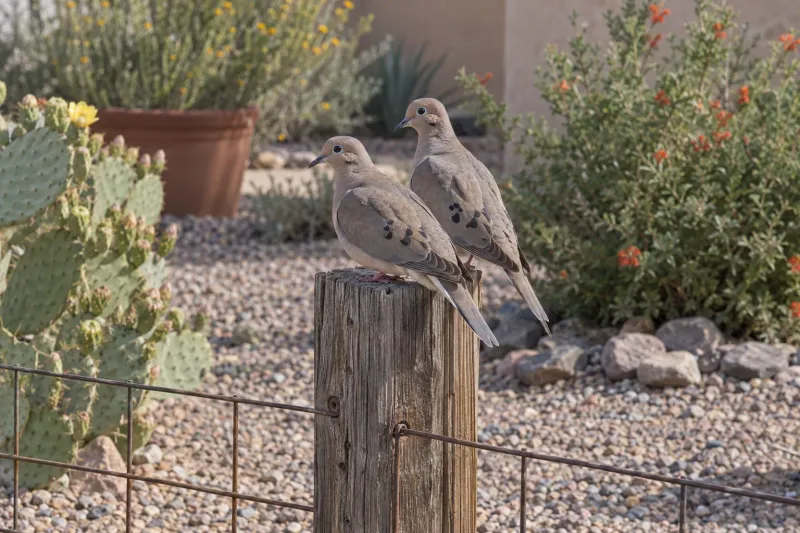
Few backyard birds are as familiar in Arizona as the soft, gray mourning dove. When one keeps showing up near your patio, it is tempting to wonder what it means.
A dove visit may offer a few clues about seed, water, and places to perch. It cannot tell you everything, though, so let’s look at what those clues can and cannot say.
A return visit is a clue, not a verdict
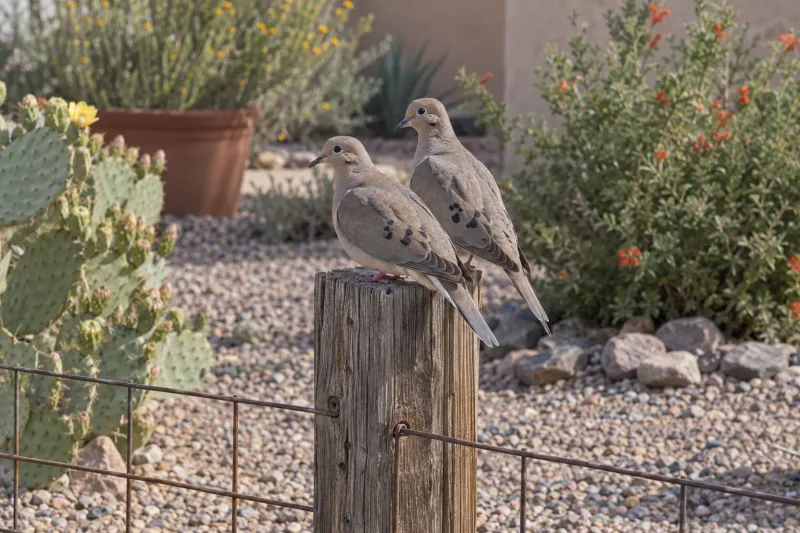
Think of a dove visit as a small hint rather than a grade. Mourning doves feed mostly on the ground and perch in trees or on wires, so a yard with food, water, or a handy branch may be useful to them, as Cornell Lab of Ornithology describes.
The catch is that these birds are adaptable and widespread. They turn up in suburbs, farms, and city blocks, so seeing one says little about how healthy your yard is overall.
Plenty of ordinary yards get dove visits.
Repeated sightings also leave some questions open. You cannot tell why a particular bird stopped by, and you cannot be sure the same bird came back.
It could be spilled seed, a shady perch, water nearby, or simply what the neighborhood offers.
So the report card idea works best as a metaphor. Treat each visit as a prompt to look around your yard and ask what resources a dove could find there.
Which dove is visiting?
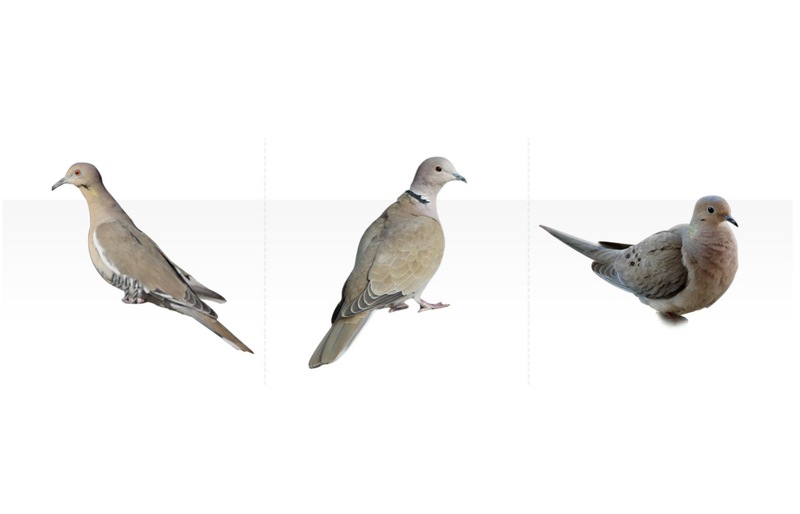
Before reading anything into a visit, make sure the bird is a mourning dove. Arizona is home to several dove species, including mourning, white-winged, and Eurasian collared doves, and Arizona Game and Fish lists them among its dove species.
Mourning doves are slim, tan-gray birds with a long, pointed tail and small black spots on the wings. White-winged doves have a bold white stripe along the wing edge.
Collared doves are paler and chunkier, with a dark half-ring on the back of the neck.
This matters because similar-looking birds do not necessarily use a yard in the same way. Food choices, favorite perches, and timing may differ from one species to the next.
Take a moment with binoculars or a phone photo. Once you know who is on the wall, the rest of this advice fits better.
Seeds on the ground may be one useful clue
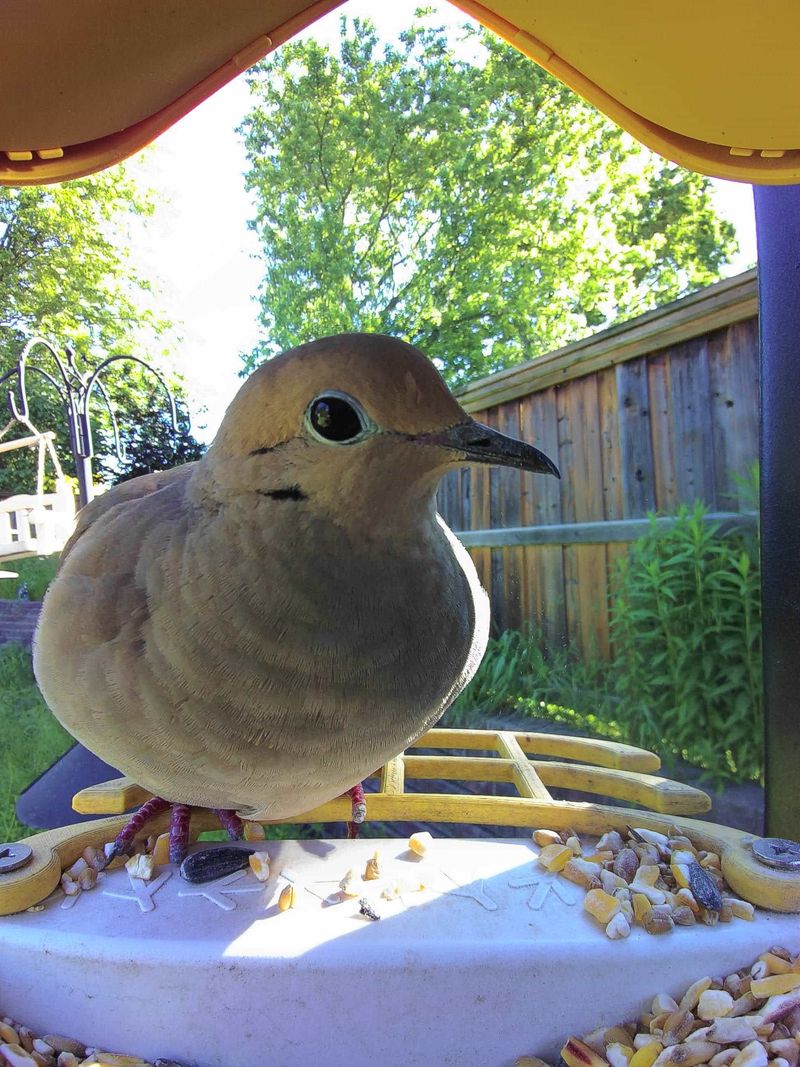
Watch where the bird’s attention goes. Mourning doves eat mostly seeds and grains, and they usually feed on the ground, according to the U.S.
Forest Service. A dove pecking along the edge of a patio may be finding something small to eat.
Possible food sources include spilled birdseed, weed seeds, and grain scattered below a feeder. Doves may also use a platform feeder or a modest scatter of millet on the ground.
None of this proves why a bird visits, and none of it guarantees future visits. A dove might be passing through, or it might be after something you never noticed.
Try a simple check. Look at the ground under feeders and weedy corners, and see whether seed is collecting there.
Your Arizona Garden Changes Every Week. Your Plan Should Too.
Gardening in Arizona changes quickly throughout the season. Every Friday you’ll receive a simple weekly plan showing exactly what to plant, prune, fertilize, harvest, and protect so you never miss the right timing.
If it is, that may be one reason a dove found a snack, and it also tells you where to sweep.
Water can help when you keep it clean
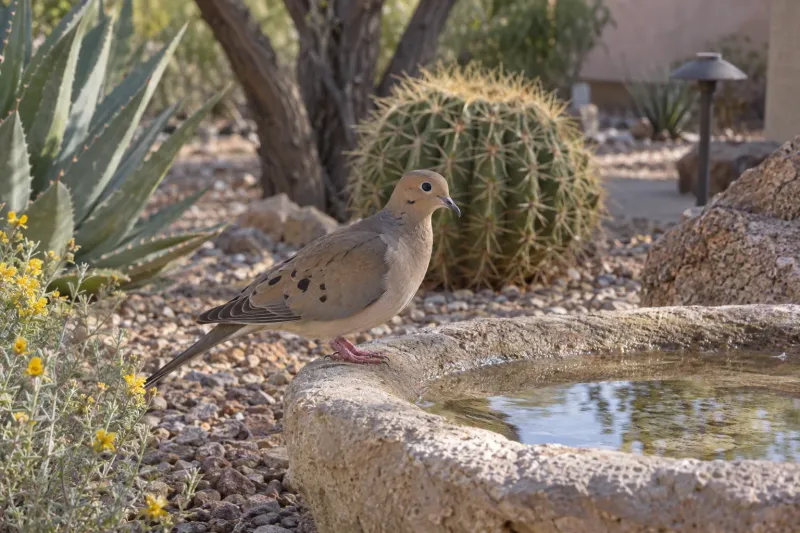
Water is a precious thing in the low desert, so a birdbath or shallow dish may be a useful resource for birds. It is not a promise of dove visits, but it can be one more piece of the picture.
If you offer it, the routine matters. University of Arizona Extension advises dumping, brushing, and refilling birdbath water daily, and cleaning birdbaths and feeders twice a month.
Why so much care? Dirty water and feed can pass illness among birds.
Arizona Game and Fish notes that diseases such as trichomoniasis can spread through feed or water contaminated by saliva.
A shallow dish with a rough surface is easy to scrub, and it uses very little water per day. If you cannot keep up with the cleaning, skipping the bath is a better choice than leaving it neglected.
Pair open feeding space with nearby cover
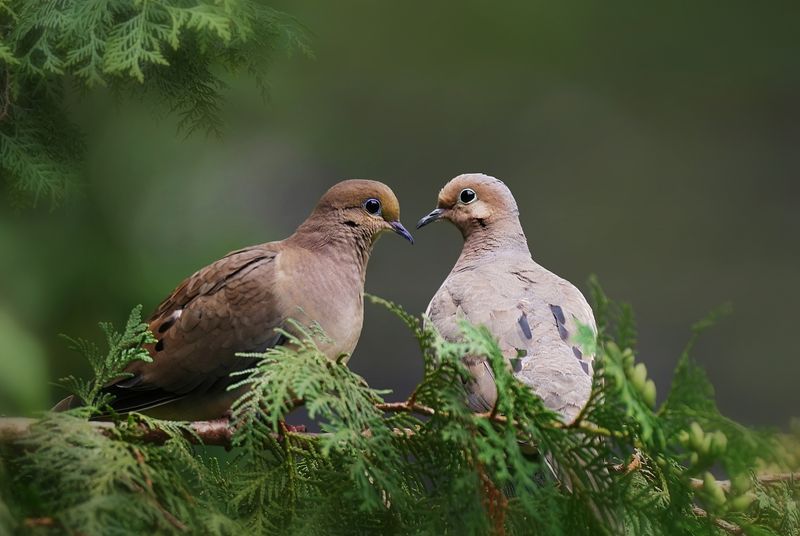
Doves tend to feed in open or lightly covered spots, then retreat to something higher. Trees and shrubs nearby can offer a perch, a bit of shelter, or a place to nest.
That combination of open ground and cover fits how the species is known to use habitat.
One Arizona example is worth keeping in its place. In river bottoms, Forest Service research reports that mourning doves preferred mesquite over saltcedar as nest trees.
That finding describes one setting, so it is not a planting rule for every yard.
For ideas on mixing layers of plants, Extension habitat guidance is a handy place to start.
Even a well-arranged yard cannot promise visits. Open ground and a nearby branch simply make your space more useful if a dove happens by.
Keep the welcome modest and read the wider pattern
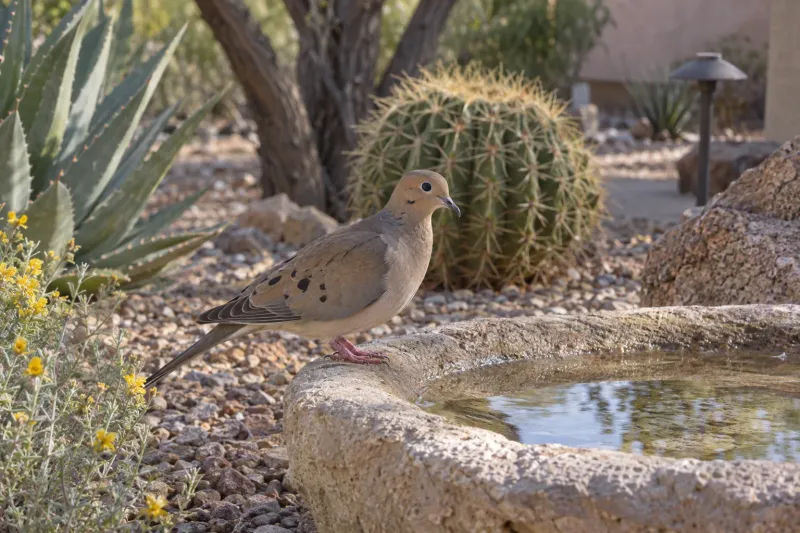
Moderation is the safest approach. Offer a small amount of seed, sweep up old hulls, and avoid crowded feeding spots where many birds share one surface.
Fewer birds at a feeder can lower disease risk, as Arizona Game and Fish points out. If you see a sick bird, take down feeders and baths and clean them.
Ground feeders are easy targets, so keeping cats indoors helps protect them. Feeders should also sit where birds are less likely to strike windows.
Numbers change through the year, too. Migration can shift how many doves are around, and patterns and timing vary, so a busy week and a quiet one may say more about the season than your yard.
No single tweak guarantees a visitor. A dove on the wall is a pleasant clue, and the yard keeps its own secrets.