This Is What It Means When A Scarlet Tanager Appears In Your Ohio Trees
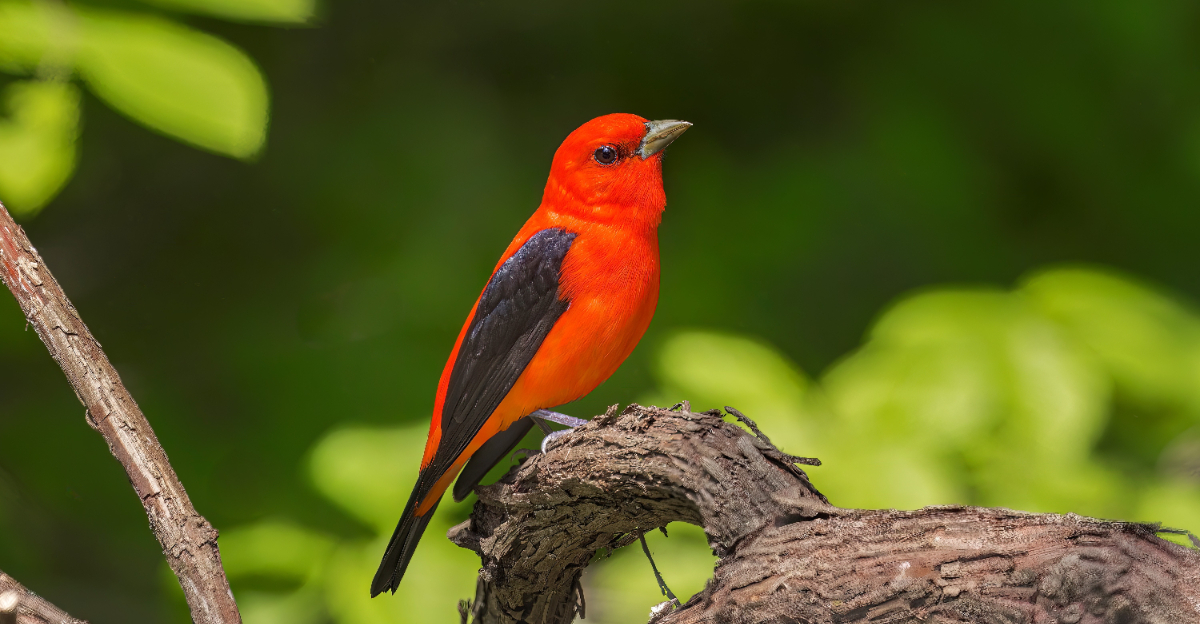
A scarlet tanager lands in an Ohio tree and the whole yard stops. That red has no business existing in a suburban canopy.
It belongs in a nature documentary, not twenty feet from the back porch. And yet there it is.
The reaction is universal. The question that follows it rarely gets answered.
Why here. Why this yard. Why this tree. Scarlet tanagers are not casual visitors.
They apply a standard to every canopy they consider and pass on most of them without a second look. A yard that earned a sighting passed something that the majority of Ohio properties never do.
What the yard was offering, what the trees provided, and what that visit actually signals about the habitat that has been building here quietly is a more interesting story than the sighting itself suggests.
The bird chose this place for a reason. That reason is worth knowing.
1. A Scarlet Flash Can Point To Mature Woodland Close By
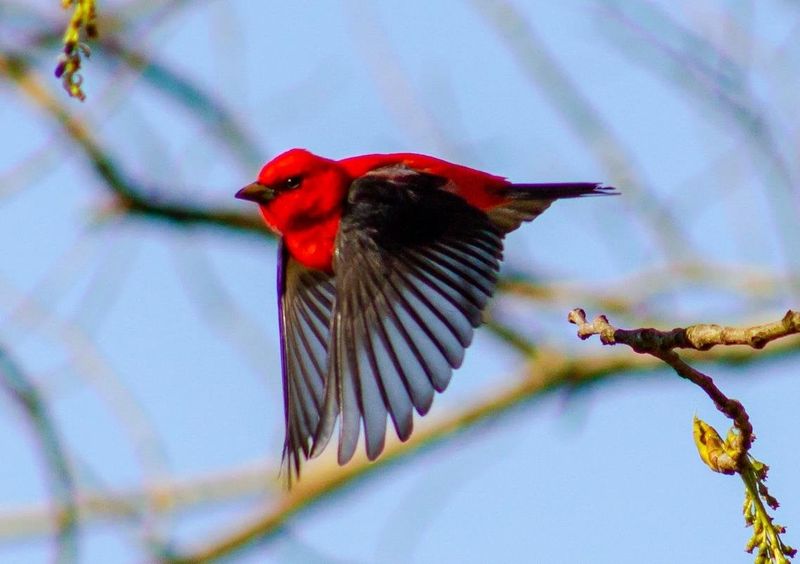
Noticing an unfamiliar bird high in your canopy can feel like a clue waiting to be decoded. Scarlet Tanagers are closely associated with mature deciduous forest, and that connection is well documented by Cornell Lab of Ornithology.
They tend to favor large, intact woodland over fragmented patches, though they do use forest edges and adjacent trees when foraging.
A bird appearing in an Ohio residential yard often signals that useful wooded habitat exists somewhere nearby. Local woodlots, stream corridors, large parks, and connected stretches of neighborhood canopy can all function as part of a broader habitat network.
The yard itself may serve as a convenient foraging or resting stop within that larger area.
No single mature tree confirms that breeding habitat exists on the property. What it may suggest is that the surrounding landscape contains enough wooded structure to support the species at least temporarily.
Researchers studying forest birds consistently note that these birds operate across landscapes far larger than one backyard.
Paying attention to what surrounds your property can be just as informative as watching the bird itself. A park, a creek lined with tall trees, or a neighbor’s mature canopy nearby could all be part of what drew the bird into your view.
The yard is one piece of a much larger picture.
2. Tall Deciduous Trees Give Tanagers The Canopy They Prefer
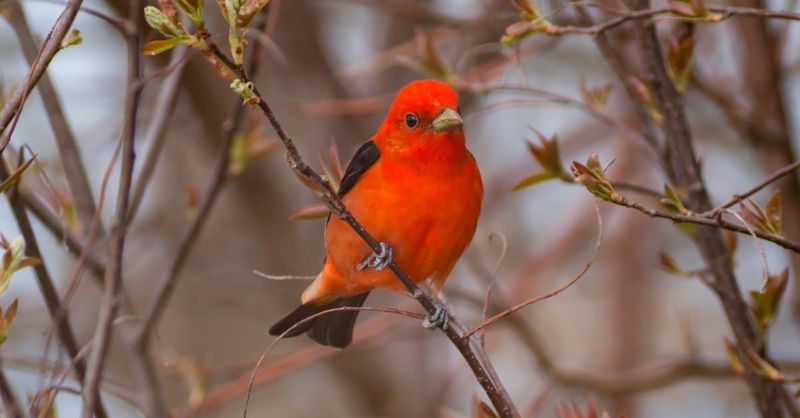
Vertical structure matters more than most people realize when it comes to where this species spends its time. According to Cornell Lab of Ornithology, Scarlet Tanagers forage primarily in the mid to upper canopy of deciduous trees.
They move through leafy branches searching for insects, and taller trees naturally offer more of that foraging space.
A yard with several tall, full-crowned deciduous trees provides something meaningfully different from a landscape of small ornamental plantings.
Height and canopy density create the kind of layered environment where these birds can move, perch, and feed without dropping to exposed ground level.
That vertical range is part of what makes a mature tree useful.
Cover also plays a role. Dense Ohio summer foliage gives the bird concealment while it works through branches looking for prey.
Your Ohio Garden Changes Every Week. Your Plan Should Too.
Gardening in Ohio changes quickly throughout the season. Every Friday you’ll receive a simple weekly plan showing exactly what to plant, prune, fertilize, harvest, and protect so you never miss the right timing.
Perching sites at different heights allow it to survey an area and move efficiently between feeding spots.
It is worth noting that not every tall tree offers equal value. Canopy density, branch structure, and the insect community living within the tree all affect how useful it actually is.
A single towering tree surrounded by pavement offers less than the same tree embedded in a layered, leafy yard with shrubs and understory plants growing beneath it. Canopy quality and context together shape what the bird can actually use.
3. Oaks And Other Hardwoods Can Make Your Trees More Useful
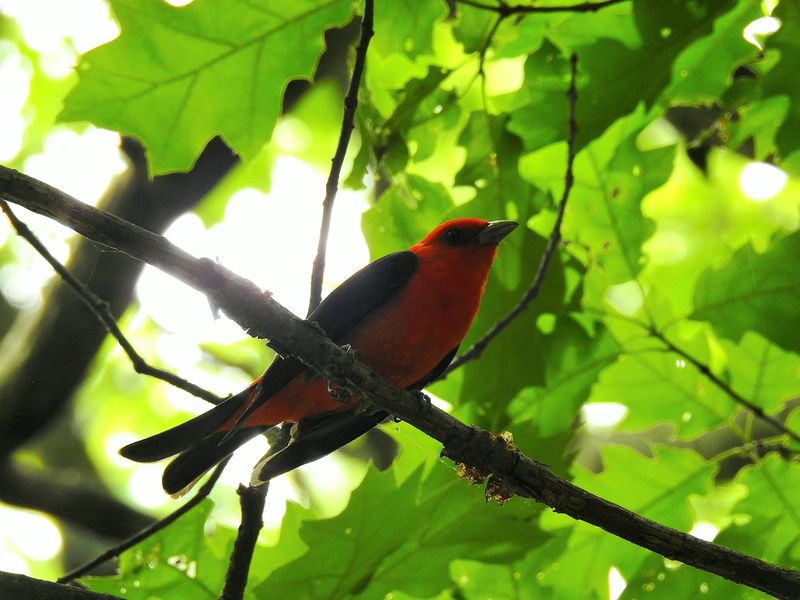
Not all trees in a yard carry the same ecological weight. Among hardwoods, oaks have received particular attention from researchers studying insect diversity and bird foraging habitat.
Entomologist Doug Tallamy’s research is widely cited in conservation literature. It documents that native oaks support a remarkably large number of caterpillar species compared with many other trees.
Caterpillars are a significant food source for Scarlet Tanagers during the breeding season, according to Cornell Lab of Ornithology. A hardwood tree that hosts abundant insect life, including leaf-feeding caterpillars, can provide real foraging value.
The mechanism is straightforward: more insects in the canopy means more reason for an insectivorous bird to spend time there.
Other native hardwoods found across Ohio, such as hickories, maples, and beeches, also support insect communities and provide large canopy structure. The connection is not that any one species of tree automatically draws tanagers.
It is that native hardwoods with established insect populations tend to offer more foraging opportunity than trees with sparse insect life.
Planting one oak will not guarantee a sighting. But a yard with mature native hardwoods may offer more to a foraging bird.
A landscape dominated by ornamentals with limited insect associations may provide less. The value builds gradually and depends on the whole canopy, not a single tree.
4. An Insect Rich Canopy Gives These Birds A Reason To Keep Foraging
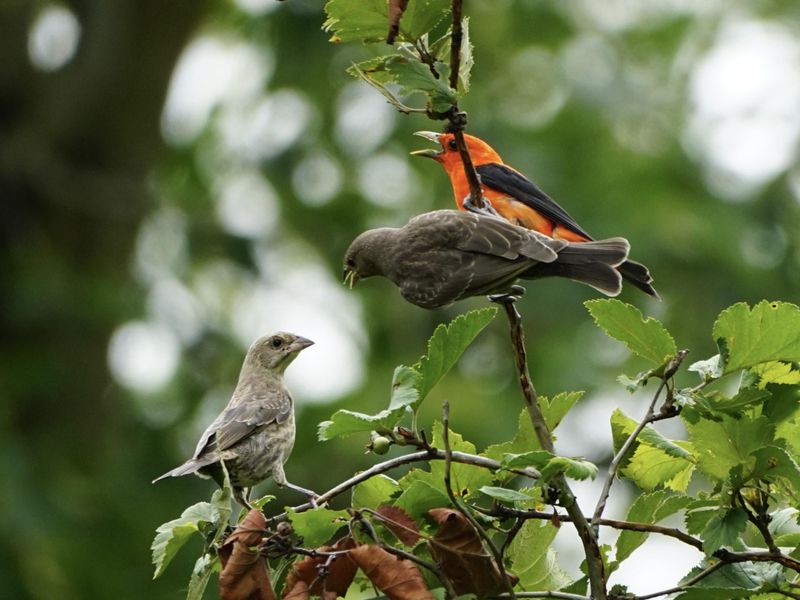
Food drives movement, and for Scarlet Tanagers, the canopy insect supply is a primary motivator during the breeding season. Cornell Lab of Ornithology describes the species as primarily insectivorous, feeding on insects and other arthropods found in foliage.
Caterpillars, beetles, wasps, and similar prey make up a large portion of the warm-season diet.
A leafy canopy teeming with insect life gives the bird an ongoing reason to stay and search. When that food supply is abundant, a tanager may work through one tree methodically before moving on.
When insects are scarce, the bird passes through quickly without lingering.
Pesticide use in and around the yard can affect the insect community available in the canopy. Broad-spectrum insecticide applications, especially those targeting foliage-feeding insects, reduce the prey base that these birds rely on.
Reducing unnecessary pesticide use where practical can help preserve the natural insect population in the canopy.
Ohio native plants tend to support more specialized insect relationships than many non-native ornamentals, though this varies by species and context. The goal is not to tolerate damaging pest outbreaks.
It is to recognize that a canopy with a functioning insect community offers more to a foraging tanager than a chemically simplified one. The bird is responding to real food, not the appearance of greenery.
5. Late Summer Fruit Becomes More Useful As The Season Starts To Shift
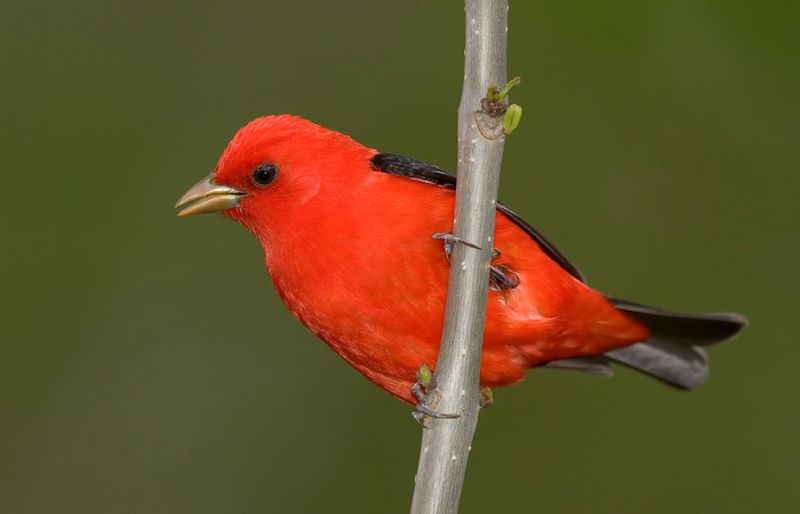
Scarlet Tanagers do not rely exclusively on insects throughout the year. Cornell Lab of Ornithology notes that the species also consumes fruit, and this part of the diet can become more prominent as the season progresses.
Wild berries, small fruits, and similar plant material supplement the insect-heavy warm-season diet.
Late summer brings a shift in what is available across the Ohio landscape. Many native fruiting plants ripen between July and September.
That period overlaps with the time when some individuals may be wrapping up breeding activity or beginning to move. A yard or adjacent area with fruiting plants can offer an additional food source during this transition.
Native shrubs and small trees that produce fruit in late summer can contribute to this resource base. Elderberry (Sambucus canadensis), which is native to much of the eastern United States, is one example that ripens during this window.
Serviceberries and wild cherries are other native species that provide late-season fruit in the region.
Fruit does not replace insects as the core of the diet. A bird seen eating berries in August may simply be supplementing its foraging rather than shifting away from insect prey entirely.
Planting fruiting natives does not guarantee that this species will visit. However, it can add seasonal value to a yard that already offers canopy structure and insect resources.
Variety in the food supply tends to make a landscape more useful overall.
6. One Sighting Does Not Mean A Pair Is Nesting In Your Yard
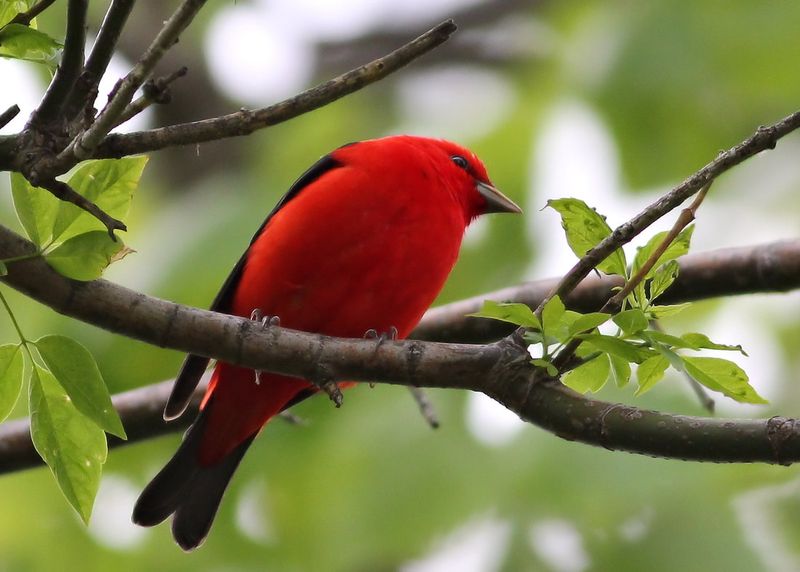
Seeing a striking bird once naturally leads to the assumption that it lives nearby. That conclusion is worth examining carefully.
A single Scarlet Tanager in a yard could represent several different situations. Nesting on the property is only one possibility and is not the most likely explanation in most residential settings.
According to Cornell Lab of Ornithology, Scarlet Tanagers nest in mature forest, typically placing their nests on horizontal branches well above the ground.
The species generally favors large, contiguous forest tracts for breeding rather than small yard plantings or isolated trees surrounded by development.
A bird seen foraging in a residential tree may be working away from a nest located in a nearby wooded area. It may be a non-breeding individual moving through the landscape.
It could also be a bird that simply found a useful tree and will not return after moving on. None of these possibilities can be confirmed or ruled out from a single observation.
Searching for a nest based on one sighting is not recommended. Nest disturbance can cause adults to abandon the site, and approaching active nests closely carries real risks for the birds involved.
Watching from a comfortable distance and noting the bird’s behavior over time provides far more useful information than any close inspection. Let the bird’s movements tell the story rather than drawing conclusions too quickly.
7. An August Visitor May Be Local Or Already Starting To Move South
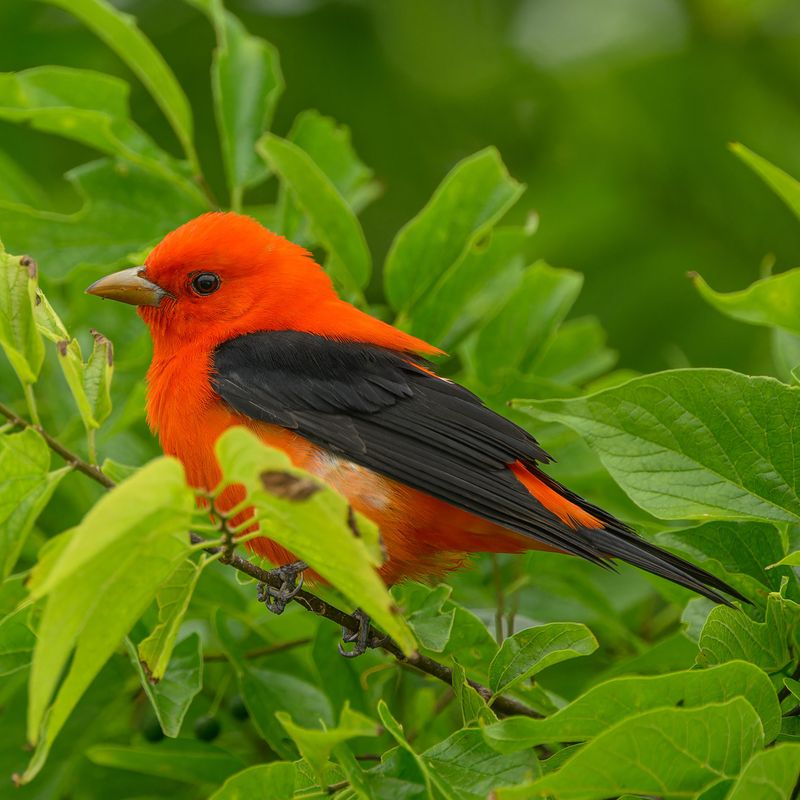
Late summer creates genuine uncertainty about what any individual tanager is doing. August sits in an overlap zone where local breeding activity, post-breeding wandering, and early southward movement can all occur at the same time.
Assigning a single bird to one category without additional evidence is difficult.
Cornell Lab of Ornithology notes that Scarlet Tanagers begin fall migration from their breeding grounds, with movement typically occurring from late summer into fall.
Some individuals may begin moving earlier than others, while locally breeding birds may still be present and active.
The timing is not uniform across all birds or all years.
Adult males can begin molting out of their breeding plumage during summer, which sometimes makes late-season birds harder to identify with confidence.
A bird that appears less intensely colored in August may be a male in transitional plumage rather than a different species.
Females and immature birds, which are olive-yellow rather than red, may also appear during this period.
A yard sighting in August could be a bird that bred in the region and is now ranging more widely as nesting duties wind down. It could also be an individual already moving through from a breeding area farther north.
Both are plausible, and both are worth considering before drawing firm conclusions. Watching for repeated visits over several days can offer a few additional clues, though certainty may remain out of reach.
8. Keeping Mature Trees Can Make Future Visits More Likely
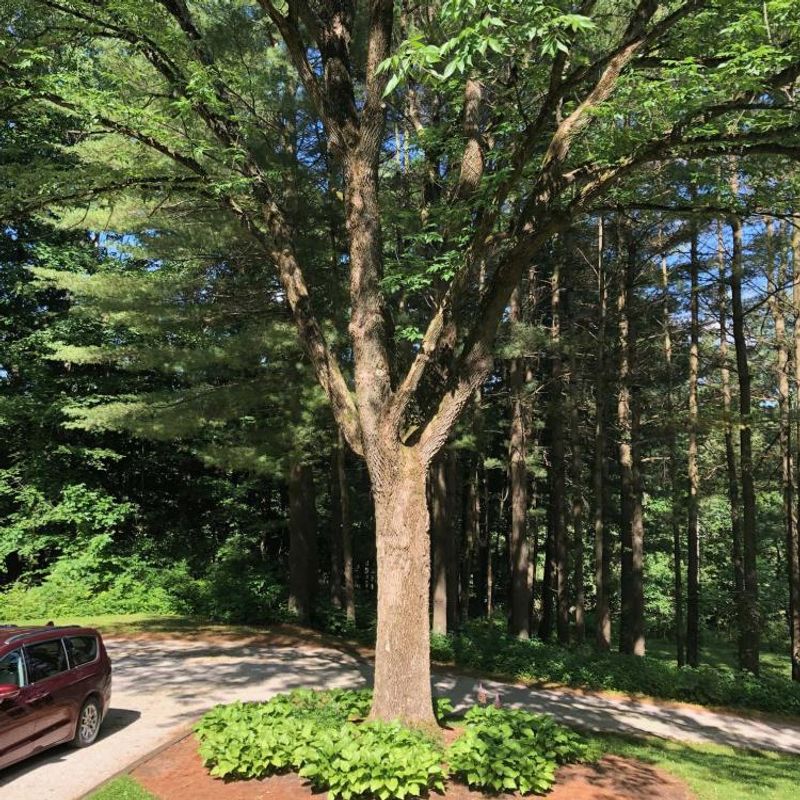
Preserving a healthy, mature canopy is one of the most concrete things a property owner can do to support woodland birds over time.
Large deciduous trees take decades to develop the canopy size, branch structure, and insect communities that species like Scarlet Tanagers can use.
Removing them eliminates that value immediately and permanently.
Tree safety always takes priority. A structurally compromised tree that poses a genuine risk should be addressed by a certified arborist.
But trees that are simply old, slightly irregular, or not perfectly manicured often provide more ecological value than a tidy, recently planted replacement.
Cavities, rough bark, and dense foliage all contribute to the insect habitat and structural complexity that foraging birds rely on.
Understory plantings beneath mature trees can add additional layers of habitat. Native shrubs and smaller trees that grow in partial shade fill in the vertical structure between the ground and the upper canopy.
That layering supports a wider range of insects and gives birds more options as they move through the yard.
Connected canopy also matters. A yard is more useful to a wide-ranging bird when its tree cover connects with neighboring trees or nearby woods.
An isolated grove surrounded by open lawn offers less connectivity. Habitat for species like this one is built gradually, across multiple properties and many years, not engineered in a single season.