What North Carolina Grubs Leave Behind This Fall And What You Can Actually Do About It
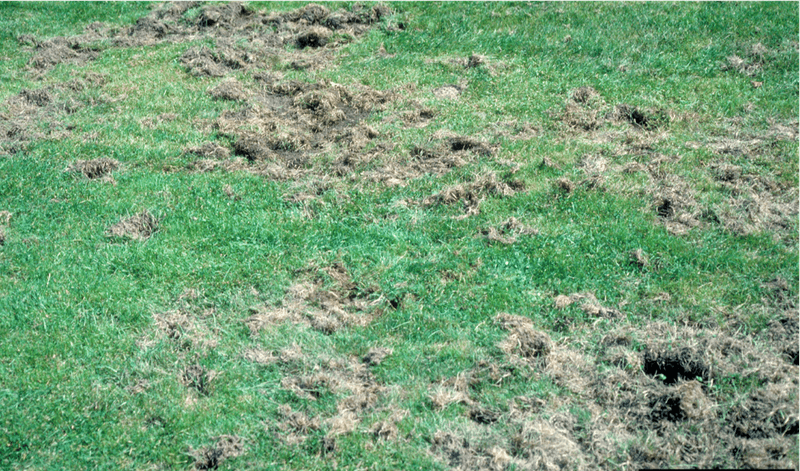
Walk across your North Carolina lawn right now and the soil beneath your feet may be quietly hosting a few dozen hungry white grubs, or it may be completely fine. The Japanese beetles that swarmed your roses and grape leaves back in July are gone, but their eggs hatched weeks ago, and the resulting grubs have been feeding on grass roots ever since. Whether that adds up to a real problem depends on what you actually find when you look, and looking is the whole point of this article.
Grubs May Be Below Your Feet
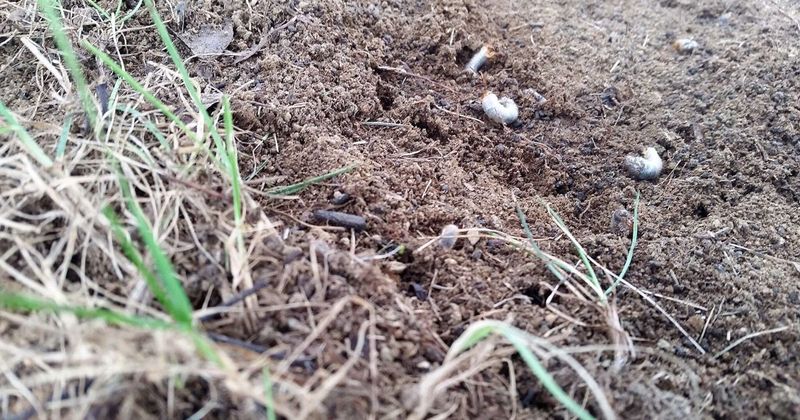
Adult Japanese beetles (Popillia japonica) do their damage above ground, chewing through the leaves, flowers, and fruit of more than 275 plant species during summer. The grub stage is a completely different story. While adults are feeding on your dogwoods and hydrangeas in July, mated females drop down to grassy areas, burrow about 2 to 4 inches into the soil, and lay their eggs. According to NC State Extension’s arthropod pest guide for North Carolina turf, those eggs hatch in roughly 10 to 14 days, and the resulting larvae spend the rest of summer and early fall feeding on the roots just beneath your grass.
Here is where people often get the first piece wrong. The beetles you watched skeletonize your rose canes may have flown in from a neighbor’s yard, a nearby pasture, or an unmanaged grassy area down the road. Females do not lay every egg in the lawn where adults were seen. Seeing heavy adult activity does not prove that your turf now holds damaging grub numbers, and it does not mean the opposite either.
As fall soil temperatures drop, grubs move deeper to overwinter and become much harder to reach with any surface treatment.
NC State’s pest profile for Japanese beetles notes that the species occurs statewide, with heavier pressure reported in the mountains and central Piedmont, though timing varies with weather and elevation. Coastal Plain soils warm and cool differently than Piedmont red clay or mountain loam, so the grub calendar is not the same everywhere. The only way to know whether your lawn actually has a problem is to go look.Early Fall Matters More Than A Calendar Date
Timing a grub treatment is less about picking a date on the calendar and more about reading what the soil is doing right now. Small, newly hatched grubs feed aggressively near the surface through late summer and into early fall, which is exactly when a properly labeled curative product has the best chance of reaching them. Once soil temperatures fall and grubs move deeper to overwinter, many rescue treatments become far less reliable.
North Carolina complicates this because the state spans USDA zones 6a in the mountains all the way to 8b along the coast. A Piedmont homeowner in Wake County and a mountain homeowner in Henderson County are not on the same grub schedule. NC State’s turf arthropod guide frames the curative window as late summer into early fall, after significant rainfall, when grubs are active and close to the surface. That description ties timing to soil conditions and weather, not to a rigid October date.
Your North Carolina Garden Changes Every Week. Your Plan Should Too.
Gardening in North Carolina changes quickly throughout the season. Every Friday you’ll receive a simple weekly plan showing exactly what to plant, prune, fertilize, harvest, and protect so you never miss the right timing.
Rainfall matters a lot here. NC State’s turfgrass pest management manual recommends applying curative products roughly 24 to 72 hours after a significant rain event, when grubs are actively feeding near the soil surface. A late application after grubs have already dropped deeper for winter is not a dependable strategy, and it will not meaningfully reduce next summer’s adult beetle pressure regardless. University of Minnesota Extension’s Japanese beetle resource makes clear that adult beetles are strong fliers and can arrive from outside any treated area, so late-season grub work should be understood as lawn protection, not beetle prediction.
Identify The Grub Before Choosing A Treatment
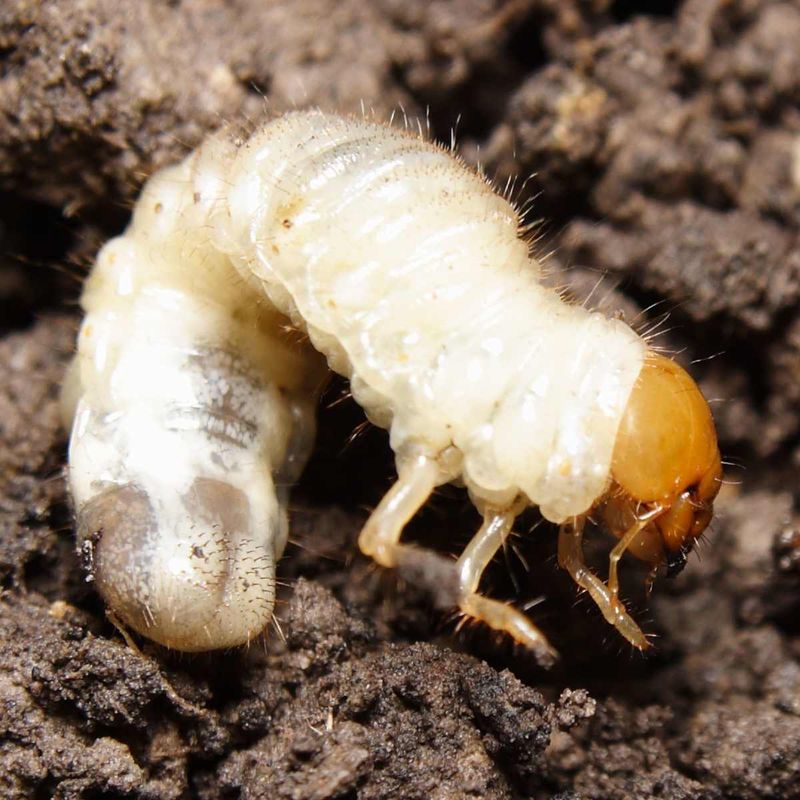
Not every white grub curled up in your lawn is a Japanese beetle larva, and the distinction genuinely matters. North Carolina turf hosts several scarab species whose larvae look similar at a glance but differ in size, behavior, life cycle, and how they respond to control products. Treating for the wrong grub wastes money and exposes your yard to chemicals that may not be needed.
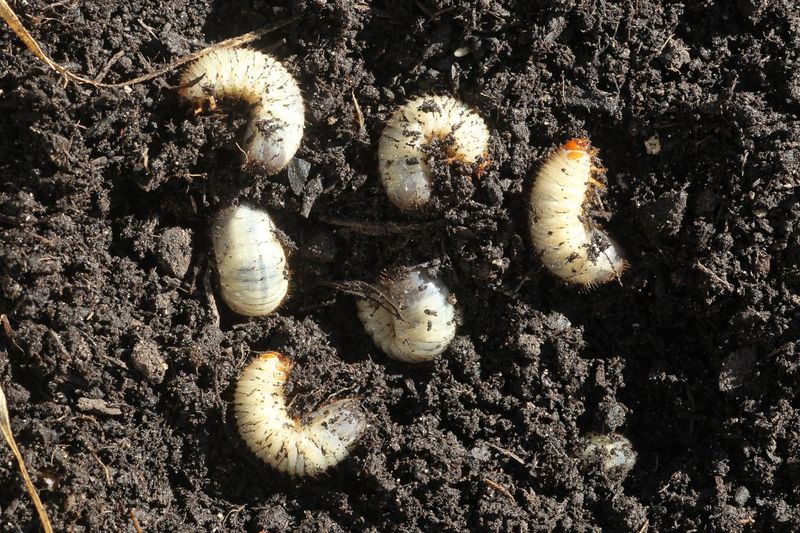
Japanese beetle grubs are cream-colored, C-shaped, and grow to about 1 inch long when mature. They have a rounded brown head and three pairs of small legs near the front of the body. NC State’s white grubs in turf publication identifies several other common scarab larvae in North Carolina lawns, including masked chafers, May or June beetles, and Asiatic garden beetles. Each species has its own life cycle and damage pattern.
Green June beetle larvae (Cotinis nitida) are a particularly common source of confusion in the Piedmont and Coastal Plain. According to NC State’s green June beetle profile, these larvae are noticeably larger, often reaching 1 to 2 inches in length, and they do not curl into the tight C shape typical of Japanese beetle grubs. Green June beetle larvae also crawl on their backs rather than curling up when disturbed, which is a reliable field clue. Their feeding behavior and the damage they cause to turf differs from Japanese beetle grubs as well.
NC State’s arthropod turf guide is a useful starting point for confirming what species you are actually looking at before you make any treatment decision.
Brown Turf Does Not Prove A Grub Problem
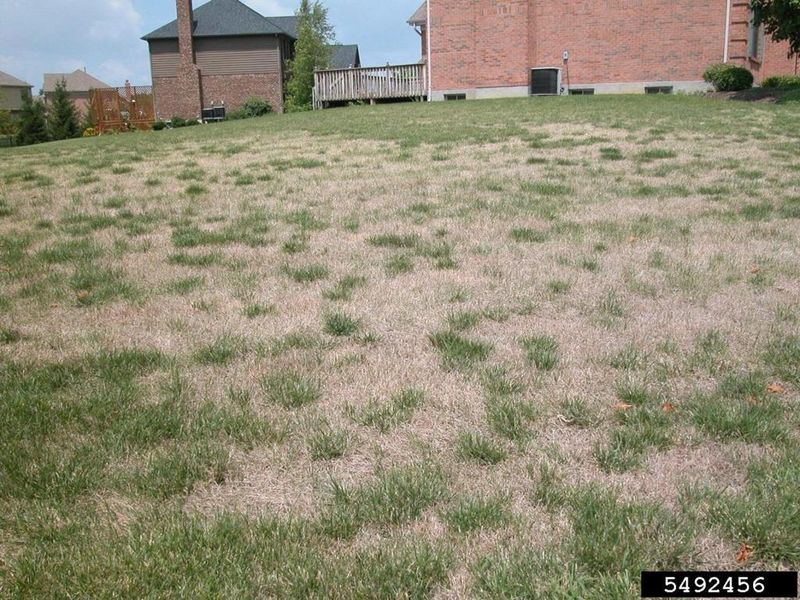
Plenty of things can turn a North Carolina lawn yellow or brown in late summer, and most of them have nothing to do with grubs. Drought stress, fungal diseases, soil compaction, poor irrigation coverage, and thatch buildup can all produce the same sad, patchy look that grub feeding causes. Treating for grubs when the real culprit is summer drought is a common and avoidable mistake.
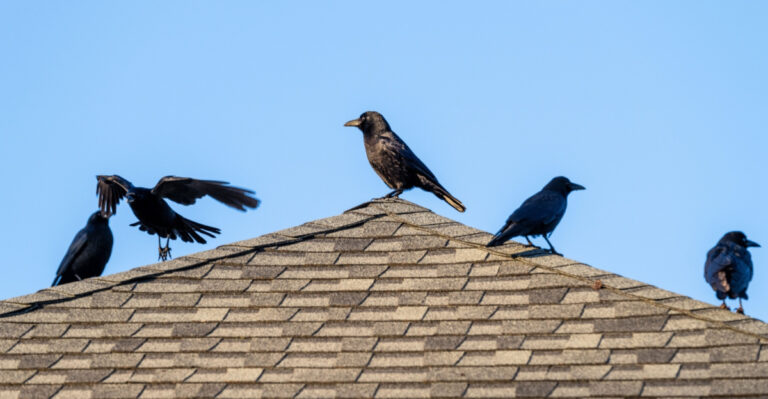
A few clues point more specifically toward grub activity. Turf that lifts away from the soil easily, almost like a loose rug, has likely had its root system eaten away. Skunks, crows, and armadillos digging up sections of lawn overnight are a strong hint that something edible is below the surface. Even then, animal digging tells you that grubs are present somewhere, not necessarily that they are present in damaging numbers.
NC State’s turf arthropod guide notes that discolored turf alone is not proof of a grub infestation.
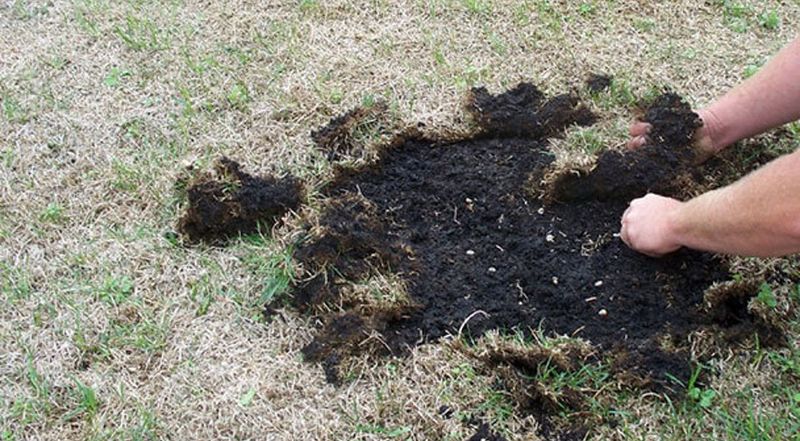
The only way to know for certain is to scout. Cut three sides around several one-square-foot sections of turf in the affected area, peel the sod back like a flap, and inspect the upper 2 to 4 inches of soil and roots. Count every grub you find, then replace and firmly press the sod back into place. Penn State Extension’s white grub guide emphasizes sampling more than one location because grubs tend to cluster rather than spread evenly across a lawn.
A single sample from the worst-looking spot can mislead you in either direction, so check at least three to five areas before drawing any conclusions.
Count Before You Treat
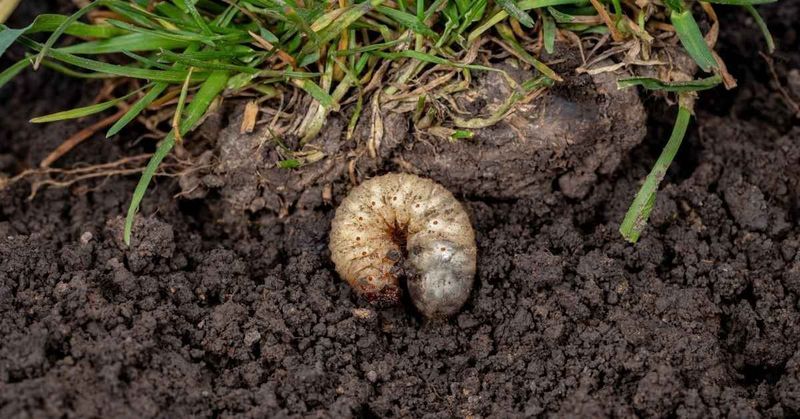
Once you have scouted several spots and counted your grubs, the next question is straightforward: do the numbers and the turf condition actually justify a treatment? NC State’s general guidance, laid out in the turfgrass pest management manual, puts the treatment threshold at roughly five or more grubs per square foot averaged across your samples. That number is a starting point, not an absolute law.
A healthy, high-value lawn, say a Bermuda grass stand in the Sandhills that you have invested years into, might justify action at a slightly lower count. A thin fescue lawn in a shady mountain yard that was already struggling before the beetles arrived might make more sense to repair or reseed rather than treat. Animal digging can also push the decision, because a lawn being torn apart by skunks every night is suffering real damage even if the grub count sits right at the threshold. The point is that your count is evidence, and evidence leads to a proportional response.
For an active infestation caught in early fall while grubs are still near the surface, NC State’s turf arthropod guide recommends applying curative products after a significant rainfall event, generally within 24 to 72 hours, when grubs are feeding actively. Whatever product you consider, the label is the legal document that governs everything: the target pest, the turf type, the application rate, the watering requirements, and whether residential use is permitted in North Carolina. EPA guidance on pesticide labels makes clear that the label is legally enforceable, and product registrations change over time, so an old recommendation or a remembered brand name is not a substitute for reading the current label. Some active ingredients carry specific restrictions around flowering plants and bee foraging areas, and those restrictions must be followed exactly.
A Treated Lawn Cannot Block Every Beetle
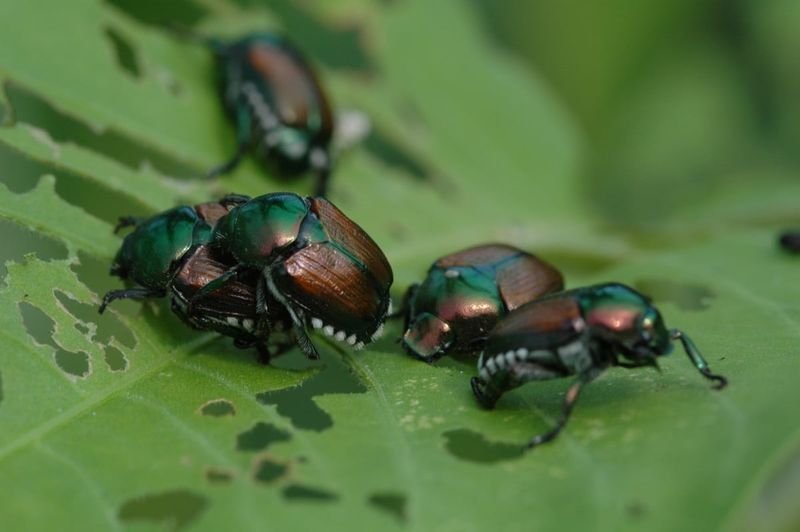
Here is the central thing worth understanding before you spend a fall afternoon treating your lawn: reducing grubs in your yard may protect your grass roots, but it will not build a wall around your property that keeps adult Japanese beetles out next summer. Adult beetles are strong fliers. They can cover significant distances from untreated lawns, neighboring landscapes, pastures, and managed turf areas that are simply out of your reach.
University of Minnesota Extension’s Japanese beetle resource explains that grub control in a single yard does not reliably reduce the adult beetle pressure in that same yard the following season, because so many of those adults originate elsewhere. Purdue Extension’s landscape management materials reinforce the same point: adult beetle populations are a neighborhood-scale problem, not a one-yard problem.
What fall grub control can realistically deliver is a lawn with less root damage, fewer bare patches, and less animal digging through winter. That is a meaningful outcome, especially if your turf count came back above threshold and your grass was already showing stress. What it cannot deliver is a guarantee that your roses, grapes, hydrangeas, or dogwoods will see fewer beetles next July.
NC State’s pest management chapter for wine grapes addresses this distinction directly in the context of ornamental and fruit crop protection.Protect the turf when the evidence supports it, and plan separately for the plants above ground.
Use Evidence Instead Of Panic
A calm, evidence-based approach to grub season beats a panicked trip to the garden center every time. The checklist is short: inspect the damaged turf, identify the grub species, count samples from several locations, and treat only when the numbers and turf condition justify intervention. When they do not, repair or reseed the thin areas and move on.
Two popular shortcuts are worth setting aside. Japanese beetle traps, the kind with the floral and pheromone lures, do not reduce grub populations in the lawn. University of Minnesota Extension’s beetle trap article explains that traps may actually draw more adult beetles toward your ornamental plants than would have arrived otherwise. Milky spore, a bacterial biological control sometimes marketed as a one-time solution, shows inconsistent results in modern university trials.
NC State’s white grubs in turf publication lists it as a biological option while noting that outcomes are variable, not guaranteed.
Careful scouting does something else worth mentioning. When it reveals that grub numbers are below the treatment threshold, you avoid applying a pesticide that would have exposed beneficial insects, soil organisms, and other non-target life to unnecessary chemical pressure. NC State Extension’s integrated pest management handbook frames this as the core logic of evidence-based pest control: treat when the evidence supports it, skip it when it does not. Your lawn does not need a rescue it does not require, and the most capable thing a North Carolina homeowner can do this fall is look before they act.