What To Do If You Spot A Giant Lizard That Doesn’t Belong In Your Arizona Yard
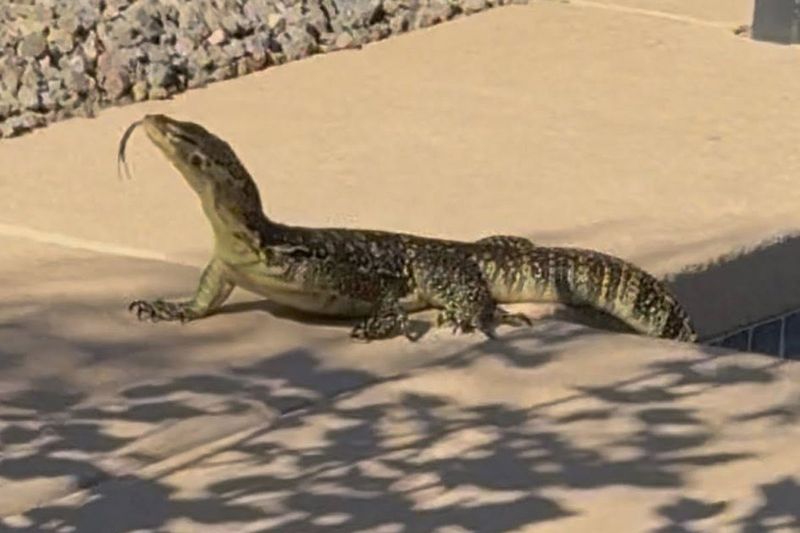
Spotting a large lizard in your Arizona yard can stop you in your tracks, especially when the animal looks bigger or stranger than anything you have seen before. Before you panic or reach for a shovel, take a breath, because the low desert is home to native lizards that can grow close to two feet long and look genuinely surprising up close.
Knowing how to read what you are seeing, keep your family safe, and reach the right agency makes all the difference between a scary afternoon and a story you tell your neighbors.
A large lizard may still belong in Arizona
Seeing a lizard that seems too big for your yard does not automatically mean something has escaped from a zoo or a private collection. Low-desert Arizona is home to native species that can genuinely approach two feet in length, and a sighting of one in a Phoenix or Tucson backyard is not as unusual as it might feel in the moment.
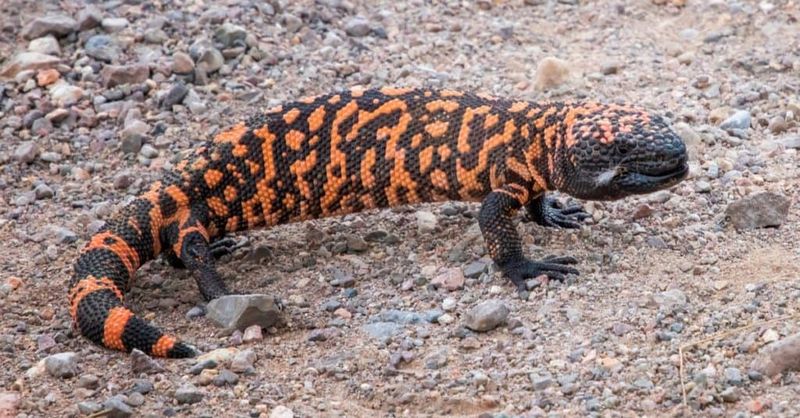
Two native possibilities deserve your attention first. National Park Service guidance on Gila monsters confirms they are the largest lizards native to the United States and can reach roughly 22 inches.
The common chuckwalla, also native to Arizona’s low desert, can grow to approximately 20 inches and is frequently spotted near boulder piles and rocky outcroppings.
Both species are documented in the Upland Sonoran Desertscrub habitat that covers much of the greater Phoenix and Tucson regions. Size and unfamiliarity alone cannot tell you whether a lizard is native, a captive escapee, or something nonnative.
The right move is to treat the sighting as an identification and reporting question, not an automatic emergency requiring removal.
Use visible traits as clues, not a verdict
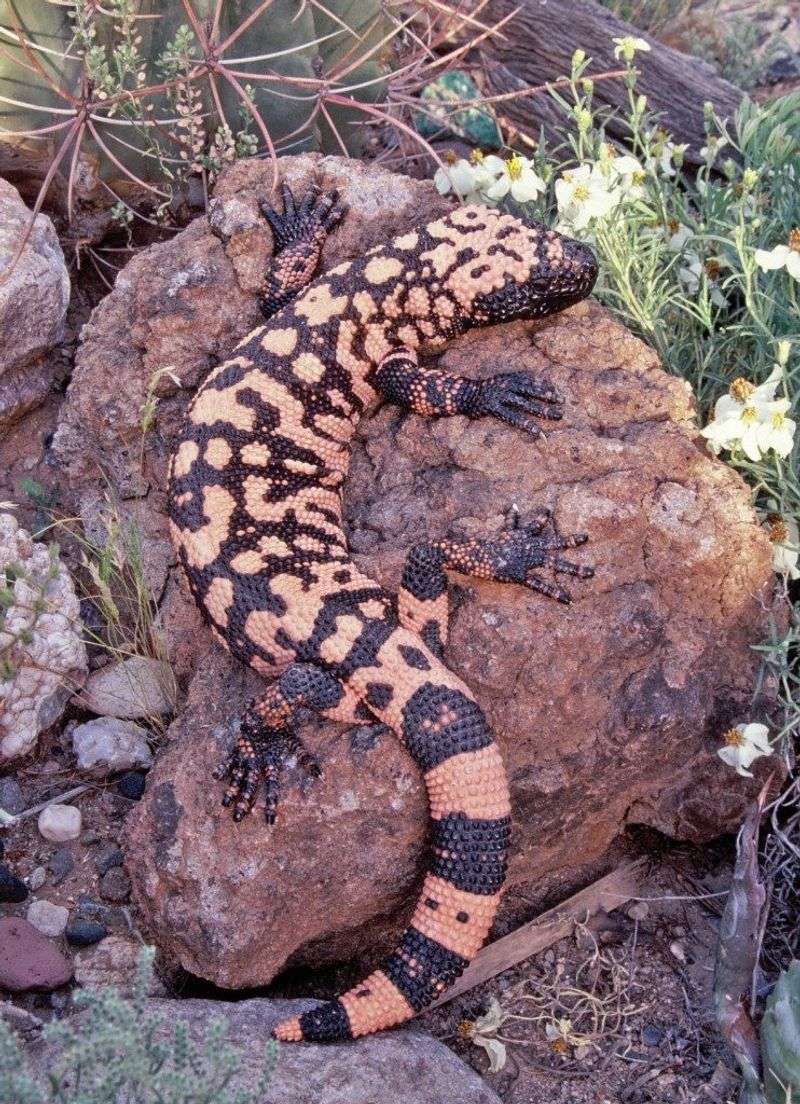
Body shape, scale texture, color pattern, and tail structure can help you narrow down what you are looking at, but they cannot replace a professional identification. Use these clues to inform your report, not to reach a firm conclusion on your own.
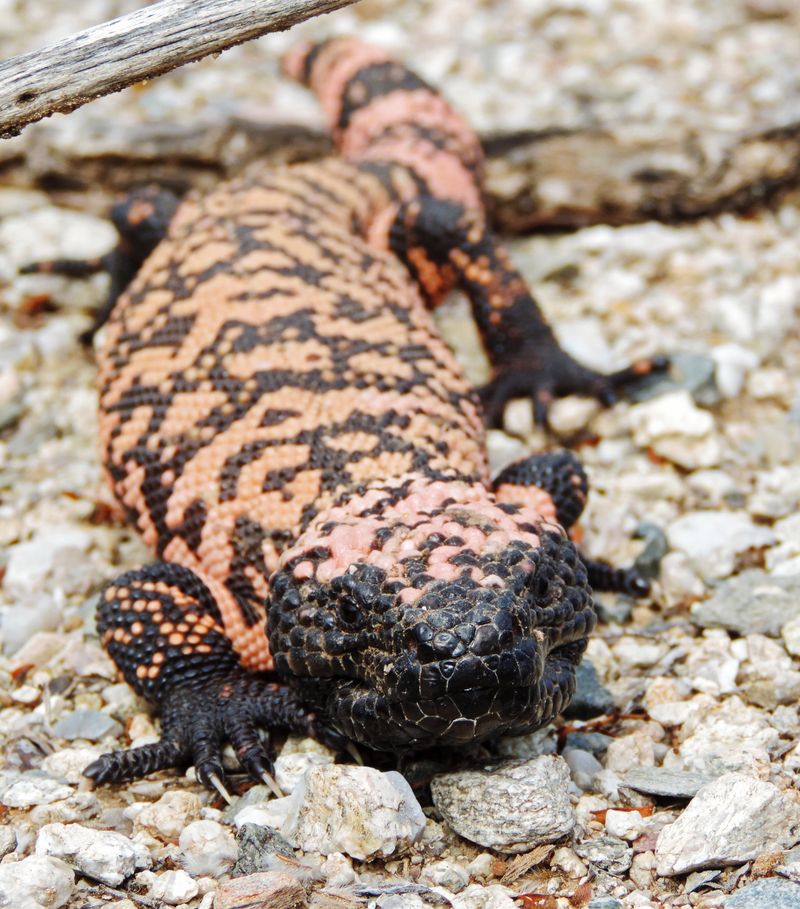
A Gila monster is hard to mistake once you know what to look for. It has a heavy, stocky body covered in rounded, bead-like scales, a thick tail that stores fat reserves, and a bold pattern of black combined with orange or pink banding.
The head is broad and flat. A chuckwalla, by contrast, has a flattened, thick body with loose folds of skin along its sides, a blunt rounded tail, and a tendency to wedge itself tightly into rock crevices when threatened.
Chuckwallas are herbivores and generally avoid confrontation.
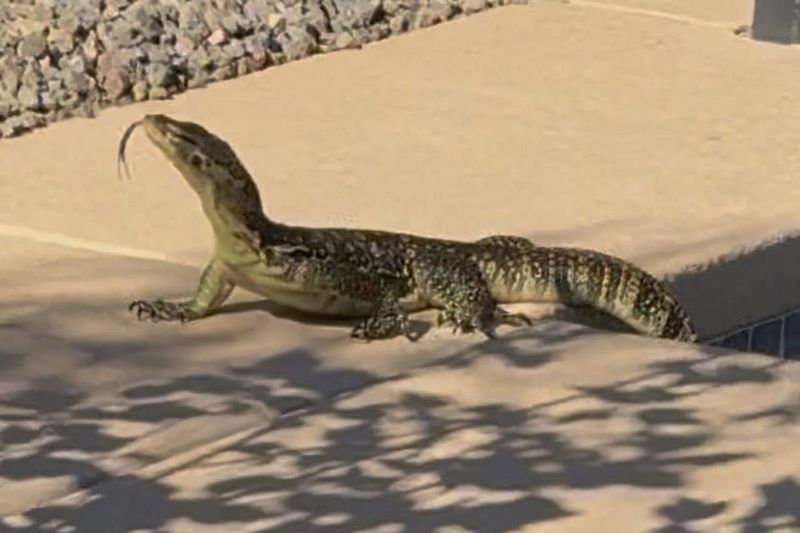
An unfamiliar lizard that looks like a monitor, tegu, iguana, or bearded dragon, featuring long slender limbs, a narrow head, or a distinctly non-desert color pattern, may point toward a captive origin. Even so, appearance alone is not proof.
Create distance before you investigate
Your first move should happen before you take a single photograph or make a single phone call. Move children and pets indoors or behind a solid barrier right away.
A curious dog or a toddler who gets too close to a large lizard, native or otherwise, is the most likely way a calm situation turns into a medical emergency.
Your Arizona Garden Changes Every Week. Your Plan Should Too.
Gardening in Arizona changes quickly throughout the season. Every Friday you’ll receive a simple weekly plan showing exactly what to plant, prune, fertilize, harvest, and protect so you never miss the right timing.
Once people and pets are clear, back away slowly and give the animal room to leave on its own. Do not surround it, chase it toward a wall or fence, or block the path it came from.
Cornered animals, including those that are not naturally aggressive, may respond defensively when they have no exit. Grabbing the tail is equally off-limits: it does nothing useful and puts your hand close to the animal’s mouth.
Gila monsters in particular are not known for seeking out confrontations with people. National Park Service information confirms that bites typically happen when a person handles the animal, harasses it, or places a body part near its mouth.
Keeping a respectful distance, at least several feet, protects you and gives the lizard the chance to move off on its own schedule. Distance and noninterference are the two tools that keep everyone safe without turning an interesting sighting into a genuine problem.
Document the sighting without approaching
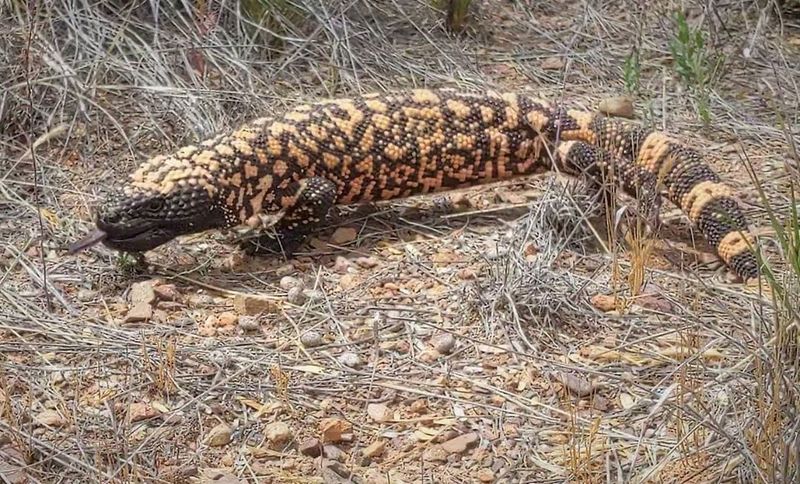
Good documentation helps wildlife professionals respond faster and more accurately, and you can gather most of what they need without moving an inch closer to the animal. Start with photographs that show as much of the lizard as possible: the head shape, the body pattern, the tail, and the feet.
Include the surrounding environment in at least one frame so an agency can place the sighting in context.
The National Park Service’s Gila Monster Project asks citizen observers to photograph Gila monsters from a safe distance without disturbing the animal, and that standard applies here regardless of species. A blurry image taken from a safe distance is more useful than a sharp close-up that required you to approach or corner the lizard.
Never justify getting closer by telling yourself the shot will be worth it.
Beyond photographs, write down or voice-memo the details that a photograph cannot capture. Record the date, the time, your exact address or nearest cross streets, the direction the animal was traveling, and your best estimate of its length.
Note anything that suggests captive origin, such as a colored tag, a microchip scanner bump on the neck, clipped claws, or the presence of a nearby enclosure or escaped-pet notice. All of these details give the responding agency a clearer picture before they ever arrive on scene.
Match the report to the situation
Not every unusual lizard sighting calls for the same response, and routing your call correctly saves time for you and for the agencies involved. The situation you are facing falls into one of a few categories, and each one has a matching contact.
When you are unsure what species you are looking at, when the animal appears to be wild, or when you have a general public-safety question, Arizona Game and Fish Department is your first call at 602-942-3000. They handle native wildlife questions and can advise on next steps based on your description and photographs.
The Arizona Department of Agriculture confirms that wildlife matters fall under Arizona Game and Fish, while loose or stray animals that appear to be pets should go to local animal control or law enforcement.
If the lizard looks like a pet, shows signs of captivity, or is clearly not a native species, contact your local animal control agency. In Maricopa County, Maricopa County Animal Care and Control can be reached at 602-506-7387.
In Pima County, Pima Animal Care Center lists 520-724-5900, with extension 4 for immediate animal-protection assistance. A qualified reptile rescue is another option if animal control cannot respond quickly.
Operation Game Thief at 800-352-0700 is the right call when you have direct evidence of a wildlife violation, meaning someone illegally releasing, selling, collecting, or possessing wildlife. It is not the appropriate line for simply seeing an unfamiliar lizard.
Reserve 911 for a situation where the animal poses an immediate physical threat to a person or is creating an active hazard on a roadway.
An unusual reptile is not automatically invasive
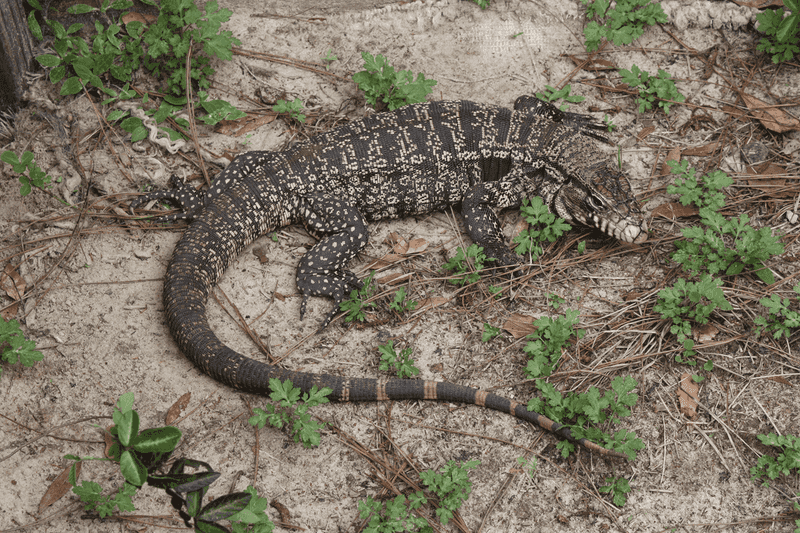
Seeing a lizard that looks nonnative is understandably alarming, but a single sighting does not mean Arizona has a new invasive species on its hands. Context and data matter a great deal before any conclusion like that can be drawn.
USGS researchers who track nonindigenous reptile introductions distinguish carefully between three very different situations: an isolated waif sighting of one or a few animals, a failed introduction where a nonnative animal appeared but did not reproduce, and an established reproducing population that has genuinely taken hold. Many escaped or released reptiles fall into the first category and never advance further.
A documented Arizona common water monitor record, for example, was attributed to probable pet escape and was not classified as an established U.S. population.
Whether any individual escaped reptile can survive, let alone reproduce, in Arizona’s specific microclimate depends on the species, the season, available food and shelter, and a range of ecological factors that a homeowner cannot assess from a yard. Photographs, location details, and an accurate agency report are what move a sighting from neighborhood rumor to documented data.
Your job is to provide that information clearly; determining whether it represents a broader concern belongs to the professionals reviewing it.
Treat a bite as a medical emergency
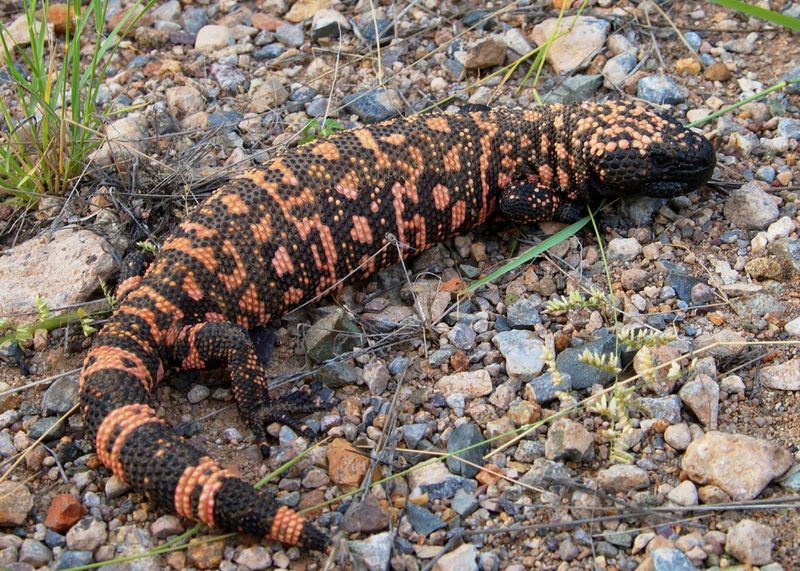
A Gila monster bite is medically serious and requires prompt emergency care. The venom is delivered through grooved teeth along the lower jaw, and because the animal tends to hold on and chew rather than strike and release, prolonged contact can increase exposure.
That said, bites are genuinely rare and almost always happen when someone handles, harasses, or accidentally places a hand or foot near the animal’s mouth.
If a bite occurs, the priority is getting away from the animal and getting to a medical facility without delay. Do not attempt to pry the lizard off by hand or with a tool.
Move away from it, keep the affected limb as still as possible, and remove rings, bracelets, or anything else that could restrict circulation as swelling develops. Arizona Cooperative Extension bite guidance specifically warns against applying ice, cutting the wound, using a tourniquet, applying electric shock, or consuming alcohol or drugs, all of which can worsen outcomes.
Call 911 or have someone drive you to the nearest emergency room. Bring your photographs of the animal if you have them, since the species identification can help medical staff assess the situation.
Treatment decisions belong to medical professionals; amateur attempts to manage the wound or recapture the animal after a bite only add risk to an already serious situation.
Do not move or release the lizard yourself
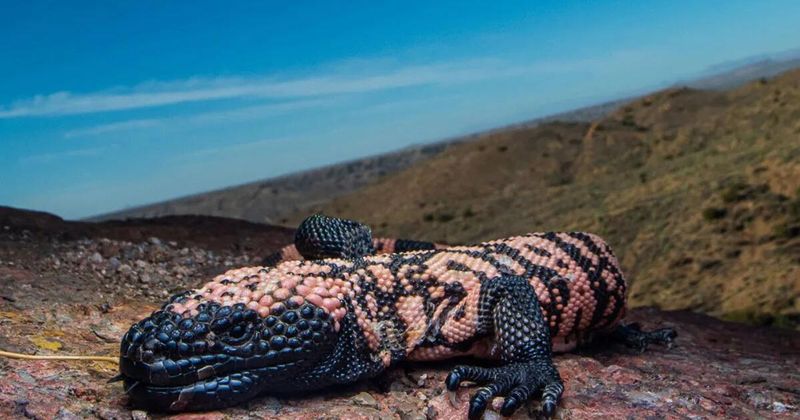
Once the area is secure and the report is made, the hardest instruction for many homeowners to follow is simply waiting. Moving or releasing the lizard yourself, regardless of your intentions, can cause real harm to the animal and may create legal problems for you.
Relocating a native lizard to another part of the desert sounds harmless but can separate it from the specific food sources, shelter sites, and established range it depends on for survival. Arizona Game and Fish guidance on keeping wildlife wild reinforces that well-meaning interventions often do more damage than leaving the animal alone.
A chuckwalla pulled from its boulder pile and dropped half a mile away faces a genuinely difficult recovery.
Releasing a suspected captive or nonnative animal into the desert carries a different set of risks. Unauthorized release may violate Arizona wildlife law, and introducing a nonnative animal, even one that seems unlikely to thrive, can create unpredictable ecological consequences.
The Arizona Department of Agriculture notes that wildlife matters are governed by Arizona Game and Fish, which means releasing an animal without authorization is not a gray area.
For a dead or visibly ill lizard, do not handle it bare-handed. Photograph it from a distance and contact Arizona Game and Fish, local animal control, or another appropriate wildlife professional for instructions specific to your situation.
No single universal protocol covers every species or circumstance. The sequence that protects everyone is straightforward: create distance, document safely, call the matching agency, and let trained professionals decide what comes next.
The lizard got along fine before you spotted it.