Why Planting Crape Myrtles Too Close Can Backfire In Florida

Crape myrtles are one of Florida’s most reliable flowering trees. Beautiful bark, summer blooms, heat tolerance that most plants can only dream about.
And yet Florida yards are full of crape myrtles that look nothing like what the homeowner originally planted them for.
However, the tree is not the problem.
One decision made before the first hole was dug created most of the issues that show up years later. One detail that many homeowners skip at the nursery sets the entire trajectory of how the tree performs for the next several decades.
Have you ever wondered why two identical crape myrtles planted in the same yard can look completely different ten years later?
The answer usually comes down to a single number that nobody checked before planting.
Eight things go wrong when crape myrtles are planted too close. All of them are preventable from the start.
1. The Wrong Cultivar In Too Small A Space Sets Up Every Problem That Follows
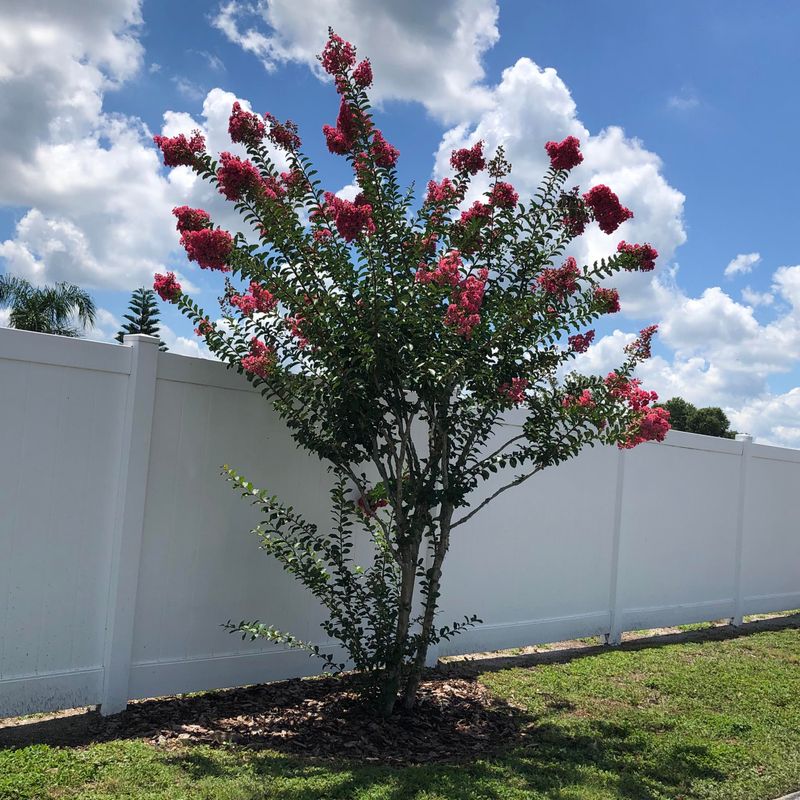
Almost every crape myrtle in a nursery row looks roughly the same in a container. Two feet tall, full of potential, completely concealing the fact that one of them will eventually reach thirty feet and the one next to it will top out at four.
That gap between container size and mature size is where most Florida crape myrtle problems begin.
Dwarf cultivars like Pocomoke or Chickasaw work well in compact spots and stay genuinely manageable.
Mid-size options like Acoma or Natchez need significantly more elbow room and will eventually claim whatever space they were not given at planting.
The plant tag carries the most important number in the entire transaction: mature width. A tree that spreads fifteen feet needs fifteen feet of clearance from its neighbors. Not twelve. Not ten. Fifteen.
That distance feels excessive when you are looking at a sapling. It feels exactly right when the tree is fully established and the canopy has room to develop its natural vase shape without pressing into anything.
Most homeowners read the bloom color on the tag and stop there. The mature spread is the information that actually determines how the tree looks a decade from now.
Choosing the right cultivar for the available space is not the glamorous part of planting a crape myrtle. It is, however, the decision that controls every other outcome.
The tree will eventually become what the tag said it would. Planning for that upfront is considerably easier than managing the consequences of ignoring it.
2. Crowded Trees Stop Breathing
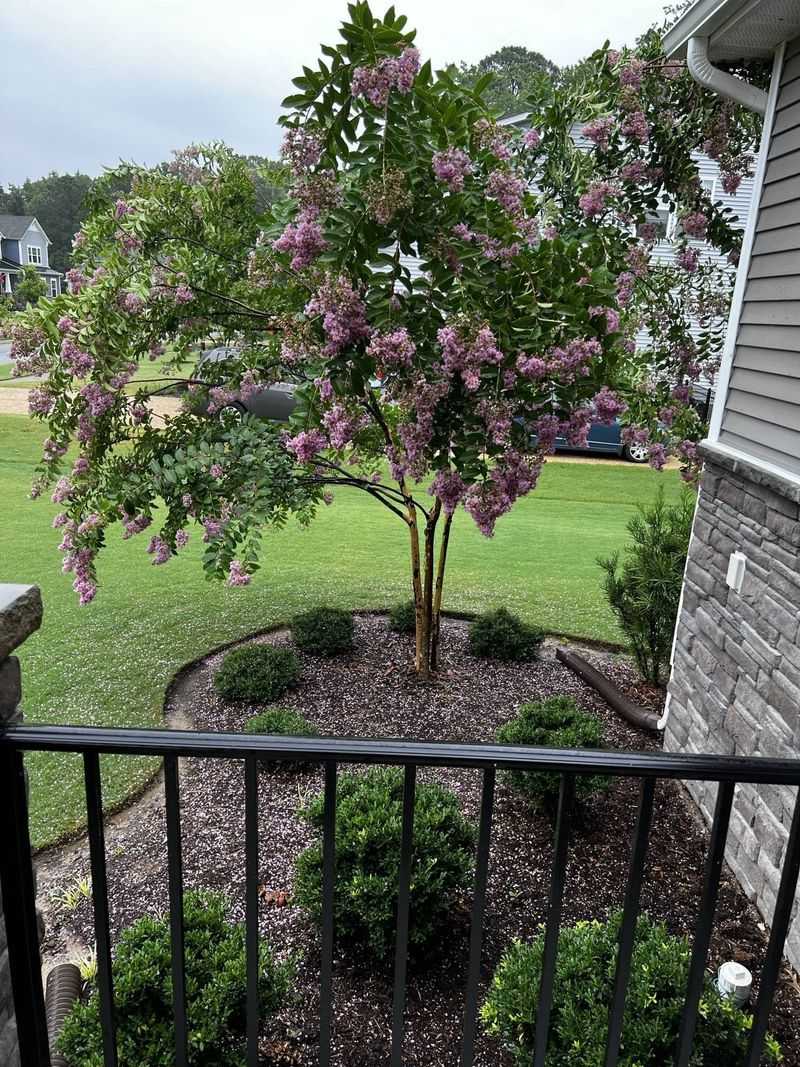
Florida summers are humid in a way that is difficult to describe to anyone who has not experienced them. The air feels thick, moisture lingers on every surface, and anything that stays wet for too long becomes a candidate for fungal problems.
Crape myrtles are generally tough, but crowd them and that toughness has limits.
When trees grow too close together, the canopy becomes a wall instead of individual structures. Air that would normally pass through the branches gets blocked.
Moisture from afternoon thunderstorms clings to leaves and bark longer than it should. That slow-drying environment is exactly what fungal spores are looking for.
Your Florida Garden Changes Every Week. Your Plan Should Too.
Gardening in Florida changes quickly throughout the season. Every Friday you’ll receive a simple weekly plan showing exactly what to plant, prune, fertilize, harvest, and protect so you never miss the right timing.
Good airflow is one of the most underappreciated factors in keeping crape myrtles healthy through a Florida growing season.
Wind moving through an open canopy carries away excess humidity, helps foliage dry quickly after rain, and reduces the conditions that fungal diseases need to establish.
The general spacing rule is practical and straightforward. Plant no closer than the tree’s expected mature width. A twelve-foot-spread tree needs twelve feet between itself and the next plant.
That gap feels significant when the trees are small. It feels completely reasonable when both trees are fully grown and still have clear air between them.
Adequate spacing also means less reliance on fungicide applications down the line. The tree’s environment does some of the protective work that would otherwise require product.
Space is not wasted when crape myrtles are involved. It is doing a job.
3. Overlapping Branches Turn A Clean Planting Into A Pruning Problem
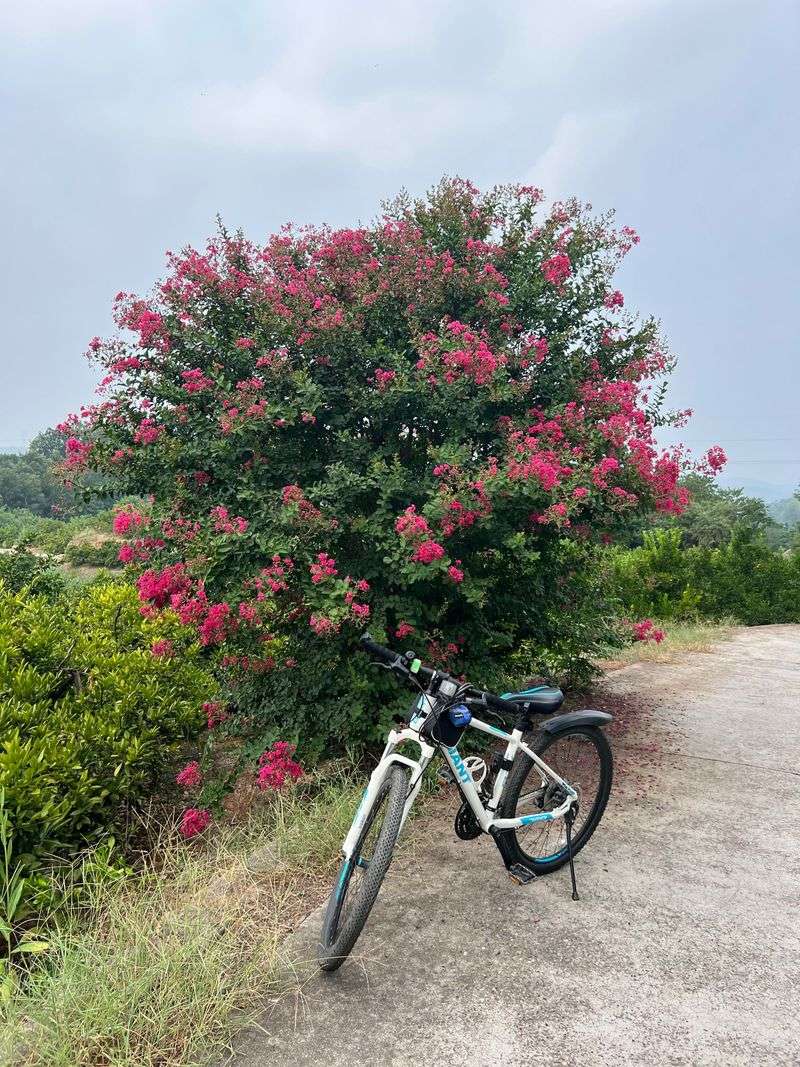
Two crape myrtles planted four feet apart look intentional and tidy for about two seasons.
Then both canopies start reaching toward each other, branches begin crossing, and what was a clean planting becomes something that requires a pruning intervention every few months just to stay recognizable.
Overlapping canopies create problems that compound over time. Crossing branches rub against each other during wind events.
Those points of contact create wounds that invite pests and pathogens into the tree’s system. Interior branches that fall into shade weaken gradually and drop, leaving bare patches in the center that no amount of pruning fully corrects.
The open, vase-shaped silhouette that makes crape myrtles so visually distinctive only develops properly when each tree has room to spread outward freely. That shape is the appeal. Crowding prevents it from forming.
Tangled crowns also turn routine care into a puzzle. Removing a single damaged branch becomes complicated when it is woven through a neighbor’s canopy.
Pest scouting gets difficult when the interior of the tree is barely visible. Everything takes longer and requires more effort than it should.
The structural health of each tree depends on developing its own form independently. Two trees sharing the same airspace are not supporting each other.
They are competing, and both show the effects of that competition over time.
Clear canopies are not a luxury. They are what keeps the trees looking like crape myrtles rather than a hedge that got out of hand.
4. Tight Spacing Turns Powdery Mildew Into A Season-Long Battle
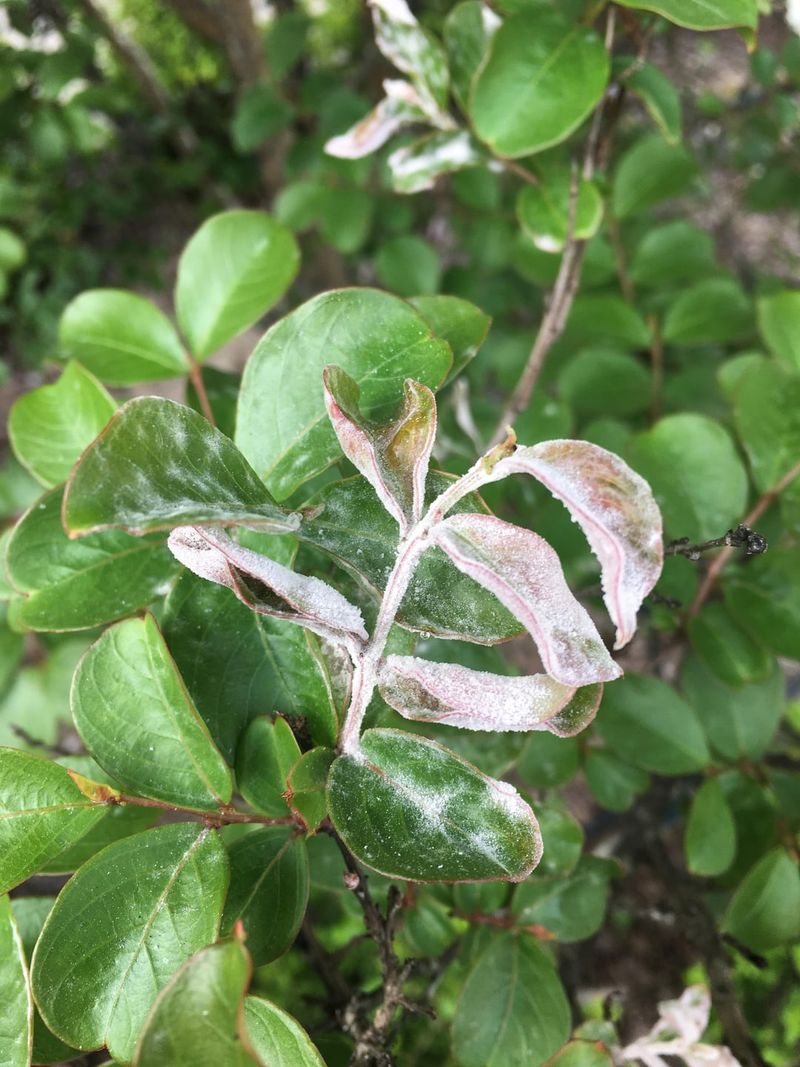
Powdery mildew is a Florida crape myrtle reality. That chalky white coating on new growth shows up reliably when humidity climbs, and humidity climbs reliably in Florida.
The question is not whether mildew pressure will arrive. It is how well the tree is positioned to handle it.
Tight spacing makes the problem significantly worse. Dense planting traps moisture, blocks light from penetrating the canopy, and creates the stagnant air conditions that powdery mildew uses to establish and spread.
A tree with some natural resistance can still struggle when its environment works against it consistently.
Plant breeders have invested considerable effort in developing cultivars that resist powdery mildew more effectively. The National Arboretum series, which includes Natchez, Tuscarora, and Sioux among others, was developed with disease resistance as a specific priority.
These cultivars handle Florida’s humidity better than older varieties and represent a meaningful upgrade for homeowners who have dealt with mildew problems in the past.
Choosing a resistant cultivar and then spacing it correctly creates two layers of protection working simultaneously.
Genetics handles what the environment cannot fully control. Spacing handles what genetics alone cannot overcome.
Skipping either step leaves the tree more exposed than necessary. Resistant cultivars planted too close together still suffer under the right conditions.
Well-spaced trees without resistance still face pressure during particularly humid stretches.
Both decisions together produce a crape myrtle that genuinely holds up through Florida’s long growing season without requiring constant intervention.
5. Shaded Canopies Stop Blooming
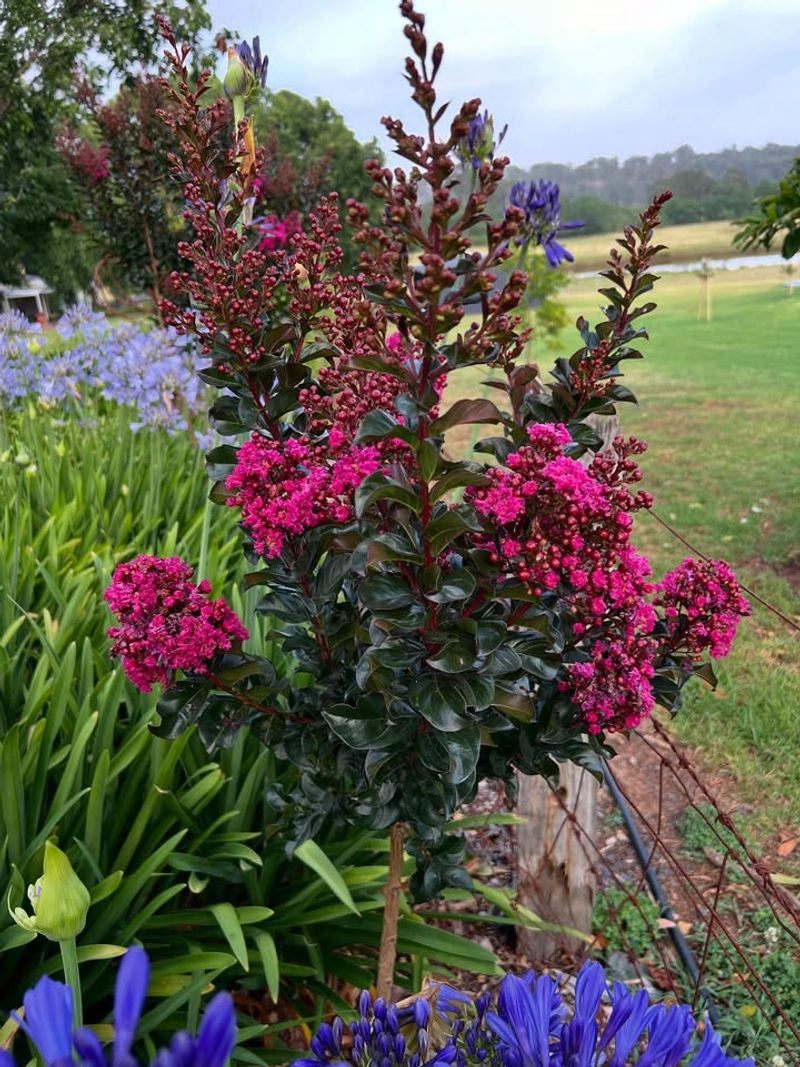
A crape myrtle loaded with blooms from top to bottom in July is one of the more satisfying sights a Florida yard can offer. That display depends almost entirely on one condition: direct sunlight for at least six to eight hours daily.
Crape myrtles mean this requirement. They are not being polite about partial shade tolerance.
When trees grow too close together, lower and interior branches quickly fall into shade. Shaded branches produce fewer flowers.
Over time they may stop blooming entirely. The tree shifts from a full flowering specimen to something thin and patchy that confuses homeowners who expected more.
Crowding also affects the competition for light among adjacent trees and nearby structures.
A crape myrtle planted too close to a fence, a larger tree, or another crape myrtle will always show a noticeable difference between its sun-facing and shade-facing sides.
That asymmetry undermines the tree’s natural symmetry in ways that selective pruning cannot fully correct.
Before planting, stand in the chosen spot at midday and look up. Note what is blocking the sky. A fence nearby, an existing tree overhead, another crape myrtle within close range, all of these reduce the sunlight budget that determines how the tree performs.
Full sun exposure is the single most important environmental factor for consistent bloom production. Everything else, fertilizer, water, pruning, supports what the sun enables.
Without adequate light, a crape myrtle produces a fraction of what it is capable of. That fraction is rarely what anyone plants them for.
6. Walls And Fences Make The Crowding Problem Significantly Worse
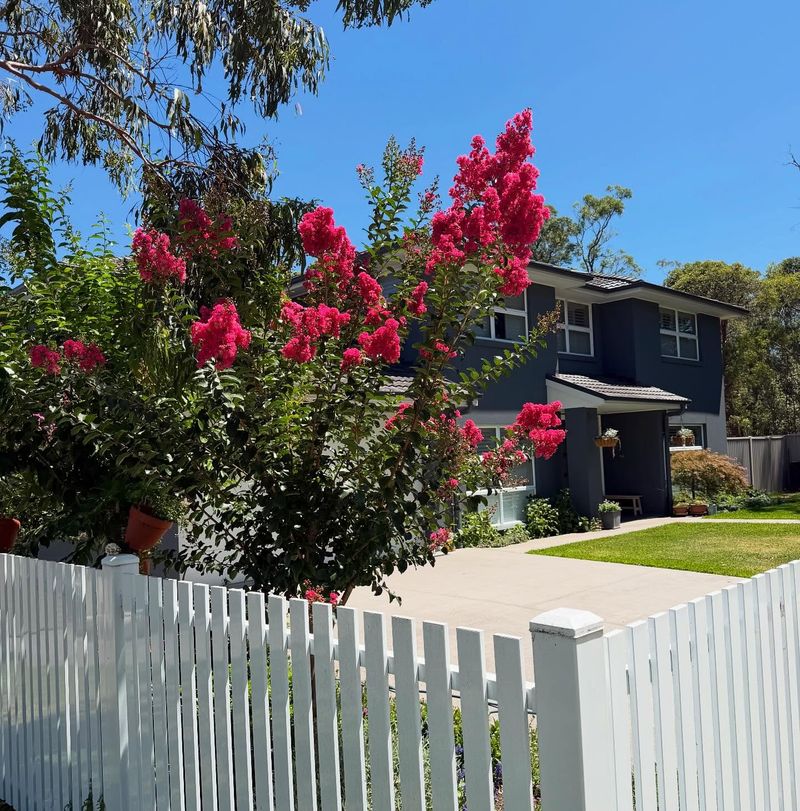
The narrow strip between a fence and a driveway looks like usable space. For a crape myrtle, it often becomes a location that creates problems steadily for years before the full extent of the mistake becomes obvious.
Walls and fences introduce conditions that open-yard planting avoids entirely. Reflected heat from masonry or light-colored surfaces pushes temperatures around the tree higher than the surrounding air.
Florida summers are already demanding, and that extra heat stress increases water demand and makes the tree more susceptible to certain pests.
Airflow near walls is consistently compromised. Wind that would otherwise pass through the canopy gets blocked, creating pockets of stagnant humid air directly around the foliage.
That trapped moisture increases fungal pressure in precisely the environment where it is already a concern.
Root expansion is limited in confined spaces. Crape myrtles need room to establish properly and anchor themselves before Florida’s storm season tests them.
A tree constrained between a wall and a hard surface develops a less stable root system than one planted in an open area.
Pruning near a wall becomes genuinely awkward. Getting behind the tree to remove crossing branches or clean up the base requires contorted angles, and many homeowners skip it rather than deal with the difficulty.
Neglected pruning allows the tree to grow irregularly and press against the structure over time.
The fence strip looks like an opportunity. For a crape myrtle that will eventually reach its full spread, it is usually a constraint that limits what the tree can become.
7. Planting Too Close Creates The Size Problem That Makes Topping Feel Necessary
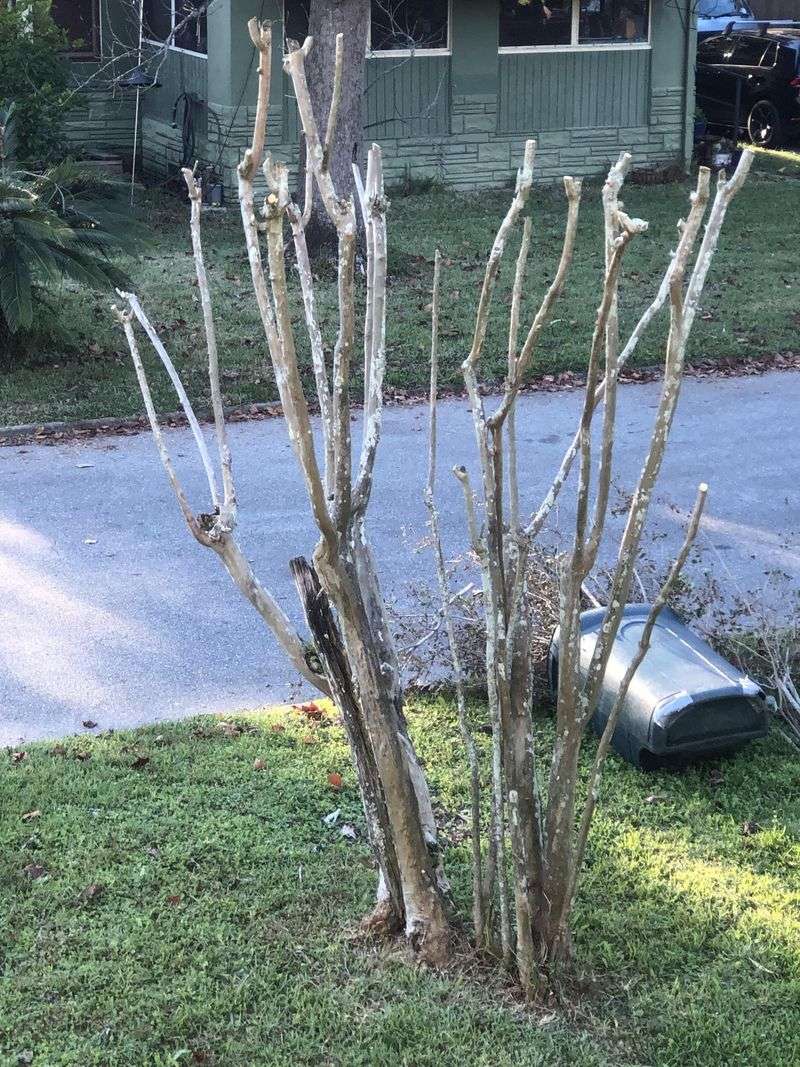
The practice of cutting crape myrtles back to thick stubs each winter to control their size is one of the most widespread and damaging habits in Southern landscaping.
Topping does not solve a size problem. It creates a sustained one.
When a crape myrtle is cut back to large stubs, it responds by sending out dozens of thin, weakly attached shoots from just below each cut.
Those shoots are structurally compromised, prone to breaking during Florida’s summer storms, and they grow back to roughly the same size the tree was before, frequently within a single season.
The underlying cause of most topping situations is straightforward. The wrong cultivar was chosen for the available space, or the right cultivar was planted too close to a structure, a boundary, or another tree.
Topping becomes an annual maintenance requirement rather than a solution because the fundamental problem was never addressed.
Correct spacing and cultivar selection from the beginning eliminates the need for severe cutting entirely. A properly placed crape myrtle needs only light corrective pruning, removing crossing branches, spent blooms, and basal sprouts, to stay in good form for decades.
That minimal approach preserves the tree’s natural structure, keeps it sound through storm season, and allows it to produce the full flower display that made it worth planting in the first place.
The topping conversation ends when the planting decision is made correctly at the start.
8. Crowded Trees Lose The Shape And Flower Display
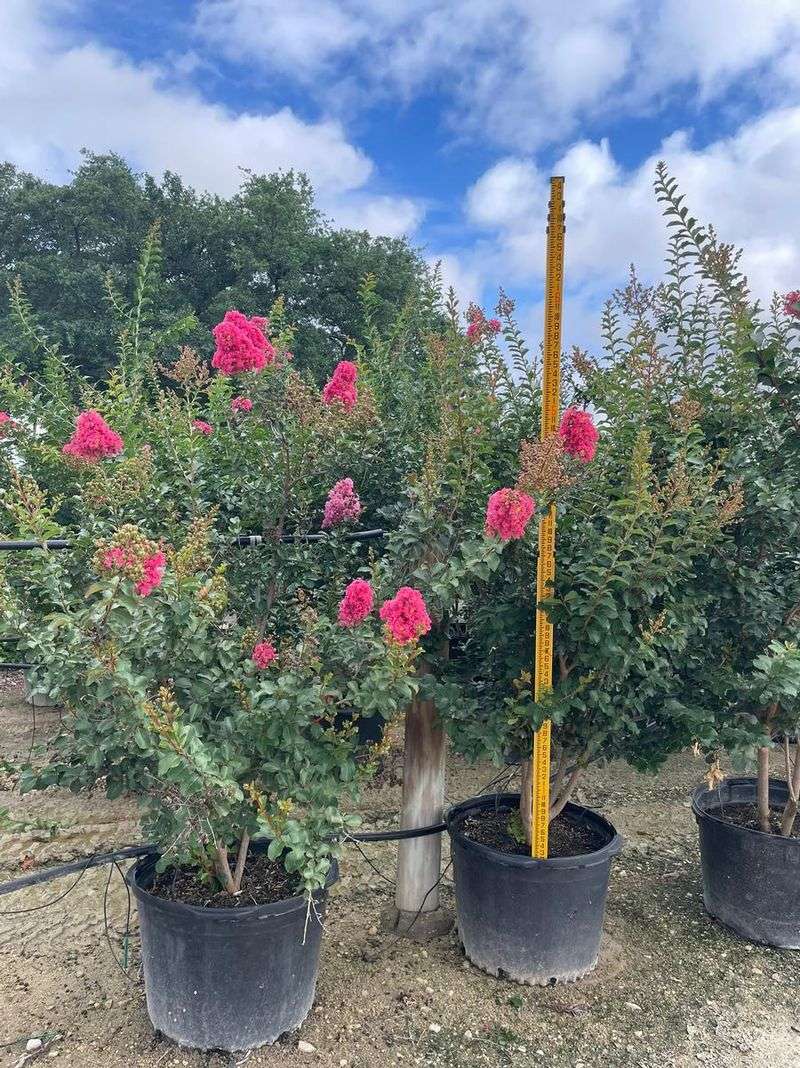
The most visually striking crape myrtle plantings consistently share one characteristic: space.
Generous space between trees that allows each one to develop its full natural form and present its flower display without competing with anything next to it.
When crape myrtles have room to grow outward freely, the graceful multi-stemmed structure becomes a design feature. The peeling, ornamental bark becomes visible from a distance.
The canopy fills evenly on all sides, producing blooms from the outermost tips through the full interior of the tree. That layered, abundant display is what most homeowners are actually aiming for when they plant these trees.
Tight planting produces a different outcome entirely.
The individual form disappears into a combined mass. Definition is lost from any reasonable viewing distance. The bark is covered by overlapping canopies. The bloom display becomes a wall of color with no structure behind it.
Proper spacing also makes a direct difference in long-term landscape health. Trees that are not competing for space maintain better overall condition, which translates to more consistent blooming across years rather than the uneven performance that stress produces.
Before planting, sketch the yard and mark the mature spread of each tree being added. That exercise typically reveals that fewer, better-positioned trees produce a considerably more impressive result than a full row of crowded ones.
A clean, open flower show carries more visual impact than a tangled thicket every time.
The trees will grow into whatever space they are given. Giving them the right amount is the entire decision.