The Mums Sold In Illinois Right Now Mostly Do Not Come Back

Every September, the front of the garden center turns into a wall of color. Orange, rust, burgundy, and gold, stacked three rows deep and priced to move.
You load two or three into the trunk, set them by the porch steps, and feel like autumn officially started. They look unstoppable, round and tight and covered in buds.
Then spring arrives, and the pots by the door stay quiet. Nothing pushes up, and the neighbor who bought the same ones has the same empty spot.
There is a reason for that, and it has almost nothing to do with how well you watered. It has to do with what you actually bought, and when you bought it.
The Real Product Behind September Mums

Here is the part almost nobody mentions at checkout. Most of those mounded, bud-covered pots stacked outside Illinois stores in September were grown as seasonal decor, not as permanent garden plants.
Growers start them in greenhouses in summer, feed them heavily, and pinch them so they form one perfect dome. The goal is a plant that looks its best for about four to six weeks on a porch.
Because of that, the roots stayed inside a small pot the whole time. All the plant’s energy went upward into flowers, not downward into a strong root system.
That difference matters more than any other single factor in whether a mum returns. A plant that spent its whole life making blooms has very little stored fuel left for surviving a Midwest winter.
Think of it a bit like a sprinter finishing a race. There is nothing left in the tank for a long walk home in the cold.
None of that makes them a bad purchase. Buying mums as a temporary seasonal display is perfectly reasonable, and lots of Illinois gardeners do it happily every year.
The trouble starts when shoppers assume the label word perennial guarantees a return. Sometimes it technically does describe the species, while the growing method and planting date work against it.
Knowing which situation you are in changes your expectations, and it changes how much you are willing to spend on twelve pots.
Florist Mums And Hardy Garden Mums Are Not The Same Plant

Two very different plants share the same friendly nickname, and that overlap causes most of the confusion. Florist types were bred for cut-flower work and indoor display, with big showy blooms on tall stems.
Hardy garden types were bred for the opposite job. They grow lower and wider, carry hundreds of smaller daisy-shaped flowers, and produce underground stems called stolons that help them spread and anchor.
Those stolons are the real secret. They let a hardy mum store energy below the soil line, which is exactly what a plant needs during an Illinois freeze-and-thaw cycle.
Florist mums skip that feature almost entirely. Their root systems stay shallow and clumpy, so winter moisture and cold reach the crown fast.
Telling them apart on a display table takes a little detective work. Hardy varieties usually list a named cultivar and sometimes mention a hardiness zone, while decorative ones often carry only a color name and a price.
Your Illinois Garden Changes Every Week. Your Plan Should Too.
Gardening in Illinois changes quickly throughout the season. Every Friday you’ll receive a simple weekly plan showing exactly what to plant, prune, fertilize, harvest, and protect so you never miss the right timing.
Nurseries that specialize in perennials tend to sell hardy stock in spring, in plain nursery pots, looking honestly unimpressive. Big-box seasonal displays in fall lean heavily toward the decorative kind.
Fun bit of history: the University of Minnesota and other northern breeding programs spent decades developing hardy mum lines specifically so cold-climate gardeners could get repeat performance.
Those bred-for-cold selections exist and they work. They simply are not what most September pallets contain.
The Calendar Problem With September Planting

Roots need warm soil and time, and September in Illinois hands out less of both every week. A newly planted perennial generally wants six to eight weeks of active root growth before hard freezes arrive.
Count backward from a typical first frost across much of the state, and the math gets tight fast. Northern Illinois often sees frost in early to mid October, with central and southern areas following within a few weeks.
Plant on September 20 and you might get three or four usable weeks. Plant in mid October, which plenty of shoppers do, and you get almost none.
Soil temperature drops even faster than air temperature feels like it should. Once soil sits below roughly 50 degrees, root activity slows to a crawl.
So the plant sits there looking fine above ground while doing very little below it. The flowers keep opening because those buds were already formed in the greenhouse.
That is the illusion that fools people. Blooming is not evidence of establishment.
Spring planting flips the whole equation. A hardy mum set out in May or June gets an entire growing season to spread stolons, deepen roots, and bank energy.
By the following winter, that same plant has a real support system underneath it. Same species, same variety, wildly different odds.
The Root Ball Problem Hiding Under All Those Flowers

Slide a September mum out of its pot and the picture explains itself. You will usually find a dense, circling mat of roots wound tightly around a block of lightweight potting mix.
Growers call that pot-bound, and it happens because the plant grew fast in a container that was intentionally small. Small pots ship better and dry down predictably for retail watering schedules.
The problem shows up after planting. Those circling roots often keep circling instead of reaching outward into the surrounding garden soil.
Meanwhile the peat-heavy mix behaves differently than clay-rich Illinois ground. Water moves between the two materials unevenly, so the root ball can go bone dry while the soil an inch away stays damp.
A little gentle work at planting time helps. Loosening the outer roots with your fingers and slicing a few vertical cuts down the sides encourages new roots to head outward.
Wide, shallow planting holes beat deep narrow ones here. Mum roots run out sideways, not straight down, so give them room in the top eight inches.
Firming soil against the sides removes air pockets that let cold reach the crown. Then water thoroughly, not just once, but every few days through October if rain stays light.
None of that turns a decorative mum into a hardy one. It does remove one of the bigger obstacles standing between the plant and next spring.
Illinois Winters Test Shallow Crowns
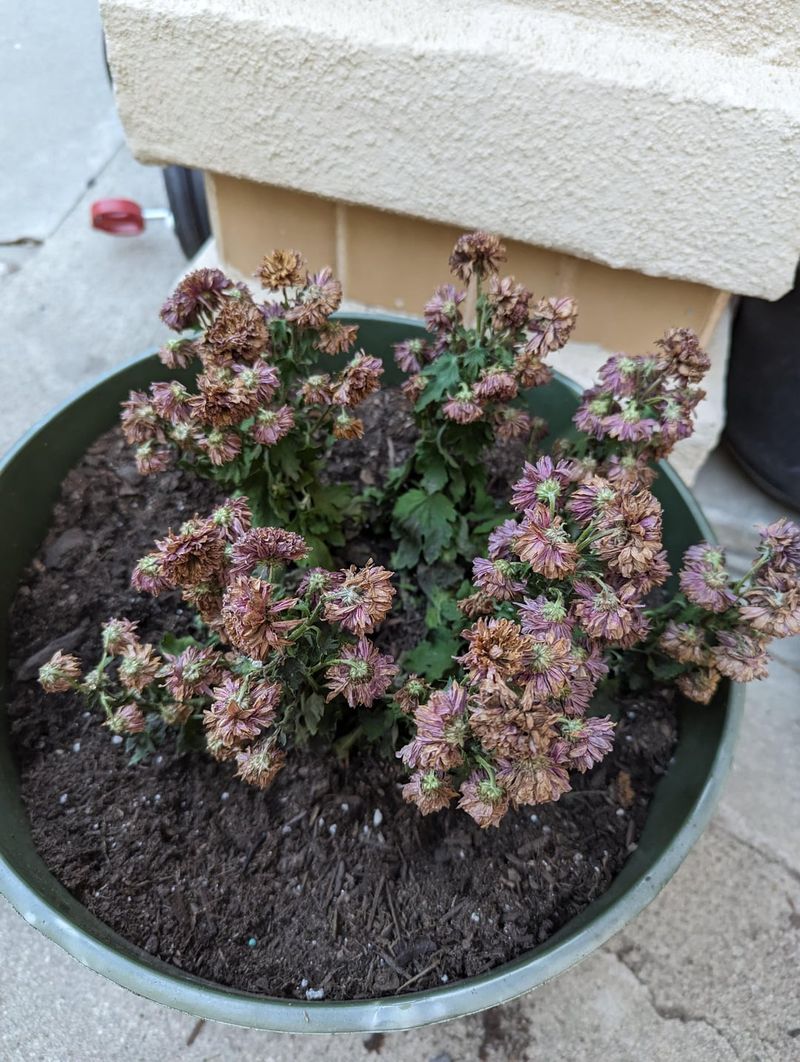
Cold alone is rarely the whole story in this state. What really tests a mum is the up-and-down swing between thaw and freeze that Illinois specializes in from January through March.
Water enters the soil during a mild stretch, then expands when temperatures drop again. That expansion physically lifts soil, a process gardeners call frost heaving.
Shallow-rooted plants get pushed upward until the crown sits exposed at the surface. Once that happens, drying wind and repeated freezing reach tissue that was supposed to stay protected.
Poorly drained clay makes it worse. Standing moisture around a crown through a February thaw is one of the most common reasons a mum fails to return.
Snow cover would help enormously, and in some winters it does. Illinois just cannot promise consistent snow, especially in the central and southern counties.
Mulch becomes the stand-in for snow. Three to four inches of shredded leaves or straw laid over the crown after the ground firms up keeps soil temperature steadier.
Timing matters, though. Mulching too early keeps soil warm and invites soft growth, so wait until after a couple of hard frosts.
Raised beds and slightly mounded planting spots also drain better than flat clay. A mum sitting on a small rise sheds winter water instead of sitting in it.
Those small adjustments do not guarantee anything. They shift the odds noticeably in your favor.
Cutting Back Too Early Costs You The Plant

Tidiness gets a lot of mums in trouble. As soon as the flowers fade in November, the instinct is to snip everything down to a neat stubble.
Those spent stems are doing quiet work, though. Standing growth traps leaves and snow around the crown, creating a natural insulating blanket right where it counts.
Stems also hold some stored energy that gradually moves back down into the crown. Removing them early interrupts that transfer.
The better move is patience. Leave the brown stems in place all winter and cut them back in early spring, once you see small green shoots at the base.
You can trim off just the faded flower heads in fall if the look bothers you. Keeping four to six inches of stem intact preserves most of the benefit.
Spring cleanup is genuinely satisfying by comparison. Snapping off dry stems to reveal fresh growth underneath is one of the first real signs of the season.
While you are there, resist the urge to fertilize heavily in autumn. Late nitrogen pushes tender new shoots that have no chance to harden before cold weather.
Feeding belongs in late spring and early summer instead. A balanced fertilizer then supports the root and stolon growth that actually carries a plant through winter.
Small habits, repeated over a season, decide whether that pot by the steps becomes a returning garden fixture.