How To Tell Fire Ant Mounds Apart From Harmless Ant Hills In Your North Carolina Yard

A pile of dirt in the lawn does not always mean trouble. Plenty of ants build small hills, and most of them will never bother you. Fire ants are the exception, and a few details give them away.
Their mounds are usually rounded domes of loose, crumbly soil. Look for the entrance. Many harmless ants leave a visible hole at the top.
Fire ant mounds often have none, because the ants tunnel in and out from below. The best clue is how they react. Poke the mound with a stick, and fire ants swarm out fast and climb.
Do it from a distance, and never with bare feet. Learning to read the signs helps you ignore the harmless hills and deal quickly with the ones that sting.
1. Fire Ant Mounds Have No Opening On Top

Sneaky builders hide their front doors, and fire ants are masters of this trick. When you look at a red imported fire ant mound, you usually will not see any hole on top. That missing entrance is one of the clearest signs you are dealing with Solenopsis invicta.
So where do the ants go in and out? Fire ants travel through a network of underground tunnels.
These tunnels often open several inches to a foot or more away from the mound itself, so the ants slip in and out at ground level where you hardly notice them.
Most harmless ants work the opposite way. Their little hills usually have a clear opening right in the top or center, like a tiny volcano. If you can see a neat hole in the middle, chances are good you are looking at a friendlier neighbor.
Checking for a hole is easy, but safety comes first. Stand a step or two back and look carefully at the top and sides of the mound. Keep your hands and feet away the whole time, because even a light bump can send angry ants pouring out.
A sunny afternoon is a great time to look. Bright light makes it easier to spot small openings, and you can quickly scan several mounds in one walk around the yard.
Here in North Carolina, fire ant mounds are common in lawns, pastures, and along driveways across much of the state.
Learning to spot a mound with no top opening gives you a fast, simple first clue. Pair it with the other signs in this list, and you will become a confident yard detective in no time.
2. Their Soil Looks Fluffy And Worked

Run your eyes over a fire ant mound and it almost looks like someone sifted flour into a pile. The soil is loose, crumbly, and fluffy, as if it has been stirred over and over. That worked texture is a big giveaway.
Fire ants are busy movers. Thousands of workers carry tiny bits of soil up from below, stacking them into a rounded dome. Inside, the mound is full of tunnels and chambers that help the colony control heat and moisture for the young ants.
Your North Carolina Garden Changes Every Week. Your Plan Should Too.
Gardening in North Carolina changes quickly throughout the season. Every Friday you’ll receive a simple weekly plan showing exactly what to plant, prune, fertilize, harvest, and protect so you never miss the right timing.
Harmless ant hills look very different. They are usually small and flat, shaped like a little crater of fine soil around a center hole. You might mistake one for a sprinkle of sand rather than a real mound.
When you walk your yard, keep an eye out for dome-shaped piles of fluffy dirt. Fire ant mounds can be just a few inches tall or grow to more than a foot high. Sometimes they seem to show up almost overnight, especially in spots you mowed just days ago.
Size can fool you, though. A young colony may build a small mound at first, so texture matters as much as height. Loose, worked soil with no top hole is a strong double clue.
North Carolina homeowners in the Piedmont often see the biggest mounds. Heavy red clay holds its shape well, so fire ants there can build especially tall, noticeable domes.
If you spot a fluffy clay hill rising from your grass, give it plenty of space and treat it as a likely fire ant home.
3. Mounds Pop Up After Rain
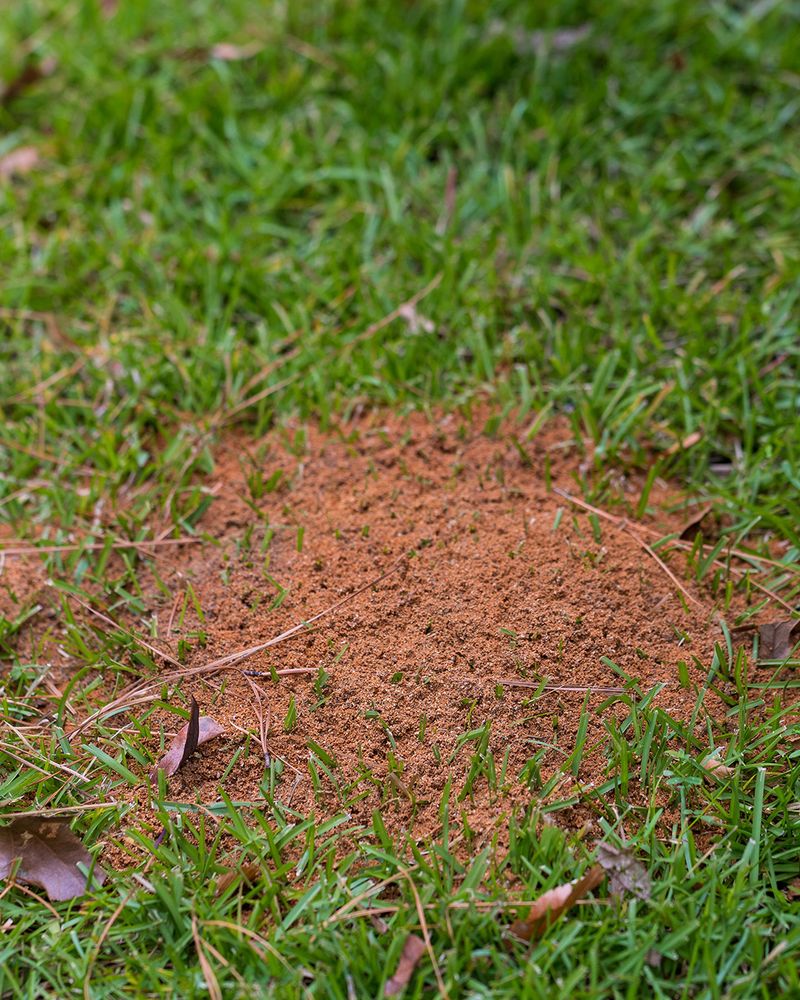
Yesterday your lawn looked perfect. Then a good soaking storm rolls through, and suddenly fresh dirt piles dot the grass like freckles. Odds are high that fire ants just got to work.
Rain plays a big part in how fire ants behave. Wet weather softens the soil and pushes the colony to build its mound higher above ground, where the ants and their young can stay drier and warmer.
Mounds that seemed missing for weeks can reappear across a yard within a day or two. Those colonies were never really gone.
During dry spells, fire ants often stay deeper underground and keep their mounds low or flat. A rainy day simply brings them back into view.
Use this pattern to your advantage. Take a slow walk around your yard a day or two after rain, paying close attention to sunny, open areas. Wear closed shoes and long pants, and note where new mounds have formed.
Timing your walk well protects everyone. Check before you mow, before kids run outside to play, and before you let your dog loose in the backyard. A quick flag, stake, or even a bright plastic cup near each mound helps family members steer clear.
North Carolina gets plenty of chances to practice. Summer thunderstorms and steady fall rains often bring a big flush of new mounds across lawns and fields.
If you build the habit of an after-rain yard check, you will catch most fire ant colonies early, when they are easier to manage and less likely to surprise you.
4. Fire Ants Swarm Fast When Disturbed

Ask anyone who has stepped on a fire ant mound by mistake, and they will tell you the same thing. The ants do not just wander out. They flood out, fast and ready for a fight.
Behavior is one of the surest ways to tell fire ants from other ants. When their mound gets disturbed, huge numbers rush to the surface in seconds. They climb up anything touching the mound, whether that is a shoe, a leg, or a garden tool, and they are ready to sting.
Most harmless ants act much calmer. They tend to scatter, move slowly, or simply carry on with their work. You will not see the same angry wave pouring over the soil.
If you truly need to check, do it the safe way. Find a long stick and stand as far back as you can. Gently poke the edge of the mound, then step away right away and watch.
A fire ant colony will answer quickly. Look for a fast stream of ants spilling out and racing up the stick toward your hand. Drop the stick and move back if they get close.
Never use your hands or feet to test a mound, and keep kids and pets inside while you look.
For North Carolina families, this clue matters a lot. One accidental step on a mound can lead to dozens of painful stings in moments. Knowing what a fire ant swarm looks like helps you spot danger quickly and teach children to stay clear of those busy dirt piles.
5. Workers Come In Different Sizes

Big, small, and somewhere in between, a fire ant colony looks like a crew where nobody got the same uniform size. That mix is a handy clue many gardeners overlook. Once you notice it, you will see it everywhere.
Fire ant workers vary quite a bit within one colony. Some are tiny, while others are noticeably larger, usually ranging from about an eighth to a quarter inch long. Scientists call this kind of size variety polymorphism, and it helps the colony divide up different jobs.
Many harmless ants are far more uniform. Pavement ants and plenty of other common species have workers that look nearly the same size. When every ant in a line seems copied from the same pattern, you are probably not looking at fire ants.
Here is what to watch for. Fire ants are small and reddish brown to dark, often with a darker rear section called the gaster. Look for a mix of sizes moving together on the mound or along a trail toward food.
A little gear helps. A magnifying glass or the zoom on your phone camera lets you study ants from a safe spot without leaning too close. Try snapping a photo, then enlarging it to compare body sizes side by side.
North Carolina gardeners find this clue especially useful when a mound looks unclear. Young colonies, rain-flattened hills, or mounds hidden in mulch can be hard to judge by shape alone.
Spotting mixed worker sizes gives you one more piece of the puzzle, so you can decide with confidence what lives under your plants.
6. They Favor Sunny, Open Ground

Fire ants are sun lovers, a lot like the folks who head straight for the beach in July. Their colonies grow best where the soil warms up quickly. Knowing their favorite hangouts makes them much easier to find.
Open, sunny ground gives a colony the heat it needs to raise young ants fast. That is why mounds show up so often in lawns, pastures, roadsides, playgrounds, and along sidewalks and driveways.
Pavement soaks up warmth, so the soil right beside it is a popular building spot. Deep shade is a different story.
Fire ants are less common under thick trees or in dark, damp corners of a yard. You might still find a mound at the edge of shade, but the sunniest patches deserve most of your attention.
Start your search in the warmest spots. Check sunny lawn areas, garden bed edges, and the strips along your driveway, walkway, and patio.
Then look closely around play sets, sandboxes, and pet runs, since those are places where people and animals spend time close to the ground.
A simple yard map can help. Sketch your property on paper and mark where you find mounds each season. Over time, you will learn which hot spots keep attracting new colonies.
Location matters across North Carolina too. Fire ants are well established throughout much of the Piedmont and Coastal Plain, but they are uncommon in most of the Mountains, where cooler weather limits them.
If you live east of the high country, sunny open areas are where your fire ant patrol should begin.
7. Many Harmless Ants Build Small Crater Hills

Good news for your yard: plenty of the ants you see are not out to get you. Pavement ants and many field ants are common in North Carolina, and most of them rarely sting people at all. Telling them apart from fire ants can save you a lot of worry.
Their hills have a look all their own. These ants usually build small, crater-shaped piles of fine soil around a clear opening in the middle. You will often find them along sidewalk cracks, between pavers, or in patches of bare dirt.
Size is a quick hint. A harmless ant hill is often just an inch or two across and fairly flat, more like a tiny ring of sand than a dome. Compare that to a fluffy fire ant mound that can rise a foot tall.
Watch the ants themselves too. Workers in these colonies tend to be about the same size, and they stay fairly calm when their hill gets bumped. Instead of charging up a stick, they usually scatter or keep going about their business.
Many of these little ants actually help your garden. They break down bits of plant matter, eat other small insects, and loosen the soil as they dig. A few crater hills near the walkway are usually nothing to fret about.
For North Carolina homeowners, correct identification has real benefits. You can skip unneeded treatments, save money, and protect helpful insects and pollinators in your garden.
Save your fire ant baits and efforts for the true troublemakers, and let the peaceful crater builders keep working quietly.
8. A Sting Leaves A Telltale White Blister

Nobody wants to learn about fire ants the hard way. Still, if a sting happens, your skin will tell you exactly which ant was responsible. The proof shows up within about a day.
A fire ant sting starts with a sharp, burning feeling, which is where the ant gets its name. The ant grips your skin with its jaws and stings with its rear, often several times in a circle.
Within roughly 24 hours, each sting site usually forms a small white pustule, a sign doctors and pest experts link closely with fire ants.
Please do not try to get stung on purpose to test a mound. The other clues in this list are much safer. But if a sting does happen, quick care helps a lot.
Brush the ants off right away, then wash the area with soap and water. Leave the white pustules alone, since scratching or breaking them can lead to infection.
A cold pack wrapped in a cloth can ease pain and swelling, and many people find an anti-itch cream helpful too.
Some reactions are serious. Seek medical help right away if someone has trouble breathing, swelling of the face or throat, dizziness, or a fast heartbeat after a sting. People with known allergies should talk with a doctor about an emergency plan.
In North Carolina, fire ant stings are a common summer and fall hazard in yards, parks, and ball fields. Knowing what a sting looks like confirms fire ants are nearby, so you can mark the area, treat the mound, and keep your outdoor fun safe.