Arizona Has No Blanket Native Landscaping Protection From HOAs, and Your Documents Decide the Outcome
Plenty of Arizona homeowners hear that state law shields native, water-wise yards from HOA rules. The real picture is more limited, and guessing wrong can cost you time and money.
A few laws do matter, but each one covers something narrower than most people think. Here is what they actually say and how to protect your plans.
Arizona law does not give native landscaping blanket HOA protection
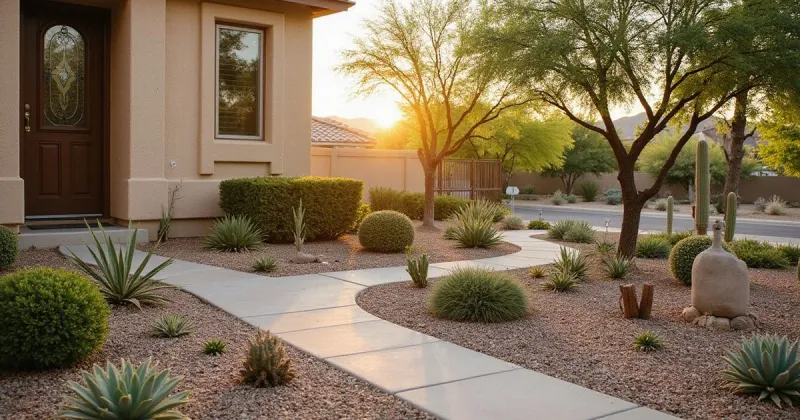
Here is the plain answer: Arizona has no general statewide right to put native or other water-wise landscaping on an HOA-controlled lot and keep it no matter what the community rules say. Whether you can keep a desert yard depends on your recorded documents and the facts of your situation.
The confusion often starts with artificial turf. Under A.R.S. § 33-1819, a planned-community HOA generally cannot ban artificial turf after declarant control ends, where the community allows natural grass.
That protection comes with statutory exceptions, and the association can still adopt reasonable rules.
Notice what that law leaves out. Fake grass is not a palo verde, a desert marigold, or a gravel and agave design.
The turf rule does not stretch to native planting or natural desert landscaping, so treat it as a narrow carve-out and not a shield for every water-saving yard.
When the HOA has discretion, its decision must be reasonable
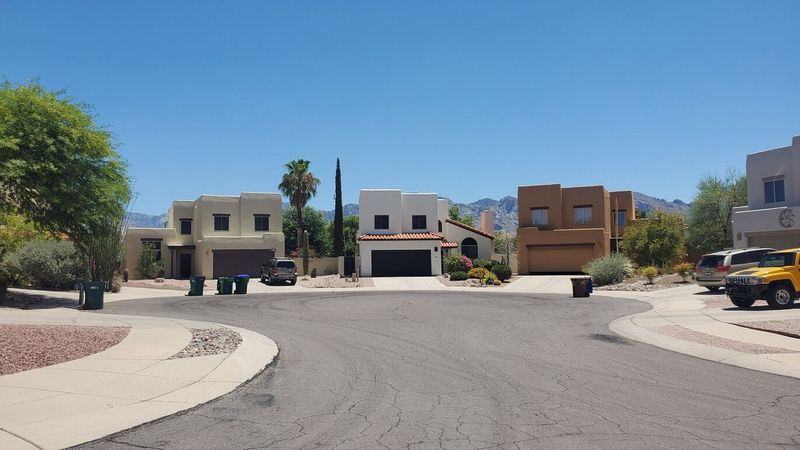
Some landscape calls are not spelled out in the covenants. When an association uses its own judgment, such as approving a plant list or a design layout, A.R.S. § 33-1821 requires a planned-community association to exercise discretionary powers reasonably, neutrally, and fairly.
That means no favoritism and no arbitrary choices.
Say the board approves a neighbor’s gravel and cactus design but denies yours with no explanation. That pattern could support an argument that the decision was uneven.
The same goes for a board that applies a rule one way for some owners and another way for you.
Keep the limits in mind, though. The statute is not an automatic override of your governing documents, and it is not a guaranteed win.
If a specific covenant clearly bans what you want, a reasonableness argument may not carry you far. Think of it as a way to question how a decision was made, not a right to keep a planting.
Municipal water rules do not create an HOA landscaping right
Water laws sound like they should help a homeowner, but they usually aim at different targets. A.R.S. § 45-563.03 restricts certain municipal landscaping requirements in initial Active Management Areas.
It speaks to cities and towns, not to a dispute between you and your HOA.
A practical example helps. A city may be limited in what turf or plant requirements it can set for new development.
That does not mean your private covenants disappear, because a city rule and a recorded community document are separate things.
So when someone tells you the state water code lets you rip out grass despite your HOA, ask which law they mean and who it governs. Do not assume municipal limits automatically control private covenants.
Your Arizona Garden Changes Every Week. Your Plan Should Too.
Gardening in Arizona changes quickly throughout the season. Every Friday you’ll receive a simple weekly plan showing exactly what to plant, prune, fertilize, harvest, and protect so you never miss the right timing.
Read the statute, then read your own declaration side by side.
A groundwater-savings exception applies only in defined circumstances
Arizona’s groundwater-savings-credit law includes an HOA provision, but it is tightly drawn. In defined circumstances involving land tied to relinquished irrigation grandfathered rights and groundwater use, an association may not impose certain minimum-turf requirements.
The history is short. The provision came through 2025 session law SB 1611, and the statute was later changed by the 2026 amendment in SB 1335.
For most homeowners, the key question is whether your property fits those conditions at all. If your land has no link to relinquished irrigation rights and the related groundwater use, this exception likely does not apply to you.
It is property-specific, so it is not a statewide native-plant or water-wise-landscaping right. If you think your lot might qualify, check your property’s history and get qualified legal advice.
Native-plant status does not automatically defeat HOA rules
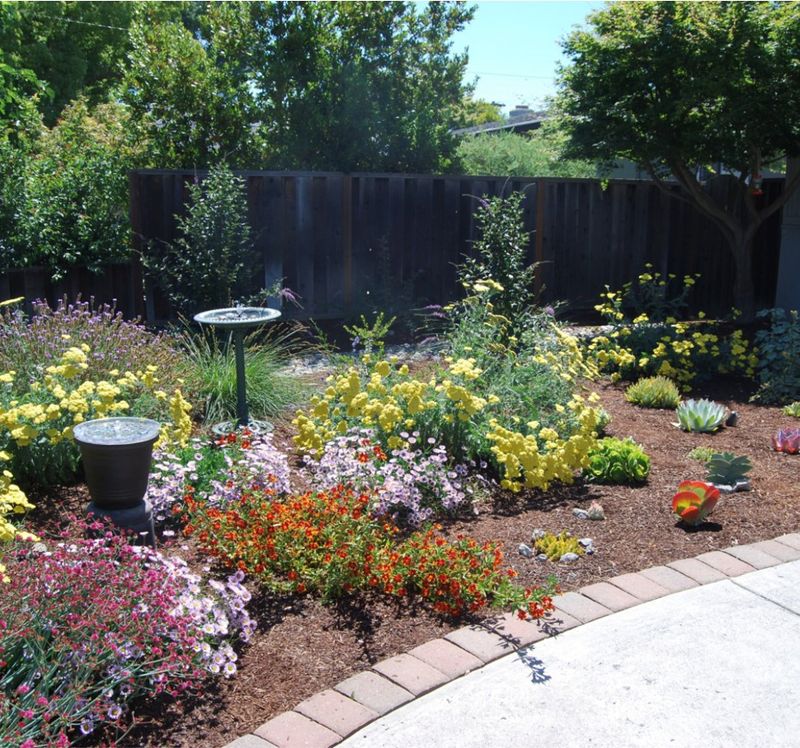
Many people hear that native plants are protected by Arizona law and conclude an HOA cannot touch them. That is misleading.
A.R.S. § 3-904 and the Native Plant Law deal with specified protected plants and particular activities, such as taking, moving, or destroying them.
It is not a general right to landscape with native species, and it is not an automatic defense against HOA covenants. A plant being native does not, by itself, stop an association from requiring a yard change.
The statute also has a qualification. Destruction of protected native plants is exempted on qualifying individually owned residential property of 10 acres or less where initial construction has occurred.
That is a narrow rule about those activities, and it does not decide whether your HOA must accept your design. Before moving or removing a protected plant, confirm both the plant rules and your community documents.
A written proposal can clarify the rules before work begins
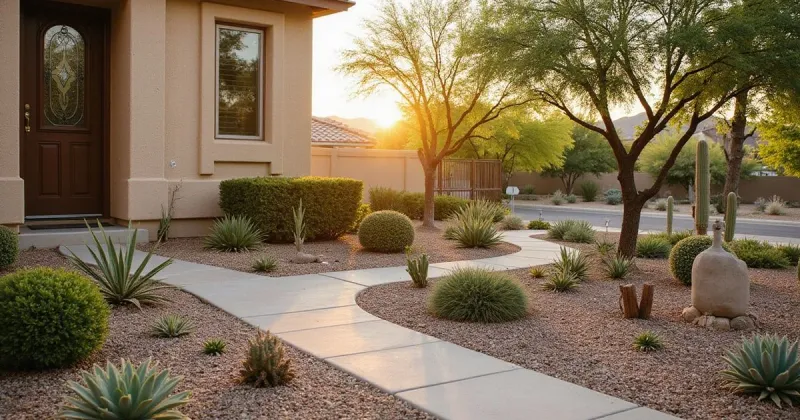
Before you move a single rock, pull your recorded declaration or CC&Rs and the HOA’s current landscape and design-review rules. Look for plant restrictions, ground cover requirements, and approval steps.
Then put your plan in writing. Include the species, the layout, how you will irrigate, and how you will maintain the yard through summer.
Keep a copy of your application and the HOA’s decision. The Arizona Department of Real Estate recommends trying to resolve HOA disputes with the association first, and a paper trail helps with that.
For plant choices, use the lists from the Arizona Department of Water Resources for your own Active Management Area, because Phoenix and Tucson are not covered by one list. ADWR’s landscaping page explains that its lists serve specified regulated uses and are not comprehensive for every application.
Appearing on a list does not override HOA rules.
A violation notice starts a process, not a right to keep the planting
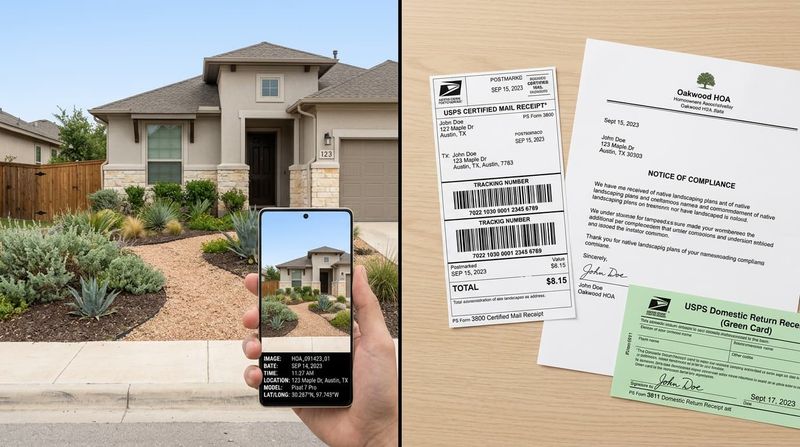
If the HOA sends a written property-violation notice, A.R.S. § 33-1803 gives you a process. You may respond by certified mail within 21 calendar days.
The association must include specified information, including the alleged rule violation and how to contest the notice.
Penalties also require notice and an opportunity to be heard. Keep in mind that this is a process right.
It does not give you a substantive right to keep a particular planting.
Respond on time, stay factual, and attach your approval records or photos if they help. Next, consider the dispute options.
The Department of Real Estate recommends first trying to resolve the matter with the HOA. Its administrative dispute process covers only eligible owner and association disputes, so it does not handle complaints from renters or complaints against individual board members.
The outcome depends on the documents and the facts

Start by naming the exact covenant or discretionary decision that is in your way. Keep your written proposal and every HOA response, then use the notice or dispute process that fits your situation.
The reasonableness duty in A.R.S. § 33-1821 may support an argument, but it does not guarantee a win or create a general right to native landscaping. For eligible disputes, the Department of Real Estate’s guidance is a good next stop.
A desert yard may thrive in the sun, but it still has to grow within your paperwork.