The Invasive North Carolina Tree Feeding Spotted Lanternfly Straight Into Your Yard
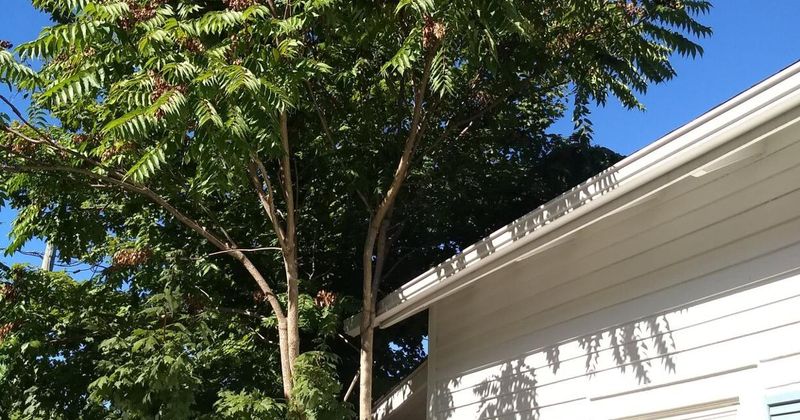
Something has been dripping from the big, fast-growing tree near your patio, and now the deck furniture is sticky and black with mold. That tree might be tree-of-heaven, Ailanthus altissima, an invasive species already spreading across North Carolina that spotted lanternfly loves to feed on. The insect was first confirmed in North Carolina in 2022, and it has been spreading into new counties since then. Knowing what you are dealing with, and what to actually do about it, puts you ahead of most neighbors on the block.
Could That Fast-Growing Tree Be Tree-of-Heaven?
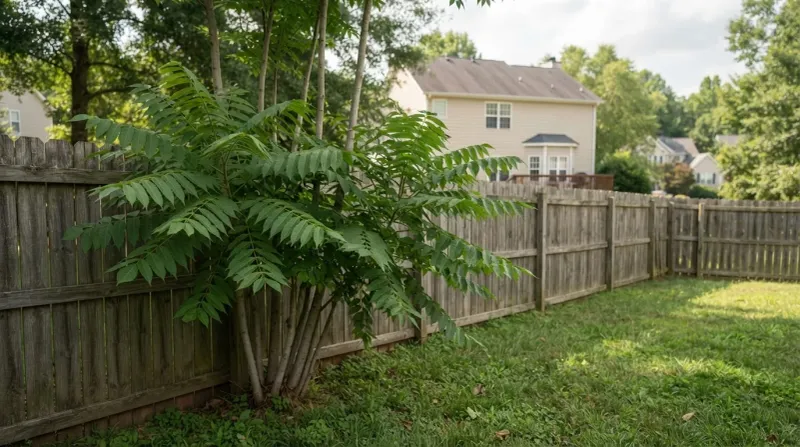
Before you fire up the chainsaw or reach for a spray bottle, take a breath. The tree shooting up along your fence line or at the edge of your yard might look suspicious, but an unfamiliar fast-growing tree does not automatically mean spotted lanternfly came because of it. The pest can arrive by hitching rides on vehicles, firewood, and outdoor equipment regardless of what is growing in your yard.
That said, one particular invasive tree is worth investigating. Tree-of-heaven, known botanically as Ailanthus altissima, is one of the most common invasive trees in North Carolina, and it is spotted lanternfly’s preferred feeding host. NC State Extension’s tree-of-heaven profile describes how rapidly this species colonizes disturbed ground: roadsides, vacant lots, fence lines, woodland edges, and the corners of suburban backyards where nothing else seems to want to grow. It can shoot up several feet in a single season, which is part of why so many homeowners notice it suddenly and wonder what it is.
The tree is native to eastern Asia and has been spreading across the eastern United States for well over a century. In North Carolina, it turns up in every region, from the Piedmont’s red clay neighborhoods to the mountain hollows and the sandy edges of the Coastal Plain.
Your first job is not removal. Your first job is identification. USDA APHIS guidance on spotted lanternfly consistently points homeowners toward confirming both the tree and the insect before taking action, because misidentification can lead to cutting down a valuable native tree by mistake. The sections ahead will walk you through exactly what to look for.
A Preferred Host Is Not A Lanternfly Magnet
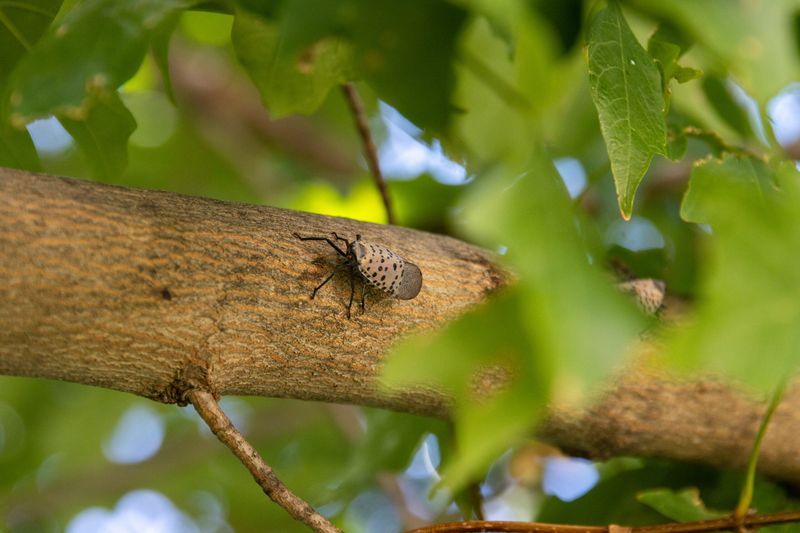
Here is where the headline needs a small but important correction. Tree-of-heaven does not summon spotted lanternfly into your yard the way a porch light draws moths. The insect feeds on more than 100 plant species, including grapevines, hops, maples, willows, walnuts, oaks, and dogwoods. It can complete its full life cycle and reproduce without ever touching a tree-of-heaven.
What tree-of-heaven actually does is act like a preferred restaurant. USDA Forest Service research on spotted lanternfly mitigation indicates that when the insect lacks access to tree-of-heaven in its diet, its fitness can decline. So a yard with a large, established tree-of-heaven may become a concentrated local feeding site, producing sticky honeydew that drips onto patios, decks, and cars, and encouraging the growth of black sooty mold on surfaces below. That is a real nuisance, and it is a legitimate reason to want the tree gone.
Your North Carolina Garden Changes Every Week. Your Plan Should Too.
Gardening in North Carolina changes quickly throughout the season. Every Friday you’ll receive a simple weekly plan showing exactly what to plant, prune, fertilize, harvest, and protect so you never miss the right timing.
But removing the tree does not come with a guarantee. Penn State Extension’s spotted lanternfly management guide states plainly that removing preferred host plants has not been specifically evaluated as a proven method for reducing spotted lanternfly populations. The insect can move in from neighboring properties, arrive on a moving truck, or walk off a vehicle parked on the street.
North Carolina’s situation is also uneven. NC State Extension Forestry’s spotted lanternfly page identifies established populations in Forsyth, Guilford, and Davidson counties as of mid-2026, while federal maps list North Carolina among states with confirmed populations. County conditions change, sometimes quickly, so treat any county list as a starting point rather than a final answer.
Identify The Tree Before You Remove It
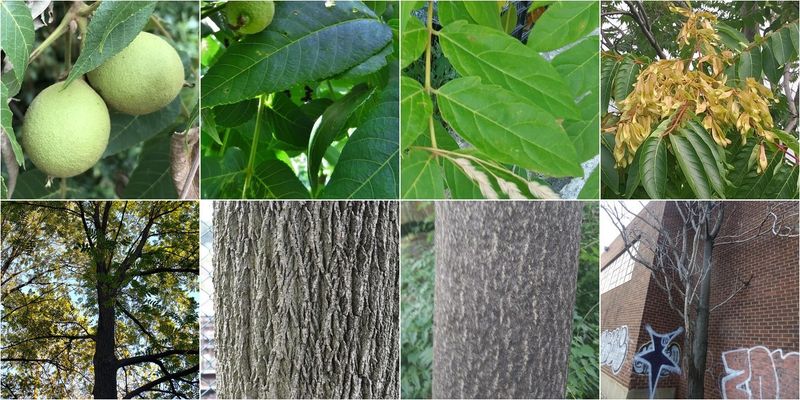
Many Piedmont gardeners have walked up to a tree-of-heaven thinking it was black walnut or staghorn sumac, and a few have gone the other direction too. Getting this wrong matters, because black walnut is a valuable native tree that supports wildlife, and cutting one down by accident would be a real loss.
Tree-of-heaven has a distinctive set of features that, taken together, make a solid identification. The compound leaves are unusually large, commonly 2 to 4 feet long, with roughly 10 to 40 leaflets arranged along a central stem. Run your finger along the edge of a leaflet, and you will feel mostly smooth margins rather than the obvious serrations you find on black walnut or many sumacs. That smooth edge is one of the most useful quick clues, but do not rely on it alone.
Crush a leaf or snap a small twig and take a sniff. Tree-of-heaven produces a strong, unpleasant odor often described as rancid peanut butter or dirty gym socks. Older trees develop gray or brown bark with shallow vertical crevices that look a bit like the skin of a cantaloupe. Female trees produce clusters of papery winged seeds called samaras, each with a single seed near the center, that spin down like helicopter blades in late summer and fall.
NC State Extension’s tree-of-heaven publication recommends comparing leaves, leaflet edges, twigs, bark, and fruit before drawing any conclusions.
Penn State Extension’s guide to tree-of-heaven native look-alikes is also worth bookmarking for a side-by-side comparison. When in doubt, photograph the leaves, a twig, the bark, and any fruit or seeds, then send those photos to your county Extension office for confirmation before you remove a mature tree or apply any herbicide.Cutting Tree-of-Heaven Alone Can Make It Resprout
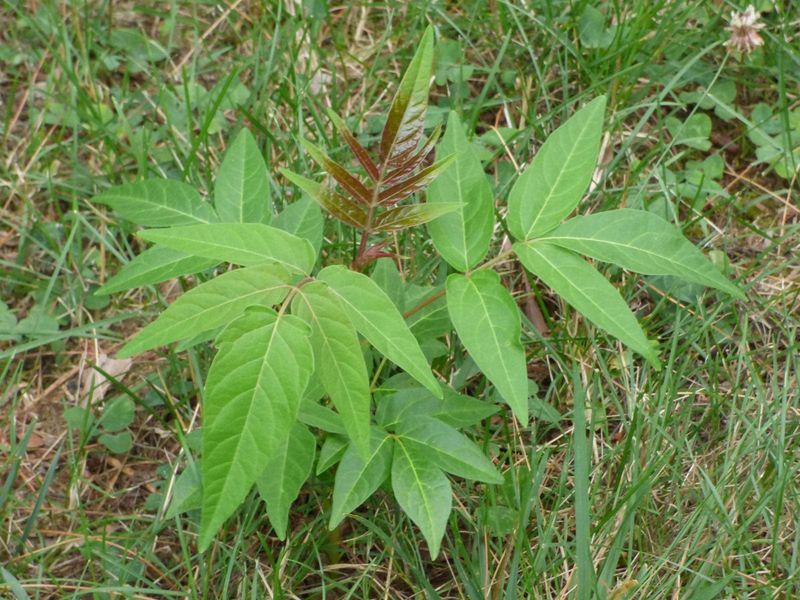
Grabbing a saw and cutting the tree down on a Saturday afternoon feels satisfying, but with tree-of-heaven, that move can backfire. The tree spreads two ways: by wind-carried seeds that can travel a considerable distance, and by root suckers that can push up new shoots as far as about 50 feet from the parent tree. Cutting or wounding the trunk without treating the root system first is practically an invitation for the tree to come back angrier and in more places.
Penn State Extension’s tree-of-heaven management guidance explains that Extension professionals generally favor treating a living tree with a systemic herbicide before cutting it, allowing roughly 30 days for the product to move through the root system, and then removing the trunk. For smaller stems, generally under about 6 inches at the base, a basal-bark treatment can work well. Larger stems are often better suited to a hack-and-squirt approach, where cuts are made into the living wood and herbicide is applied directly. These are not the same technique, and the right choice depends on the tree’s size, location, and the specific product label.
None of this is a casual weekend project for a large tree. A professional arborist may be necessary where the tree overhangs a roof, sits near power lines, or leans toward a fence, vehicle, or neighbor’s property. Herbicide decisions must follow the current product label precisely, because legal uses, concentrations, and approved sites vary by product and can change.
EPA pesticide safety guidance is clear about protecting wells, streams, edible plants, pets, and children during any herbicide application. Your county Extension agent can point you toward products registered for this use in North Carolina and help you think through the site-specific risks before you begin.
Monitor Plants And Surfaces Even After Removal
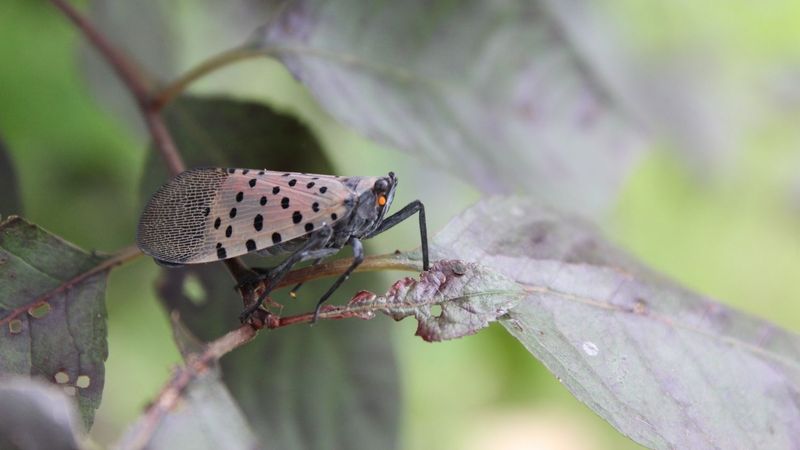
Pulling the tree-of-heaven out of your yard is genuinely a good move for the yard’s ecology, but the work does not end there. Spotted lanternfly uses more than 100 host plants, and it can move into a yard on its own after the preferred feeding tree is gone. Monitoring is how you catch a new problem before it turns into a bigger one.
NC State Extension’s spotted lanternfly resource page gives North Carolina homeowners useful approximate windows to watch by: immature nymphs from about May through September, adults from July through December, and egg masses from October through June. Weather shifts those windows, so treat the dates as a rough calendar rather than a firm schedule. A warm February in the Piedmont or a slow spring in the mountains can push things earlier or later.
Walk your yard and look at grapevines, walnuts, maples, willows, oaks, and dogwoods, along with any ornamental plantings near the patio or garden beds. Check the trunks and hard surfaces too, including the undersides of deck boards, fence rails, and stone walls. Honeydew dripping from leaves and the black sooty mold that follows it are signs of concentrated feeding nearby, but they do not mean the plant is going to die. Penn State’s management guide notes that established plants other than grapevines, tree-of-heaven, and black walnut saplings are not commonly killed outright by lanternfly feeding, though they can be stressed and look rough through a bad season.
Grapevines get the most attention for a reason. If you grow grapes anywhere in the yard or have neighbors who do, make them a priority on your monitoring walks from late summer through fall.
Destroy Only Reachable Egg Masses
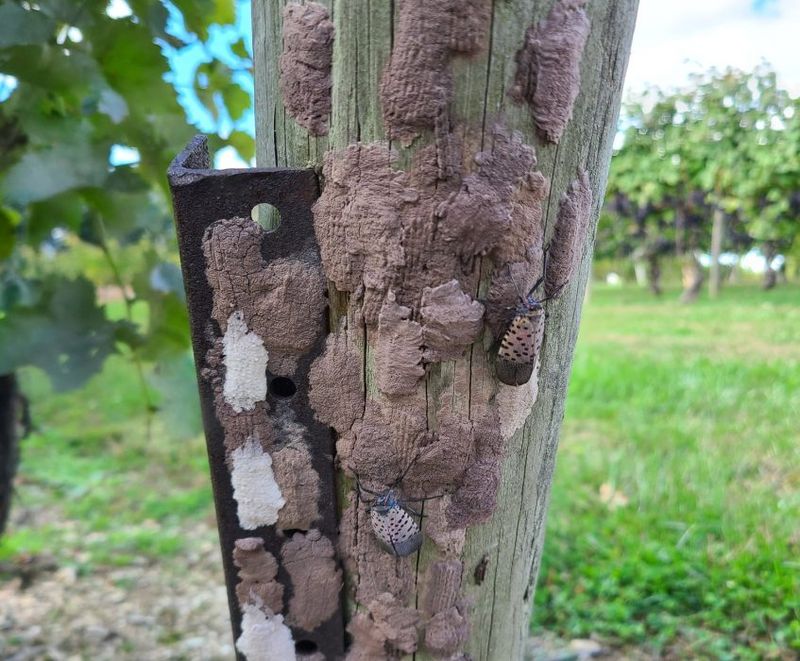
Spotted lanternfly egg masses do not limit themselves to tree-of-heaven bark. They turn up on almost any firm surface: stone walls, brick foundations, wood fences, deck boards, patio furniture, outdoor grills, garden equipment, and the undercarriage of vehicles. They are gray or brownish, with a dull, mud-smeared look, and each mass typically contains about 30 to 50 individual eggs arranged in neat rows beneath a waxy coating.
USDA APHIS spotted lanternfly guidance recommends scraping reachable egg masses into a sealed plastic bag containing rubbing alcohol or hand sanitizer, then disposing of the sealed bag in the trash. Thoroughly smashing them against a hard surface also works. The key word is reachable. Do not climb a ladder or attempt to scale a tree to reach masses high on a trunk.
Penn State Extension’s egg mass guidance points out that fewer than 2 percent of egg masses found on trees are within a safe 10-foot reach, so the ones up in the canopy are mostly beyond practical intervention for a homeowner.
If you want to catch nymphs climbing up trunks in spring, sticky bands or traps can help, but bare adhesive wrapped directly around a trunk is genuinely dangerous to wildlife. Birds, lizards, skinks, and small mammals can get stuck and die. NC State Extension’s spotted lanternfly publication recommends using a wildlife-safe barrier or protective mesh design around the sticky material so that birds and beneficial insects cannot make contact with the adhesive. Check any trap every few days and remove non-target animals promptly if they do get caught.
Use A Layered Plan, Not A Promise Of Eradication
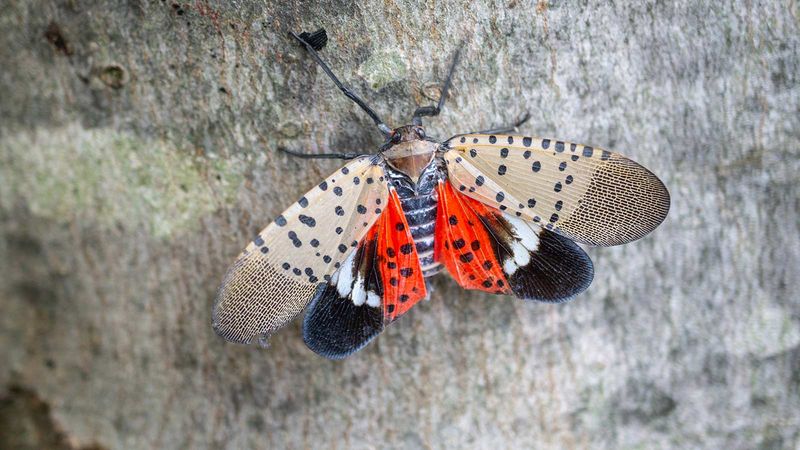
No single action clears a yard of spotted lanternfly, and any plan that promises otherwise is selling something. What actually works is a layered approach where each step covers a gap that the others leave open.
Start by confirming both the tree and the insect. Once you have a positive identification, arrange professional or label-directed tree-of-heaven control when it is practical and safe to do so, keeping in mind the resprouting risk and the need for root-focused treatment. Continue monitoring your yard through the windows described in the previous section, and destroy only the egg masses you can reach safely from the ground.
Before you move any vehicle, haul firewood, or transport outdoor furniture, equipment, or nursery plants, inspect everything carefully for egg masses and live insects. USDA APHIS guidance on cleaning outdoor items before moving them explains the inspection steps clearly and is worth sharing with anyone who visits your property and parks in the driveway.
Reporting matters too. NC State Extension Forestry’s spotted lanternfly page is the right place to check current North Carolina reporting instructions, because residents in newly infested counties may have different guidance than those in areas where the pest is already established. A trap tree, meaning a tree-of-heaven intentionally left standing and treated with a systemic insecticide to concentrate and kill feeding insects, is sometimes used in managed nursery or production settings, as described in NC State Extension’s nursery IPM publication, but it is a specialized professional tactic rather than a general backyard strategy.
Removing tree-of-heaven is genuinely worth doing: it eliminates an invasive plant, reduces a concentrated feeding site, and cuts down on the honeydew and sooty mold fouling your outdoor spaces. What it cannot do is put a fence around your yard that lanternflies cannot cross, because this pest has never paid much attention to property lines.