The Tiny White Balls On Your Arizona Tomato Leaves That Look Like Fairy Wands – Here’s What They Are

Spotting tiny white balls on thin stalks beneath your tomato leaves can stop any Arizona gardener in their tracks. Those strange little structures look almost magical, like miniature lollipops or fairy wands tucked under the foliage.
Knowing what they are matters, because the wrong response could wipe out one of your garden’s best allies. The good news is that these odd shapes are most likely something worth protecting, not destroying.
Those Fairy-Wand Shapes Usually Point to Green Lacewings

Pale eggs perched on hair-thin stalks beneath an Arizona tomato leaf are a striking sight, and the stalk itself is the strongest first clue to what you are looking at. University of Arizona Cooperative Extension guidance on beneficial insects describes green lacewings as common in Arizona gardens and notes that they lay pale eggs on threadlike stalks on the undersides of leaves.
That description matches the fairy-wand pattern almost exactly.
In Arizona, green lacewings belong to the family Chrysopidae and are widespread across home gardens, orchards, and desert landscapes. The adults are delicate, pale green insects with large netlike wings, and they are often drawn to porch and yard lights on warm nights.
When a female lays her eggs, she attaches each one to the tip of a thin silken stalk, creating that distinctive elevated appearance that puzzles so many gardeners.
The identification should stay probabilistic unless you can examine the eggs closely or photograph them. Calling every pale object on a tomato leaf a lacewing egg without checking the stalk, color, shape, and placement would be a mistake.
That said, when the stalk is clearly present beneath an Arizona tomato leaf, green lacewing eggs are the leading explanation, and correctly identified eggs are generally beneficial rather than a cause for alarm. The sections ahead explain how to confirm the details before taking any action.
The Stalk Creates the Lollipop Appearance
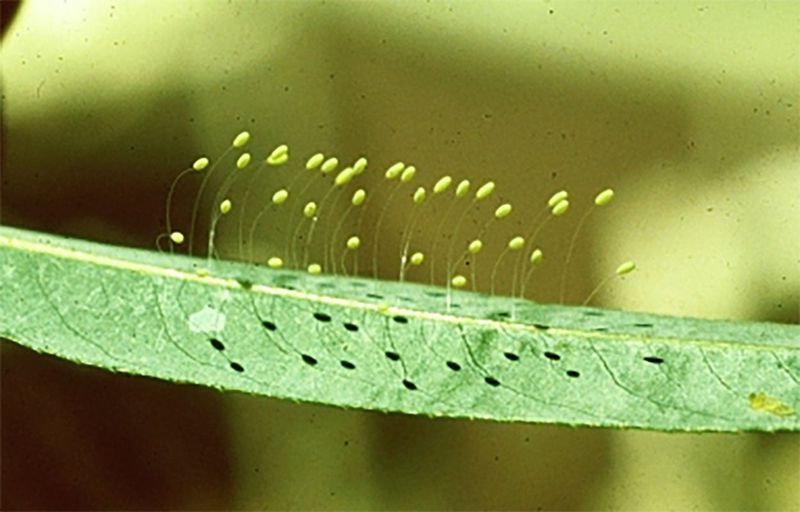
Each green lacewing egg is a small, oblong structure attached to the very tip of a thin silken stalk. Authoritative sources describe the eggs as generally 1.5 millimeters or smaller, and UC IPM notes they are oblong rather than perfectly round.
Arizona gardeners often perceive them as white balls because of their small size and the angle at which they are viewed, but a closer look usually reveals a slightly elongated shape.
The color at laying is typically pale green, pale yellowish-green, or white, and University of Kentucky Entomology Extension research on green lacewings notes the stalk may help protect newly hatched larvae from each other and from other predators, since a sibling that hatches first cannot easily reach eggs elevated above the leaf surface. Before hatching, the egg can darken or shift in color, so a grayish or brownish egg on a stalk is not necessarily a different species.
In Arizona gardens, the stalk is what sets these eggs apart visually and gives them the fairy-wand or lollipop quality that catches a gardener’s eye. Resist the temptation to classify the eggs as perfect white spheres based on a quick glance.
Your Arizona Garden Changes Every Week. Your Plan Should Too.
Gardening in Arizona changes quickly throughout the season. Every Friday you’ll receive a simple weekly plan showing exactly what to plant, prune, fertilize, harvest, and protect so you never miss the right timing.
The oblong shape, the elevation off the leaf, the pale color, and the placement on the underside of the leaf all need to fit together before you can feel confident in the identification. When they do fit, the picture becomes much clearer.
Lacewing Larvae Deliver the Pest Control
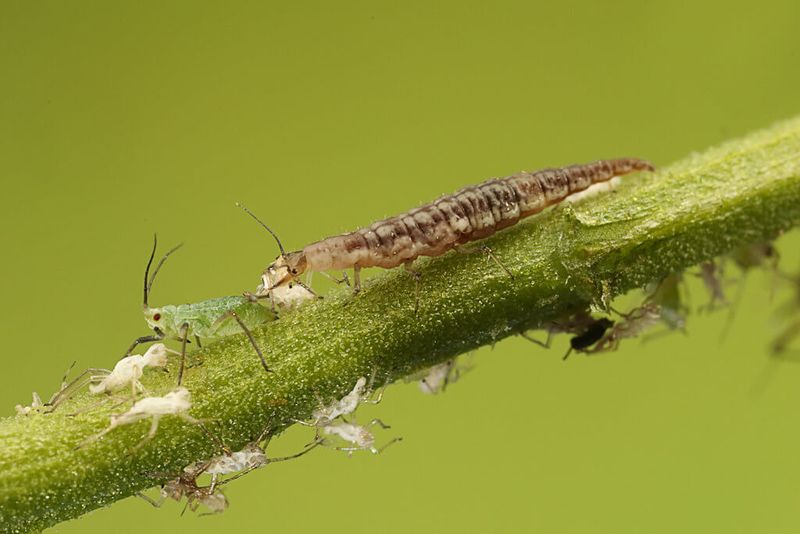
Finding lacewing eggs on an Arizona tomato plant is generally reassuring because of what hatches from them. The larvae, sometimes called aphid lions, are elongated, flattened, and alligator-like in appearance, with prominent curved jaws built for grabbing prey.
University of Minnesota Extension describes them as active predators that move through plant foliage hunting soft-bodied insects.
In Arizona gardens, lacewing larvae may feed on aphids, whiteflies, mites, lace bugs, and some insect eggs. That list covers several of the most common tomato pests in the low desert, which is why their presence tends to be welcome.
The larvae are the main predatory stage; many adult green lacewings feed primarily on nectar, pollen, honeydew, or other plant-derived foods rather than hunting insects. Knowing that distinction helps set realistic expectations: the eggs on your tomato leaf signal that larvae are coming, and the larvae are where most of the pest-suppression work happens.
Even so, lacewing larvae are not a guaranteed solution. Their impact depends on how many larvae hatch, what prey is available, whether pesticides have disrupted the local insect community, whether ants are protecting aphid colonies from predators, and other conditions specific to your Arizona yard.
They may reduce pest populations meaningfully, or they may not keep up with a heavy infestation. The honest framing is that lacewing larvae can help suppress small, soft-bodied pests in Arizona gardens, and that help is worth protecting when you find eggs on your tomato leaves.
Check the Leaf Before You Call Every Egg Beneficial
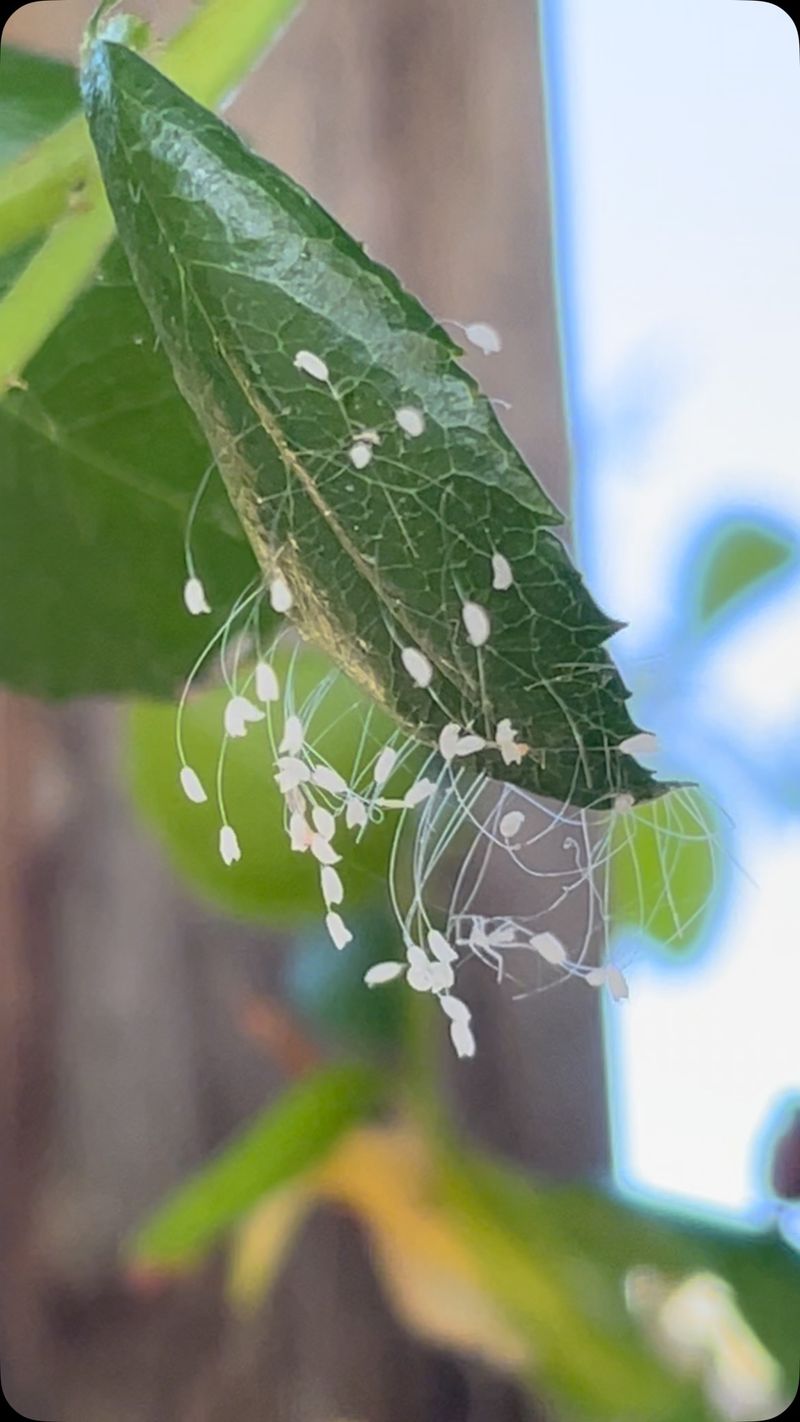
The stalk is the strongest first clue that an egg belongs to a green lacewing, but it is not a substitute for checking the full picture. Shape, color, and placement all matter, and a few common lookalikes on Arizona tomato plants deserve a closer look before you decide what you are dealing with.
Tomato fruitworm eggs are one meaningful comparison. UC IPM guidance on tomato fruitworm describes their eggs as small and pale when newly laid, ribbed, slightly flattened on top, and laid directly on the leaf surface rather than elevated on a stalk.
If the pale object you see is sitting flat against the leaf with visible ribbing, that is a meaningfully different situation from a stalked lacewing egg, and fruitworm eggs require a different response.
Whitefly eggs and immature stages present a different pattern. Whitefly eggs are generally pale brown to yellow and tend to appear along leaf veins.
Whitefly nymphs or pupae may look like flattened, raised structures or produce waxy filaments on the leaf surface. Neither pattern matches the classic elevated stalk of a lacewing egg.
Additionally, University of Florida IFAS Extension notes that brown lacewing eggs are generally not stalked, so a stalked egg points more strongly toward a green lacewing than toward a brown lacewing species. In Arizona, close inspection with a hand lens or a phone camera set to macro mode is the most practical way to sort these differences out before drawing any conclusions.
Scout the Tomato Before You Reach for Spray
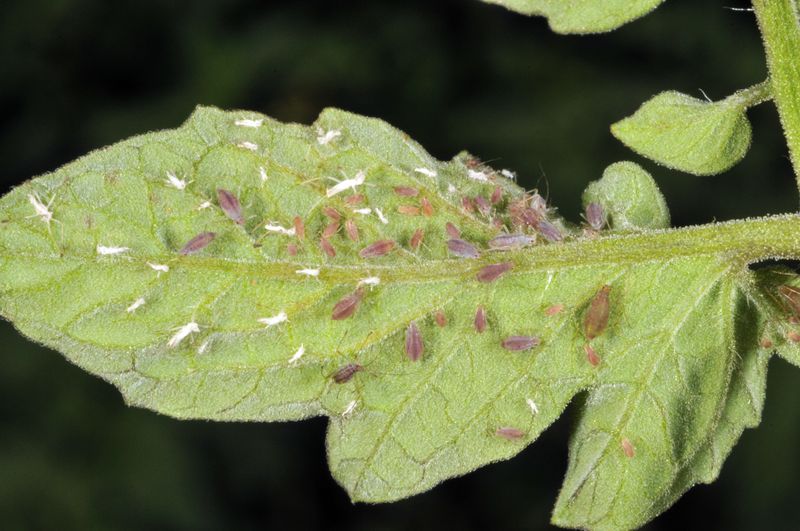
Correctly identified lacewing eggs deserve to stay right where they are. The practical next step in any Arizona garden is to leave those eggs in place and shift your attention to the tomato plant itself, checking both sides of every leaf for signs of actual pest pressure.
Look for aphid colonies, whitefly adults or nymphs, mite stippling, leaf curl or distortion, sticky honeydew residue, or sooty mold. University of Arizona Cooperative Extension guidance on integrated pest management for the home garden emphasizes scouting and checking leaf undersides rather than treating automatically.
Eggs alone, whether lacewing or otherwise, do not prove that your tomato is suffering damaging pest pressure, and they certainly do not guarantee that any pests present will disappear on their own.
Arizona gardeners also need to keep insect diagnosis separate from heat stress. According to University of Arizona Cooperative Extension guidance on growing tomatoes, temperatures above 90 degrees Fahrenheit can reduce pollen viability and fruit formation, with poor fruit development particularly common during July and August in southern Arizona.
If your tomato is dropping flowers or failing to set fruit during a heat wave, that problem is most likely climate-related rather than caused by the insects on the leaf underside. Sorting out heat stress from pest damage before reaching for any treatment saves time, protects beneficial insects, and keeps your Arizona tomato garden on steadier footing.
Use Water Carefully When Pest Pressure Is Minor

When scouting turns up a small aphid colony or a light whitefly presence on an Arizona tomato, the least disruptive first response is a strong stream of water aimed directly at the pest colony. Direct the spray at the insects themselves, working along the underside of affected leaves where pests tend to cluster.
Try to avoid or use minimal force around any areas where you have spotted lacewing eggs or larvae, since dislodging them removes a potential ally, though no water application can guarantee the beneficial insects will be preserved.
Broad-spectrum insecticides are a poor choice when lacewings or other natural enemies are active in your Arizona garden. University of Arizona Cooperative Extension insecticide guidance cautions against applying broad-spectrum products when predators and parasitoids are present, because doing so can eliminate the very insects helping to keep pest populations in check.
Arizona’s climate adds another layer of caution. Extreme heat, intense sun, and plant stress during summer months can make any spray application riskier for the plant and for non-target insects, including bees and other pollinators that visit tomato flowers.
Casual treatment during the hottest part of the day or during flowering can cause more harm than the minor pest pressure it was meant to address. Water used thoughtfully and targeted at pest colonies is a reasonable first tool in Arizona’s low-desert gardens when the problem is still manageable.
Read the Tomato Label Before Treating

When scouting confirms real pest pressure that water alone cannot manage, the next step is finding a product whose label specifically permits use on tomatoes. That label is not optional reading.
It governs the legally permitted application rate, coverage method, harvest interval, timing restrictions, and safety requirements for every use on an edible crop. No product should go on your Arizona tomato plants unless the label says tomatoes are a permitted site.
Contact products such as insecticidal soaps are sometimes considered lower-risk options, but they are not automatically harmless. They require thorough contact with the target pests, including the undersides of leaves where soft-bodied insects feed and hide.
They can also harm lacewings, other beneficial insects, and even plant tissue if applied incorrectly. EPA biopesticide classifications and UC IPM tomato pest management guidelines both reflect the principle that even reduced-risk pesticides carry real conditions for safe use.
Household dish soap and homemade soap mixtures are not substitutes. They are not formulated for crop use, can injure foliage, and lack the label directions that make a product legally and practically safe for tomatoes.
In Arizona, the timing of any application matters as much as the product choice. University of Arizona Cooperative Extension insecticide guidance recommends evening applications to reduce risk to pollinators and other beneficial insects, and warns that some products, including spinosad, can harm bees and natural enemies when applied improperly or at the wrong time of day.
Extreme heat, full sun, and flowering periods all increase the risk of non-target harm and foliar injury. The label sets the outer boundary; Arizona conditions often call for extra caution within that boundary.
Keep the Wands, Then Check the Plant
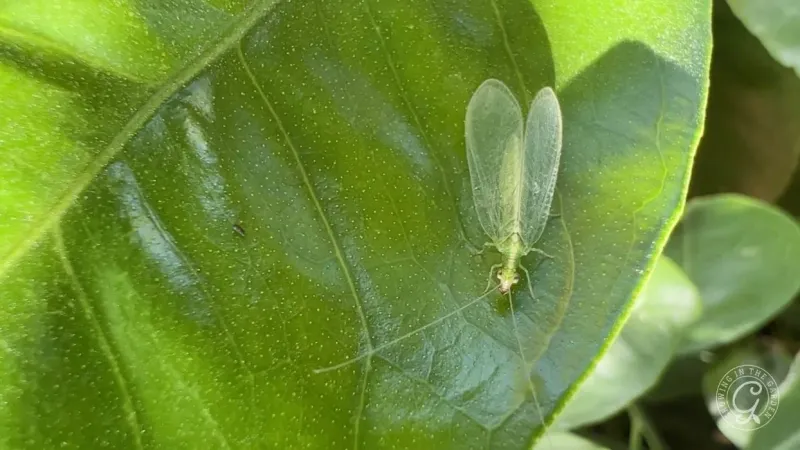
Pale eggs on thin stalks beneath an Arizona tomato leaf most likely belong to green lacewings, and the full pattern of stalk, oblong shape, pale color, and placement on the leaf underside supports that conclusion. When the evidence fits, leave the eggs where they are.
They signal a predator that can help with soft-bodied pest pressure once the larvae hatch.
That said, the eggs are a starting point for scouting, not a finish line. Check the plant for real signs of pest damage, separate any heat-stress problems from insect issues, and reach for water before any spray product.
If treatment becomes necessary in your Arizona garden, the tomato label decides what is permitted and how it must be applied.
Lacewing eggs are a useful sign, not a promise. A garden that hosts them is one where a natural predator has chosen to reproduce, and that is worth a moment of appreciation before moving on to the next task.