The Tiny White Clue On Michigan Hemlocks That Gardeners Should Report Before Branches Turn Gray
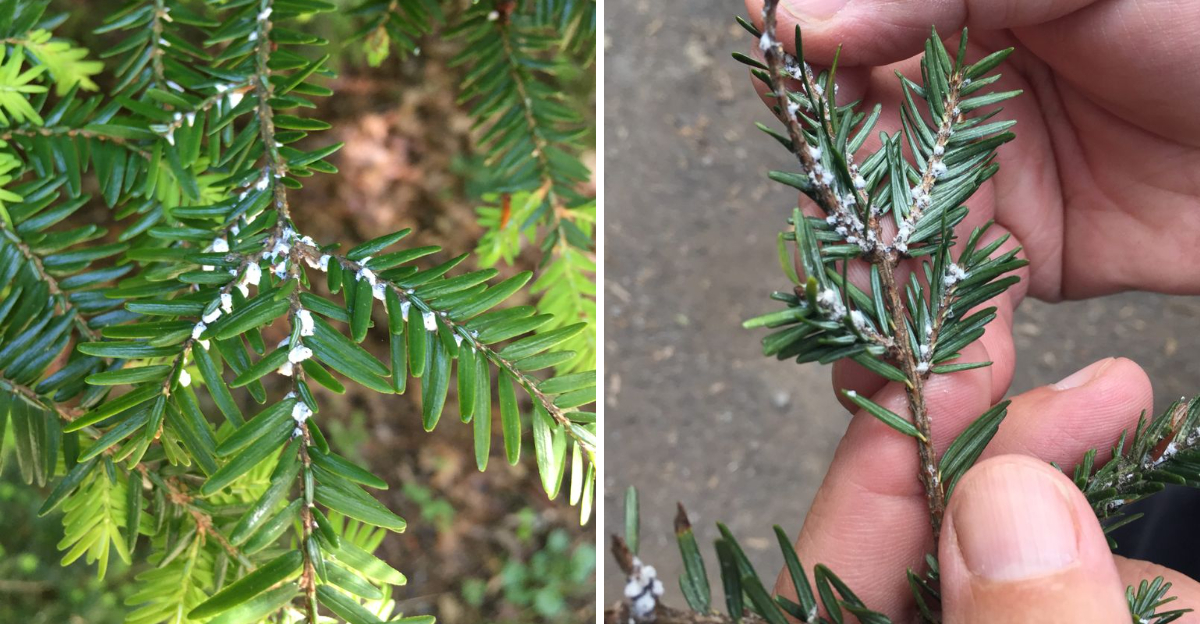
Small white masses clinging to the underside of hemlock needles are an early warning sign Michigan gardeners should never ignore.
This tiny clue often points to hemlock woolly adelgid, an invasive pest capable of causing significant harm to hemlock trees over time.
Left unreported, infestations can spread quickly, eventually leaving branches looking gray and thin as needles drop prematurely.
Catching this sign early gives local agencies a chance to track and manage outbreaks before they spread further across the region.
Checking the undersides of needles closely, especially in spring and late summer, helps catch infestations before visible damage appears.
Reporting sightings to Michigan’s invasive species program helps build a clearer picture of where these pests are spreading.
Avoiding movement of hemlock branches or firewood also helps slow their spread to new areas. A few minutes of checking now protects hemlocks throughout your entire neighborhood.
1. The White Clue Is A Hemlock Woolly Adelgid Ovisac
Not every white speck on a tree is harmless. When you spot a soft, cottony white substance clinging to the branches of an eastern hemlock, you could be looking at one of the most significant invasive insect threats in Michigan today.
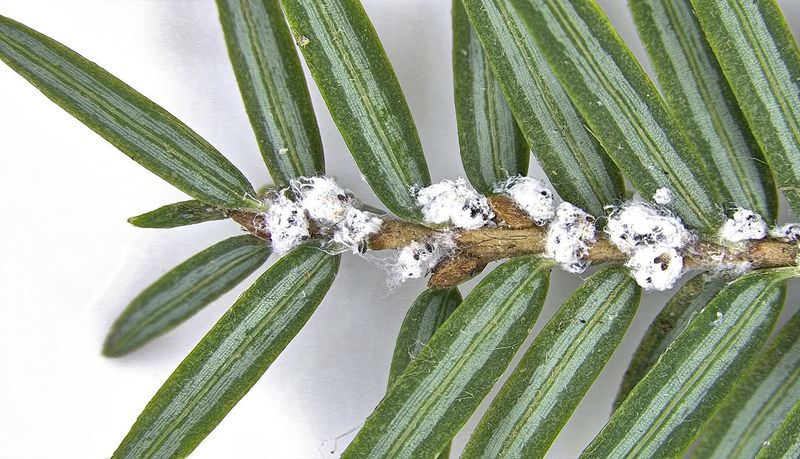
That fluffy white material is called an ovisac, and it is produced by a tiny insect known as Hemlock Woolly Adelgid, or Adelges tsugae.
The ovisac is essentially a protective covering the insect builds around its eggs. The adelgid secretes fine, waxy strands that wrap together into a small, wool-like mass.
These strands shield the eggs from temperature changes and other environmental pressures while the insect feeds quietly beneath the covering.
It is a clever survival strategy, but it also happens to create a very visible clue for sharp-eyed gardeners.
One of the most important things to understand is that this white material is not part of the hemlock tree itself. Hemlock foliage does not produce any natural white coating or waxy residue that looks like this.
Seeing it should immediately prompt you to take a closer look rather than brushing it off as dirt or debris. The sooner you recognize the ovisac for what it is, the sooner you can take the right steps.
Reporting a suspected sighting to Michigan authorities is the single most helpful action a gardener can take after spotting these white masses. Early reports allow officials to respond faster and protect more trees across the state.
2. Ovisacs Appear Where Needles Join The Twig
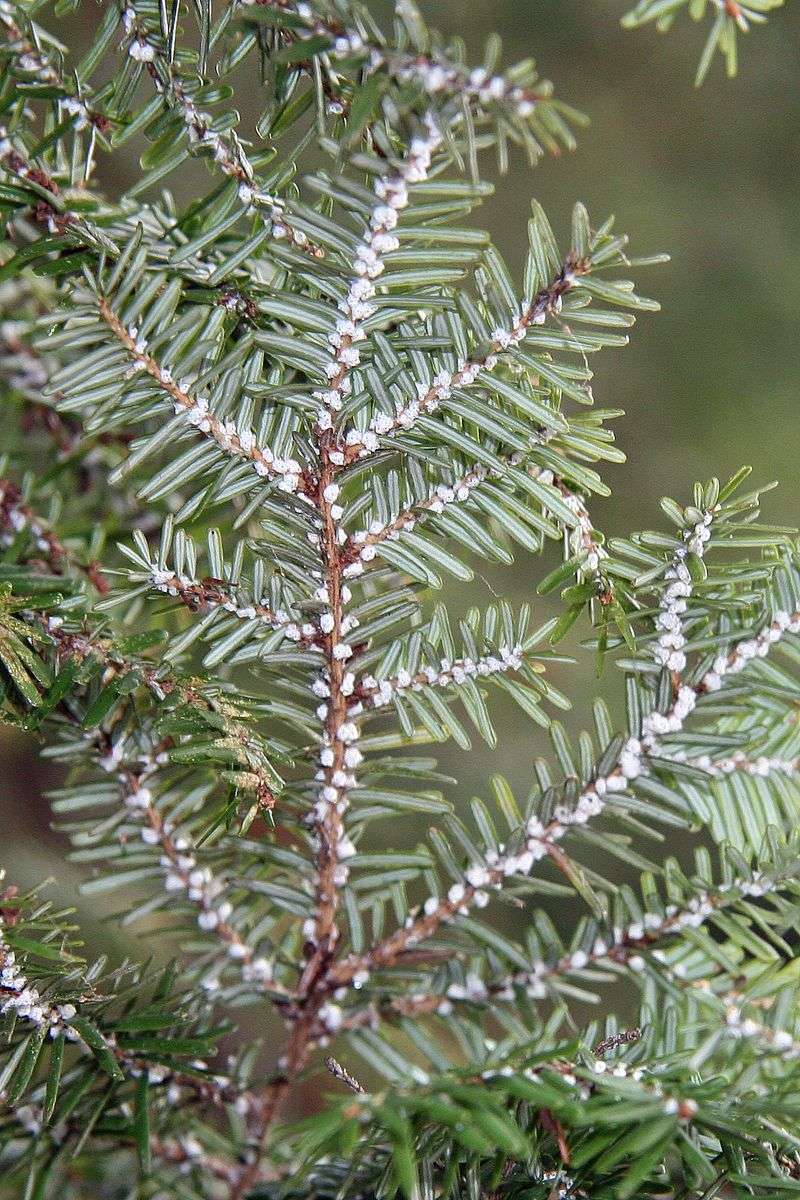
Knowing exactly where to look can save you a lot of searching time. Hemlock Woolly Adelgid ovisacs are not randomly scattered across the tree.
They attach specifically at the base of individual needles, right where the needle meets the twig. This precise location is tied directly to how the insect feeds, since it inserts its mouthparts into the twig tissue at that exact spot.
Michigan gardeners should focus their inspection on the undersides of outer branches. From above or from a distance, the white masses can be nearly invisible because the needles and branch structure block the view.
Your Michigan Garden Changes Every Week. Your Plan Should Too.
Gardening in Michigan changes quickly throughout the season. Every Friday you’ll receive a simple weekly plan showing exactly what to plant, prune, fertilize, harvest, and protect so you never miss the right timing.
Flipping a branch gently so you can see the underside will give you a much clearer picture of what is actually there. A good starting point is to check branches at eye level or lower, where you can get close without needing a ladder.
The ovisacs can appear individually, spaced out along a twig one by one, or they may show up in small clusters where several needles grow close together. Either pattern is worth noting.
You might spot just a handful on one branch, or you might find them spread across multiple branches in the same area. Even a small number of ovisacs is enough reason to make an official report.
The insect population can grow rapidly once established, so catching it early, even when only a few ovisacs are visible, gives authorities the best opportunity to assess the situation and respond appropriately before the infestation spreads further.
3. The White Masses Are Small But Distinctive
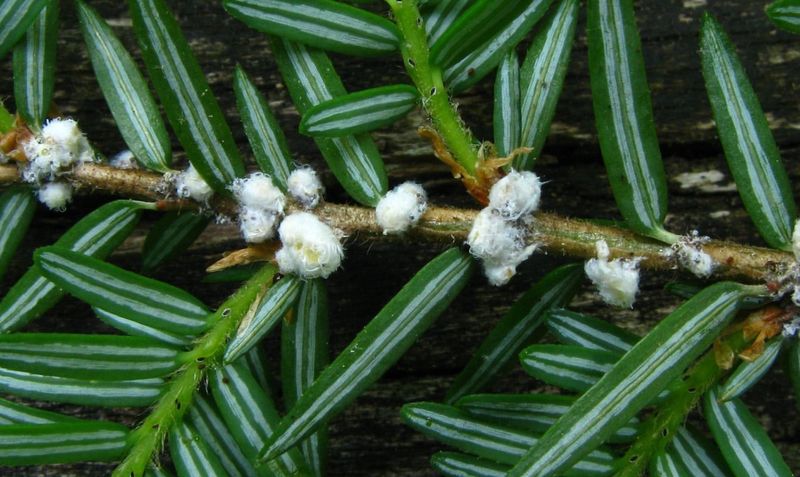
Size can be deceiving in the plant world, and Hemlock Woolly Adelgid ovisacs are a perfect example. These white masses are genuinely tiny, measuring roughly one sixteenth to one quarter of an inch across.
For comparison, the smaller ones are about the size of a pinhead, while the larger ones might reach the size of a small pea. They are easy to overlook on a casual walk through the yard, but up close they look remarkably distinctive.
When viewed closely, the ovisacs resemble miniature cotton balls. They have a soft, rounded, white appearance with a slightly woolly texture caused by the fine waxy strands the insect produces.
This cottony look is one of the most helpful identification features, because very few other things you would naturally find on a hemlock twig look quite like it.
Some gardeners initially mistake them for a fungal growth or an unusual seed structure, but the texture and placement quickly set them apart from anything the tree produces on its own.
Getting a clear look does not require any special equipment. A smartphone camera with a zoom or macro feature works very well for capturing a close image of suspected ovisacs.
A small magnifying lens is another handy tool to keep in a garden bag. The key is to look carefully without removing any material from the tree.
Clipping off a twig or brushing away the white masses might seem like a harmless way to investigate, but leaving everything in place is actually the correct approach when you suspect Hemlock Woolly Adelgid activity.
4. Cooler Months Offer The Clearest Inspection Window
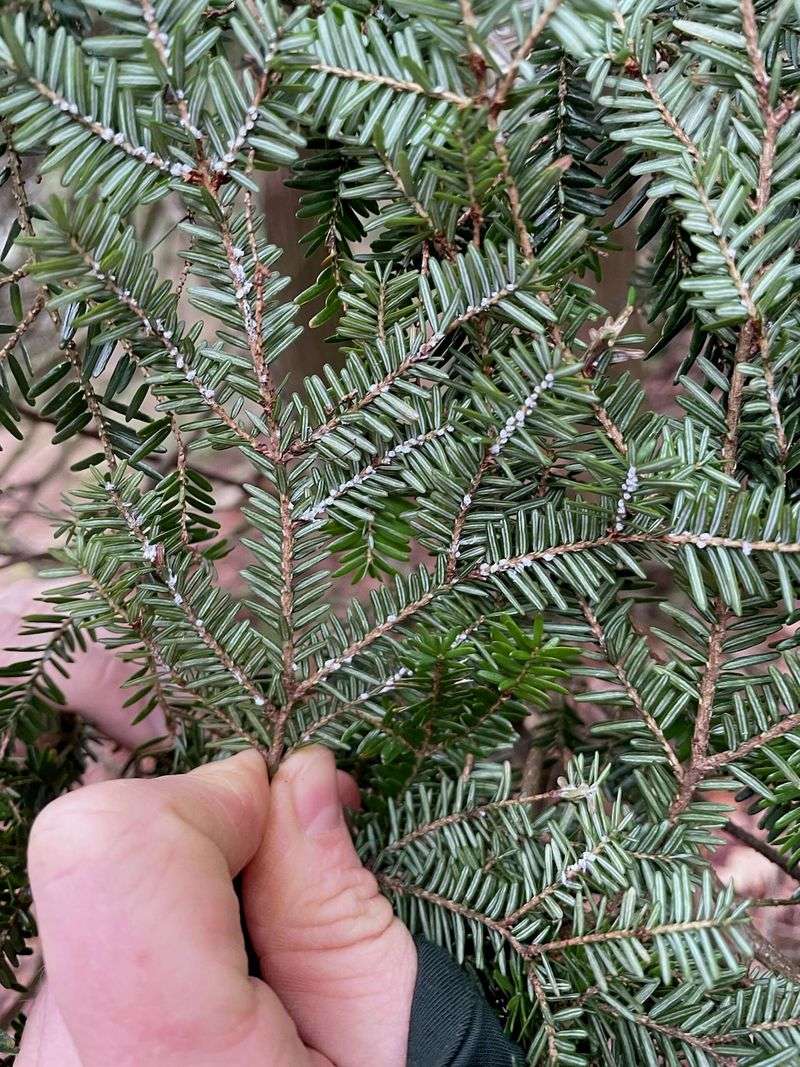
Timing your inspection can make the difference between spotting a problem early and missing it entirely.
Hemlock Woolly Adelgid ovisacs can technically be found on the tree at any point during the year, but they tend to be most visible and easiest to identify from November through July.
That long window covers late fall, winter, and spring, which is fortunate because those are also seasons when many Michigan gardeners are paying extra attention to their landscape.
Cooler temperatures play an interesting role in this insect’s life cycle. During the fall and winter months, the overwintering generation of adelgids becomes active and begins feeding.
As feeding ramps up, fresh waxy material is secreted and the white ovisacs become more pronounced and easier to see against the dark twig background.
This makes late fall through early spring one of the most productive times to walk through your property and check hemlocks carefully.
Michigan gardeners should take advantage of the leafless or low-canopy period to examine branches that are within reach. You do not need to inspect every single twig on a large tree.
Focus on the outer branches at the tips, especially on the lower half of the tree where you can actually get close. Pick several branches from different sides of the tree and check the undersides near the needle bases.
Spending just ten or fifteen minutes on a cool November or March afternoon could lead to an early discovery that makes a significant difference for your hemlock’s long-term health and for the trees around it.
5. Gardeners Must Confirm The Tree Is Eastern Hemlock
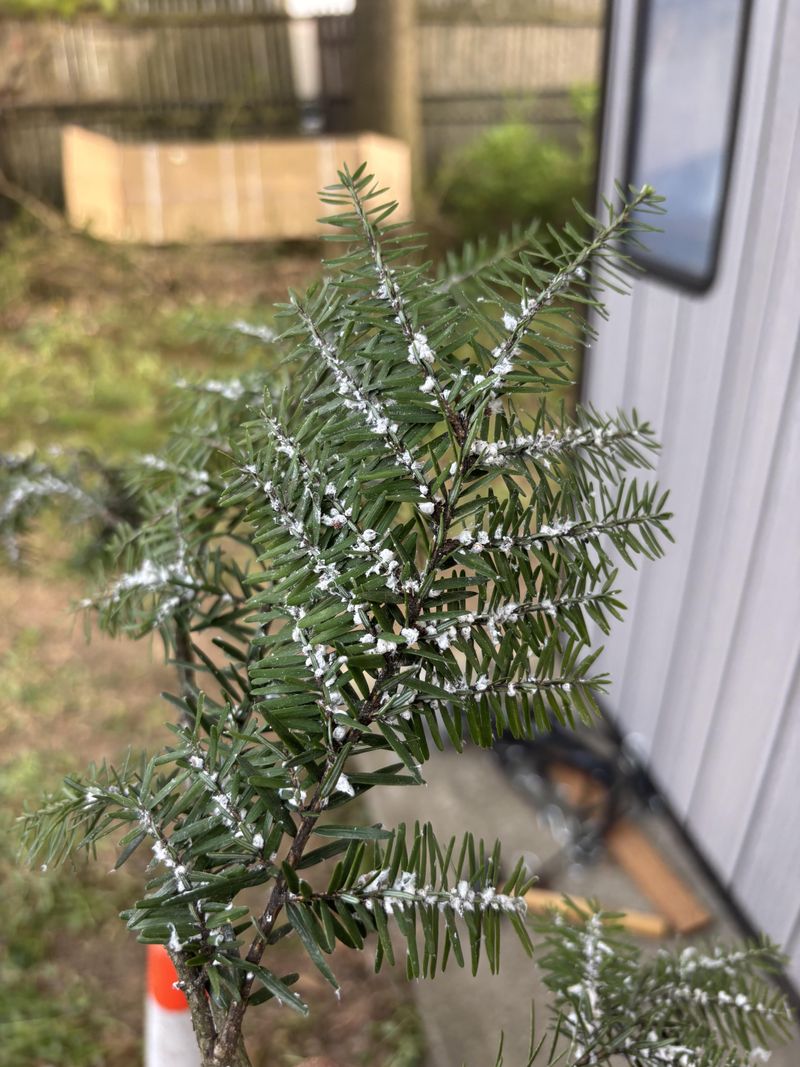
Before reporting a suspected sighting, it helps to make sure you are actually looking at an eastern hemlock.
Michigan has several conifer species, and knowing which one you have in your yard prevents confusion and helps officials prioritize their response.
Eastern hemlock, known scientifically as Tsuga canadensis, has a set of features that make it recognizable once you know what to look for.
Start with the needles. Eastern hemlock needles are short, flat, and grow individually from the sides of the twig rather than in clusters or bundles like pine needles do.
Flip a needle over and you will notice two thin white stripes running parallel along the underside. These stripes are one of the most reliable identification features of this species.
The overall branch structure of eastern hemlock tends to look feathery and slightly drooping at the tips, giving the tree a graceful, layered appearance that stands out from the stiffer profile of spruce or fir.
The cones are another helpful clue. Eastern hemlock produces small cones, usually less than an inch long, that hang down from the branch tips and have a thin, papery look.
They are much smaller than pine or spruce cones and tend to stay on the tree through winter. Hemlock Woolly Adelgid affects eastern hemlock specifically and does not infest pine, spruce, or other common Michigan conifers.
Confirming the tree species before submitting a report ensures that your information is accurate and useful for the officials who rely on these reports to track the insect’s spread across the state.
6. Grayish Green Foliage Is A Later Sign Of Decline
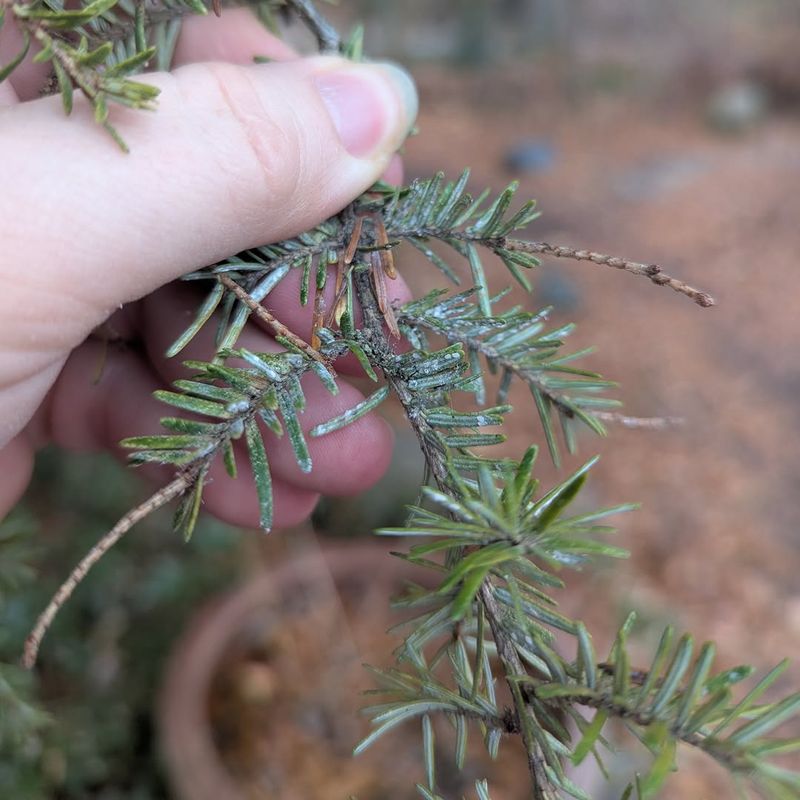
Here is something many gardeners do not realize until it is too late to act early. By the time a hemlock starts looking grayish green or its foliage begins to thin noticeably, the Hemlock Woolly Adelgid has likely been feeding on that tree for a significant period.
The white ovisacs are the early warning. The color change in the canopy is a later signal that the tree has already been under stress for some time.
The way the insect causes this change is worth understanding. Hemlock Woolly Adelgid inserts its mouthparts into the twig tissue near the needle bases and feeds on stored starches and nutrients inside the tree.
Over time, this feeding reduces the tree’s ability to move energy and resources to its needles and new shoots. Needles begin to lose their deep green color, turning a dull grayish green that looks noticeably different from healthy hemlock foliage.
New shoot growth slows down or stops, and branches that once looked full and lush begin to thin out.
Gardeners who notice this color change should still report the tree, but the goal of early reporting is to catch the situation before these broader symptoms appear.
A hemlock with ovisacs but still healthy-looking foliage has a better chance of responding well to management efforts than one that has already experienced significant stress across large portions of its canopy.
Watching your hemlocks regularly through the seasons and knowing what healthy foliage looks like gives you the advantage of catching problems while the tree still has strong reserves to work with.
7. Suspected Branches Should Be Photographed And Left In Place
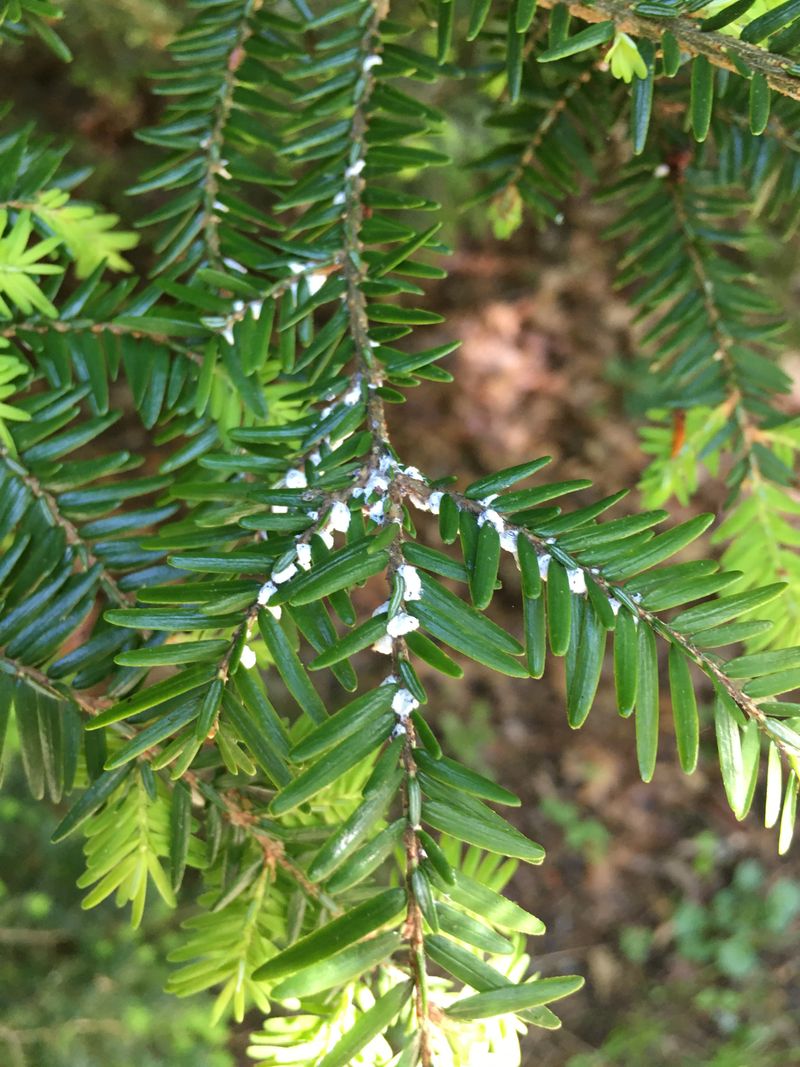
Finding suspected ovisacs on your hemlock can feel like a moment that calls for immediate action, and it does, but the right action might surprise you.
The most helpful thing you can do after spotting white cottony masses on a hemlock twig is to take clear photographs and leave everything exactly as you found it. Do not clip the branch, pull off the white material, or collect samples in a bag.
The reason this matters is straightforward. Hemlock Woolly Adelgid spreads in part by being moved from one location to another on plant material.
Carrying an infested twig across town, mailing it to a friend, or tossing it in a compost pile that gets transported elsewhere all create opportunities for the insect to reach trees and areas where it has not yet been found.
Even well-intentioned attempts to bring a sample to a local nursery or extension office can create unintended risk if the material is handled without proper protocols. Photographs are genuinely all you need to support a strong report.
Use your smartphone to capture several angles of the affected branch, including a close-up of the ovisacs at the needle bases and a wider shot showing where on the tree the branch is located.
Note the address or GPS coordinates of the property, and if the hemlock is in a park or natural area, note any landmarks that would help someone find the exact tree.
Clear photos and a precise location are the two most valuable pieces of information you can provide to Michigan officials when reporting a suspected infestation.
8. Every Suspected Michigan Infestation Should Be Reported
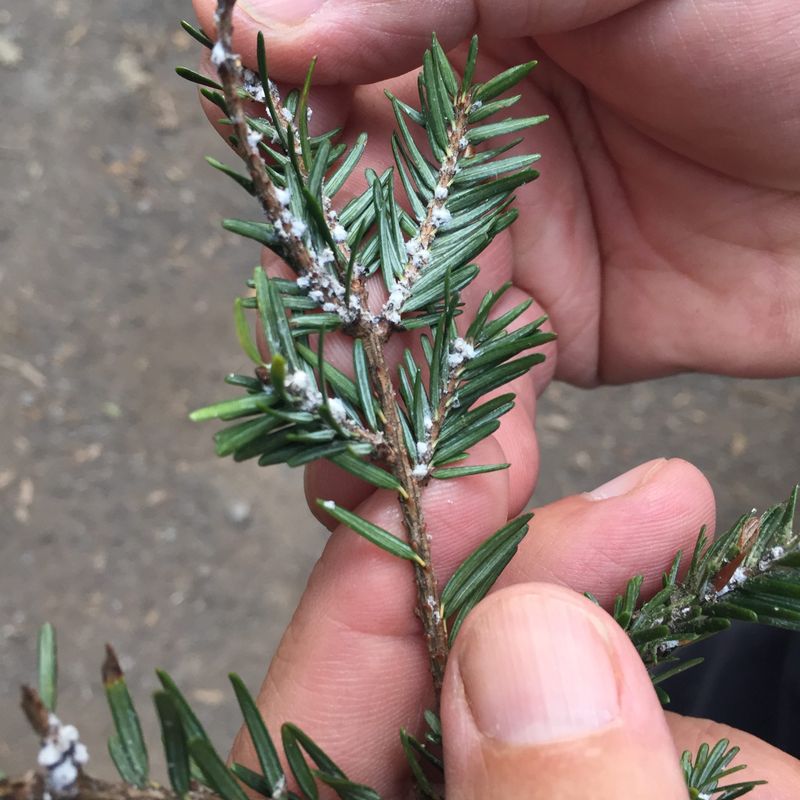
Reporting your sighting is genuinely one of the most powerful things a Michigan gardener can do. Officials cannot survey every hemlock in the state on their own.
When gardeners submit reports, they add crucial data points that help map where the insect is present, where it is spreading, and where survey resources should be directed next.
Your report has real value regardless of whether you plan to manage the tree yourself. The Midwest Invasive Species Information Network, commonly called MISIN, is one of the primary platforms for submitting reports.
You can use the MISIN website or download the free MISIN smartphone app to submit your photos and location information directly.
The app makes reporting especially easy because it uses your phone’s GPS to record the location automatically. Filling out the report takes only a few minutes and your submission goes directly into a database that researchers and state officials actively monitor.
Two additional reporting options are available for Michigan residents. You can email your photographs and location details to MDA Info at Michigan dot gov, which reaches the Michigan Department of Agriculture and Rural Development directly.
You can also call the MDARD Customer Service Center at 800 292 3939 to speak with someone and describe what you found. Both options are staffed by people familiar with invasive species reports and they can guide you on next steps if needed.
Submitting a report through any of these channels, even if you are uncertain whether what you found is actually Hemlock Woolly Adelgid, is always the right call. Officials would rather investigate a false alarm than miss a real infestation because nobody spoke up.