What It Means When a Cactus Wren Keeps Showing Up in Your Arizona Yard

Spotting a cactus wren once in your yard is a treat, but seeing the same bold, chattering bird show up day after day raises a natural question: what is going on? Arizona’s state bird is not a random wanderer, and its repeated appearances usually have a straightforward, biological explanation rooted in territory and habit.
Understanding what draws it back can help you make sense of what you are seeing and decide how to respond without accidentally doing more harm than good.
Repeated visits usually point to nearby territory

Cactus wrens are year-round residents across much of southern, western, and central Arizona, and they do not migrate when temperatures climb or drop. According to Arizona Game and Fish Department species profile, these birds hold and defend territories throughout the year, which means the same individual or pair may routinely cover the same patches of ground, week after week, season after season.
When a cactus wren keeps turning up in your yard, the most straightforward reading is that your property falls within a nearby bird’s regular territory. The yard may offer a reliable foraging spot, a perch, or a shaded resting area that the bird works into its daily circuit.
That is ordinary behavior, not a signal that something unusual is happening.
What the visits do not tell you is equally worth keeping in mind. Repeated appearances alone do not confirm that a nest is active in your yard, and they are not evidence of a spiritual omen or a special bond between bird and homeowner.
Cactus wrens are loud, assertive, and highly visible, so their presence tends to feel significant even when the explanation is simply that your yard sits inside a well-traveled territory.
A yard can offer food, shelter, or a place to roost

Cactus wrens forage mostly on the ground, flipping leaf litter and probing soil for insects, seeds, and fruit. A yard with open ground, native debris, or low-growing vegetation gives the bird practical reasons to return.
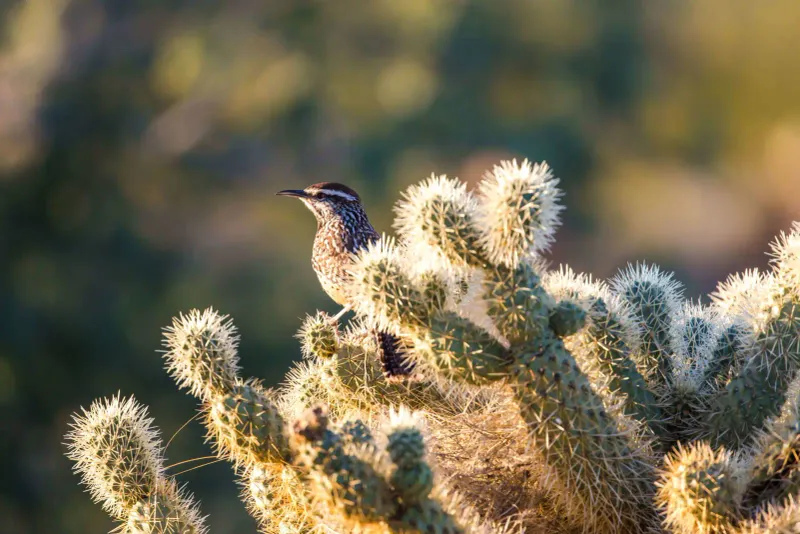
Thorny cover matters too: Cornell Lab’s Cactus Wren overview notes that the species relies heavily on cacti and spiny shrubs for shelter, and Arizona Game and Fish lists cholla, saguaro, mesquite, ironwood, palo verde, and catclaw acacia among the plants wrens use for nesting and cover.
Any combination of these features in or near your yard can make it a logical stop on a wren’s daily route. A bird may forage along a fence line, rest in a shaded shrub during midday heat, or use a nest structure for overnight roosting even when no eggs are present.
That said, none of these features guarantee a visit or explain exactly why one particular bird appears when it does. Local conditions vary, and a yard that looks suitable to a human observer may be passed over entirely while a less obvious neighboring property gets regular traffic.
The features create opportunity; they do not create certainty.
A nest is a clue, not proof of active breeding
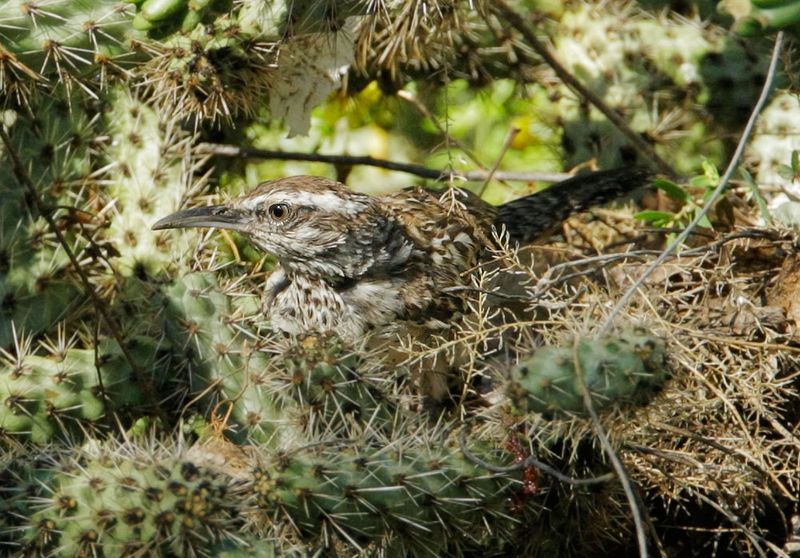
One of the more distinctive signs that cactus wrens are using an area is their nest. The structure is hard to miss: a bulky, football-shaped bundle of grasses and plant fibers with a narrow, tunnel-like entrance on one side.
Your Arizona Garden Changes Every Week. Your Plan Should Too.
Gardening in Arizona changes quickly throughout the season. Every Friday you’ll receive a simple weekly plan showing exactly what to plant, prune, fertilize, harvest, and protect so you never miss the right timing.
Spotting that kind of construction in a cholla or thorny shrub in or near your yard is a reasonable clue that wrens are active nearby.
The catch is that finding a nest does not tell you whether breeding is currently underway. Cactus wrens build and maintain multiple nest structures, and outside the breeding season they use those same nests for nighttime roosting.
A nest that looks occupied may simply be a regular sleeping spot with no eggs or chicks inside.
Cornell Lab’s identification and overview pages both note this roosting behavior, which is why the presence of a nest structure is a clue rather than a conclusion. Resisting the urge to check inside is the right call.
Approaching or handling the nest risks disturbing a bird that may be roosting or, if breeding is underway, could cause the adults to abandon the site. Watching from a comfortable distance with binoculars gives you far more useful information without putting the bird at risk.
Arizona breeding timing does not provide a simple test
Many Arizona homeowners assume that if they know the nesting season, they can figure out whether a visiting wren is breeding nearby. Breeding timing in this species is more variable than a fixed calendar suggests.
A local bird guide published by the Tucson Bird Alliance notes that egg-laying can begin as early as late February and that timing shifts with rainfall patterns from year to year.
That variability means a date on the calendar is not a reliable indicator of whether a nest you see is active. A bird calling frequently in March might be defending territory, attracting a mate, or simply doing what cactus wrens do regardless of breeding status.
Increased activity or a wren carrying nesting material is more informative than the month alone, though neither observation is definitive proof that eggs are present.
The practical takeaway is to treat any nest you find with caution throughout the year, not just during a narrow window you have identified as peak season. Conditions that trigger or delay breeding are not always visible to a backyard observer, and approaching a nest to investigate only adds stress to a bird that may already be managing a demanding territorial schedule.
Preserve useful cover without expecting a guaranteed visitor
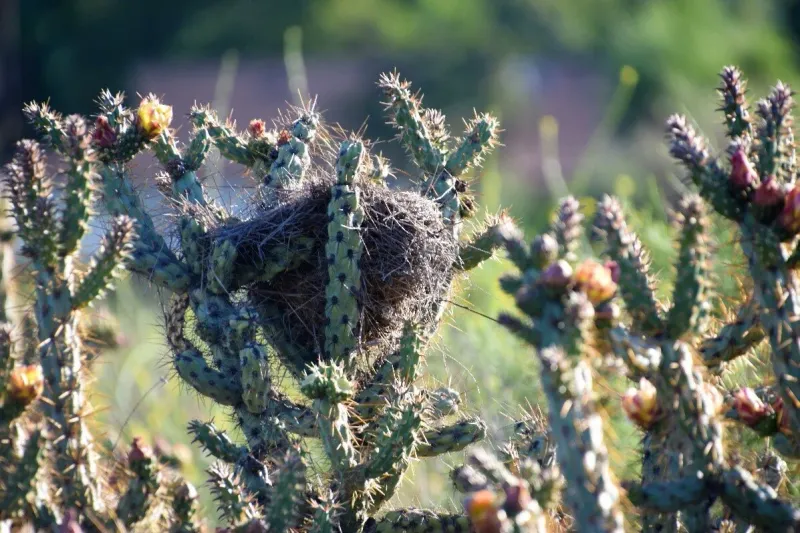
If you enjoy having cactus wrens pass through, the most honest and habitat-friendly step you can take is to hold onto suitable cover that already exists in your yard. Thorny plants such as cholla, prickly pear, mesquite, ironwood, palo verde, and catclaw acacia are among the native species Arizona Game and Fish associates with cactus wren nest sites.
Removing them eliminates features the bird may be using for shelter, foraging, or roosting.
Retaining existing cover is more reliable advice than planting a particular species with the expectation that a wren will show up. Habitat associations tell us what kinds of plants the bird tends to use across the landscape, not that placing a new cholla in your yard will produce a resident wren.
Whether any individual bird uses your yard depends on where its territory sits, what else is available nearby, and factors that are simply outside your control.
A few practical considerations are also worth keeping in mind for households with children or pets. Thorny cacti and shrubs that benefit wrens can also pose safety concerns at close range.
Preserving cover does not mean ignoring those realities; it means making thoughtful decisions about which plants to keep and where, rather than clearing everything out of an abundance of caution.
Cactus wrens are not dependable pest control

Cactus wrens eat a varied diet that includes insects, spiders, seeds, and fruit, and watching one work across your yard can easily give the impression that it is cleaning up pests. The reality is more nuanced.
Ordinary foraging behavior does not translate into meaningful, measurable control of any particular household pest at the yard level.
A USGS study that examined the diet of cactus wren nestlings in coastal California found a broad range of arthropods in fecal samples, with scorpions making up a very small fraction of identified prey. That USGS nestling diet study was conducted in a specific geographic area under specific life-stage conditions, and its findings do not carry over to Arizona yards or to adult birds foraging on their own schedule.
Expecting a cactus wren to handle your scorpion population or reduce mosquito pressure sets up a disappointment. The bird may eat an occasional arthropod that happens to cross its path, but it is not hunting systematically for the pests that concern most Arizona homeowners.
Appreciating the wren for what it actually does, foraging opportunistically across a desert territory, is a more grounded way to think about its role in your yard’s small ecosystem.
Leave a potentially active nest undisturbed
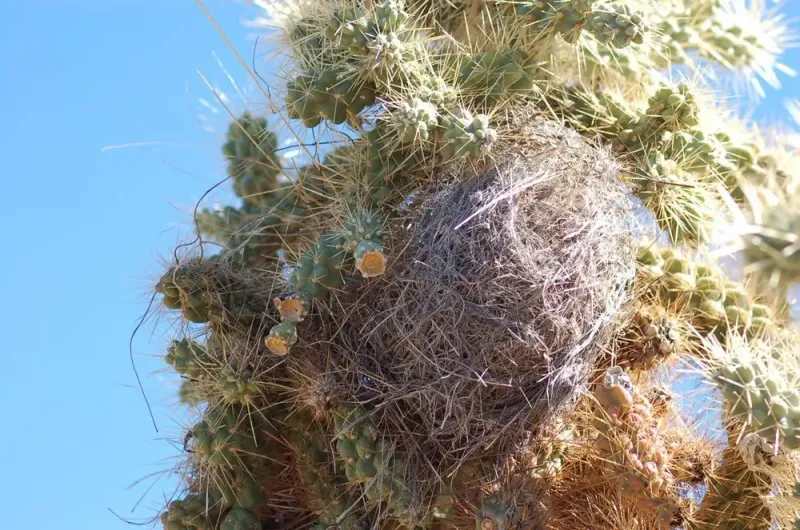
Finding a cactus wren nest in your yard can feel like an invitation to take a closer look, but the right move is to keep your distance and leave it alone. If birds, eggs, or dependent young are present, removing or relocating the nest yourself creates a real risk of harm to the birds and puts you in legal territory that is worth understanding before you act.
Most bird nests, including cactus wren nests, are protected under the Migratory Bird Treaty Act. U.S.
Fish and Wildlife Service guidance on bird nests states that destroying a nest that is in active use requires authorization, and that the rules differ depending on whether a nest is currently active or has been inactive for a full season. That distinction matters, and it is not always easy for a homeowner to determine from the outside.
If a nest is causing a genuine problem, such as a location that creates a safety hazard or blocks essential access, the right step is to contact Arizona Game and Fish or U.S. Fish and Wildlife before doing anything.
They can advise on your specific situation. An empty nest from a prior season is a different circumstance than one with a bird sitting inside it, and getting that guidance protects both you and the bird.
The cactus wren’s habit of reusing nests for roosting makes that call worth making before assuming a nest is truly abandoned.