Why Georgia Lawns Are Going Brown In August And What Actually Stops It
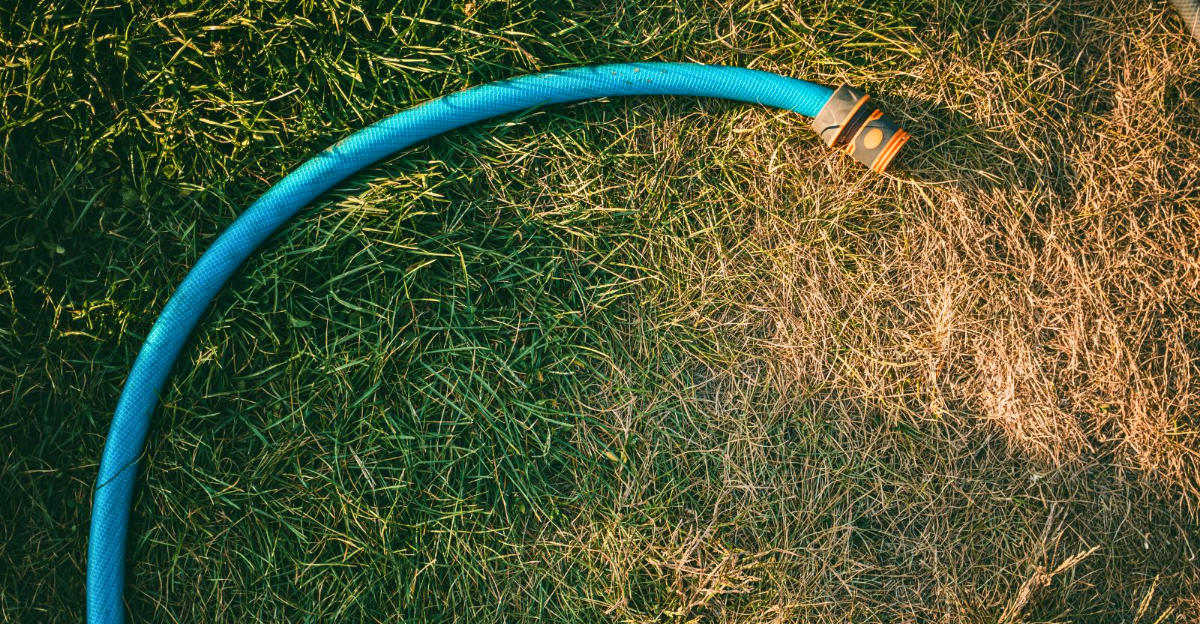
August has a way of making even the most carefully maintained Georgia lawn look like it’s given up.
The frustrating part is that brown, patchy turf in late summer can mean several completely different things depending on what’s actually going on beneath the surface.
Drought stress looks a lot like fungal disease from the curb. Insect feeding can mimic the kind of damage that comes from mowing too short in the heat.
And reaching for the hose or a bag of fertilizer without knowing the real cause is the kind of well-meaning move that can make certain problems significantly worse rather than better.
August lawn diagnosis requires a little detective work before any action, and getting that part right first saves a lot of wasted effort, money, and time during one of the toughest months of the Georgia growing season.
1. August Heat And Dry Soil Stress Lawns
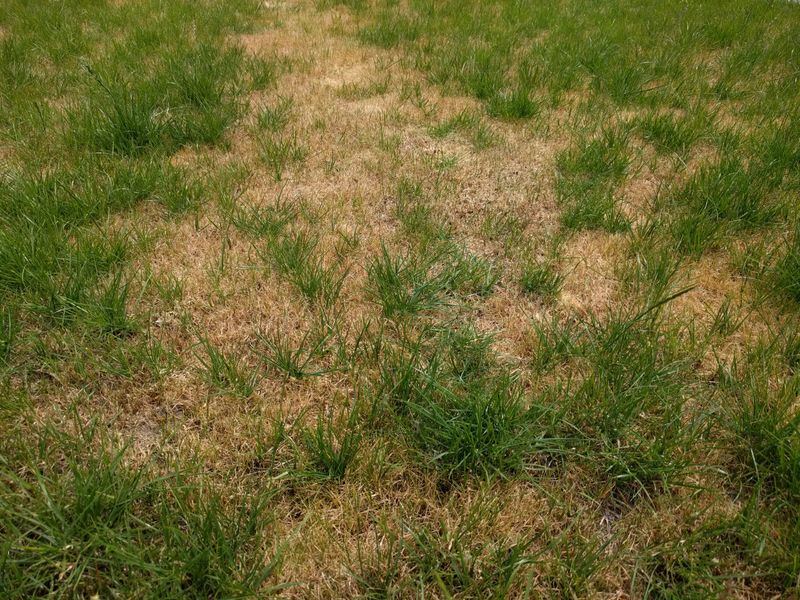
Walking across a Georgia lawn in mid-August can feel like crossing a parking lot. Soil temperatures climb, rainfall becomes unpredictable, and even grasses well-suited to the South begin showing signs of heat and moisture stress.
When turf does not receive enough water to replace what evaporates through the leaves and soil surface, the grass blades wilt, lose color, and eventually turn brown.
Warm-season grasses like bermudagrass and zoysiagrass handle drought better than most, but they still have limits. Centipedegrass and St. Augustinegrass can show stress symptoms more quickly during extended dry stretches.
Tall fescue, a cool-season grass grown in parts of Georgia, tends to struggle considerably during August heat even with irrigation.
One of the most useful checks before reaching for the sprinkler is the footprint test. If your footprints remain visible in the turf for several minutes after walking across it, the grass is likely under moisture stress and may benefit from irrigation.
Footprints that spring back quickly suggest the soil still holds reasonable moisture.
Deep, infrequent watering generally supports stronger root development than frequent shallow watering.
UGA Extension guidance has suggested that many lawns need roughly one inch of water per week during summer, though actual needs vary depending on soil type, slope, sun exposure, and how well your irrigation system distributes water evenly.
Checking soil moisture a few inches below the surface before irrigating can help you water based on what the lawn actually needs rather than a fixed schedule.
2. Mowing Too Low Turns Turf Brown
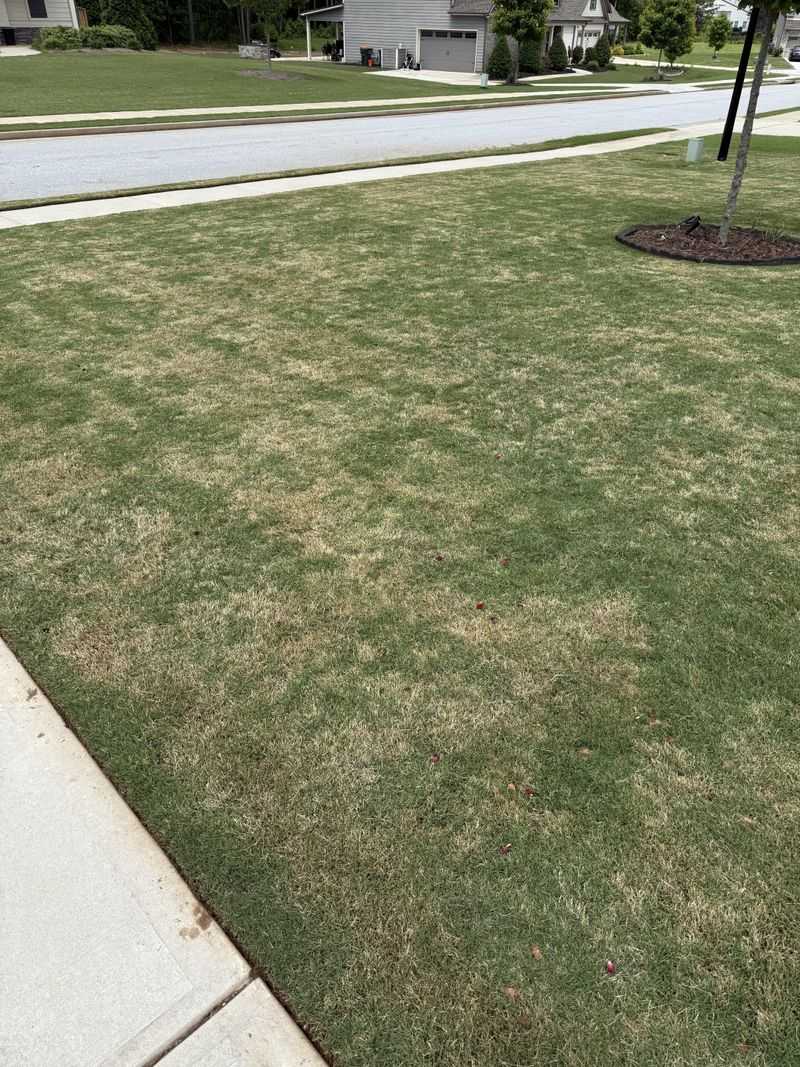
Scalping a lawn in the middle of a Georgia summer can set turf back in ways that take weeks to recover from.
When a mower removes too much leaf tissue at once, the grass loses much of its ability to photosynthesize and protect itself from heat and soil moisture loss.
That sudden stress often shows up as browning within a day or two of mowing.
A widely referenced guideline from UGA Extension recommends removing no more than roughly one-third of the grass blade during any single mowing.
Cutting below that threshold, particularly during drought or extreme heat, removes green tissue faster than the plant can replace it and leaves the crown and soil more exposed to the sun.
Your Georgia Garden Changes Every Week. Your Plan Should Too.
Gardening in Georgia changes quickly throughout the season. Every Friday you’ll receive a simple weekly plan showing exactly what to plant, prune, fertilize, harvest, and protect so you never miss the right timing.
Appropriate mowing height varies by grass species, so what works for bermudagrass may not be right for centipedegrass or tall fescue.
Bermudagrass is often maintained at lower heights than other warm-season grasses, while centipedegrass and St. Augustinegrass generally do better at moderate heights.
Tall fescue tends to benefit from being kept on the taller side, especially during summer stress.
Mower blade sharpness also matters more than many homeowners realize. A dull blade tears and shreds grass rather than cutting cleanly, leaving ragged tips that turn tan or brown and make the lawn look worse than it actually is.
During periods of heat and drought, some lawn managers raise their mowing height slightly to help turf maintain more leaf area, retain soil moisture, and manage stress more effectively through the hottest weeks of summer.
3. Armyworms Can Brown Lawns Fast
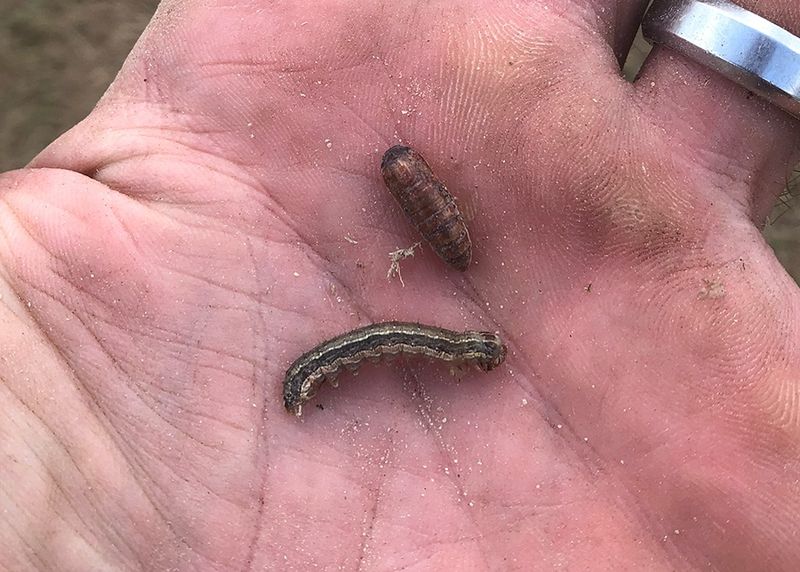
Few lawn problems move as quickly as a fall armyworm outbreak in Georgia.
These caterpillars can appear in large numbers during late summer, feeding heavily on grass blades and leaving behind brown, ragged patches that spread faster than most homeowners expect.
Because the damage looks similar to drought stress or disease from a distance, many people do not realize insects are responsible until the problem has already expanded.
Fall armyworms are the larval stage of a moth that migrates into Georgia during summer and early fall.
The moths lay eggs in masses on grass blades or nearby surfaces, and the caterpillars that hatch feed on turf, often concentrating their activity during cooler parts of the day.
Bermudagrass and other warm-season grasses commonly grown in Georgia can experience significant feeding pressure during outbreak years.
Before treating, inspecting the turf closely is a practical first step. One method that has been referenced by university Extension sources involves mixing a small amount of liquid dish soap with water and pouring it over a square foot or two of suspect turf.
Caterpillars present near the surface may move upward within a few minutes, making them easier to spot and count.
Smaller caterpillars are generally more responsive to management than larger, more developed ones when treatment is warranted.
Treatment decisions should be based on confirmed caterpillar activity and appropriate product labeling rather than on the appearance of brown patches alone.
A lawn that looks drought-stressed in August may be hiding active armyworm feeding just beneath the surface of the turf.
4. Chinch Bugs Thrive In Hot Turf
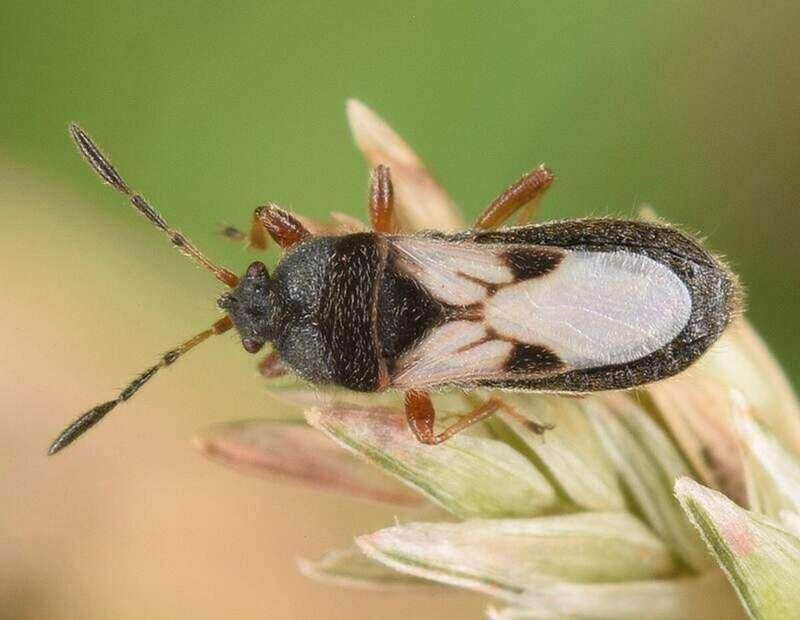
On a hot afternoon, the outer edges of a brown patch creeping across a St. Augustinegrass lawn can be one of the clearest signs that chinch bugs may be at work.
These tiny insects feed by piercing grass stems and withdrawing plant fluids while also injecting a substance that disrupts the plant’s ability to move water.
The result is a patch of wilted, yellowing, and eventually brown turf that tends to expand outward as the insects move to fresh grass.
St. Augustinegrass is particularly susceptible to chinch bug injury in Georgia, and the problem tends to be most noticeable during hot, dry weather when turf is already under stress. Sunny, open areas of the lawn often show damage before shaded sections.
Because the symptoms can look similar to drought stress, some homeowners water affected areas repeatedly without realizing insects are the actual cause.
Inspecting the outer edge of a damaged area, where insects are more likely to be actively feeding, can help with identification.
One approach referenced by university Extension sources involves pressing an open-ended can or cylinder into the turf, filling it with water, and watching for small insects floating to the surface over several minutes.
Chinch bugs are very small, so looking closely along the soil and thatch layer near the damaged margin is often necessary.
Treatment should follow confirmed identification and pesticide label directions rather than being applied automatically to every brown spot.
Not every brown patch in a Georgia lawn during August involves chinch bugs, and treating without a confirmed cause can add unnecessary chemical exposure and expense.
5. Brown Patch Hits Stressed Tall Fescue
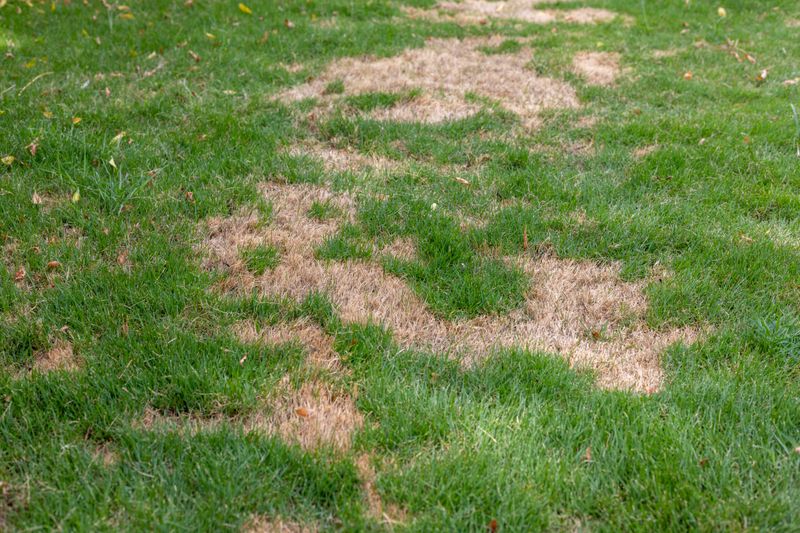
Tall fescue occupies an interesting and sometimes difficult place in Georgia’s lawn landscape. As a cool-season grass, it grows well during fall, winter, and spring across much of the state, but August brings conditions that push it to its limits.
High temperatures, overnight humidity, and extended periods of wet leaf tissue create exactly the environment that favors Rhizoctonia blight, commonly called brown patch.
Brown patch in tall fescue often appears as roughly circular areas of tan or brown grass.
The affected patches may show a darker, water-soaked ring at the outer margin in early morning, though this symptom is not present in every case and visual diagnosis alone does not provide a certain identification.
Lesions on individual grass blades, often with tan centers and darker borders, can be another sign associated with this disease.
Several practices can contribute to brown patch pressure during summer.
Applying nitrogen fertilizer to tall fescue during warm weather, watering in the evening or overnight so leaves stay wet for extended periods, and heavy thatch accumulation have all been associated with increased disease severity.
Adjusting irrigation timing so turf dries before nightfall, avoiding unnecessary summer nitrogen applications, and mowing at an appropriate height can all help reduce conditions that favor the disease.
If a fungicide seems warranted, proper diagnosis, product selection, timing, and label compliance matter considerably.
Applying a fungicide to an undiagnosed brown lawn without confirming that a fungal disease is actually present is not a reliable management approach and may not produce the results a homeowner is hoping for.
6. Take-All Root Rot Weakens Turf
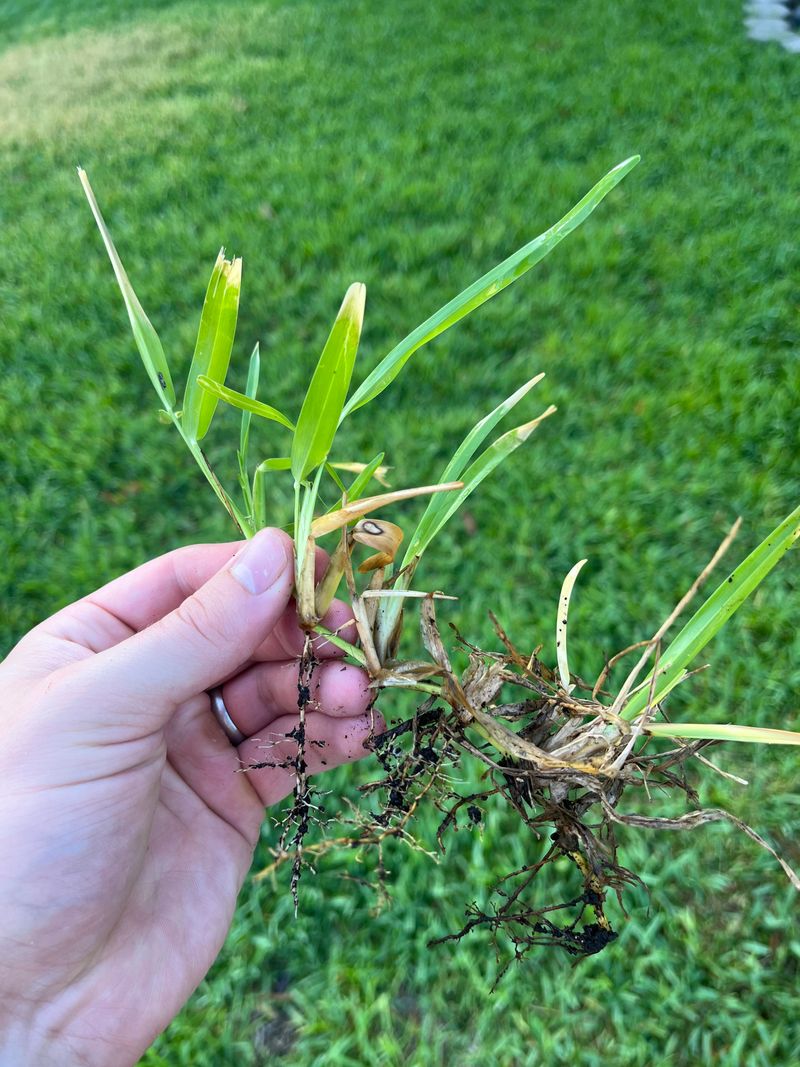
Some lawn problems show up above ground but originate entirely below it.
Take-all root rot is a fungal disease that attacks the roots, stolons, and lower stems of susceptible warm-season grasses, making it harder for affected turf to absorb water and nutrients even when both are available.
The result is grass that looks stressed, yellows, thins out, and eventually turns brown in irregular patterns that can be easy to confuse with drought or nutritional problems.
In Georgia, take-all root rot has been documented on St. Augustinegrass, bermudagrass, centipedegrass, and zoysiagrass, though susceptibility can vary.
Environmental and cultural factors that stress turf, including poor soil drainage, soil compaction, excessive thatch, low soil pH in some situations, shade, and over-irrigation, have been associated with increased disease pressure according to Extension-based resources.
Pulling affected grass and examining the roots can provide useful clues. Roots affected by take-all root rot are often short, dark, and rotted rather than firm and white as healthy roots tend to appear.
Because the visible symptoms above ground can resemble several other problems, a proper diagnosis is helpful before beginning any treatment program.
Soil testing to check pH and fertility, improving drainage where possible, reducing compaction, and addressing thatch are often recommended as part of a management approach.
Fungicide timing can matter for take-all root rot, and applications made without a confirmed diagnosis or at the wrong point in the disease cycle may not provide meaningful results.
Identifying the underlying stress factors is generally as important as any single treatment step.
7. Sod Webworms Can Mimic Drought
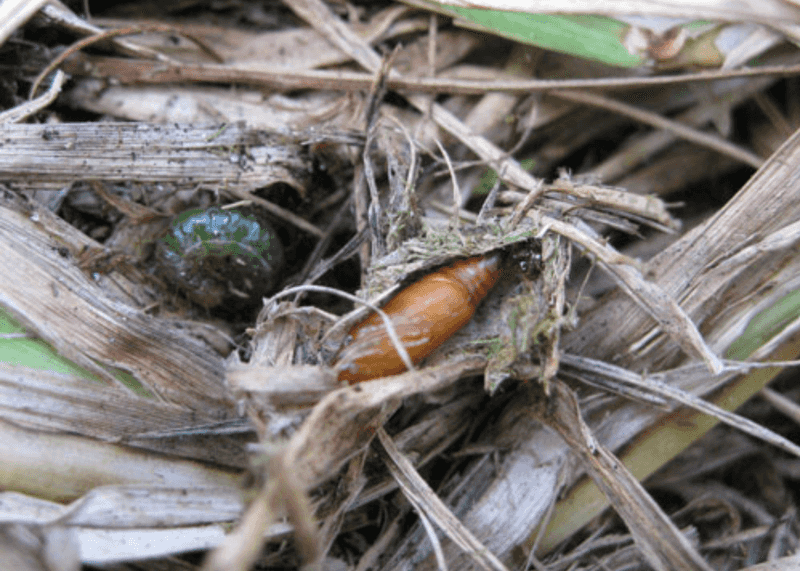
Irregular brown patches that appear suddenly in a Georgia lawn during summer do not always trace back to heat or dry soil.
Sod webworms are the larval stage of small lawn moths, and their feeding on grass blades near the soil surface can produce browning that looks remarkably similar to drought stress or uneven irrigation coverage.
Homeowners who water more in response, without checking for insect activity first, may find that the patches continue to expand regardless.
The adult moths are small and tan or gray, and they tend to fly in a low, erratic zigzag pattern over the lawn at dusk. Seeing several moths flushed up while walking across the grass can be an early signal worth investigating further.
The larvae themselves feed at night and spend daylight hours in silk-lined tunnels within the thatch layer, which makes them easy to miss during a casual daytime inspection.
Examining the thatch and soil surface in and around damaged areas during daylight, or using a soapy-water flush in a small section as referenced by some university Extension sources, may help reveal larval activity.
Chewed grass blades near the soil surface and small green pellets of insect frass in the thatch are sometimes associated with active feeding.
As with other insect problems in Georgia lawns, treatment decisions should follow confirmed identification rather than the appearance of brown patches alone.
Grass species, larval population levels, and current product labeling are all factors that should inform any management decision.
Treating a lawn for sod webworms when drought or disease is actually responsible will not stop the browning from continuing.
8. White Grubs Can Damage Roots Below
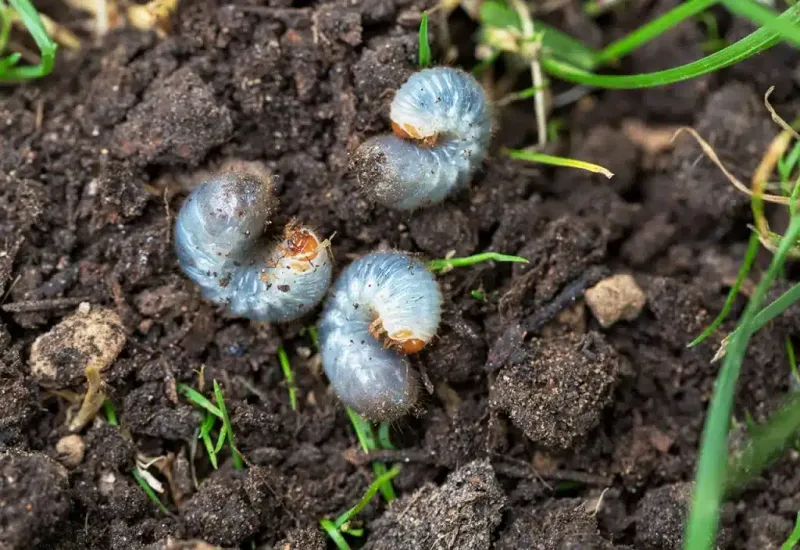
Turf that feels spongy underfoot, pulls up easily like a loose mat, or develops irregular brown patches that do not respond to irrigation may be worth investigating below the surface.
White grubs, the larvae of several beetle species, feed on grass roots in the soil and can reduce a lawn’s ability to take up water and nutrients.
In Georgia, grub activity tends to peak during summer and early fall as larvae grow larger and consume more root material.
Several beetle species produce white grubs that feed in Georgia lawns, including masked chafers and the Japanese beetle, among others.
Grub species, population density, and timing of activity can vary, which is one reason that a blanket treatment approach does not fit every situation.
Not every lawn with some grub presence will develop visible damage, as turf can often tolerate low populations without significant browning.
A practical way to check for grubs is to cut and fold back a one-square-foot section of turf in a damaged area and count the larvae present in the top few inches of soil.
University Extension resources often suggest that treatment thresholds vary by grass species and conditions, so the number of grubs that warrants attention is not the same for every lawn.
Proper timing matters considerably for grub management. Younger, smaller larvae near the soil surface are generally more responsive to management than larger, more developed grubs feeding deeper in the soil later in the season.
Identifying the species if possible, confirming population levels, and following current product labeling are all important steps before deciding on any treatment approach for a Georgia lawn.