What Hawks Nesting Closer To North Carolina Homes Are Really Saying About Your Yard
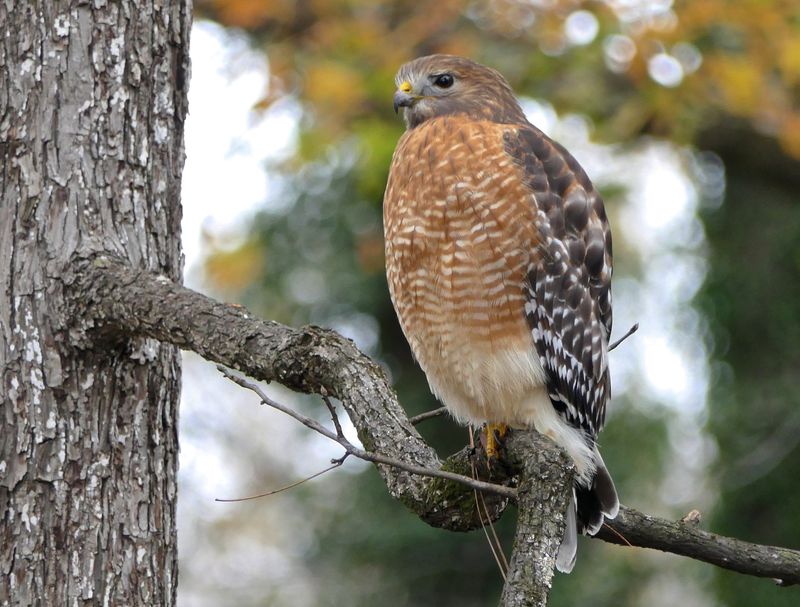
Spot a hawk perched on your fence post or circling low over the backyard and your first thought is probably that something big just changed out there. That bird did not land randomly. Its presence is more like a quiet field report on the landscape your neighborhood has quietly assembled, block by block, yard by yard. Understanding what it is actually reading can help you make smarter choices about feeders, pets, and the habitat you are already growing.
The Hawk Is Reading More Than Your Yard
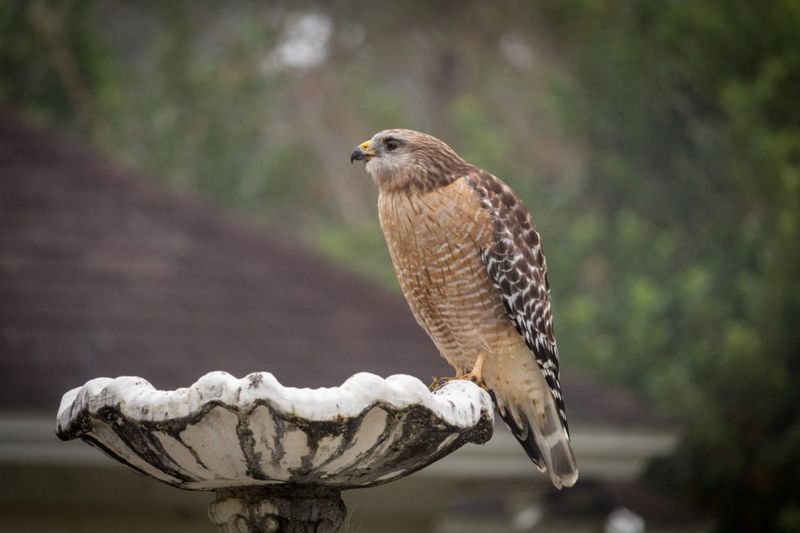
Plenty of North Carolina homeowners see a hawk cruise low over the garden and immediately credit their own yard for the visit. The honest picture is more interesting than that, and a little more complicated. A hawk near your home may be responding to one or more resources spread across the broader neighborhood, including available prey, useful cover, a suitable nest site if it is nesting, or a reliable hunting perch in a tall pine three lots away.
The relevant landscape stretches well beyond your property line. Parks, wooded lots, creek corridors, cemeteries, and neighboring yards all contribute to what a hawk finds worth investigating in your direction. A 2018 study of Cooper’s and Sharp-shinned Hawks in the Chicago metropolitan area found that prey abundance helped explain their establishment in urban and suburban settings, even where tree cover was limited. That study tracked occupancy patterns across a metro area, so it does not point a finger at any single homeowner’s landscaping choices.
Closer to home, an NC State study of 58 residential yards in Raleigh found that supplemental feeding had the strongest effect on wildlife abundance among the yard features tested, and that predator abundance tracked alongside prey abundance. A hawk may genuinely be responding to the food web your neighborhood built, including food unintentionally supplied by bird feeders, gardens, compost bins, chicken coops, or brush piles next door.
What that means practically: your yard may be one piece of the puzzle, or it may just sit inside a territory that extends across several properties. Either way, the hawk is reading the whole neighborhood, not grading your garden on a curve.
Which North Carolina Hawk Keeps Appearing?
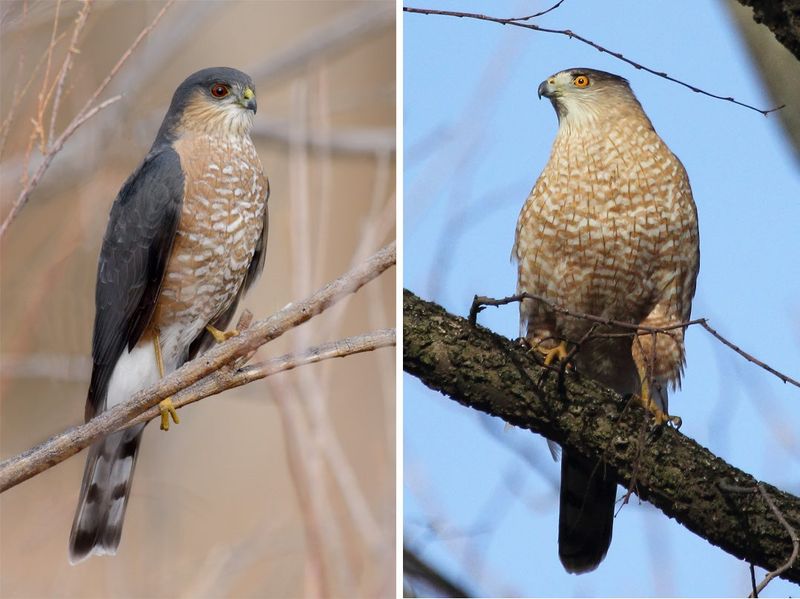
Not every hawk tells the same story, and treating them as one ecological type leads to the wrong conclusions. Three species show up regularly around North Carolina homes, and their habits are genuinely different enough to matter when you are trying to read what the bird is actually after.
Cooper’s Hawks are the ones most likely to be working your wooded neighborhood or backyard feeder. Cornell’s All About Birds profile of the Cooper’s Hawk describes a bird built for weaving through trees at speed, with a diet that leans heavily on other birds, including Mourning Doves, robins, European Starlings, and Rock Pigeons, plus squirrels, chipmunks, and mice when the opportunity comes up. A Cooper’s Hawk near a busy feeder is not a mystery.
Red-shouldered Hawks pull toward a wetter, woodier world. Cornell’s Red-shouldered Hawk guide places them in forests, bottomlands, ponds, streams, swamps, and mixed suburban woodlands. Their menu runs wide: small mammals, lizards, snakes, frogs, crayfish, and some birds. If you back up to a creek corridor or live near a Piedmont pond, a Red-shouldered Hawk fits that setting well.
Your North Carolina Garden Changes Every Week. Your Plan Should Too.
Gardening in North Carolina changes quickly throughout the season. Every Friday you’ll receive a simple weekly plan showing exactly what to plant, prune, fertilize, harvest, and protect so you never miss the right timing.
Red-tailed Hawks generally favor more open hunting ground, fields, roadsides, and large lawns, and they eat mostly mammals. A big, broad-winged hawk circling a pasture edge in the Coastal Plain is more likely a Red-tail than a Cooper’s.
Keep identification provisional. One sighting from a distance cannot confirm a species, establish what habitat it is using, or tell you whether it is nesting anywhere nearby. Watch the behavior and the setting over several visits before drawing conclusions.
A Visit Does Not Confirm a Nest
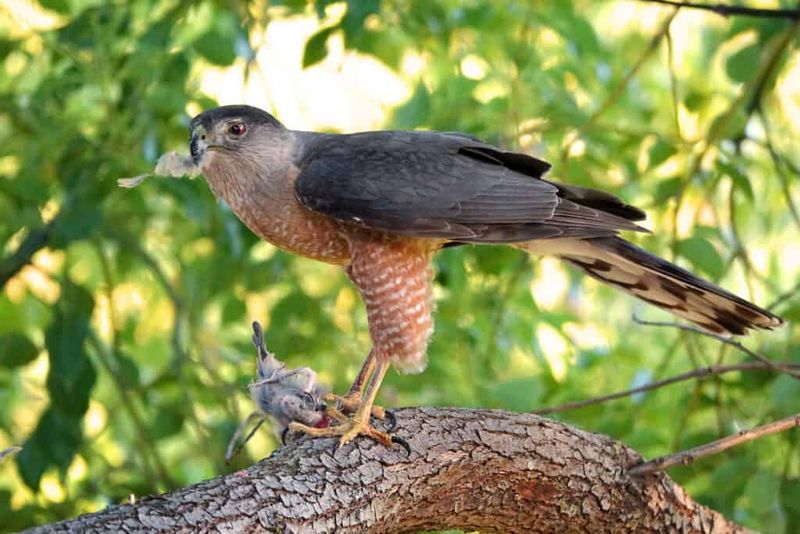
Seeing a hawk near your house regularly does not mean it has set up a nest on your property. A hawk can pass through on a commute, hunt around a feeder for a few days, use a tall tree as a midday lookout, or follow prey that has concentrated in a neighboring yard without ever building a nest within a hundred yards of your back door.
When nesting is actually happening, the clues are more specific. Repeated presence in one tight area, carrying sticks or prey to a particular tree, persistent vocalizing, circling low over one spot, or adults diving at people or dogs near a tree can all raise the possibility. But none of those behaviors alone is a definitive nesting test, and timing varies by species, weather, and whether a pair is replacing a failed clutch.
If nesting does seem plausible, species matter for where to look. Cooper’s Hawks commonly build nests 25 to 50 feet high in trees, often in wooded neighborhoods or parks with a mix of deciduous and conifer cover. Red-shouldered Hawks tend to nest in wooded settings near water, including the creek corridors and bottomland forests that cut through many Piedmont and Coastal Plain communities.
Either way, the bird may be nesting in a neighbor’s tall tree, a nearby park, or a wooded lot down the road, not on your property at all. A sighting near your fence line is not proof of a property-level cause. Give the bird space, watch from a comfortable distance, and let the behavior tell you more before assuming the nest is yours to manage.
Your Feeder May Be the Real Magnet
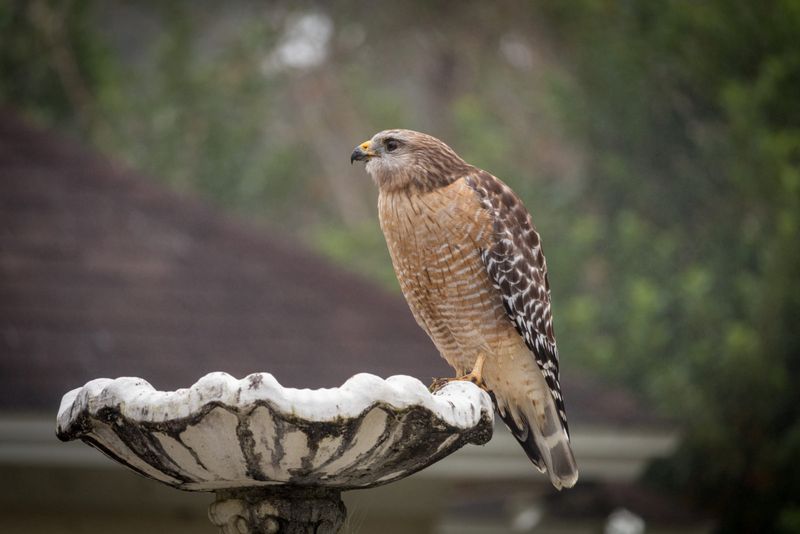
Here is where it gets tricky. A yard full of native plants and a yard with a busy tube feeder can both attract a hawk, but for different reasons, and the fix is different depending on which one you are dealing with.
Supplemental feeders concentrate songbirds in one small spot, and that concentration is exactly what a bird-hunting Cooper’s Hawk or Sharp-shinned Hawk is looking for. The feeder is not creating a healthy ecosystem so much as it is creating a reliable hunting station. Cornell’s guidance on hawks hunting feeder birds recommends temporarily taking feeders down so smaller birds can disperse and the hawk moves on, then putting them back once the hawk has stopped visiting regularly. Cornell does not specify a fixed number of days as a universal rule, so follow the actual conditions: when the hawk has not appeared for several days and the smaller birds are moving freely again, it is reasonable to try restoring the feeders.
Removing feeders temporarily is a targeted adjustment, not an indictment of feeding birds altogether. Cooper’s Hawks are genuinely adapted to suburban feeding stations and will relocate when the concentrated prey source disappears. The smaller birds that scatter when feeders come down are not harmed by the break; they return to foraging across a wider area, which actually reduces their risk.
The broader point from the NC State residential yard research is worth keeping in mind: supplemental feeding had the strongest measurable effect on wildlife abundance in Raleigh yards. A hawk visit tied to a feeder is a different signal than a hawk using a naturally diverse habitat. Knowing which mechanism is at work helps you choose the right response.
Build a Food Web, Not a Hawk Trap
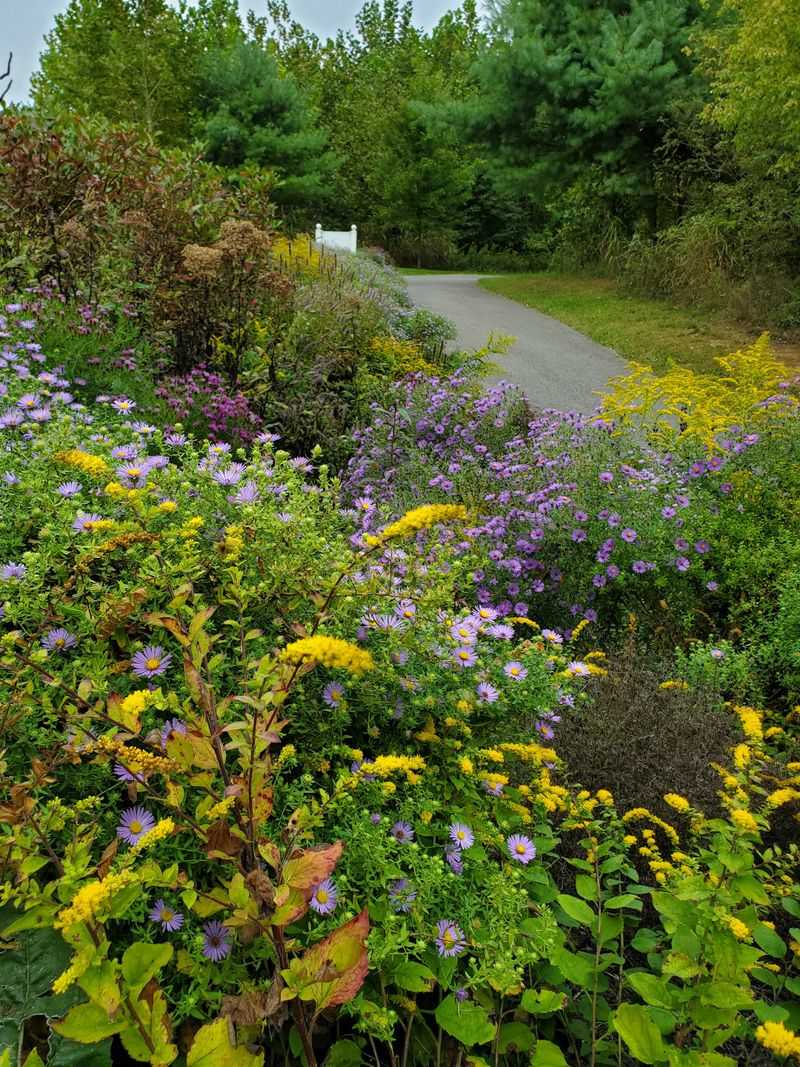
Supporting a resilient yard and trying to attract a hawk are two very different goals, and only one of them is worth pursuing. Native plants, water, cover, and nesting structure build a food web that benefits dozens of species across every season. A hawk may show up eventually as part of that web, or it may not, and either outcome is fine.
NC State Extension’s wildlife habitat guidance organizes the basics around four needs: food, cover, water, and places to raise young. Native North Carolina plants like goldenrod (Solidago spp.), Joe Pye weed (Eutrochium purpureum), and native viburnums deliver berries, seeds, and insects across different seasons, giving songbirds, pollinators, and small mammals something to work with year-round rather than just during feeder hours.
Water is simpler than most people expect. NC State Extension’s backyard bird habitat guide recommends a shallow birdbath no more than 3 inches deep with a nonslip surface so smaller birds can use it safely. Keep it clean and topped off through the muggy Piedmont summers and the mild but unpredictable winters that can drop to the low 20s in the mountains.
Cover and structure matter as much as plants. Brush piles, dead snags left standing when safe, and dense shrub layers give small animals places to hide and nest, which supports the broader food web from the ground up. That is genuinely different from leaving food waste, unsecured compost, or accessible poultry feed out where it concentrates rodents or attracts opportunistic predators.
Manage sanitation alongside habitat. Secure compost, pick up fallen fruit, store birdseed in sealed containers, and keep brush piles away from the house foundation. A yard can be ecologically generous and still be tidy enough that it does not create preventable hazards for the animals, including your own, that share the space.
Protect the Small Animals You Actually Keep
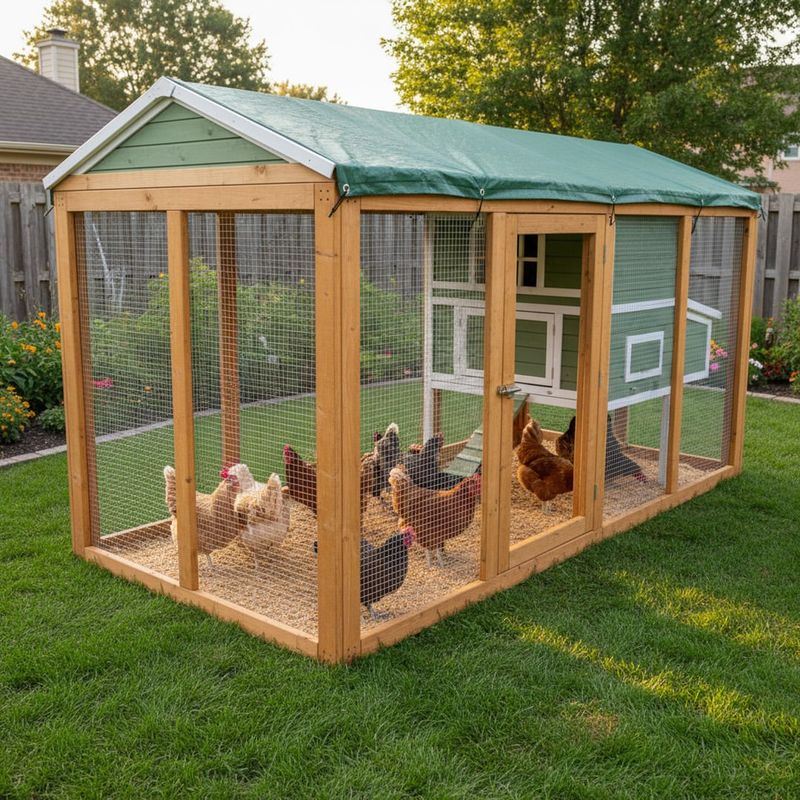
A hawk perched nearby does not automatically put your pets in danger, but it is worth thinking through which animals you actually need to protect and how to do it well. Proportionate responses beat panicked ones every time.
Ordinary adult dogs and cats are not common hawk targets. Cornell notes that attacks on dogs or cats by Red-tailed Hawks are very rare, and the same general caution applies to other common suburban species. That said, hawks are not harmless, and very small pets, think a two-pound rabbit or a tiny toy-breed puppy, should not be left unattended outdoors near an active nest, especially if the adults are vocalizing or circling low.
Chickens, ducks, quail, and other small poultry are a different situation. Hawks can and do take small poultry during daylight hours, and the only genuinely dependable defense is a fully covered run or secure overhead netting.
Extension poultry predator management guidance is consistent on this point: physical overhead coverage is the reliable solution. Scare devices, loose netting draped over the top, and removing every tree from your yard are not dependable alternatives.On the rodent question, do not use a hawk as a reason to leave rodents accessible or to skip integrated pest management. Rodent poison creates its own serious risk. EPA guidance on rodenticide safety directs users to place bait only in tamper-resistant stations, follow label directions exactly, and remove dead rodents promptly to reduce the risk of secondary poisoning in wildlife and pets. EPA restrictions on rodenticide products limit the most toxic second-generation anticoagulants for residential use precisely because hawks and owls eating poisoned rodents have been seriously harmed.
Use exclusion, sanitation, and secure food storage as your first line of defense, with any rodenticide as a carefully managed last resort.
Give an Active Nest Plenty of Room
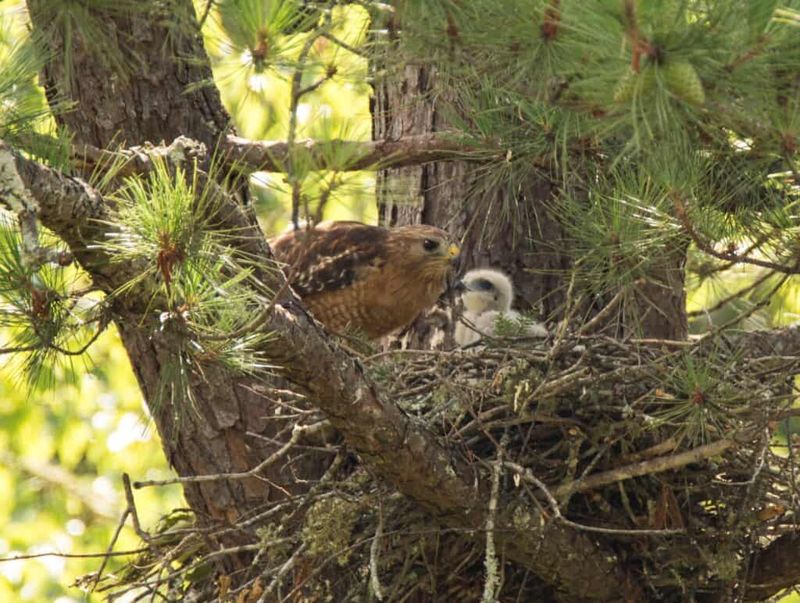
Once you are reasonably sure there is an active nest nearby, the most useful thing you can do is back up and stay back. Watch from a comfortable distance with binoculars if you have them, keep children and dogs away from the nest tree, and let any scheduled yard maintenance or tree work wait until the nest is empty.
Pay attention to the adults’ behavior as your guide. Cornell notes that Red-shouldered Hawks may strike at people who approach their territories, while Cooper’s Hawks tend to be more secretive near the nest. If adults are vocalizing loudly, circling repeatedly, or diving toward people or pets, that is a clear signal to increase your distance, not investigate further.
Do not climb toward the nest, attempt to handle a fledgling on the ground unless a licensed wildlife professional directs you to, cut the nest tree, or try to chase, trap, poison, shoot, or relocate the hawk. The Migratory Bird Treaty Act protects most native migratory birds and their active nests. U.S. Fish and Wildlife Service guidance on bird nests makes clear that active nests should not be disturbed without proper authorization, and USFWS nationwide avoidance measures for birds outline the steps land managers and contractors are expected to follow near active nests.
If you genuinely need tree work done near a suspected nest, contact a licensed wildlife professional or your state wildlife agency before scheduling anything.
Read the habitat honestly, remove the hazards you can actually control, and let the hawk be what it actually is: a wild neighbor passing through or raising a family in the broader landscape your neighborhood built together, not a yard project you need to manage.