This Invasive Texas Tree Spreads Faster In Drought Than Anyone Expected
Most invasive plants slow down when drought conditions set in. Stressed environments generally favor established native species that have evolved local adaptations over centuries.
But there’s one invasive Texas tree that defies that expectation entirely, and the drought conditions that have been affecting much of the state in recent years have not slowed its spread at all. If anything, drought has made it faster.
This tree has drought tolerance that its native competitors in the Texas landscape simply cannot match, giving it a decisive advantage precisely when conditions turn harsh.
While native trees and shrubs struggle and pull back, this invasive keeps growing, seeding, and establishing in areas that have been opened up by drought stress in the surrounding vegetation.
Land managers and conservationists across Texas have been watching this pattern develop with increasing concern.
The spread is outpacing removal efforts in some regions, and the ecological cost in native plant communities is significant and difficult to reverse once the tree gets established.
Here’s what this tree is, why drought favors it, and what Texas property owners can do when they find it.
The “Popcorn Tree” Taking Over Parts Of Texas
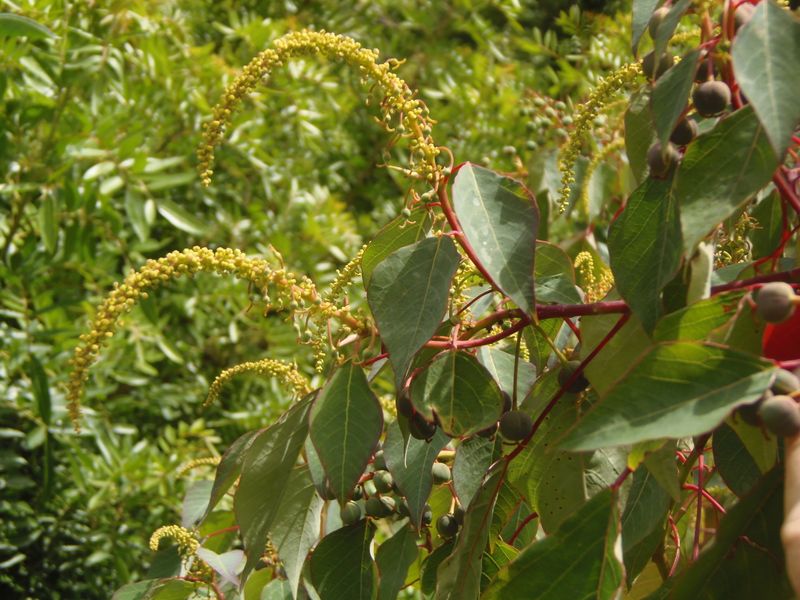
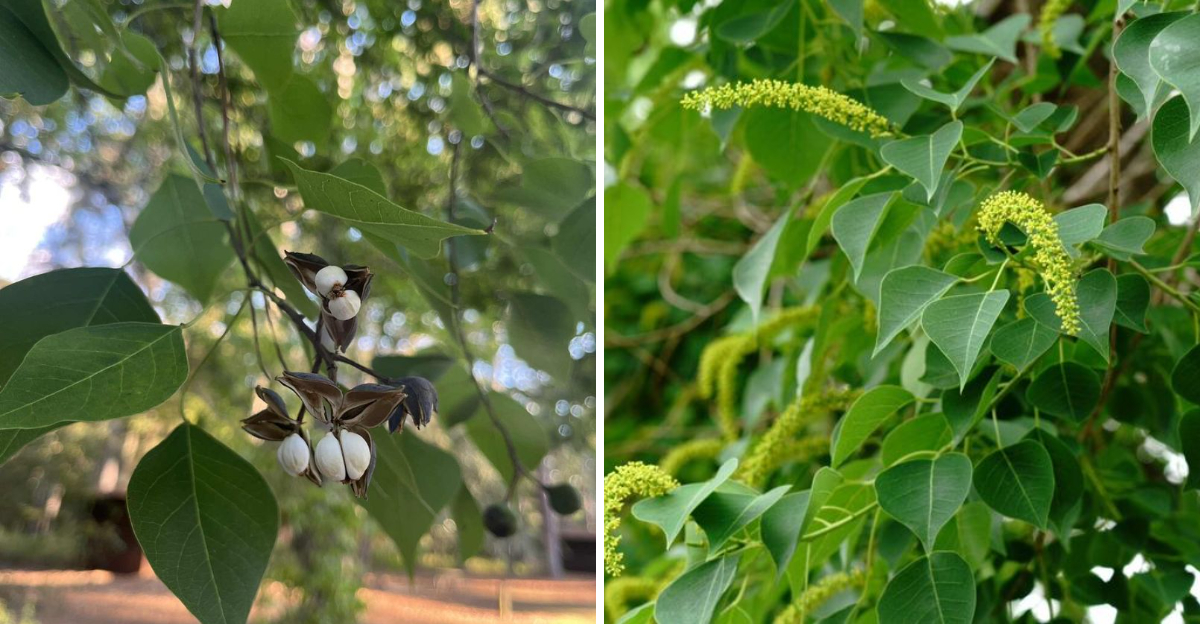
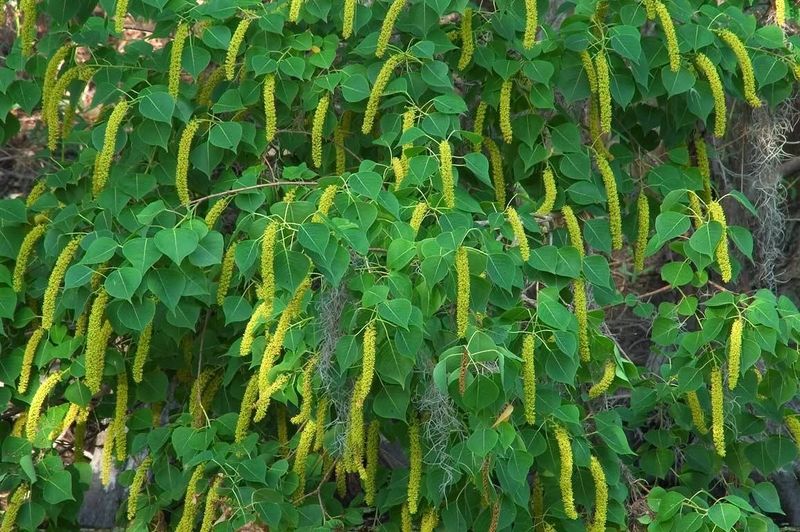
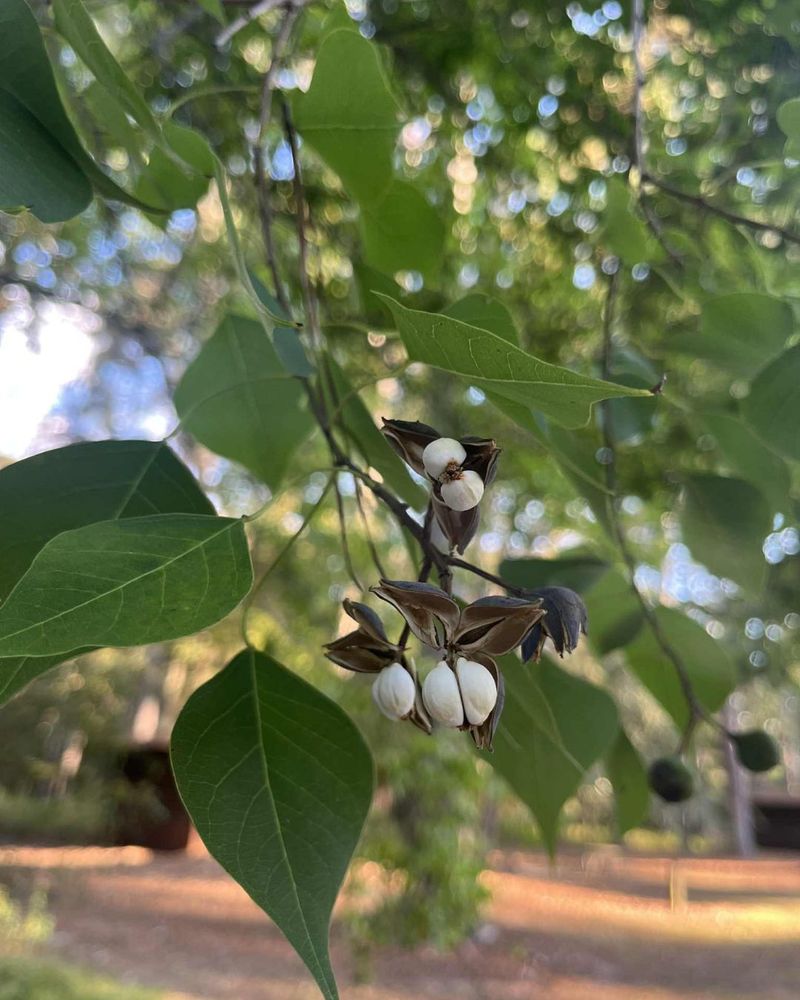
You might have spotted it along a roadside or in a neighbor’s yard without realizing what it was. Chinese tallow, known scientifically as Triadica sebifera, goes by the nickname “popcorn tree” because of its clusters of small, white, waxy seeds that look just like popped popcorn.
Originally from China and Japan, this fast-growing tree was brought to the United States as an ornamental plant and for its seed oil. It has since become one of the most troublesome nonnative trees in Texas.
The tree is especially common in East Texas and along the Gulf Coast. You can also find it invading coastal prairies, wetlands, forests, roadsides, and disturbed areas throughout the region.
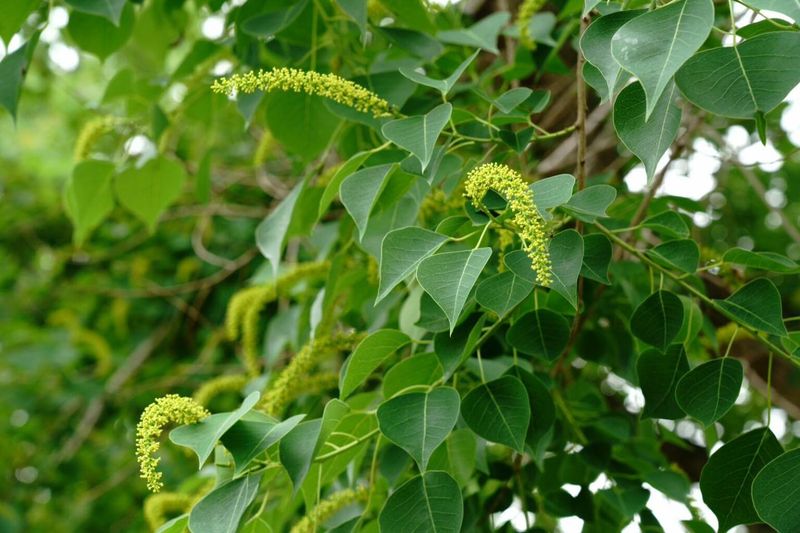
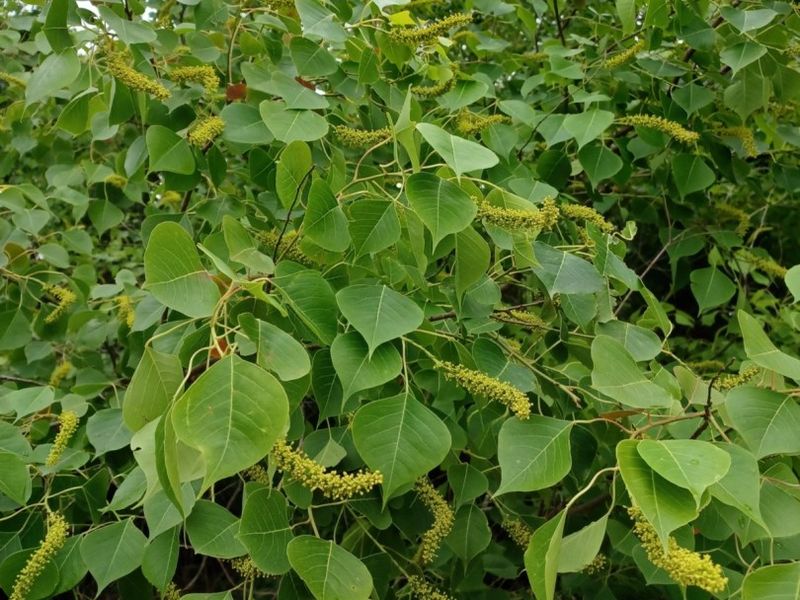
Its heart- to diamond-shaped leaves turn brilliant shades of red, orange, and yellow in the fall, making it look attractive at first glance.
That attractive appearance is actually part of the problem. People planted Chinese tallow as an ornamental tree for decades, not realizing how aggressively it would spread.
Once it escapes into the wild, it forms dense stands that crowd out native plants. A forest edge or open field that once supported a variety of native grasses, shrubs, and wildflowers can transform into a nearly pure tallow grove in just a few years.
Texas land managers and conservation groups have been working hard to raise awareness about this tree, but many homeowners still do not recognize it.
Knowing what Chinese tallow looks like is the first step toward stopping its spread in your neighborhood and protecting the native plant communities that local wildlife depend on.
Why Texas Drought Doesn’t Stop Chinese Tallow
Most plants struggle when water becomes scarce. Native trees like oaks and elms can suffer serious damage or even lose large portions of their canopy during a bad Texas drought.
Chinese tallow, on the other hand, seems almost unbothered. Researchers have documented that even two-year-old tallow seedlings survived well in southeast Texas during the exceptional drought of 2011, one of the worst on record for the state.
Your Texas Garden Changes Every Week. Your Plan Should Too.
Gardening in Texas changes quickly throughout the season. Every Friday you’ll receive a simple weekly plan showing exactly what to plant, prune, fertilize, harvest, and protect so you never miss the right timing.
The secret to its toughness is its unusual flexibility. Chinese tallow can handle an impressively wide range of growing conditions, including not just drought but also flooding, poor soils, salty conditions, and heavy shade.
Most plants are specialists that thrive in a narrow set of conditions. Tallow is a generalist, and that makes it incredibly hard to stop.
During the 2011 drought, Texas experienced record heat along with severely reduced rainfall for months on end. Native trees across the state suffered heavy losses.
Mature oaks that had stood for decades were badly weakened. Meanwhile, tallow seedlings in the same areas were reported to have survived at surprisingly high rates.
This contrast is striking and important. When surrounding native plants are struggling or losing ground, tallow does not have the same level of competition.
Moisture that would normally go to a variety of plants becomes available mostly to the tallow, giving it an advantage it would not have in normal conditions. Scientists emphasize that tallow’s drought tolerance is not just an interesting biological fact.
It is a key reason why this tree continues to expand its range across Texas even during the harshest summers the state has seen in recent memory.
Drought Can Create Exactly The Openings This Tree Needs
Picture a Texas woodland after a brutal summer drought. Several canopy trees have been so weakened that large branches have fallen.
Gaps open up in the forest roof, letting sunlight pour down to the ground. For most native seedlings, those gaps are hard to take advantage of quickly. For Chinese tallow, those gaps are an invitation.
Tallow is especially effective at colonizing disturbed habitats and open sites. Scientists who study invasive plants have found strong evidence that disturbance, whether from storms, flooding, fire, or drought, tends to promote tallow invasion.
When a drought weakens or removes established native trees, it creates exactly the kind of open, resource-rich environment where tallow thrives. More sunlight reaches the ground, competition from other plants is reduced, and space becomes available.
Tallow seedlings and saplings are well-positioned to take advantage of those conditions quickly.
An important nuance here is that drought does not necessarily cause tallow seeds to travel farther or faster on their own. Rather, drought creates the conditions that allow already-present tallow seeds and seedlings to establish and grow with less competition.
Once even a small source population of tallow trees is present in an area, seeds continue to rain down season after season.
With each drought event that opens up gaps in the surrounding plant community, new tallow trees can fill those gaps before native plants have a chance to recover.
Over time, this process allows tallow to steadily advance into areas it could not have easily colonized before. Understanding this cycle helps explain why drought years often seem to be followed by noticeable jumps in tallow coverage across Texas landscapes.
One Tree Can Start A Much Bigger Infestation
Here is a fact that surprises a lot of people: a single Chinese tallow tree can become the starting point for a large infestation. The tree reaches reproductive maturity in as little as three years.
That is remarkably fast for a tree. By the time many native trees are still establishing their root systems, tallow is already producing seeds. And it produces a lot of seeds. Each tree can generate thousands of seeds per year.
Birds love the white waxy berries and carry the seeds far from the parent tree as they move through the landscape. Water also plays a big role in spreading tallow seeds, especially in low-lying areas near streams, wetlands, and coastal zones.
A single flood event can carry seeds miles downstream, starting new colonies in areas that had no tallow presence before.
Cutting a tallow tree down might seem like a simple solution, but tallow has another trick. It can regrow from its root system and from cut stumps, a process called vegetative reproduction.
A stump left untreated after cutting will often send up multiple new sprouts within weeks. Those sprouts grow quickly and can reach seed-producing size faster than a seedling grown from seed.
This combination of rapid seed production, bird and water dispersal, and the ability to regrow from roots means that a handful of scattered tallow trees can multiply into a dense colony within just a few years.
Land managers in Texas have learned this lesson the hard way, discovering that ignoring even a small cluster of tallow trees can lead to a much larger and more expensive problem down the road.
What Happens When Chinese Tallow Takes Over
Spend some time in an area where Chinese tallow has fully taken hold and you will notice something unsettling. The variety of plants that used to grow there is gone.
What was once a diverse coastal prairie or mixed woodland has become a nearly single-species tallow grove. The ground underneath is shaded and carpeted with fallen tallow leaves, and very few other plants can grow there.
Tallow changes the light conditions beneath its canopy dramatically. Its dense leaf cover blocks sunlight that native grasses, wildflowers, and shrubs need to survive.
It also competes aggressively for water and soil nutrients. Some research suggests that tallow leaves may even alter soil chemistry as they break down, making it harder for native plants to reestablish even after tallow is removed.
The result is a landscape that looks green from a distance but is actually ecologically impoverished.
Texas Parks and Wildlife specifically identifies Chinese tallow invasion of woodlands and coastal prairies as a serious threat to habitat diversity and integrity. When native plant diversity drops, the effects ripple through the entire food web.
Native insects that depend on specific host plants lose their food source. Birds that rely on native seeds, berries, and insects find less to eat.
Mammals that need native understory plants for cover and food are also affected. The loss is not just about plants.
A tallow-dominated landscape supports far fewer species overall than a healthy native habitat.
Protecting Texas’s rich natural heritage means taking the threat of tallow invasion seriously, not just on public lands but on private property and in neighborhoods where these trees often get their first foothold.
What Texas Homeowners Should Do When They Find One
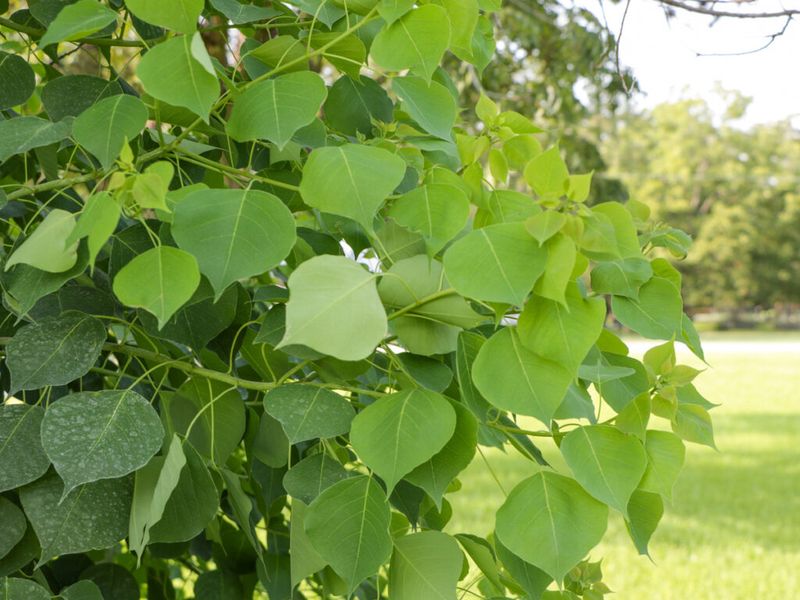
Finding a Chinese tallow on your property does not have to be overwhelming, especially if you catch it early. The most important step any homeowner can take is to avoid planting this tree intentionally.
Some nurseries still sell it, so it pays to know what you are buying before a tree goes in the ground. If you already have one, dealing with it while it is small is much easier than waiting.
Small seedlings can often be pulled out by hand when the soil is moist enough to allow the entire root system to come out cleanly. Getting the roots matters because tallow will regrow if any root material is left behind.
For larger plants and established trees, hand-pulling is not enough. Tallow readily resprouts from roots and cut stumps, so simply cutting a tree down without treating the stump will likely result in a flush of new growth within weeks.
Texas A&M AgriLife Extension recommends more effective approaches for larger tallow trees, including cut-stump treatments and basal bark herbicide applications. A cut-stump treatment involves cutting the tree and immediately applying an appropriate herbicide to the freshly cut surface to prevent resprouting.
Basal bark treatments apply herbicide directly to the lower bark of a standing tree. Always follow herbicide label instructions precisely, and choose products that are labeled as safe for use near water if your property is close to a creek, pond, or wetland.
When in doubt, contact your local Texas A&M AgriLife Extension office for guidance specific to your situation. The bottom line is clear: early action makes a real difference. A single seedling removed today is far easier to handle than a spreading grove next year.