What It Really Means When Praying Mantises Suddenly Show Up All Over Your North Carolina Garden
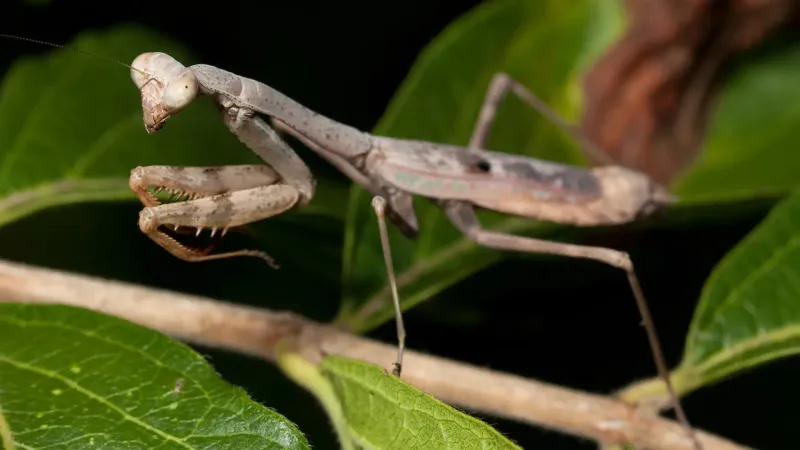
You step out to check your tomato cages one morning and count a dozen praying mantises before you even reach the second raised bed. For most North Carolina gardeners, that first reaction is somewhere between fascination and mild alarm. The good news is that a sudden crowd of mantises is rarely the disaster it looks like, but it is telling you something specific about your yard, and the message depends almost entirely on what size and age those insects are.
Start by Separating Nymphs From Adults
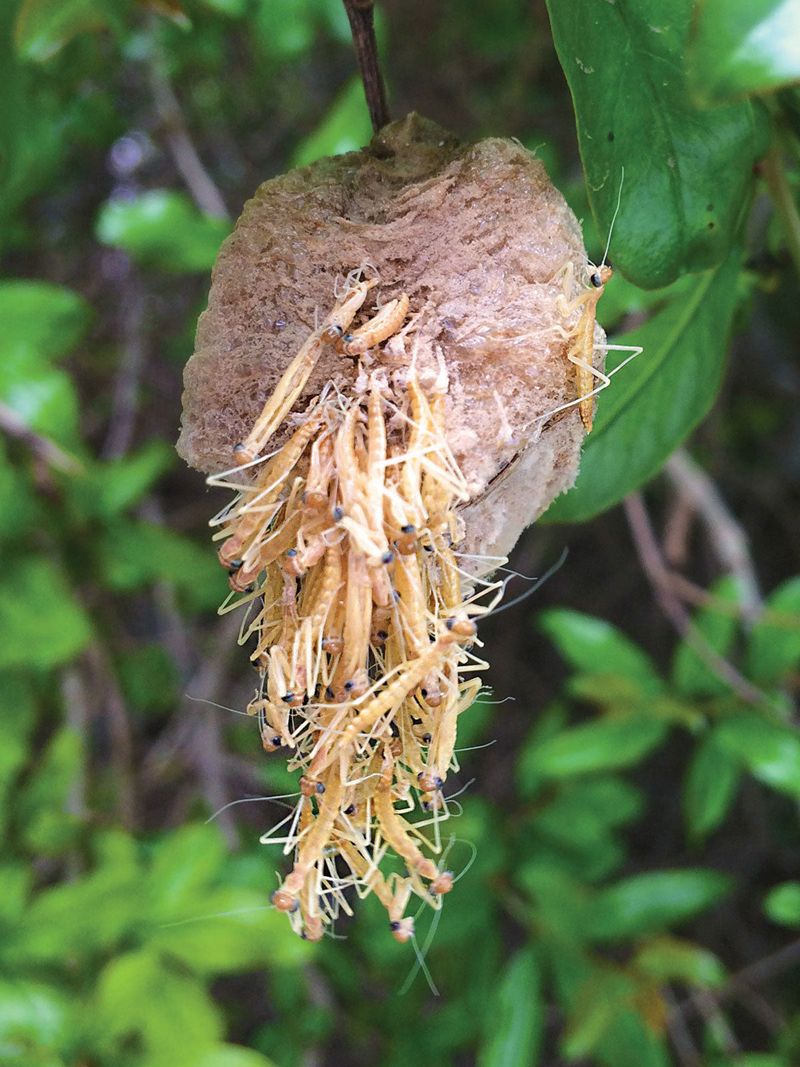
Size is the first clue, and it changes everything about what you are seeing. A wave of tiny, thread-thin mantises all roughly the same length as your thumbnail points toward one explanation: a nearby egg case, called an ootheca, hatched recently. A gathering of large, fully formed adults is a different situation entirely and does not, by itself, mean a hatch just occurred nearby.
One ootheca can hold anywhere from 12 to 400 eggs, according to Utah State Extension research on mantid biology. That range is wide on purpose, because egg counts vary by species and by individual case. When those eggs hatch, the nymphs emerge together and can make a single twig look like it sprouted legs overnight. The NC State Extension Gardener Handbook advises gardeners to recognize mantid egg cases and preserve them when possible, which is a reasonable default once you know what you are looking at.
After the hatch, the nymphs disperse quickly. Some move to nearby plants, some get eaten by birds or spiders, and some eat each other when food runs short. The visible crowd can shrink noticeably within days, often without any action from you.
If you are seeing small nymphs, walk the immediate area slowly and check twigs, tomato supports, fence rails, shrub stems, and porch railings within about 10 to 15 feet of where the cluster appeared. A tan, ridged, papery case the size of a large grape or walnut is what you are looking for. Finding it does not diagnose a pest outbreak or tell you whether your garden is healthy or struggling. It simply means a case hatched nearby, and the nymphs are doing what nymphs do.
A Sighting Offers Possibilities, Not A Diagnosis
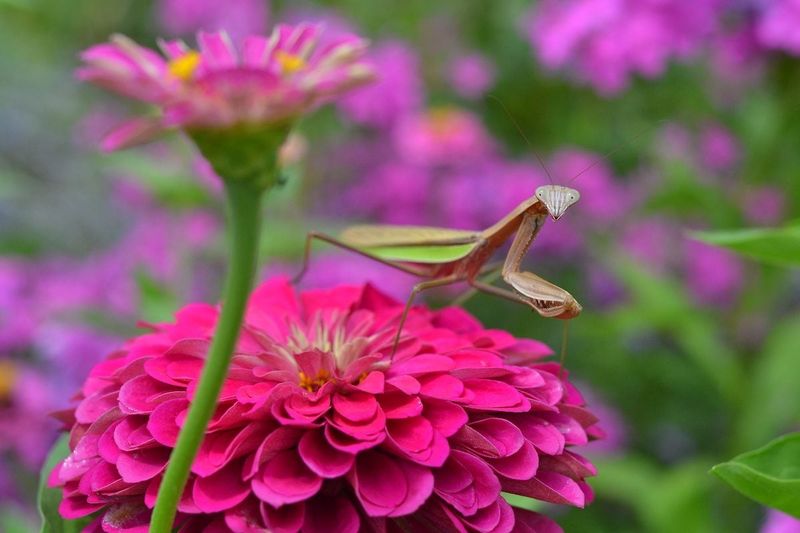
Many gardeners assume that a yard full of mantises must mean the yard is full of pests. That logic feels reasonable, but the reality is more complicated and actually more reassuring. Mantises may show up where cover is good, flowering plants are present, and prey passes through, but none of those factors alone explains a sudden crowd, and a sighting cannot tell you which factor is driving it.
Here is where it gets genuinely interesting. A study published in Environmental Entomology found that pollen supplementation helped Chinese mantis nymphs develop better and helped adult females maintain egg production even when insect prey was limited. That finding was from a controlled experimental setting using one species, the Chinese mantis, so it does not prove that the flowering plants in your Piedmont vegetable bed caused your mantis crowd. But it does suggest that flowers can contribute to mantis nutrition under some conditions, which means a yard with blooms might support mantises even when the insect prey population is not unusually high.
Your North Carolina Garden Changes Every Week. Your Plan Should Too.
Gardening in North Carolina changes quickly throughout the season. Every Friday you’ll receive a simple weekly plan showing exactly what to plant, prune, fertilize, harvest, and protect so you never miss the right timing.
The NC State Extension profile of the Carolina mantid describes the species as part of the garden food web, connected to the plants, prey, and shelter a yard provides. That framing is the right one. A mantis on your pepper plant is one small piece of a larger picture, not a precise readout of how many caterpillars or aphids are hiding in your beds.
So what does a crowd of mantises actually mean? It means your yard is supporting at least one part of a food web. Whether that reflects a recent hatch, good cover, available flowers, passing prey, or some combination of all of those, the sighting alone cannot sort it out. Treat it as a prompt to look closer, not as a verdict on your garden’s condition.
Mantises Hunt What Comes Within Reach
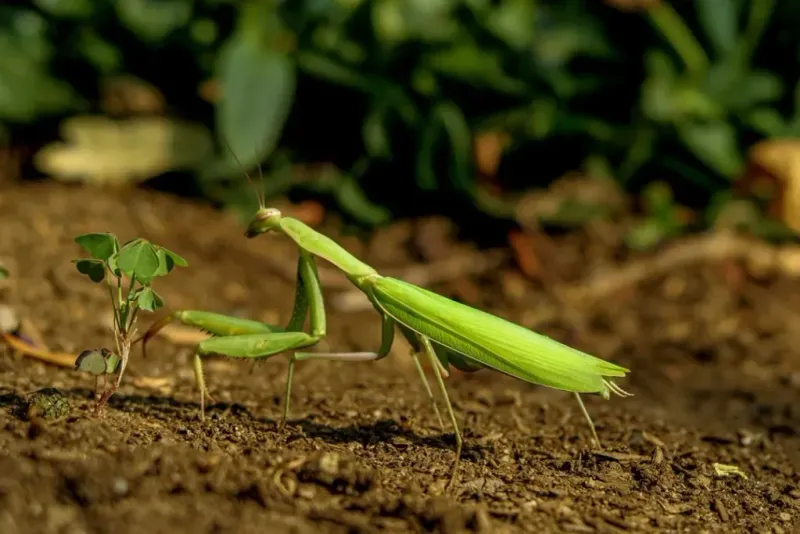
Picture a mantis on your tomato cage, completely still, facing outward for twenty minutes straight. That stillness is the whole strategy. Mantises are ambush predators. They do not patrol beds looking for aphid colonies or track down caterpillars on the undersides of leaves.
They wait on stems, shrubs, cages, and flowers, then strike at whatever moves within range.
That hunting style matters when gardeners wonder whether a yard full of mantises means the aphids are out of control. NC State Extension’s guide to biological pest control for home gardeners is direct on this point: mantises do not actively seek common garden pests such as aphids, caterpillars, and thrips, and they are not considered dependable controls for those targets. The ambush method means a mantis catches whatever happens to walk or fly past, regardless of whether that insect is a pest or a pollinator.
And that prey list is genuinely broad. Utah State Extension notes that mantises eat a wide range of arthropods, including bees, butterflies, moths, wasps, spiders, lady beetles, lacewings, and other mantises. Research indexed at PubMed similarly documents mantises taking a variety of prey types depending on body size, location, and what passes within striking distance.
This nonselective feeding is why a crowd of mantises cannot tell you that stink bugs, Japanese beetles, ticks, or tomato hornworms are overwhelming your plants. A mantis eating a honeybee on your squash blossom is following the same instinct as one catching a hornworm on your tomatoes. Their presence is one data point, not a pest census. If you want to know what is actually damaging your plants, you have to look at the plants themselves.
Identify The Mantis Before You Decide
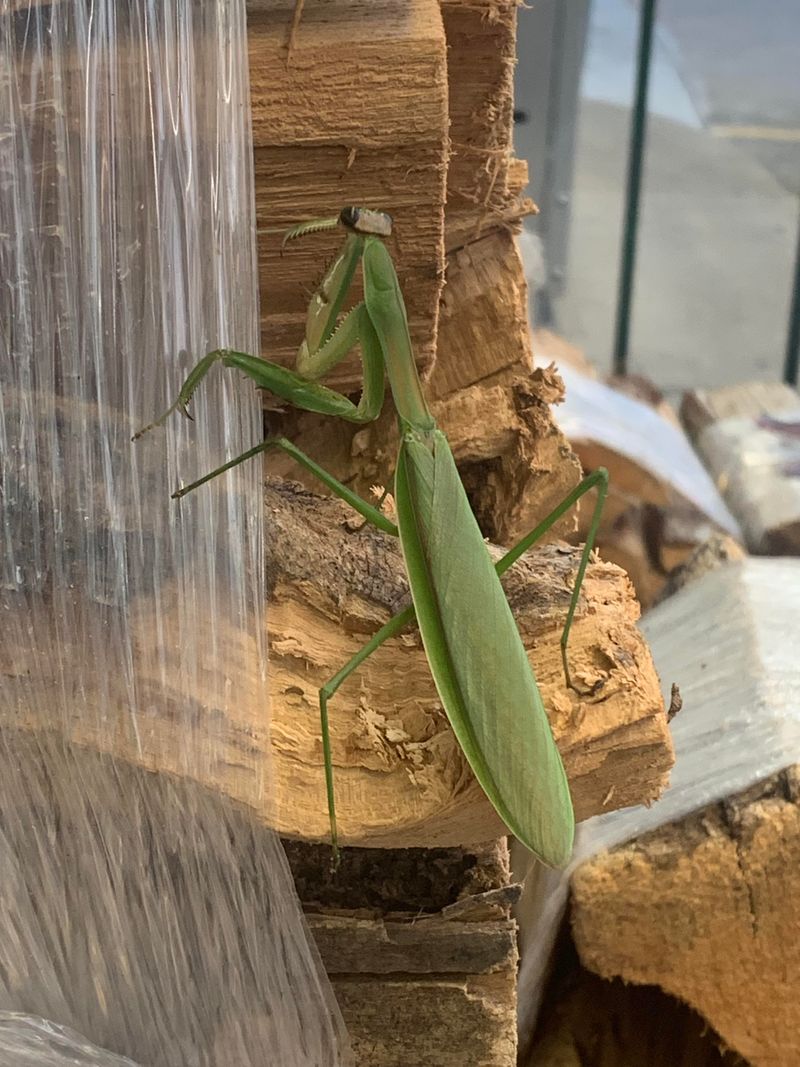
North Carolina is home to more than one mantis species, and that detail matters before you decide what to do with any egg case you find. The native Carolina mantid, Stagmomantis carolina, is common across the state and is the species most often pictured in local gardening guides. But Chinese mantises and European mantises also turn up in the eastern United States, and either one could be the insect perched on your pepper plant or fence post right now.
According to the NC State Extension profile of the Carolina mantid, body markings, overall size, wing length, face shape, and the form of the egg case can all help with identification. The Carolina mantid is generally smaller and shorter-winged than the Chinese mantis, which can reach 4 inches or longer. European mantises fall somewhere in between. The egg cases also differ in shape and texture, which can be useful when you find a case attached to a twig or fence rail.
A photograph taken from a few angles is a good first step, but a photo alone may not support a confident identification. If you are uncertain about what species you have found, NC State Extension offers insect identification resources that can help you work through the details before you act.
Finding a nonnative mantis does not automatically call for removal. The sources reviewed here support learning to recognize species and avoiding intentional releases of purchased nonnative cases, but they do not establish a universal rule that every Chinese or European mantis in a North Carolina yard must be eradicated. Identification gives you better information. What you do with that information can be a measured decision rather than an automatic one.
Leave A Confirmed Outdoor Ootheca Undisturbed
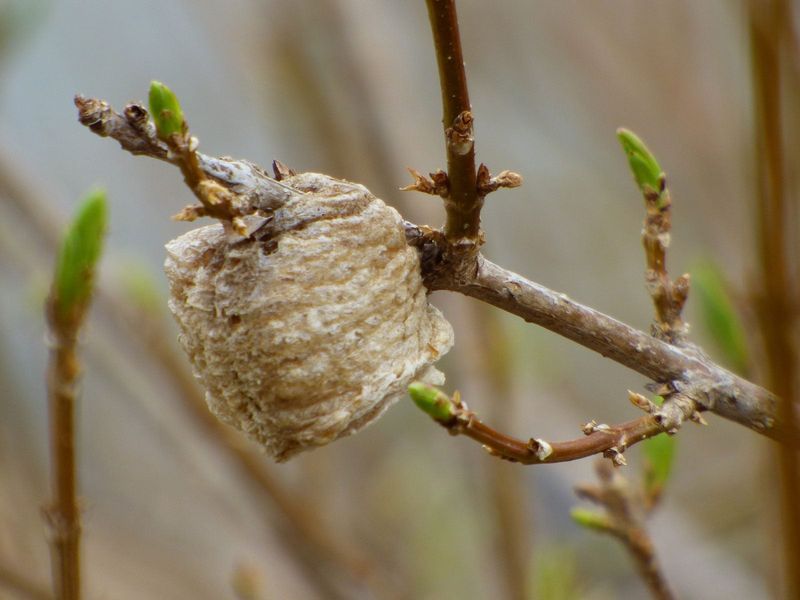
Once you have found an egg case and identified it with reasonable confidence, the default response is simple: leave it alone. An ootheca attached to an outdoor twig, fence post, shrub stem, or tomato support is already in the right place. The NC State Extension Gardener Handbook specifically recommends carrying a twig bearing an identified mantid egg cluster into the garden and placing it somewhere it will not be disturbed, which is practical advice for cases that end up in inconvenient spots after pruning.
Before you move or handle anything, make sure you actually have an ootheca. Not every foamy or papery mass on a twig is a mantis case. NC State Extension advises photographing unfamiliar material and using identification resources rather than handling an uncertain mass. Some foam-like structures belong to other insects entirely, and disturbing them unnecessarily can cause problems you did not have before.
If a confirmed case is outdoors and attached to a stable surface, the nymphs will emerge on their own schedule, generally in spring as temperatures warm. They disperse quickly, so the visible crowd you see right after a hatch may be gone within a few days as nymphs spread through the yard, climb fences, or get picked off by birds and other predators. You do not need to intervene to speed that process along.
The NC State Extension Carolina mantid page does not recommend blanket removal of nonnative cases found outdoors. Identification is the useful step. After that, leaving a confirmed case in place is a reasonable choice for most North Carolina gardeners.
Manage Plant Damage, Not The Mantis Count
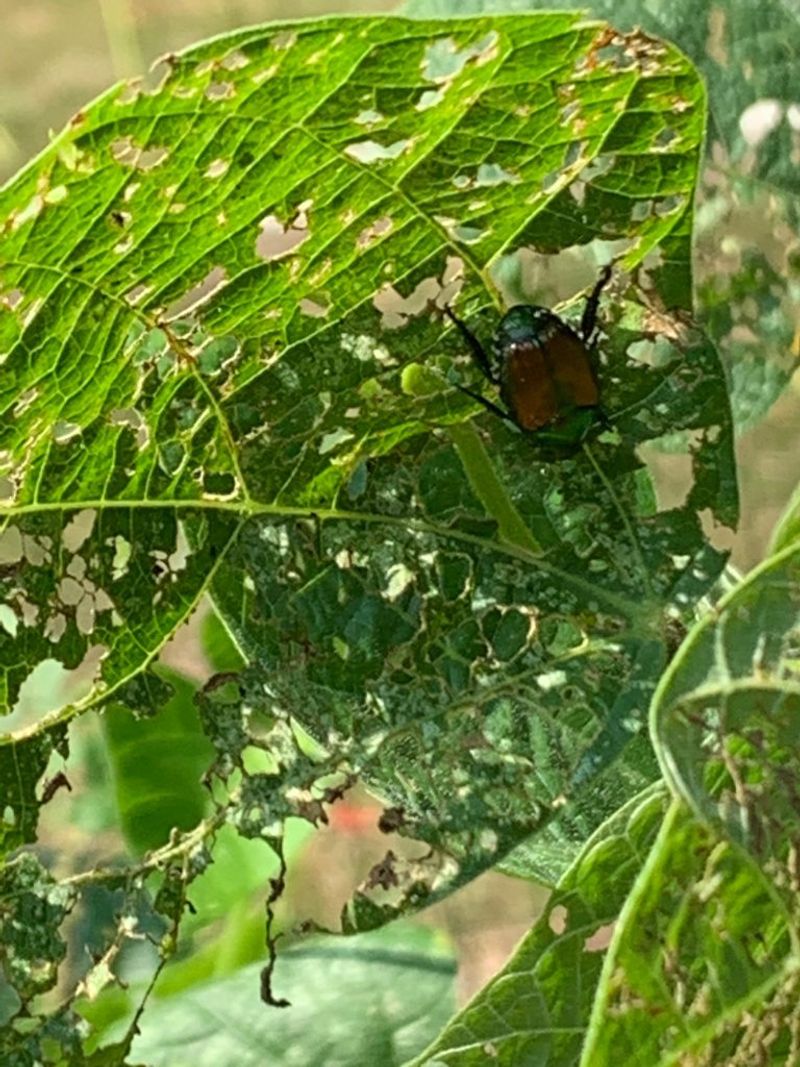
Seeing a lot of mantises can tempt gardeners to either celebrate and stop worrying about pests or to reach for a spray bottle. Both reactions skip the step that actually matters: checking your plants for real damage. The mantis count does not tell you whether your peppers have a problem. The plants do.
One thing worth skipping entirely is buying mantis egg cases to release as pest control. NC State Extension states plainly that commercially sold mantises are not effective for home-garden pest control because they are nonselective predators that do not target specific pests. Commercial cases may also contain nonnative species. Releasing them does not reliably reduce a pest population and can harm the pollinators and natural enemies already working in your yard.
When you do find actual plant damage, the right approach is integrated pest management. The NC State Extension IPM chapter walks through the process: identify the insect causing the damage, inspect the plant to understand how severe the problem is, decide whether the damage has reached a level that actually justifies action, and then start with the least disruptive option. Hand removal, physical barriers, traps, sanitation, and targeted treatments all belong on that list before broad spraying enters the conversation.
Spraying your garden broadly to protect pollinators from mantises is backwards and counterproductive. Pesticides do not distinguish between a mantis, a honeybee, and a parasitoid wasp. If a treatment is genuinely needed for an identified pest, NC State Extension pesticide safety guidance and the NC Department of Agriculture pollinator protection guidance both require reading and following the label, avoiding blooming plants, avoiding windy conditions that cause drift, and timing any application for late in the day after pollinators have finished foraging. Those precautions protect the beneficial insects your yard is already supporting, mantises included.
Support The Whole Garden Food Web
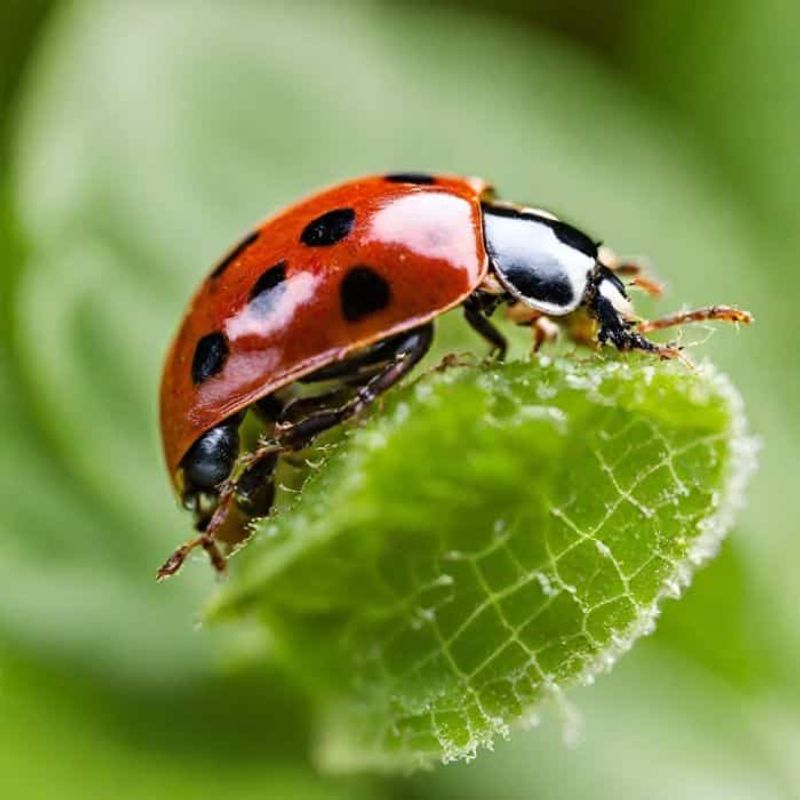
A yard that supports mantises is also a yard that can support lacewings, lady beetles, ground beetles, parasitoid wasps, predatory mites, and wheel bugs. Each of those natural enemies has different prey preferences and different habitat needs, and together they do more for long-term pest balance than any single predator can manage alone. The goal is not a yard full of mantises. The goal is a yard diverse enough to support many moving parts.
NC State Extension recommends flowering plants, shelter, moisture, undisturbed areas, and overwintering sites as the foundation for naturally occurring predators and parasitoids. Native plants suited to your part of North Carolina add seasonal food and structure without requiring you to manage a single purchased insect. The NC State Extension native plants chapter and the NC State landscaping for wildlife with native plants guide both offer regionally specific options, whether you are gardening in the Piedmont, the Coastal Plain, the Sandhills, the mountains, or along the coast.
Plants like goldenrod, Joe Pye weed, and native asters provide late-season pollen and nectar that support a range of beneficial insects into fall, when Piedmont gardens are winding down and monarchs are still moving through. Leaving some stems standing over winter gives parasitoid wasps and other small natural enemies a place to overwinter, so they are present when pest pressure picks up again in spring.
When you see mantises in your yard, the most useful response is also the simplest: note whether they are nymphs or adults, look at your plants for actual damage, protect the pollinators and natural enemies already present, and act only when a verified problem gives you a real reason to. A yard that asks you to pay attention is already doing something right.