What It Really Means When Zebra-Tailed Lizards Keep Appearing in Your Arizona Yard
Spotting a zebra-tailed lizard darting across your patio once is a surprise, but seeing them regularly starts to feel like a pattern worth understanding. Many Arizona homeowners wonder whether repeated sightings signal a problem, a benefit, or something else entirely.
The honest answer is more grounded than alarming: these lizards have specific habitat preferences, and your yard or the land nearby may simply match what they look for.
Repeated sightings do not prove a takeover
Seeing a zebra-tailed lizard every few days can feel like the lizards have moved in and claimed the place. That impression is understandable, but repeated sightings alone cannot tell you whether a population is growing, whether something unusual is happening in your yard, or whether there is any problem at all.
A more grounded explanation is that your yard, or land close to it, offers the kind of open habitat these lizards already use.
According to the Arizona-Sonora Desert Museum’s account of sand lizards, zebra-tailed lizards are most often found in washes, desert pavement, and hardpan areas with sparse plants and stretches of open soil. If your yard or a nearby lot shares those qualities, sightings make sense without requiring any special explanation like an invasion or an unusual surge.
Research on Salt River sites in the Phoenix area shows that lizard abundance at those locations can shift with rainfall, vegetation changes, water availability, and site-specific conditions. None of that research tracked residential yards, so it cannot confirm what repeated sightings in your backyard mean.
The sightings are real; the takeover framing is not something the available evidence supports.
Open, hard ground is the habitat clue
Zebra-tailed lizards are not generalists that move comfortably through any green yard. Their documented preference is for open, hard-packed ground with minimal plant cover, the kind of terrain found in desert washes, hardpan flats, and areas of natural desert pavement.
That preference is a useful clue when you are trying to make sense of where you keep seeing them.
If part of your yard has compacted caliche soil, a gravel-covered patch with little ground cover, or a decomposed-granite border along a wall, those areas may feel like familiar ground to a lizard that spends its life moving across exposed surfaces. Nearby vacant lots, undisturbed desert edges, or dry drainage channels could also bring lizards through your yard as they move across the landscape.
Recognizing this preference is helpful context, not a landscaping prescription. The Arizona-Sonora Desert Museum notes that sparse vegetation and open soil characterize the places these lizards use most, but that observation describes where the animals tend to be found.
It does not mean your yard needs to be redesigned, and no planting plan has been shown to reliably attract zebra-tailed lizards. The habitat connection explains a possible reason for sightings without turning those sightings into a diagnosis of your yard’s condition.
Look beyond a wagging tail to identify one
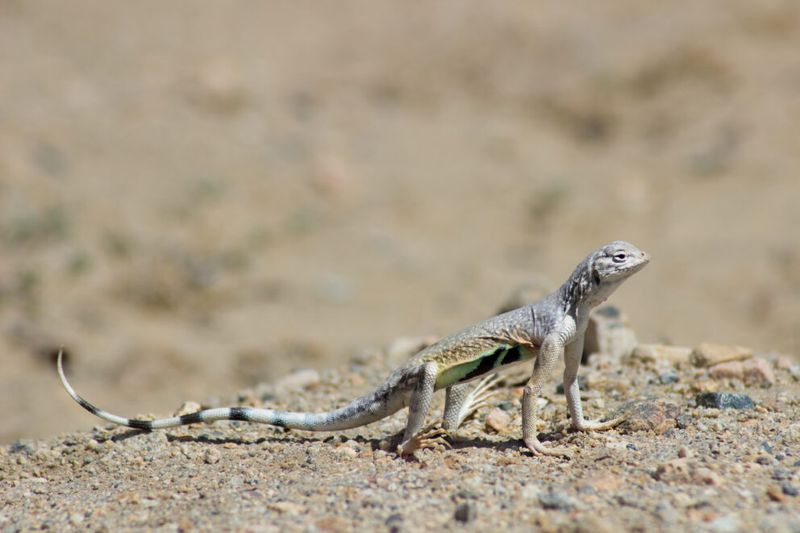
A lizard curling its tail upward and waving it slowly is eye-catching, and many people use that behavior as the main identification clue for zebra-tailed lizards. The behavior is real, but it is not exclusive to this species.
Your Arizona Garden Changes Every Week. Your Plan Should Too.
Gardening in Arizona changes quickly throughout the season. Every Friday you’ll receive a simple weekly plan showing exactly what to plant, prune, fertilize, harvest, and protect so you never miss the right timing.
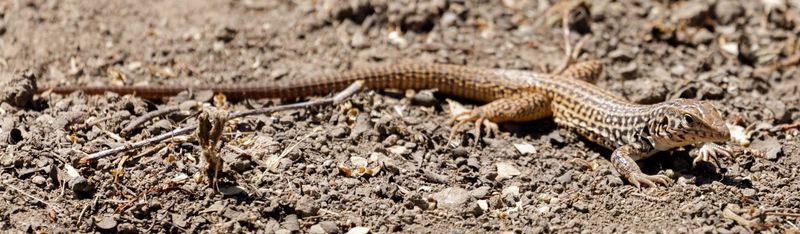
Greater earless lizards, which live in similar Arizona habitats, also wag their tails and can look strikingly similar at a quick glance, so the display alone is not enough to confirm which lizard you are watching.
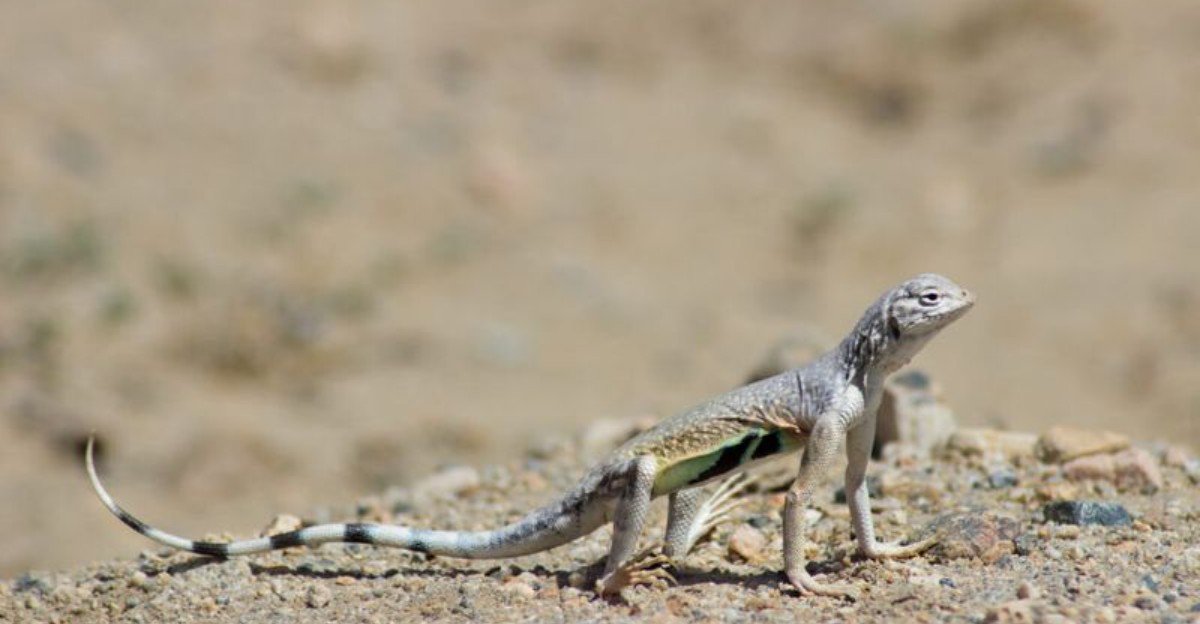
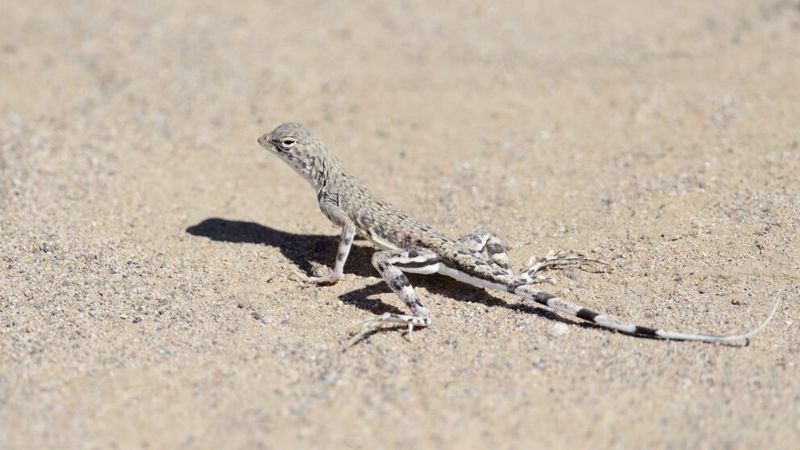
More reliable features to look for are the long, slender legs and a long tail that often shows distinct banding, particularly toward the tip. Saguaro National Park’s lizard guide describes zebra-tailed lizards as having those long limbs and a banded tail, and notes their preference for hard soils with sparse plant cover.
Body shape and leg length, combined with the habitat where you spot the lizard, tend to be more useful together than any single feature on its own.
As for what the tail waving actually does, researchers have investigated the display’s role in predator encounters for decades without settling on one explanation. The Tucson Herpetological Society summarizes a field experiment whose authors argued against a distraction or tail-sacrifice explanation and favored a pursuit-deterrence signal instead.
Because the question is genuinely unresolved, it is worth holding any single tidy explanation loosely.
Their diet is not a pest-control promise
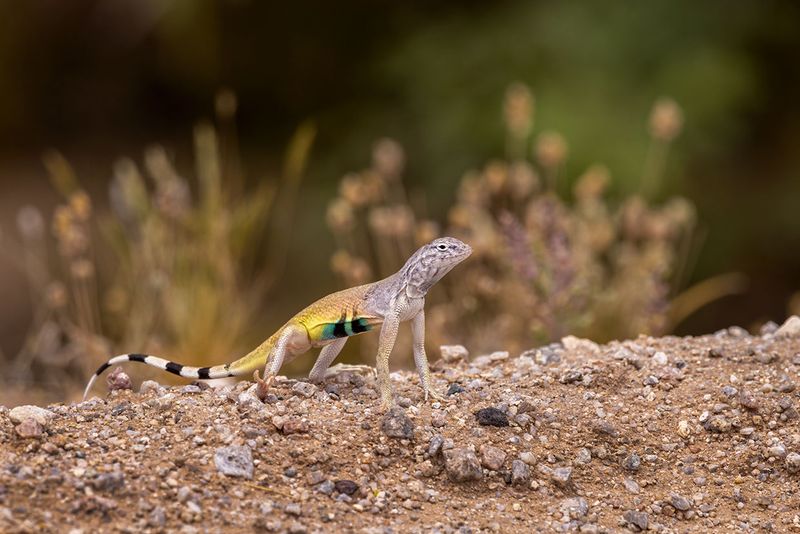
Zebra-tailed lizards eat insects and other invertebrates, and may also take small lizards and some plant material on occasion. That range makes them active participants in the yard’s food web, which is worth knowing.
What it does not do is guarantee any particular pest will be controlled or reduced in your yard.
Scorpion-eating behavior has been documented for some Arizona lizards, but those reports involve other species. Transferring that reputation to zebra-tailed lizards without species-specific evidence overstates what is known.
The same caution applies to claims about mosquitoes, roaches, or other household pests. A broad insect diet and reliable household pest control are not the same thing, and the sources reviewed for this article do not establish the latter for this species.
Thinking of zebra-tailed lizards as part of a living yard rather than as a pest-management tool is a more accurate framing. They eat what is available, they move through territory in search of food, and their presence reflects the insects and invertebrates already in the environment.
That role is ecologically real and worth appreciating, but it should not be the reason a homeowner decides to encourage or discourage lizards from the yard.
River-site counts cannot explain a backyard pattern
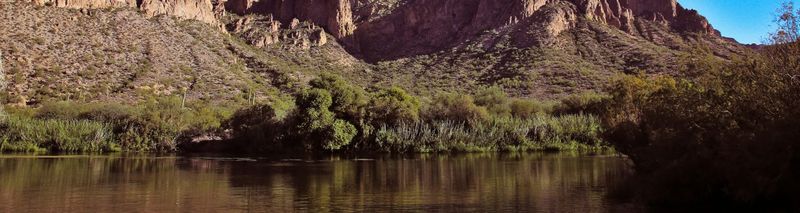
Phoenix-area research has tracked lizard populations at Salt River sites over multiple years, and those studies offer genuinely interesting findings. Lizard abundance at those locations shifts with precipitation, vegetation cover, water availability, and the specific character of each site.
One survey found zebra-tailed lizards at an upstream, less-urban location but not at the more urban sites it sampled, suggesting that local conditions matter a great deal even within a relatively small geographic area.
Those findings come from carefully monitored natural and riparian sites, not from residential neighborhoods. A 10-year study of perennial and intermittent urban river areas provides useful context about how environmental variables shape lizard numbers in those specific places, but it cannot be extended to explain what is happening in a homeowner’s backyard a mile or several miles away.
A yard is not a surveyed riparian corridor. The sampling methods, the site conditions, and the ecological context are all different.
Using river-site data to confirm or deny a yard-level population pattern would be like using weather readings from a river valley to explain what is happening on a rooftop three blocks away. The regional research is worth understanding, but it cannot answer the question of why a particular homeowner keeps seeing zebra-tailed lizards near the back fence.
Observe them without turning sightings into a project
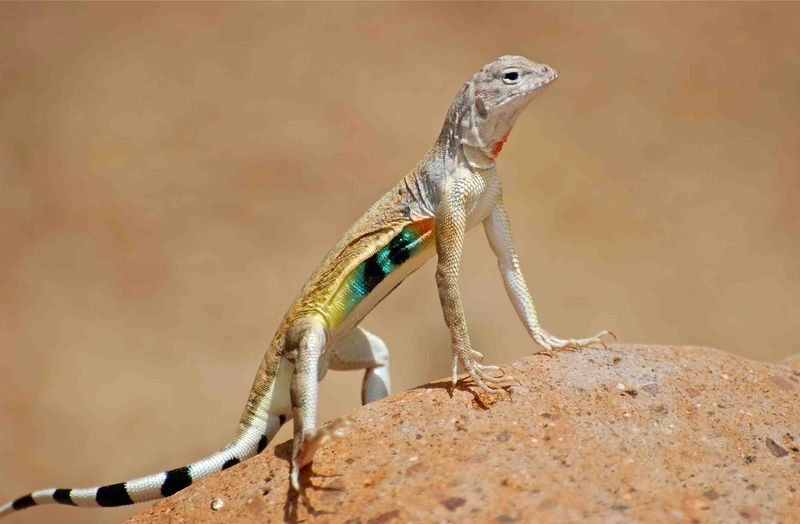
Watching a zebra-tailed lizard move across your yard is one of those low-cost pleasures that comes with living in the Sonoran Desert. The most useful thing most homeowners can do is keep that distance and let the lizard go about its business.
Trying to catch, relocate, or handle a wild lizard is not a casual fix, and Arizona has regulations that apply to wild reptiles. Before any capture, possession, or relocation, check current rules with Arizona Game and Fish’s regulations page, which is updated regularly and covers the applicable species, seasons, and conditions.
Photographing from a distance is genuinely satisfying and causes no harm to the animal. A smartphone with a zoom function or a basic camera with a telephoto lens lets you get a clear look at body shape, leg length, and tail banding without moving close enough to stress the lizard or interrupt its behavior.
The National Park Service recommends observing lizards without disturbing them, and that guidance applies just as well in a residential yard as it does on a park trail.
If pesticide use is part of your yard routine, keep in mind that pesticides can affect lizards and other non-target wildlife, as the Arizona Department of Environmental Quality notes. That does not mean any particular product will harm a specific lizard in your yard, but it is a reason to be thoughtful about indiscriminate spraying near areas where lizards are active.
Sightings alone are not a reason to act – they are simply a sign that the desert is closer than your fence line suggests.